
I
Like Vietnamization, the new China policy had its covert beginnings in the Johnson Administration. A cable from Johnson to Ambassador Lodge in Saigon, which turned up in the Pentagon Papers, is evidence of an earlier recognition in Washington that the Sino-Soviet split might offer useful leverage in power politics. It was dated March 20, 1964, 1 and spelled out the reasons for delaying any open attack on North Vietnam. Johnson added as “an additional international reason for avoiding immediate overt action” that “we expect a showdown between the Chinese and Soviet Communist parties soon and action against the North will be more practicable after than before a showdown.”
When the air war against the North began in 1965, it was accompanied by friendly “signals” to Peking. In December, 1965, Johnson modified travel restrictions to allow the heart specialist Dr. Paul Dudley White and other famous doctors to visit Communist China. The following year athletes, teachers, and members of Congress were added to the list of the permitted. This was the first step toward ping-pong diplomacy. Johnson’s State of the Union message in 1967 expressed the hope of a reconciliation with Communist China and said the US had no intention of denying Peking’s “legitimate needs for security and friendly relations with her neighboring countries.”
How enviously Johnson must have watched Nixon’s arrival in Peking on TV! How unfairly treated Johnson must feel! Nixon had been allowed in, though his visit, like the wheeler-dealer’s first friendly feelers, had also been preceded by a sharp escalation in the air war. That old suspicion of downright racial prejudice against him may have recurred to Johnson. He may have felt that those snobbish Mandarins, like us mean Eastern intellectuals, just don’t cotton to little old country boys with a Texas accent.
There are bigger stakes than the Vietnam war involved in the new entente with China. Another of Washington’s neo-Maoists, Secretary of Defense Laird, touched ever so lightly upon them in his new “defense posture” statement to the Senate Armed Services Committee. “As we evaluate the strength of Soviet and Chinese weapons development and deployments,” Laird said, “we must also take into account in a realistic net assessment the fact that they face some considerable constraints.” The first—and the foremost—he cited was that “the Soviet Union and Mainland China must deploy hundreds of thousands of troops to their Far Eastern border.”2
Tito was an ideological diversion, the first break in the once monolithic world communist movement, but an altogether minor shift in the East-West military balance. But Mao’s defection is a major change in the power equation. It means that the USSR must deploy and plan its forces for war on two fronts, both major. It faces the same threat of military encirclement that was Germany’s nightmare before World Wars I and II. The Soviet Union was spared this problem in World War II by Japan’s decision to strike south against the colonial possessions of the Western powers instead of against Siberia, so the Russians could concentrate their forces against the German invaders. But now they must take into account the real possibility of war on two fronts that are widely separated and poorly connected.
Mao is a Pentagon bonanza. The dimensions begin to appear in the fiscal 1973 posture statement delivered to the Senate Armed Services Committee by Admiral Moorer, chairman of the Joint Chiefs of Staff, right after Laird’s appearance. Admiral Moorer thought it would be “useful to note the current deployment of all Soviet divisions and tactical air units.” He told the committee, “Of a total of 160 Soviet divisions and about 4,300 tactical aircraft, about one quarter is oriented toward China.” That means forty divisions and more than 1,000 tactical air units which would be available against the West if there were no Sino-Soviet split. It is no wonder that old anti-Chinese Communist hands like Joe Alsop are delirious about Nixon’s romance with Mao, indifferent to the broken heart Nixon left behind him in Taipei.
No doubt these stray and sparse glimpses of the new military realities are being widened behind the closed doors of the Armed Services Committee. No doubt this delicate subject is figuring in the cross-examinations to which Laird, Moorer, and the other Pentagon witnesses are now being subjected in the annual military authorization and budget hearings before the armed services and the appropriations committees of both houses of Congress. Perhaps some further revelations will survive the censor’s blue pencil.
The size of the shift in the military balance is given curiously little attention in the voluminous prepared statements of the Pentagon chiefs. They are treating it almost as if it were a military secret. Laird himself did not give it more than one sentence and even lumped it with two other “constraints” on Soviet military capacity, as if to downgrade its importance. But one of the other “constraints” he mentions is hardly new and the other is trivial. The first is his discovery that the growing Russian navy lacks warm weather ports! Laird was scooped on that story by Peter the Great. The other is Laird’s boast that the Russian navy lacks “containerization”! It probably also lags behind ours in fresh frozen hamburgers.
Advertisement
These annual posture statements cover not only the next fiscal year’s military and military assistance budgets but the Pentagon’s projections for the next five years, its annual—excuse the expression—Five Year Plan, the Pentagon’s Piatiletka. Nowhere in the prepared statements will one find a word about what may prove to be the most important new factor in the next five years: The extent to which China diverts Soviet military resources away from Western Europe could be increased by assistance to Chinese industrial development. The equipment of China’s armies and the speed of its nuclear development would be strongly influenced should one ultimate outcome of the Nixon visit be American aid in the shape of credits and know-how. This is the common Sino-American interest in that agreement the Nixon-Chou communiqué records, “to facilitate the progressive development of trade between their two countries.” Here credits must have been discussed because no real expansion of trade with China is possible without them, and here surely is the place to suspect some further and wider understanding, as yet undisclosed. Here is the carrot for Peking, the stick over Moscow.
China’s slim industrial base reduces here weight in the military balance. This is particularly true in the case of nuclear development. There is a wide range of non-nuclear industrial and electronic machinery and technology that would make a crucial difference in the tempo of her nuclear program. Already, as Laird notes, “the Chinese missile threat encompasses most cities and other area-type targets in South and East Asia and a substantial part of the USSR.” The Pentagon believes, he continued, “that the Chinese could begin deployment of an ICBM with a range of 3,000 nautical miles or more, capable of striking all or most of the USSR, by 1975.” But 3,000 nautical miles would only be a third of the way across the Pacific.
All this opens the widest—indeed the giddiest—perspective yet for the Nixon Doctrine. This is a new name for the old idea he has taken from John Foster Dulles of providing the equipment so that Asians can fight Asians for us, at fire-sale prices and coolie wages. What if it could be applied not to the relatively few Viets, Thais, Khmers, and Meos, but to China’s teeming millions, fearful of a Soviet first strike and eager for weaponry to defend themselves?
This is the card that old poker-player Nixon is taking with him to Russia in a few weeks to the biggest poker game of his career. This is the card with which he hopes in the Kremlin to conclude the first phase of the SALT talks and perhaps other matters as well. If Canning, with what became the Monroe Doctrine, hoped to redress the balance of the old world with the new, Nixon can redress the world military balance by threatening to rearm China if the Soviets do not come to terms. The Pax Americana may be in the process of acquiring the world’s most populous state as client. This is the innermost meaning of the Peking visit and the coming Kremlin talks.
II
Much becomes clearer if one views the new defense budget presentations and the SALT talks in this perspective. The essence of the negotiations is to force the Soviets to accept over-all quantitative as well as qualitative inferiority as the price of an agreement. This is what happened with the Test Ban Treaty and this has been the US objective from the first in SALT.
The Soviet Union is now ahead in numbers of land-based missiles and may soon equal the US in sea-based missiles as well. We would like an agreement limiting the numbers of both. But we do not propose and have never proposed any limits on the quality of missiles, where we are ahead.
The interrelation of the quantitative and the qualitative is complicated because our lead in quality has become a lead in quantity of a new kind. In developing MIRV, our qualitative lead has paid off in a major expansion in the number of our nuclear warheads, or “force loadings” as the Pentagon has begun to call them, with its genius for coining terms that obscure and confuse. It is the number of warheads on the missiles and not the number of missiles (or “launchers” in Pentagon lingo) that are now the major index of nuclear striking power. The more warheads, the more targets we can hit, and the more warheads the easier it becomes to “saturate” any antiballistic missile defenses the other side may put up.
Advertisement
The pattern of arms negotiations for more than a century has been to try to limit the weapons in which one’s potential enemy is ahead, and avoid limitations on those in which one has an advantage. So in all our talk of limiting the numbers on the other side we have never proposed limiting the number of warheads, much less foregoing MIRV altogether.
The kind of fears an imbalance of warheads naturally stirs may be seen from a passage in Laird’s new posture statement. “Of greatest concern to the survivability of US ICBM forces,” he says on page 41, “would be improvements in the accuracy of Soviet missiles and the development of a MIRV capability.” But it is the US that is already deploying the MIRV and it is our missiles that are ahead in accuracy. The same sentence revised would express Soviet fears. Of the greatest concern to the survivability of their ICBMs are the improvements in the accuracy of US missiles and our development of a MIRV capacity, something the Soviets do not yet have.3
Though the Pentagon is doing its best in current propaganda and in testimony on the new arms budget to make it look as if we are falling dangerously behind, the reverse is true. The gap in missile warheads is widening rapidly in our favor to the point where the Soviets must fear that we are trying for some kind of counter-force, pre-emptive or first strike capacity. Here are the figures for the past eighteen months taken from this year’s and last year’s posture statements:
In other words, in the eighteen months ending June 30 with this fiscal year we will have increased our lead in warheads by 1,000. Eighteen months ago we had 2,200 more than the Soviets; by midyear we will have 3,200 more, more than twice as many warheads as do the Soviets.
The imbalance will grow sharply—the gap wider—in the next few years. The air force has its own MIRV—the SRAM, or Short Range Attack Missile. In his testimony to the Senate Armed Services Committee on February 23, Air Force Secretary Seamans described it as “a small high velocity missile capable of low trajectory” to “get under” Soviet air defenses and therefore “difficult to defend against.” The test program was completed last July, he told the committee, and “we expect to have a SRAM capability on some of our B-52s and FB-111s this calendar year.” He said, “We are programming” the SRAM for both bombers.
These missiles, like MIRV, are “separately targetable.” According to the last Military Balance 1971-72 published by the International Institute for Strategic Studies in London, the B-52 and the FB-111 can carry twenty-four SRAMs and the new B-1 is being built to carry thirty-two SRAMs. This would multiply the number of targets the B-52 and the FB-111 could reach by twenty-four and the B-1 by thirty-two. Since the Institute credits the US with 430 B-52s and FB-111s in service, SRAM would enable them to hit 10,320 separate targets with these air-borne warheads.
By 1975, according to the Institute, more than 500 of our Minutemen will be outfitted with three separately targetable warheads each, adding 1,000 MIRVs to that force. In the meantime the conversion of thirty-one Polaris submarines to Poseidon, according to the Institute, will “raise the total number of warheads deliverable by the American SLBM force from about 1,500 (capable of attacking 656 separate targets) to over 5,400 (capable of attacking some 5,000 separate targets).”4 By mid-1975, the total of US separate warheads and “force loadings” would then look something like this:
If our purpose is only to have a second strike capacity to deter Soviet attack, what will we do with this lunatic overkill? There are about 180 cities in the entire Soviet Union with populations of more than 100,000. One Poseidon-equipped submarine could hit 160 of them since each submarine carries sixteen launchers and each Poseidon launcher carries from ten to fourteen warheads. What will we do with 20,000 separate warheads? If the situation were reversed, we would suspect the Soviets of building up toward a first strike threat.
Yet Nixon is going to Moscow against the backdrop of a Pentagon propaganda campaign which, though a little muted compared with last year, still hints that the Soviets are building up for a first strike against us. He is going to Moscow with a new defense budget that adds $6.3 billion to arms authorizations. This $6.3 billion is only the down payment on new weaponry which will eventually cost $50 billion or more. The new budget will speed up work on two new monsters—the B-1 bomber, which will carry thirty-two SRAMs, and the new ULMS, Underwater Long Range Missile Submarine. ULMS (according to the latest edition of Jane’s Fighting Ships, 1971-72) will have between twenty and twenty-four launchers each, as against the sixteen of Polaris-Poseidon, and probably a good many more MIRVs per launcher. The ULMS, an underwater battleship of which we plan thirty at about $1 billion each, is only the most sensational escalation in this year’s arms race budget.
Is this a preparation for a generation of peace or a generation of ever more costly and lunatic arms race? From a shortsighted political point of view it makes sense in an election year. It promises expanded jobs for skilled labor; it will please George Meany and the Machinists; it should bring grateful campaign contributions from the armament makers.
But from the other side’s point of view, especially after the emerging entente with China, it must look like another effort “from a position of strength” to put the screws on the Soviet Union. From the American public’s point of view, it spells mounting arms budgets, and from humanity’s, an intensified nuclear arms race which can lead only to a dead end.
The defense budget offers the Democrats a clear opportunity for alternative proposals and priorities. But so far only McGovern has offered these alternatives. I hope to compare his with the Laird-Nixon program in a coming issue.
Nixon, Chou, and the Wonders of the Dialectic
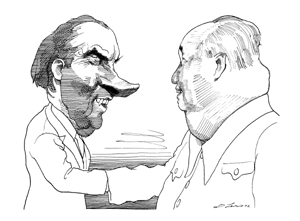
When Nixon said at his farewell banquet in Shanghai, “This was the week that changed the world,” he was not exaggerating as much as usual. From the widest historical perspective, of course, the world has not changed at all. Once again the hatred by schismatics for the Mother Church has proven stronger than their hatred of the pagan. That Mao should prefer capitalist Washington to “revisionist” Moscow is only a new version of an old story. That ideology should take second place to national interest was already a familiar pattern when. Cardinal Richelieu supported Protestant powers against Catholic for the aggrandizement of France. The Nixon-Chou meeting was classic power politics, and power politics—with its delusions about the balance of power—have brought on two world wars and could bring a third in our lifetime. Dr. Kissinger may see himself as Nixon’s Metternich, but it is too late for Metternichs.
Yet in a narrower perspective, it was a week that changed the world. The configurations of international politics have been shaken, as if by an earthquake. They will never be the same again. Moscow and Tokyo have begun a rapprochement. The Christian Democrats in Bonn are clamoring for an opening to Peking in place of Willy Brandt’s courtship of Moscow. Chiang Kai-shek—already titillated by the visit to Taipei of the unofficial Russian agent Victor Louis—may try to shift from our lap to the Kremlin’s. When Richard Nixon can open the world’s doors to communist China anything can happen, even—if one can take seriously certain words of the communiqué about the need for communication between countries of different ideologies—an end to our cruel embargo of Castro’s Cuba. Whatever his motives, whatever his hidden purpose, Nixon deserves support for breaking the ice around China. We hope the Democrats will not be led by George Meany’s anachronistic anticommunism and the natural momentum of an election year into hostility toward the new China policy.
The real duty of the opposition and of the left lies elsewhere. It lies in avoiding the pitfalls of the past. Historically new friendships between long hostile nations have been the product of new fears and enmities. Thus old causes of war are removed only to make way for new ones. It is our duty to emphasize the human reality behind the new power equations—to see that China has justifiable fears of Russia and Russia has justifiable fears of China as both have justifiable fears of us and we of them. The path to peace lies in the easing of these common and all too human anxieties, not in new line-ups for new conflicts.
When the President said in his farewell toast to Chou En-lai, “Our two peoples tonight hold the future of the world in our hands,” he was exulting in a new imbalance of power. He was talking as if behind the murky phrases of the communiqué there had already taken shape a truly colossal alliance of the world’s richest with the world’s most populous country. This could have fatefully different consequences depending on the road the two governments now take. A Sino-American understanding could lead (as we show in our article this week) to a heightened arms race and new world tensions, or it could become the foundation of a more stable world order. Unfortunately, in spite of Nixon’s rhetoric, the former is more likely to be our direction.
The soft underbelly of the Nixon-Chou communiqué lies in the section on the Indian subcontinent. There one can see the beginning of the Sino-American entente, the first clear convergence. The communiqué spells out the ideological differences between Washington and Peking. We say we stand for “individual freedom” while China says it stands for revolution. “Wherever there is opposition,” the Chinese portion of the communiqué says with Maoist grandiloquence, “there is resistance,” and “the Chinese side stated that it firmly supports the struggle of all oppressed people.”
The painful ordeal of Bangla Desh shows how easily this gulf may be transcended. In the joint communiqué both sides continue to support bloodstained Pakistan, we in the name of “individual freedom” (as in Saigon, Athens, and so much of Latin America), they in the name of revolution—while both fish side by side for new trouble in the stale waters of the Kashmir dispute. This coincidentia oppositorum, dear comrades and theologians, shows in what mysterious ways the Dialectic moves its wonders to perform.
This Issue
March 23, 1972
This Issue
March 23, 1972
-
1
Text on page 285 of the New York Times edition, Bantam, 1971. ↩
-
2
Statement of Secretary of Defense Melvin R. Laird before the Senate Armed Services Committee on the FY 1973 Defense Budget and FY 1973-1977. Program, February 15, 1972. Superintendent of Documents, $1.75. Stock Number 0800-0165. ↩
-
3
Every year the annual posture statement announces the imminent debut of a Soviet MIRV, but Admiral Moorer’s presentation on February 15 discloses that we’re not even sure they’ve reached the stage of working on one! “The Soviets, from August 1968 through November 1970,” Admiral Moorer testified to the Senate Armed Services Committee, “conducted a large number of tests with the Mod 4 [i.e., the fourth model of the SS-9—IFS]. Although all of the technical data on the tests conducted in late 1970 had not been completely analyzed at the time I appeared here last year, our intelligence specialists agreed that it was reasonable to conclude that the Soviets were working on a MIRV system. Further analysis during the past year of all of the available flight-test data has now led to the conclusion that regardless of whether the Soviets were, in fact, working on a MIRV, the Mod 4 has thus far failed to demonstrate the actual achievement of such a capability” (our italics). If the Soviets don’t hurry up the Pentagon will have to give them a MIRV, just to keep the arms race going full blast. ↩
-
4
According to Secretary of the Navy Chafee’s presentation to the Senate Armed Services Committee on February 22, “The conversion of ten Polaris submarines to Poseidon has been successfully completed and seven are now on patrol or have completed patrols.” The Institute calculates the number of warheads on each Poseidon as ten, but many newspaper reports have credited it with as many as fourteen. Since each Polaris submarine carries sixteen launchers, Poseidon (even if it has only ten MIRVs) expands the number o each submarine’s warheads from 16 to 160! ↩
