
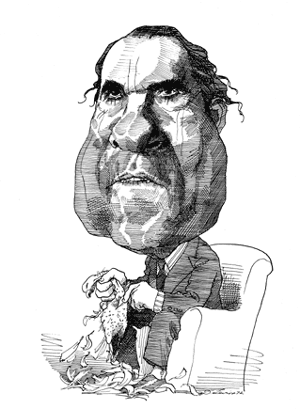
Q: Mr. President, you had some public advice today and yesterday about how critics of the war should conduct themselves. Do you have any public advice for Mr. Haldeman?
A: I have answered the question. Anything further?
—Nixon’s press conference of February 10
I
Treason has always been the spécialité of Nixon cookery. It was served up piping hot in his first campaign for Congress against Helen Gahagan Douglas. After the Republican return to power in 1953, Nixon launched the “twenty years of treason” campaign against the Democrats, with the assistance of J. Edgar Hoover and Attorney General Herbert Brownell. Two decades of epochal social reform and a world victory over Fascism were thus smeared as “aid and comfort,” presumably to the enemies Nixon is about to meet in Peking and Moscow. The old tactic reappeared when his White House Chief of Staff, H.R. Haldeman, charged that critics of Nixon’s new eight-point peace plan were “consciously” giving aid and comfort to the enemy. Explicitly or implicitly treason has suddenly become a major theme of Administration oratory as the air war escalates in Indochina and Nixon runs for re-election on the charge that the Democrats block peace by encouraging the enemy to continue the war.1
The Democrats are not guilty of treason. What they are guilty of is running a divided and ill-organized campaign. They have been outfoxed and outmaneuvered. The new peace plan produced by Nixon and Dr. Kissinger is as subtle and complicated as a champion chess game. Not only is the board crowded but the American public have been allowed to see only the pieces and only the moves Nixon wants them to see. The Democrats were silly to let themselves be trapped into instant comment after the Nixon speech because it hid more than it disclosed of last year’s secret negotiations. The antiwar candidates have yet to understand and make the public understand just how tricky the proposals are.2
To start with, the Nixon plan does not set “a date certain” for withdrawal. Indeed the so-called eight-point peace plan unveiled on January 25 is vaguer on withdrawal than were the proposals tabled privately at the Paris talks on October 11. All the Administration spokesmen have insisted that the former is “essentially” the same as the latter. But the October 11 proposal differed in a number of respects; among them it would have reduced the negotiating time and offered a shorter and more precise withdrawal promise.3
On October 11 the other side was told that if they accepted the US proposal as a “statement of principles” to govern negotiations and signed it by December 1, 1971, then we would withdraw all troops from South Vietnam within seven months or no later than July 1, 1972, “except for a small number of personnel needed for technical advice, logistics and observance of the cease-fire.” The cease-fire was to cover all Indochina and to begin on the signing of the peace agreement. In six months from the date of that signing, an election was to be held in South Vietnam. Our residual force would be “progressively withdrawn” beginning one month before the election “and simultaneously with the resignations of the incumbent President and Vice President,” and the withdrawal would be completed by election day.
The January 25 version of the peace proposals is vaguer on withdrawal. Three time spans are involved in the new proposals. The first would cover the time required for an agreement in principle, something which has yet to be reached in three years of negotiation. The second period would begin with the signing of this preliminary agreement. In this time span the two sides would hammer out the details of the final agreement. Six months from the signing of this final agreement the US would withdraw all troops from Vietnam, though not from the Thai air bases or the adjacent seas from which the Seventh Fleet and its bombers operate.4
The only firm date offered for total withdrawal is six months from the signing of the final agreement. Thus the total time would be x (the time needed to achieve the preliminary agreement on principle) plus y (the time needed to negotiate and sign the final agreement) plus six months. This might best be described as six months after two mañanas. The whole process, like the SALT talks, could easily stretch out for years. This would give Thieu another period of reprieve in which to solidify his dictatorship, for that is really what it is. This is very far from “a date certain,” and the Democratic candidates who said Nixon had been offering privately what he opposed publicly when the Senate passed the various Mansfield and Cooper-Church amendments designed to establish a fixed deadline were deluded. They played into Nixon’s hands, which again proved swifter than their eye.
II
The Democrats have also failed to understand, or been afraid to touch upon, another aspect of the Nixon plan—the false hope it raises for our POWs. The peace proposals are made unacceptable to the other side by provisions that would require them to release most of the prisoners before a final agreement had been negotiated and signed. This is one of the most intricate and tricky parts of the Nixon proposals. The President mentioned it in passing in his January 25 address, but emphasis was placed upon it in the background briefings which preceded that telecast. “Because some parts of that agreement,” Nixon said, “could prove more difficult to negotiate than others, we would be willing to begin implementing certain military aspects while negotiations continue on the implementation of other issues, just as we suggested in our private proposal in October.”
Advertisement
The White House briefer told the radio and TV men it was proposed October 11 that “after an agreement in principle is signed the clock could start running on certain military aspects, especially withdrawals and prisoners [italics added], and while that clock is running, the further details of the final agreement could be negotiated, after which the clock would start running on the election.”
The clearest picture of what the Administration has in mind was given by the State Department’s top official on Vietnamese policy in little noticed testimony before the House Foreign Affairs Committee on February 3. Ambassador William H. Sullivan, deputy assistant secretary of state for East Asian and Pacific Affairs, explained that the over-all settlement would be implemented in two phases:
There would first be an agreement in principle covering the major military and political issues; once the details of these issues had been worked out a final agreement would be signed. Recognizing that more time would presumably be needed to reach agreement on such difficult political problems as elections, our plan envisages implementing prisoner release in parallel with troop withdrawals during the first phase; that is, as soon as the agreement in principle is reached but without waiting for the final agreement to be signed.
This is pretty cute. Even in buying a house or negotiating for a new job, there is apt to be a wide difference between agreement in principle and the final contract. It is the details on which deals most often break down. No good lawyer allows a client to begin delivering valuable property or services until the final agreement has been signed and sealed. But under this proposal the other side would begin “implementing prisoner release” before the final agreement, and if the talks broke down, we would have regained some or most of the POWs in the meantime.
Of course there would have to be troop withdrawals on our part to match the POW releases, but Nixon is committed to withdraw all our remaining troops except a small residual force as part of “Vietnamization” anyway. As Ambassador Sullivan put it, “It is our hope that such a phased approach to a comprehensive settlement would facilitate the earliest possible return of our prisoners without sacrificing the goal of assuring the South Vietnamese people of a chance to decide freely their own political future.”
The likelihood that the other side would release these prisoners in advance of a final settlement is nil, especially since they are almost all pilots and Laird himself has revealed that at least one released pilot has already been used to brief other pilots on Southeast Asia. Pilots, who cost as much as a half million dollars to train, are too valuable to expect their release until peace has finally been restored, especially when the air war is constantly being escalated.
III
The Democratic antiwar candidates ought to be telling the country that Nixon missed a chance to obtain the release of the prisoners during the elections in South Vietnam last year rather than risk Thieu’s defeat. “The time has come,” Nixon said in his peace plan broadcast of January 25, “to lay the record of our secret negotiations on the table.” So it has. But what he and Dr. Kissinger have laid on the table is not the full record but only another of those “selective declassifications” which have misled the American people about our Vietnamese entanglement ever since we took over from the French. The full record would once and for all settle the question of whether the other side last year was willing, as it hinted to McGovern and others, to release the POWs for a total US withdrawal.
To exchange the prisoners for total withdrawal would be to separate the military issues from the political, leaving the latter to be settled between the Vietnamese themselves. The other side is not willing to do this so long as Thieu—and the kind of regime he represents—is in power. The key to their willingness to separate the two issues for a time last year is that the presidential elections in South Vietnam last year offered the US a peaceful and face-saving way to get rid of the Thieu regime in a really open and fair election. The full record would show, I believe, that if the US had made such an election possible, instead of stage-managing the charade of Thieu’s one-man one-vote one-candidate election, the other side might have been willing to exchange the prisoners for total withdrawal.
Advertisement
Two pieces of the puzzle have surfaced in recent Nixon Administration statements. The first, to which I called attention in the February 24 issue of The New York Review, turned up in Dr. Kissinger’s on-the-record backgrounder of January 26, when he perhaps inadvertently revealed that last year’s elections figured in last year’s secret peace negotiations. For he disclosed that an offer made last August 16 included “specific proposals for American neutrality in the forthcoming South Vietnamese elections.” This was rejected by the other side September 13, Dr. Kissinger revealed, on the ground that “a simple declaration of American neutrality while the existing government stayed in office would not overcome” its electoral advantage. Now that the curtain has been lifted a little on last year’s secret talks, the public has a right to the full record. Could we have gotten the POWs back by ensuring a really fair election last year in South Vietnam?
Another bit of the truth surfaced in Ambassador Sullivan’s testimony to the House Foreign Affairs subcommittee on February 9. Ambassador Sullivan said that
…despite hints that Hanoi might in fact negotiate and even implement prisoner releases and troop withdrawals before and apart from resolution of political questions, within a few weeks after presenting the Seven-Point Program [on July 1] they had dispelled any illusions on this point by repeatedly asserting that the military and political elements of their program were “inseparable” and that there could be no release of prisoners until both elements had been resolved.
It is a pity that no member of the House Foreign Affairs subcommittee listening to Ambassador Sullivan was alert enough to ask him what he meant by “a few weeks” and what happened in that period. The seven-point program was made public on July 1. The situation changed completely the following month. In August all chances not only of an honest election but even of a contested election disappeared. On August 5, the South Vietnamese Supreme Court invalidated the candidacy of Ky, leaving Big Minh the only opposition candidate in the field. On August 14, Big Minh presented the Supreme Court and the US Embassy in Saigon with a voluminous dossier of documents showing widespread intimidation of his supporters and preparations to rig the elections. On August 20, Big Minh withdrew after Washington declined to intervene and gave Thieu the green light for a rubber stamp election.
Was it after the events of August that the other side changed its mind? Ambassador Sullivan does not answer the question directly in his testimony. But it is significant that he went on to say, after the passage quoted above, “Pham Van Dong, North Vietnam’s President, made this clear,” i.e., the unwillingness to do a prisoners-for-total-withdrawal deal, “in a speech on November 21.” It is significant that Sullivan could not cite an earlier statement. The unopposed re-election of Thieu (with 91.5 percent of the vote, no less!) took place on October 3. Then Sullivan said that “by year’s end Hanoi had reverted to its original formulation regarding prisoner release.” The italics are ours. But why did Sullivan say “reverted” when Nixon and Dr. Kissinger have spread the impression that in fact the policy never changed, that McGovern and others were deliberately misled by the other side? One does not have to revert to a position that has never been abandoned. It is obvious that we have not gotten the full story.
Those Democrats who protested Nixon’s failure to force a real election in South Vietnam last year could have spoken even more strongly and aroused the country if they had known that behind the scenes the issue of a free election had been raised by the other side in secret talks and that this was the missing link which explained its willingness last summer to exchange the prisoners for a total withdrawal. Had Big Minh won the election, the other side would have had a regime with which it could negotiate peace, we would have had a face-saving way out, and Nixon could honestly have said that he had obtained the release of the prisoners “without,” in Ambassador Sullivan’s words, “sacrificing our goal of assuring the South Vietnamese a chance to decide freely their own political future.”
IV
It must have looked like a farce to the other side when on October 11, eight days after Thieu’s unopposed re-election, Dr. Kissinger turned up with a new peace plan calling for Thieu and his vice president to step down one month before new elections. This is the first time we ever heard of a con man offering the Brooklyn Bridge at half price twice in a row to the same visiting hayseed. It is no wonder that Le Duc Tho felt sick after reading Nixon’s October 11 proposal. It should have been accompanied by a gift sample of Pepto-Bismol.
The only new element in the Nixon eight-point plan is the offer to have Thieu resign one month before an election. Everything else, including the offer of aid in reconstructing the North which goes back to Johnson’s Johns Hopkins speech in 1965, is a reshuffle of previous proposals. This includes the idea of an electoral commission to supervise the elections. An electoral commission was first proposed by Thieu more than two and a half years ago, on July 11, 1969, when he also included international supervision of the balloting.
In the White House backgrounder for radio and TV on January 25, a White House spokesman made much of Thieu’s offer to step down. “Up to now they have said that as long as Thieu is in office, there can’t be free elections,” he said. “Well, we have taken care of that in the sense that he has agreed to resign before the elections, so he won’t be in office on the election day.” But when asked about Thieu’s future in the press backgrounder which followed, the spokesman explained, “The resignation of Thieu from the Presidency does not mean that he cannot stand for election if he wants to, as far as I understand it, but that is up to him to decide. So we are not foreclosing the future.” Certainly not Thieu’s future.
The offer of an election in which Thieu stepped down for only one month, leaving his military and police apparatus intact, an election in which he could run for re-election, and would resume the presidency the day after and before the votes were counted, must look fishy to the other side. Even Secretary Rogers, when he attacked Senator Muskie February 3 for criticizing the Nixon plan, admitted that Muskie’s question, “How can you expect the election to be fair while the police power is with the government of South Vietnam?” was “a perfectly fair question.” (It is remarks of this kind that explain why Thieu would welcome Rogers’s appointment as Ambassador to Iceland or Consul General in Patagonia.) It is more than a fair question. It is the heart of the problem.
A reporter followed up the Rogers admission by asking him, “How in the President’s peace plan would you get around the problem that not only the police power but the army, the administration, the provinces, the secret police, etc., etc., would remain in the hands of a pro-American South Vietnamese government?” The Secretary of State never really answered the question but he ended his rambling reply by disclosing that the other side has been “asking a few questions recently about how could they be sure an election was fair.” He said, “If they want to discuss that, we are prepared to discuss it, and we are flexible about it. We realize the difficulties.”
But the same day Rogers spoke in Washington, the other side in Paris tabled two new points. They offered for the first time to deal with the Saigon regime if Thieu alone stepped down. They also offered new elections for a constituent assembly: This was a striking departure from the nine-point plan tabled by North Vietnam in the secret talks last June 26 and not made public until two days after Nixon’s speech. Point 3 of that plan called for the resignation of the Thieu government “so that there may be set up in Saigon a new Administration standing for peace, independence, neutrality, and democracy. The Provisional Revolutionary Government of the Republic of South Vietnam will enter into talks with the Administration to settle the internal affairs of South Vietnam and to achieve national concord.” There was no mention of an election in the nine-point plan.
Now in the second of the two points, the PRG offered to discuss with the Saigon regime minus Thieu “a three segment government of national concord with a view to organizing general elections in South Vietnam, to elect a constituent assembly, work out a constitution and set up a definitive government of South Vietnam.” It proposed that the general elections “be held according to procedures agreed upon among the political forces in South Vietnam so as to ensure effectively their free, democratic and fair character.”
As a preliminary step to ensuring free elections, and as a condition for dealing with the Saigon regime minus Thieu, the PRG demanded that Saigon “end its warlike policy, disband at once its machine of oppression and constraint against the people, stop its ‘pacification’ policy, disband the concentration camps, set free those persons arrested on political grounds and guarantee to the people the democratic liberties as provided by the 1954 Geneva agreements on Vietnam.” Without fundamental changes of this kind, free elections are impossible no matter how “supervised.”
How can you have free elections when thousands of politicals, including the runner-up “peace” candidate for president against Thieu in 1967, are in jail? When suspected communists and “neutralists” are being liquidated by the terror squads of the CIA’s Operation Phoenix? When populations suspected of sympathy with the NLF are being forcibly uprooted and transplanted under guard as part of “pacification”? When there is constant interference with freedom of press, speech, and assembly despite the guarantees of the South Vietnamese Constitution?
These are obviously some of “the difficulties” to which Rogers referred. He said the American government was flexible and prepared to discuss them. At the Paris talks, however, there was no sign of any readiness to discuss the “two points.” If we were serious about free elections, the conditions they set at least had the virtue of indicating the kind of changes required to make a genuine poll possible.
But the closing remarks of Ambassador Porter in Paris February 3, after the “two points” had been presented, were a stale harangue which failed to deal with and tried to divert attention from the new initiatives in the two points the other side had tabled. The US delegation’s official spokesman, Stephen Ledogar, at the press conference following that day’s session, did his best to belittle the new proposals.
When Ledogar dismissed the “two points” as “nothing new,” one reporter asked, “Do you mean to tell us that they have said before that they are willing to talk to the Saigon administration? Because on the face of it, it seems as though this is something new, perhaps limited, but new.” Ledogar’s only answer was “No comment.”
After a prolonged effort to make Ledogar be specific, one reporter said he was puzzled “about the general trend” of his comment. Are you saying, he asked Ledogar, “that what they said is completely negative, no good, hardening, etc.? Or whether at this stage, before having studied it carefully, you are puzzled?” Ledogar ended another unresponsive reply by saying, “Even as a façade it doesn’t stand analysis taken on its face.” Then he was asked whether he was disregarding the “two points.” The answer was “You ask that question, please, of the other side.” These were hardly the reactions of a government ready to be flexible and looking for a way to negotiate. The strategy was to black out the new offers and to make it appear simply that the other side was refusing to negotiate. And that is the impression the press reports out of Paris created.
V
In a backgrounder for radio and TV reporters two hours before the President went on the networks with his new eight-point plan January 25, a White House spokesman who must be nameless was asked how the other side could “feel assured” of a free election. “The notion of a free election,” was the witty rejoinder, “does not come naturally to Leninists.” Measured by this standard, US policy on elections in South Vietnam can claim to be consistently Leninist.
Some day someone is going to apply psychoanalysis systematically to politics. I hope they will not overlook the curious capacity of the United States to go on ravaging Indochina in the name of self-determination when on another level of consciousness everyone is aware that there hasn’t been a free election in South Vietnam since we took over from the French. The concepts of repression and the unconscious apply perfectly to this happy amnesia.
An important task if we are ever to disentangle ourselves from Indochina is to force the painful record back into public consciousness. The facts are well-known but constantly forgotten. We blocked the elections promised in the 1954 Geneva agreement because (as Eisenhower later revealed in his memoirs) every expert he consulted agreed that Ho Chi Minh would win 80 percent of the vote. The South’s experiment in democracy began with the plebiscite of October 23, 1955, in which Diem got 98.2 percent of the vote against Bao Dai whom he had exiled with American approval. The first election for a General Assembly on March 4, 1956, was boycotted by all the opposition parties to protest the lack of a free press, and at least 101 of the 123 delegates elected were securely Diem’s. Diem did even better in the General Assembly elections three years later when only three independents were elected out of 123 and two of the three were barred from taking office.
The fakery in these free elections was hardly a secret. Early in 1960 the “Eighteen Notables” appealed to Washington in vain for a liberalized regime. In November of that year there was an attempted coup. In March of 1961 the NLF declared open war on the Diem regime. The signals were ignored. In April, 1961, Diem got himself re-elected in another rigged election in which he polled more than 90 percent of the vote in the provinces though only 63 percent in Saigon. Two years later he got himself another hand-picked General Assembly by setting up a new electoral device—all candidates had to be approved in advance by the Diem regime. Two months later on November 1, 1963, he was assassinated. November 1 is still celebrated in South Vietnam as its No. 1 political holiday. It is called “National Day.” The name implies that the assassination was a national liberation. The government of South Vietnam to this day celebrates as a national holiday the overthrow of the dictator we imposed upon them for eight years in the name of self-determination. And Nixon still regrets his passing!
Thieu is becoming as much of a dictator as was Diem, and there is no sign that the US is prepared to relinquish its hold on South Vietnam via this dictatorship. The eight-point proposal envisages a continued patronclient relationship. “We are prepared,” the White House spokesman said in the January 25 press backgrounder, “to accept limitations on economic and military assistance to South Vietnam if North Vietnam is willing to accept a limit on military and economic aid. In the absence of these limitations, we will not accept or ask South Vietnam to accept those limitations.” There can be no better evidence that we expect Thieu to emerge victorious from the elections the eight-point plan offers and to remain our satellite.
Another tip-off in our plans for the future is that our prisoner exchange proposal speaks of releasing “innocent civilians” (italics added). South Vietnam’s prisons and concentration camps are full of oppositionists of all kinds, like Dzu, the 1967 runner-up peace candidate for president, who have been jailed on one trumped up “nonpolitical” charge or another. An electoral commission would run the elections but the Thieu political apparatus with its CIA advisers would continue to run the camps and prisons. The militants on the other side would be committing suicide if they were to surface for elections under these conditions.
From the standpoint of the other side the Nixon eight points are a preposterous fraud. Their real purpose is in internal American policy. They are part of a master plan to smear the antiwar opposition and to excuse the terrible escalation of the air war now under way.
TWO LATIN AMERICAN “VIETNAMS” WHICH MAY ERUPT AGAIN
Guatemala and the Dominican Republic are textbook cases of the wisdom of the adage that it is easier to get into a bear trap than to get out of it. In each country the US got into the bear trap by intervening to frustrate a process of social change…. By intervening…the US bought time in which to apply measures less radical than those it intervened to prevent. But this time has been largely wasted. The result is that despite $850 million in US aid and despite a growth in GNP of 6 to 7 percent a year, the economic and social disparities in both countries are greater now than before. Change seems inevitable, and it is likely to be more radical—and possibly more violent as well—for having been postponed. Because the US has been identified with the status quo (and an increasingly repressive status quo, at that) for so long, the change will be more anti-American than would necessarily have been the case at an earlier time….
The US military assistance program in Guatemala has averaged about $1.5 million a year…. To administer this program, there is a MILGP of twenty-six officers and men, plus secretaries…. When pressed, MILGP officers list US national interests in Guatemala as 1) to keep them “on our side” so that they vote with us in the UN and the OAS, and 2) to help them develop socially and economically so that they can be a leader in Central America and so that they can avoid a Communist takeover…. It may be questioned whether we are getting our money’s worth….
Balaguer [in the Dominican Republic] has proved himself an agile politician. He feels pressure from the country’s extreme conservatives who resist all change and he is aware of the residual power of the military. Like Arana in Guatemala, he has pushed social palliatives rather than fundamental change. He has accomplished very little of the former and none of the latter. The lowest estimate I heard of unemployment was 30 percent of the labor force…. Balaguer has done something to meet this through public works, but these are widely criticized as being wasteful and of the wrong type—e.g., broad, well-paved avenues through good residential neighborhoods while slum streets are almost impassable….
Us military assistance to the Dominican Republic totaled $27 million, 1946-70. For 1971, it was about $1.8 million and is projected to continue at approximately this level…. To administer this program, the MAAG has a current strength of twenty-six officers and men….
The Dominicans have only two possible uses for armed forces—either to fight each other or to fight the Haitians. Twice within the last two years they have mobilized to fight the Haitians…and both times have been gently reminded that they did not have enough gasoline to get to Port-au-Prince…. It is much more likely that they will fight each other—which they have also done, at considerable cost to themselves and to the US, within the last ten years….
One’s doubt…is increased by a realization of the political price the US pays. Dominicans generally have the same image of their military as they do of their police and grossly exaggerate the extent of US involvement.
—Guatemala and the Dominican Republic. A staff study by the
Senate Foreign Relations Committee, released January 2, 1972.—IFS
This Issue
March 9, 1972
This Issue
March 9, 1972
-
1
In the division of labor between “high road” and “low road” rhetoric, the White House would go no further in commenting on the Haldeman accusation than to have Press Secretary Ziegler say that it did not “necessarily” reflect the President’s thinking! The day after the Nixon peace plan speech, Dr. Kissinger had explained that “composing the domestic disharmony is a very major objective of our entire policy.” This drew from the Washington Post, February 9, the tart comment that “the imputation of treason to prominent members of the political opposition is a curious way to go about” it. Dr. Kissinger, to his credit, in a press conference that same day prefaced his own statement of disagreement with McGovern by acknowledging the senator’s integrity, conviction, and patriotism. We hope Dr. Kissinger will not be accused of giving aid and comfort to traitors. ↩
-
2
I certainly would not hazard the claim that I understand them fully either. They cannot be understood without collating diverse sources, as one would a jigsaw puzzle. In preparing this article I have read and reread (among others) the following documents: the President’s speech of January 25, the eight-point proposal released with it, the two White House backgrounders just before the speech, one for the press and the other for the radio and TV men; Dr. Kissinger’s on-the-record briefing the next day; the transcripts of the public statements and press briefings by both sides after the Paris meetings of January 27, February 3, and February 10; and the Vietnam portions of the President’s State of the World message of February 9 and Dr. Kissinger’s press briefing on it the same day. These are basic but still insufficient. In a dozen or more phone calls to the State Department and the White House I found that, except at the very highest level, many officials are still confused about what the new peace plan really means. There is no complete presentation. Every speech or briefing has opaque spots calculated to confuse the unwary. ↩
-
3
The differences have escaped attention because the actual text of the October 11 proposals was made public only after the other side in Paris on January 27 released their own version and the exchange of messages about the November 20 meeting to show that it was canceled by the US and not the other side as falsely implied by Nixon and Dr. Kissinger. The US versions of these documents were then made available at the State Department rather than the White House. Since the “secret peace talks” was a White House story, the White House press corps seems to have missed the significance of the documents released three days later and a half-mile away. ↩
-
4
The question of the Thai bases and the Seventh Fleet was touched upon at the White House backgrounder for radio and TV men just before the President’s broadcast January 25. The briefer, who cannot be named under the rules of that backgrounder, was asked, “Are we giving them any kind of guarantee on further withdrawal from Thailand, elimination of air bases or anything on that subject?” The briefer replied, “That issue has never been raised.” This is hard to believe. He added that if there were a general cease-fire, it would mean the end of all military activity over Indochina. Apparently the bombers of the Seventh Fleet and on the Thai bases would not be part of the withdrawal. ↩
