
1.
“Indonesia has been one of the most remarkable development success stories in the last third of the twentieth century. In the mid- 1960s, it was one of the poorest countries in the world, with a per capita income below that of many African and South Asian countries. It had experienced little economic growth for thirty years, it was on the verge of hyperinflation, it was engulfed in political turmoil, and it had begun to disengage from the world community and economy. Living standards were stagnant and about two thirds of the population lived in abject poverty….
“No one at that time would have dared to imagine—much less to predict—that just thirty years later Indonesia would be regarded as a dynamic “tiger” economy, and a member of that most exclusive club, the World Bank “East Asian Miracle Economies.” The notion that Indonesia’s economy would expand six-fold over this period, and that according to World Bank projections it could become the world’s fifth-largest economy by the year 2020, would have appeared preposterous in the gloom of 1964-66. Yet that is precisely what has occurred in these three decades: economic growth has been among the highest in the world, and it has been accompanied, with a lag, by striking improvements in social indicators.”
—Hal Hill, May 1997
“[Very] suddenly and unexpectedly, everything collapsed [in Indonesia] in the latter half of 1997 …in the onslaught of the Asian financial crisis. The extent of the turnaround is nothing short of astounding. Economic output is expected to contract by about 15 percent, after expanding 8 percent in 1996 and 5 percent in 1997. The single-year collapse in growth is among the largest recorded anywhere in the world in the post- World War period. Millions of Indonesians, many just surviving over the poverty line during the good times, have lost their jobs. Food production has been disrupted…. Prices for many export commodities…have fallen on world markets. Investors, both foreign and domestic, have fled to safer havens. The banking system is moribund and thousands of firms are facing the prospect of bankruptcy and closure.”
—Steven Radelet, September 19981
Since Indonesia’s sudden reversal of fortune, globalism interrupted, a great deal more has happened there than capital flight, currency collapse, and a tripling of the poverty rate. The regime has changed twice—the regime, not just the government—once abruptly, in a spasm of violence, once glacially, with troubled and unnerving hesitation. The first time, in late 1998, Suharto, the architect, or anyway the godfather, of both the expansion and the collapse, walked away amid wild disorder—race riots, looting, bloody clashes between students and the army, Jakarta on fire, Surakarta ransacked—leaving B.J. Habibie, his just- appointed crony vice president, haplessly behind to sort through the ruins. The second time, a protracted, vastly complicated, ultimately indecisive, but, so it seems, fair and open national election (ninety million voters, forty-eight parties, seven hundred electors) ended last autumn with the midnight designation, by a half-dozen arriviste kingmakers, of Abdurrahman Wahid as the new president. An ill, erratic, nearly blind religious intellectual, he had been written off by almost everyone as too frail to serve.
In September, the ex-Portuguese enclave of East Timor, half of a very small island out on the edge of the archipelago, was at last allowed to separate after thirty years of on-again, off-again resistance to annexation, only to be laid waste by Indonesian-armed irregulars, whose savagery brought on a worldwide outcry, an Australian-led UN intervention, the human rights attentions of Mary Robinson, and, just possibly, a revanchist problem for the future. Local violence, some of it ethnic, some of it religious, some of it merely criminal or entrepreneurial, has broken out all over the archipelago, from Aceh and Kalimantan in the west to the Moluccas and New Guinea in the east, leaving hundreds dead, thousands in flight, the government at a loss, and the neighbors—Malaysia, Singapore, the Philippines, and Australia, who have minorities (and refugees) of their own who might like to see things generally rearranged—worried.
The army, its leadership divided and threatened with prosecution for war crimes in East Timor and elsewhere, is demoralized, resentful, disprivileged, cherishing enemies, weighing possible strategies. The press has been freed and reenergized: books are no longer banned. Suharto, ill and demonized, is housebound, as incommunicative as ever; and the country’s most famous political prisoner, the radical nationalist novelist Pramoedya Ananta Toer, is out and about, giving interviews, accepting tributes, and counseling the youth. Oil looks good again, inflation is down, exports have recovered a bit, bankrupts are regrouping, growth has advanced to zero.
At the same time, militant Islam, NGO environmentalism, populist xenophobia, neoliberal utopianism, Christian apologetics, and human rights activism have all grown markedly in volume, visibility, and the capacity to bring on mass rallies, mobs, and marching in the streets. Factional party politics have returned with a vehemence and complexity not seen since the early Sixties, when Sukarno’s “guided democracy,” designed to keep him in power for life, collapsed in conspiracy and slaughter. It is a mixed and unsettled, fluctuating picture, without center and without edge—resistant to summary, hard to hold in place. As virtually everything has happened, it seems that virtually anything might; and it is impossible to tell whether all this stir and agitation—what the Indonesians, with their usual gift for verbal camouflage, have come to call reformasi—is the end of something or the beginning of something.
Advertisement
What it might be the end of is the political impulse that set the country in motion in the first place. Along with India, Egypt, and perhaps Nigeria, Indonesia has been a prototype of the “emerging,” “developing,” “post-colonial” country—crowded, splayed, capriciously bordered, and the product of a world-historical shift in the distribution of sovereignty, selfhood, and the power to act. Officially established at the end of 1949, after four years of intermittent warfare against the Dutch, and nearly forty of agitation before that, the country took shape during the heyday of third world nationalism—Nehru, Chou, Tito, Nkrumah, Mussadegh, Nasser; Dien Bien Phu, the Battle of Algiers, Suez, Katanga, the Emergency, the Mau Mau.
By now, this period—call it “Bandung,” after the famous gathering of nonaligned, “emerging forces” leaders that Sukarno (“I am inspired…I am absorbed…I am crazed by the Romanticism of Revolution”) staged there in 1955—is not even a living memory for most of the population. Its concerns are faded, its personalities simplified; the obsession that obsessed it, and to a fair extent subsidized it, the cold war, has been summarily called off. But the doctrines that were developed then, and the sentiments that accompanied them, continue to shadow the country’s politics. A half-century old this coming winter, and just emerging from thirty-two years of business-card autocracy, Indonesia still projects itself as a triumphalist, insurgent, liberationist power.
The question that engages the more reflective Indonesians, and particularly the older ones who have been through it all and seen what it comes to, is of course how far this master idea, with its slogans, stories, and radiant moments, remains a living force among either the country’s elites or its population, and how far it has become just so much willed nostalgia—declamatory, a pretense, worn, and seen through, cherished if at all by West-ern romantics and political scientists. Certainly the history of the country, which has tended to be one of grand promises and grander disappointments in quickening alternation—large plans, large collapses—would seem to militate against the continuing hold of Bandung-size expectations. Neither Sukarno’s “old order” populism nor Suharto’s “new order” paternalism (the differences between them have been much exaggerated by the partisans of both—their contrasts were mainly in style and presentation, and to some degree in disciplinary reach) was able to impress an identity and a transcending purpose on the society as a whole, to make of it an integral community, real or imagined.
“The Nationalist Project,” the construction of an aroused and self-aware people moving as one toward spiritual and material fulfillment—“An Age in Motion,” so the tag says—has become increasingly hard to formulate in believable terms, much less to pursue and carry out. The shaken country that was delivered first, faute de mieux, to the unfortunate Habibie in the spring of 1998 (his presidency lasted seventeen months, plagued by confusion and scandal), and then, in camera, to the improbable Wahid, had lost more than its bank balance, its equilibrium, and its international reputation. It had lost the power of its history to instruct it.
2.
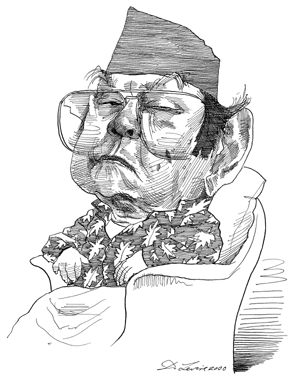
The man who is expected to correct all this, to right its economy, calm its politics, restore its confidence, reset its course, clear its conscience, and improve its image, as well as, perhaps, to entertain and distract it, is a fifty-nine-year-old veteran politician whom virtually everyone seems to have met (including me: a decade ago, I spent four days closeted with him and a few of his allies in a rest house near Bandung discussing, no less, the future of Islam in Indonesian politics), most seem to have liked, and almost all seem to have underestimated.
Known universally as “Gus Dur,” his honorific childhood nickname (“Gus” means “handsome lad”), Wahid was born and grew up at the very center of Javanist Islam and Javanist Islamic politics—his grandfather’s famous religious boarding school, or pesantren, fifty miles southwest of Surabaya. His grandfather, a personage and a personality, as well as a renowned Koranic scholar, founded the country’s largest Muslim organization (it may, in fact, be the largest in the world), Nahdatul Ulama, in 1926—in part, at least, to counter the growth of secularist nationalism, and to strengthen the hold of vernacular piety against modernist innovations flowing out of the Middle East. The tolerant, open, somewhat traditionalist, somewhat inward “Javanese Islam” he represented continues to the present as a major social and religious force. Wahid’s father, in the loose, inexplicit sort of way in which power is passed in the pesantren tradition, inherited the school, the stature, the program, and the organization; he was the country’s first minister of religion, and a broker of consequence in Sukarno’s ideological spoils system, distributing jobs to petitioners in the vast and shambling clerical bureaucracy that to this day regulates mosques, marriages, benefactions, and religious courts.
Advertisement
Wahid, after traveling, studying, and getting himself known in Cairo, Baghdad, and various countries in Europe for awhile in the mid-Seventies, returned to become a widely read columnist at Tempo, the country’s leading, and later suppressed, news magazine, and to found Forum Demokrasi, an elite ginger group whose criticisms of the establishment drove the government to near-murderous distraction. He also took over the reins of the Nahdatul Ulama organization, which he then promptly separated from the counterfeit political party (“Development and Unity”) Suharto had concocted to contain it.
If close-up, been-through-the-mill experience, as well as patience, agility, humor, and a refined sense of timing, is what Indonesia needs, Gus Dur, who is the closest thing to a machine politician the country has, could be the man. Compared at various times to Peter Falk’s Columbo, the Javanese shadow-play buffoon Semar, Chaim Potok’s lapsed rabbi Asher Lev, Ross Perot, Yoda, and (by his defense minister) a three-wheel Jakarta taxi, Wahid would seem well equipped to weave his way through the densest sort of lunatic traffic.
That much, surely, he demonstrated in his oblique, arduous, and—when we consider what he had to overcome to undertake it—brave and tenacious trek to the presidency. When the electoral process (which was rather more of an enormous, and enormously complicated, straw poll designed to assess the general state of popular opinion than it was a proper selection mechanism) began in late 1998, Wahid was in the hospital, just beginning to recover from the second of the two diabetic strokes that had put him in a coma; he had already been damaged in one eye by diabetes, and blinded in the other. Aside from him, there were four leading candidates, thrown up by the convulsions of the previous two years, and off and running: Habibie, the sitting president, an establishment satrap trying desperately to look like a new broom; Megawati Sukarnoputri, Sukarno’s daughter, a reclusive and taciturn, rather standoffish suburban matron, whom an unexpected and uncharacteristic series of strategic blunders on the part of Suharto had transmogrified into a popular hero; and Amien Rais, an ambitious and mercurial Muslim intellectual and sometime college professor who had studied theology and political science at both Notre Dame and the University of Chicago and who had played a leading role in arousing the students in the last stages of Suharto’s collapse. Then, in the extra-party, shadow-state style of the Indonesian army, there was General Wiranto, its hesitant and unconfident and soon to be infamous chief of staff.
Other suggestions and possibilities surfaced from time to time. Among them were the Sultan of Yogyakarta; a Berkeley-trained neoliberal economist; the head of Golkar (i.e. “Functional Group”), Suharto’s parliamentary party and political arm; and one of Wahid’s oldest and, up to that point anyway, closest friends. But for the whole eleven months the lumbering drama took to unfold these five were the dominant players, and they remained so to and through its quite operatic, vertiginous end.
For most of the campaign, indeed until a few half-hours before Wahid squeezed his way in through the narrowest of spaces, the leading candidate, far and away, was Megawati. Despite her heritage and the lingering charisma of her father’s name—particularly strong in Java, where power is supposed to pass supernaturally and act thaumaturgically—she was a newcomer to Indonesian high politics, having lived the smooth and upholstered life of a society wife until a spectacular collision with Suharto, which she had neither sought nor wanted, and did not quite know what to do with once it occurred, turned her overnight into the reluctant vehicle of popular outrage.
Seeking, apparently, to test the limits as the general, ill and recently bereaved of his wife, began to stumble a bit, one of his concocted political parties—“Indonesian Democracy,” which was designed to contain the nationalist left—installed Megawati as its titular head in December 1993. Suharto, to whom she must have seemed like the ghost of insurgencies past, wildly overreacted, trying forcibly to replace her with an army-backed puppet. When that failed, leading to a breakaway of the party and the movement of university students into the streets crying for Suharto’s head and for his children’s fortunes, he sent soldiers and para-militaries to take over Megawati’s Jakarta offices and arrest her supporters. In July 1996, this produced what turned out to be the most consequential “affair” of his regime: thirty or so killed, a hundred-odd arrested, scores of stores, houses, and vehicles burned. This, though no one knew it yet, was the end of the beginning of the end of his rule. Megawati, startled and swept along, was established as the people-power heir apparent, Indonesia’s version, culturally reedited, of Cory Aquino.
Despite the divine-right regality which never deserted her and in the end undermined her, Megawati’s campaign was an over-the-top, quasi-revivalist, in-your-face affair: frenzied mass rallies, revolutionary symbolism, hypernationalist sloganizing, and a certain amount of putsch-in-the-works and street-tough threats—all of which may have frightened as many people as they attracted, while scholars and journalists talked of civil war and the return of the repressed. Wahid, more or less recovered from the worst of his illness, formed a party of his own and set up an odd, on-again off-again, arms-length alliance with her.
The Islamic right, without a champion of its own or much of a program beyond moralism and xenophobia, attacked Megawati as not really a Muslim but some sort of Javanist Hindu, beholden to Christians and Chinese, possibly a crypto-Communist, and, anyway, a woman. She avoided the press, issued only the vaguest of policy statements (she had been against independence for East Timor and for a pegged rupiah, but she soon glided noiselessly away from these positions). She spoke, she said, with her dead father daily. In the event, after a half-year or so of this, she got a bit more than a third of the vote in the June 1999 elections for the National Assembly, which is convened every five years to designate a president. Habibie, who, ostensibly anyway, was Golkar’s candidate and particularly strong outside Java, got a bit more than a fifth; Wahid and his party, whose appeal was localized, a bit more than a tenth; and Rais, who had been expected to do much better, given his popularity with educated Muslims and the Jacobin role he played in the last days of Suharto (whom he called, inter alia, “a rabid dog, biting everything,” and volunteered to replace immediately), got something less than 8 percent. The stage was set for some serious politicking.
The details of the maneuvering, the alliances, the horse trades, the betrayals, the flatteries, the ear-whisperings, and the pirouettes that took place during the final three days of the “election”—i.e., the opening days of the National Assembly in October—remain, for the most part, both obscure and contested.2 What is clear is that Megawati was out of her element, and Gus Dur was in the very thick of his. Unwilling, or unable, to cut deals and exchange favors, and apparently convinced that having roused the masses and “won” the election, she could not be denied, she lost every scrimmage at every stage, until in the end only Wahid, who had allied himself with just about everybody else in turn as the process unfolded, was left standing. (Rais, with Wahid’s support, became head of the Assembly. Habibie’s man in Golkar, a Sumatran named Akbar Tanjung, was induced to desert his boss and, with Wahid’s support, became speaker of the Parliament. Wiranto, with Wahid’s, as it turned out, retractable support, lobbied vigorously for the vice presidency.) “Wait until next time,” Wahid is supposed to have told Megawati, kindly, one imagines: “You need more experience.”
When Wahid’s selection was announced on October 20, the reaction on the part of Megawati’s supporters, who were as convinced as she was of her moral right to the presidency and the illegitimacy, deceitfulness, and corruption of everyone else, was enormous. Violence erupted all over the archipelago. In Bali, where her campaign had begun and her support was perhaps the most passionate (she won 80 percent of the vote there), trees were felled across all the roads, a government office was burned, and youths attacked a dormitory where Timorese refugees were being held awaiting their repatriation. Plans were laid to attack the Muslim quarter, the so-called kampong jawa, which, had they been carried out, might well have convulsed the entire country. In Jakarta, a large downtown hotel where a huge crowd had gathered throughout the night to hear the outcome was immediately trashed, and angry protesters, weeping and screaming, spilled out into the city. It looked as if the promised civil war, or anyway a sidewalk coup, was at hand.
Wahid instantly changed course, turned away from Wiranto, and appointed Megawati as his vice president. He told her to go on radio and television and calm her followers, which she immediately did, saying, “I am your mother. You are my children. Return to your homes.” And, in what, in some ways, was the most startling twist in the whole twisting drama, only slightly more startling than her acquiescence in her own eclipse, they promptly and efficiently obeyed—put away their placards, packed up their revolution, and walked quietly away. Bali was cleaned up in the course of a few hours; it was as though nothing at all had happened. Jakarta remained calm, if shaken. The eruptions elsewhere—in Surabaya, Medan, South Kalimantan, the off-coast islands of West New Guinea—soon fizzled out into scattered clashes. Whether all this was, as some began to call it, a move toward freedom, democracy, maturity, and the free market, or simply another turn in a very old wheel, there clearly was, at last and for the moment, a more or less legitimate, more or less open, more or less consensual government in place.
3.
The great question remaining is, can the government in fact govern? Almost everything about the Wahid presidency, not just the President himself, breathes of the temporary, the ad hoc, the fragile, the jerry-built. Brought into existence by a thrown-together coalition of power brokers who have known one another too long and too well, confronted not by a single crisis but by a flood of them, and lacking very much in the way of either popular backing or a worked-out program, the new regime is reminiscent of nothing so much as those of the Naguibs, Barzagans, and Kerenskys of the world: distracted, scuttling, more or less well-meaning place-holders in a historical process preparing to run over them. Wahid, or his government, may turn out to be less evanescent than theirs, more consequential, or even more capable of defending its interests. That is at least one prospect insofar as one can speak yet of Wahid’s actually having a government, as opposed to just a role (only a few of his cabinet members are his own choices; most are the result of what he himself called “a cattle auction” among the politicos who put him in power). It is clear by now that betting against Gus Dur is a bit of a mug’s game. But he has, to put it mildly, a lot to do, and not much beyond his wits and, some say, his supernatural connections to do it with.
The problems facing him are diverse and urgent, each clamoring for immediate attention before they reach, severally or together, a point of no return. They cannot be listed as items for an agenda, because there is no way to put them into a logical sequence of importance and priority. But they fall, more or less, into three broad categories. First (but not, as foreign businessmen anxious to get back to foreign business tend to assume, necessarily foremost) there is the need to reignite the local version of the transnational economy that, between 1977 and 1997, added nearly $400 billion to the GDP, made a few people rich and a fair number middle class, and turned Jakarta, where upward of 70 percent of the activity was concentrated, into a forest of grandiloquent high-rises.
Second, there is the need to rein in and reprofessionalize the army, to halt and reverse the vast expansion of the functions and powers, legitimate, illegitimate, and outright criminal, that it achieved, first under Sukarno, who brought it into the world of commercial management when he dispatched the Dutch and confiscated their properties, then under Suharto, who fashioned it into a furtive para-government extending the hand of violence into the smallest and most distant corners of civil society. And third, there is the need to respond to an enormous increase in the power of regional, ethnic, racial, and religious forces, most of them not entirely new, entirely unified, or entirely clear in their aims, but all of them newly excited about their development possibilities now that the dominance of Jakarta has weakened and threatening to dismember the country and turn it into a Balkan nightmare.
When we try to sum up the Indonesian crisis in this compound, multiplex way, its most striking characteristic, the one that makes what happens there seem so broadly instructive, is that the immediate and the fundamental are thoroughly tangled up together. The restless surface—the street demonstrations, the regional killings—lies very close to the settled bottom—Muslim/Christian religious division, the political ascendancy of Java and the Javanese. The most pressing issues are at the same time the most far-reaching. Quick fixes, such as reallocation of revenue among regions, and lasting changes are so tightly linked that transient adjustments—a change of provincial boundaries, the dissolution of a government department—have general and enduring resonance. There is no small policy. Tactics are strategy, tinkering is planning, repair is reform, and however ad hoc and pragmatic particular actions may seem to be (and Gus Dur’s are both, plus antic, mystifying, offhand, and unpredictable), they are responses to a good deal more than the fragility of the rupiah, the command structure of the army, or the stability of the outer provinces.
Whatever the fate of what some enthusiasts are already calling “the Wahid revolution” and others, less entranced, “what-the-hell-ism” (biarin-isme, for the cognoscenti), the path by which it arrives there, and what happens to it en route, should tell us a great deal about what can happen and what cannot, and not just in Indo-nesia or the post-heroic, post-colonial world, but in the dispersed, border-less, McDonaldized, and networked “global civilization” supposedly in the making.
So far as the revival of the neoliberal market economy is concerned—if that, amid the corruption, the waste, and the imaginative misuse of resources, is what it was in the first place—even the quick fixes and the transient adjustments are but scarcely begun. The relatively speedy recovery that the smaller “tigers,” Thailand, Malaysia, Hong Kong, and South Korea, have experienced has as yet to take place in Indonesia, by far the largest among them. Unemployment is rising, production is flat, and there is little sign of a return of departed capital or departed capitalists, from wherever it is that it, or they, may now be resting, hiding, or beginning a new life.
But the deep-lying issues that any move toward recovery, however hesitant, however slight, immediately uncovers are already, not two hundred days into Gus Dur’s term, subjects of heated, what-side-are-you-on politi-cal struggle. Every cabinet reshuffle, or rumor of one, every budget recalibration, however modest, every policy proposal, even the most technical or circumstantial—to allow a foreign bid on a state-seized company, to shift ministerial control over a bankrupted bank, to remove a Suharto-era businessman from his Suharto-era business, to renew a standing contract with an American mining company—gives rise to a loud, Aesopian debate which only seems to be about the matter at hand. The real division is over a deep and unresolved, possibly unresolvable, foundational question: How open, how borderless, how transnational an economy do we really want? How “global,” how “developed,” how “market rational” can we be, should we be, dare we be?
This may seem to be nothing more than the familiar opposition between those who see transparency, trade, and market freedom as the beginning, the middle, and the end of everything, and those who wish to replace what Sukarno fifty years ago called (just before he demolished it, and elections with it) “free fight liberalism” with policies more sensitive to cultural conscience and national feeling. But though free trade and protectionism, comparative advantage and import substitution, foreign capital and domestic ownership remain the poles between which the arguments and accusations move, the experience of the last thirty years has changed the sense of what is at stake in the debate. Having known, now, both the joys and costs of extravagant market expansion and the pains and spin-offs of extravagant market collapse, the Indonesian elites, and a good part of the populace as well, are concerned less with trying to isolate the country from storms of “high,” “late,” “global,” “footloose,” or “advanced” capitalism than they are with enabling it to survive and move forward in the face of them.
There is, as the saying goes, no other option on offer than connecting the national economy to the IMF-WTO- Davos world being put together in the banks and boardrooms of New York, Tokyo, Frankfurt, London, Paris, and Geneva. The trick, if there is one, is somehow to ride out, even perhaps somehow to profit from, what no less a neoliberal than Paul Volcker has called the inevitable train wreck that occurs when grand, unregulated, high- velocity capital flows collide with weak and rickety national economies.3 Economic nationalism still lives in Indonesia, so do “Asian values,” and there are even some relics of the theory formerly known as Marxism lying about. But their promises of empowerment, authenticity, justice, and moral shelter, just yesterday so beguiling, ring increasingly hollow.
The same general picture, the persistence of familiar threats and the inadequacy of familiar remedies, appears in the other matters of immediate concern: the role of the army and the integrity of the state. So far as the army goes, the problem is simple enough on the surface—specifying its function and confining it to it. But after three decades during which local political capacity, the simple ability to manage one’s own affairs through one’s own institutions, melted away in the face of close-up and pervasive military control, that is not easy to do. The soldiers are dug in, and, in many places at least, removing them would remove as well whatever is left of a national presence and an enforceable order; and they have in any case, as East Timor demonstrated, very little willingness to accept restrictions.
So far as the state’s integrity goes, the call to national unity in the name of a shared ideal seems to be a wasting asset. Whatever is going to hold the place together, if, in the face of population movements, regional imbalances, and ethnic suspicions, anything is, it is not going to be settled by an ingrained sense of common identity and historical mission, or by religious, “Islamic State”hegemony. It is going to be something a good deal more patchy, capricious, and decentered—archipelagic. In whatever direction Gus Dur looks with his one good eye there seems nothing to do but hang in there, try something, stay loose, hope for the best, and above all keep moving. Nothing if not mercurial, nimble and ingenious, and, blithely unaware, or unconcerned, that his position is impossible, he seems made for the moment, however long—it could be days or years—the moment lasts.
—April 12, 2000
This Issue
May 11, 2000
This Issue
May 11, 2000
-
1
Hal Hill, Indonesia—Industrial Transformation (Singapore: Institute of Southeast Asian Studies, 1997), p. 1, references removed; Steven Radelet, Indonesia’s Implosion (Harvard Institute for International Development, 1998), p. 1. ↩
-
2
For the closest thing to a blow-by-blow account of what happened, see Jeremy Wagstaff, “Dark Before Dawn: How Elite Made a Deal Before Indonesia Woke Up,” The Wall Street Journal, November 2, 1999 (the event itself took place on October 20). For a brief description of the presidential election and its postscript outcome, see R. William Liddle, “Indonesia 1999: Democracy Restored,” Asian Survey, XL2, forthcoming (2000). ↩
-
3
Volcker, the former head of the Federal Reserve, is quoted from a video conference on “international financial architecture,” in The Calendar and Chronicle, Council on Foreign Relations, March 2000, p. 4: ↩