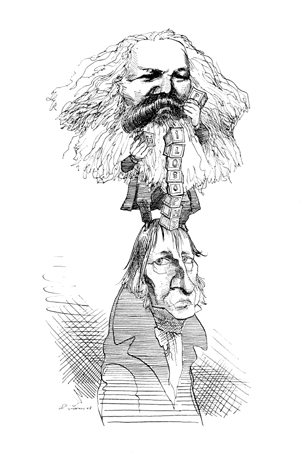
The owl of Minerva spreads its wings when the shades of dusk are falling. Hegel’s celebrated aphorism has often been invoked to characterize the difference between his own contemplative bent and the activism of his rebellious disciples. Philosophy (it was said) was indeed backward-looking by its very nature. Hegel had been right to emphasize this truth, but wrong to suggest that contemplation of the past was the only mode of thought proper to rational comprehension of the world. History, after all, was still going on, and its understanding could not be put off until the time had once more come to sum up the achievements of a bygone epoch. It was possible to theorize about the future, as well as about the past. More than that: the future could be shaped by conscious action guided by experience. Hegel had severed theory from practice, thought from action, reason from revolution. The task was to re-unite them. “The philosophers have merely interpreted the world in different ways. What matters is to transform it.”
Today the Promethean revolt of the Hegelian Left has in its turn become a chapter in the history of that process which Hegel sought to analyze, and which his more radical pupils tried to shape. The world has indeed been transformed, not least by those of Marx’s followers who took to heart the eleventh of his Theses on Feuerbach: stop interpreting the world and start changing it. But the transformation, although partly conscious and occasionally guided by true insight into the material needs of the human species, has created new and unforeseen problems to which neither classical liberalism nor classical Marxism offers a solution. Moreover, the ancient fatality has not really been shaken off: what is actually happening (the technological unification of the planet) occurs not under intelligent direction, but blindly, catastrophically, through wars, revolutions, and the turmoil of conflicting passions: national, social, racial. The half-hidden logic of the process has to be inferred from an accumulation of seemingly pointless disasters. Its human agents—not merely individuals, but entire nations—are sacrificed to aims they had not consciously willed. The “Cunning of Reason” reasserts itself. Hegel takes his revenge upon the empiricists who consigned his teachings to the dustbin of history. Science is powerless to control the instrumentarium of death it has let loose upon the world. Statecraft sinks to the level of manipulation. Alternatively, it pursues senseless or utopian aims, then stands appalled at the result. None of this would have surprised the thinker for whom world history was a “slaughterhouse.”
PROFESSOR LOBKOWICZ has devoted a huge volume (the first part, it appears, of an even larger work) to the study of Marx’s Hegelian origins, and to the notion of “revolutionary practice” generally. His book would be important for its theme alone. What makes it an intellectual event is the light it sheds (at times a trifle obliquely) upon the radical discontinuity of classical and modern thought. This History of a Concept from Aristotle to Marx is also, among other things, a defense of Aristotle against Marx (and against Kant, Fichte, and Hegel too). What we have here is a Thomist critique of Marxism—and of German Idealism as well (albeit mainly by implication). Lobkowicz stands in a tradition which is able to look back, across the gulf of nineteen centuries of Church history, to the Greek sources of Christian theology. Specifically, he draws upon the Aristotelian inspiration of Thomism, hence of the major Catholic tradition. For although in the currently fashionable climate of ecumenicism he is polite about heretical variants of the faith, the attentive reader is left in no doubt that the great adventure of German Idealism—with its unexpected culmination in Marx—is ultimately traceable to the Reformation. However, the accent falls upon the Luciferian revolt of the Young Hegelians, rather than upon Hegel’s secularized Lutheranism which even in its speculative guise still trailed transcendental clouds of glory. Lobkowicz sees Kant and Hegel as fellow-Christians gone wrong. He even affirms (with good reason) that in reacting against Kant’s phenomenalism, which denied the possibility of true insight into super-sensible reality, Hegel had executed a half-turn back to Aristotle. The question he poses to himself and to the reader is why this promising approach should in the end have yielded the dragon seed of revolutionary praxis.
The theme is pursued at two levels: the biographical (to which we shall come in a moment) and the logical. To start with the latter, Lobkowicz confronts the awkward circumstance that it was precisely Hegel’s all-embracing rationalism which made possible the world-transforming activism of his radical followers. They could do nothing with Kant, for the Kantian distinction between physics and ethics led to the conclusion that moral (and political) decisions could not be reached theoretically: What ought to be cannot be deduced from what is. Hegel did away with this distinction, and thereby opened the road to revolution! Not that he had the slightest intention of doing anything of the sort: he was an instinctive conservative long before he had become the official apologist of the Prussian State. But his grandiose metaphysical construction had implications of the most world-shaking kind, once its meaning had been grasped. For what was it that he affirmed? Simply that the Kantian ought was unnecessary, because the “noumenal” realm, the realm of absolute knowledge, was accessible to Reason after all!
Advertisement
For Kant, “practical” philosophy had been a matter of the individual conscience. Its true ground could not be met anywhere in actual experience, and hence took on the character of an “ideal,” of something that ought to be but is not. Hegel demolished this barrier, along with the Kantian thing-in-itself and the cautious agnosticism that flowed from it. Not that Kant lacked self-confidence his ethics (by implication at least) did away with the idea of a supersensible deity. But the notion that there is absolutely nothing beyond the reach of human thought belongs to Hegel. Once this faith had sunk in, it did not take his bolder followers long to conclude that the material world can be (and therefore must be) transformed, so as to turn it into a creation of the human spirit (itself consubstantial with the divinity).
But how could the link between Reason and Revolution be forged by men who thought of themselves as interpreters of the Master? No group of theorists ever detonated a greater explosion than the Hegelians—the thunder is still rolling around the globe; by comparison with it, all the noise made by modern technology, nuclear fission included, is trivial—yet none were less aware of the practical consequences of what they were doing. Hegel’s nature thought rivaled Aristotle’s in its attempt to interpret the universe as a mundus intelligibilis, satisfying both to the minds and to the hearts of men. What he demanded of his readers (as Lobkowicz puts it) was “an ascent to the standpoint from which it becomes obvious that reality is exactly as it ought to be, namely ‘rational.”‘ The real world having thus been transfigured into an Absolute, how could “theory” turn into “practice”? Lobkowicz lets the cat out of the bag (somewhat reluctantly, it seems to this reviewer, but then the Aristotelian in him probably cannot help sympathizing with Hegel) in a passage which deserves to be quoted:
We are using the expression “transfiguration” in order to indicate the point at which most of the problems of Hegel’s disciples will arise: instead of either predicting that the world will become perfect through and through, or trying to transform the world in order to make it perfect, Hegel simply describes it as perfect. His disciples soon will discover that Hegel overcame the ought only at the level of speculative thought, leaving reality itself unchanged; and the romantic philosophy of Sollen will re-emerge, though in a quite different form [pp. 149-50].
The urge to make the real truly rational could be read into the system because Hegel had affirmed that world history is nothing other than “the gradual emergence and the eventual definite break-through of reason” (p. 155). As if this were not enough, the first decisive step away from contemplation toward revolution was taken by a conservative aristocrat, who for good measure was a Catholic mystic: the Polish nobleman and Hegelian philosopher August von Cieszkowski.
THIS IS NOT an altogether new discovery. There is a small literature on Cieszkowski (as the reader of Professor Martin Malia’s biography of Alexander Herzen can discover for himself in a somewhat different context). Perhaps by way of reaction against the conventional emphasis upon better-known figures, such as Strauss and Feuerbach, Lobkowicz (it seems to me) makes a bit too much of Hegel’s Polish pupil. He is, however, quite right in saying that Cieszkowski is rarely mentioned in Anglo-American writing. This is unfortunate, for his Prolegomena zur Historiosophie (1838) is an important link between Hegel and Marx (and more particularly between Hegel and Bakunin). There is no evidence that Marx (who in the 1840s was personally acquainted with Cieszkowski and thought him a long-winded bore) ever read the Prolegomena. But we know that Moses Hess did, and Hess for three critical years (1842-45) was Marx’s teacher. We also know that it was Cieszkowski’s book which launched Bakunin on the road to revolutionary anarchism—an outcome that must have appalled the Polish aristocrat. Bakunin was then in Germany studying Hegel’s philosophy, and his radical interpretation of Cieszkowski’s mystical doctrine that the future can be known was soon to ferment in the heads of Russian students. In far-away Vladimir, the youthful Alexander Herzen—exiled from Moscow for having toyed with the notion of aristocratic conspiracy against the Tsar—read the Prolegomena soon after their appearance, and drew from them the assurance that mankind’s future could be known and shaped.
Advertisement
A faithful Catholic—his God and the Palingenesis (1842) was devoted to the defense of orthodox Christianity against its detractors among the left-wing Hegelians—Cieszkowski nonetheless had taken the first decisive step from theory to practice, from philosophy as contemplative understanding of the past, to philosophy as speculative construction and practical determination of the future. For the coming age could be molded (thanks to Hegel) by “post-theoretical practice”: that was Cieszkowski’s great discovery. Absolute knowledge having been attained, “humanity has become mature enough to make its own determinations perfectly identical with the Divine Plan of Providence.” Hegel’s universal system was the beginning of the end. “Philosophy has now reached so classical a point that it must transcend itself and yield up the universal empire to another.” This “other” could only be “practical, social life.” Being and thought “must perish in action, art and philosophy in social life, in order to re-emerge and to unfold in the ultimate form of social existence.” For his own part, Cieszkowski remained a philosopher, and a Catholic philosopher at that (even though he toyed with the utopian socialism of Fourier). He had nonetheless set the avalanche in motion. Within three years of the Prolegomena, the message of prolitical revolution was sounded by Moses Hess (from whom Marx inherited it) in another important and neglected piece of writing, the Europaeische Triarchie (1841).
None of this is altogether to Professor Lobkowicz’s taste, but he is too good a scholar to obscure the connection between Cieszkowski and Marx. If anything he makes too much of it. For the rest, the Left Hegelians are so unsympathetic to him that he even revives the standard complaint about their overweening self-confidence and the purely destructive character of their writings. As if in the Germany of their day they could have done anything but criticize! It is revelatory of his conservative bias that he stays silent on the awkward topic of Lutheranism as a State Church, and says as little as possible about Bruno Bauer’s influence on Nietzsche. His principal target anyway is Marx, against whom he scores polemical points by the simple expedient of treating him as an errant Hegelian. If he had been no more than that, the world would not have been obliged to take notice of him.
It is, however, the case that Marx can be understood only in relation to Hegel, and it is the great merit of Lobkowicz’s work that he emphasizes the central importance of Hegel’s philosophy for Marx’s thinking. He also brings out the dilemma in which Marx found himself when confronted with the question why anyone should proceed from theory to practice. On Hegelian principles (even as reinterpreted by Cieszkowski, Bauer, and Hess) there was no very convincing answer, which is why Marx in the end broke with Bauer and the Left Hegelians generally. Yet he never quite came to terms with an ambiguity in his thinking which had probably been implanted by the early influence of Hegel’s great predecessor, Fichte. The eleventh of the Theses on Feuerbach simply does not make sense on any interpretation other than the “idealist” one that “the world” must be “changed” because it is not as it ought to be: which was just what Hegel had stigmatized as nonsense.
AS A THOMIST, and therefore a believer in the existence of an objective and intelligible moral order, Lobkowicz is well placed to measure the depth of the spiritual crisis into which post-Reformation Germany was plunged after Kant had extruded the last shadowy remnant of the older medieval world picture. He sees clearly enough what is usually concealed from philosophers unfamiliar with intellectual history and groping helplessly among the disembodied categories of Hegelian logic—that Hegel and his successors were wrestling with a set of problems which were ultimately “existential,” to employ the fashionable term. He also sees that Hegel’s grandiose system, though conceived as an attempt to restore a pre-Kantian sense of the objectivity and universality of truth, was vitiated by the hidden subjectivism of the idealist approach which assumes the ontological primacy of an absolute called mind or spirit. What he does not quite seem to grasp is that Marx’s “materialism” was in its own way a return to a less exalted and more common-sensible view of the world.
It is true that his first volume terminates in 1845, when Marx was still struggling with the unsolved problem of relating Left Hegelian “theory” to French materialist “practice.” But even then it was already obvious that the author of the German Ideology had at any rate abandoned one cardinal assumption of all forms of German Idealism: the unspoken conviction that within the subject-object dialectic the last word must always lie with the thinking subject. The Aristotelian in Lobkowicz might have given Marx more credit for having (at great cost) freed himself from this idealist hypostatization of the thinking mind into the role of creator of its own universe.
Here and there the critical reader of Lobkowicz’s work encounters traces of a more familiar and conventional kind of misunderstanding, e.g., in the suggestion that Marx positively welcomed pauperization as a necessary precondition of revolution, or that he “never made the slightest effort to help the proletariat,” since on Hegelian principles he viewed such activities as useless (p. 371). No one familiar with socialist history, and specifically with the history of the First International, could for a moment entertain such a singular misconception, but then Lobkowicz is outside the socialist tradition. He is also insufficiently attentive to the change that came over Marx once he had made his escape from the Hegelian Olympus and established contact with ordinary political reality in France. However, this is an important and immensely learned work which compresses a mountain of erudition into a few hundred pages. As an analysis of the fate which overtook speculative metaphysics on the road from Aquinas to Kant and Hegel, it also possesses the singular merit of being truly original.
Professor Jordan has set himself a narrower theme, but within its context he too may be said to have broken new ground. The Evolution of Dialectical Materialism can be treated as a companion volume to Gustav A. Wetter’s study of Soviet philosophy (first published in Austria in 1952 and since translated into English), inasmuch as he too devotes a good deal of space to Lenin (and, rather surprisingly, Stalin). But the emphasis is differently placed. Wetter had paid little attention to Hegel, and hardly noticed the differences between Marx and Engels. Professor Jordan (already known as the author of an authoritative study of philosophy in Poland) has tackled the subject from the other end, and provided a much-needed historical and critical study of both Marxism and Marxism-Leninism, in their respective philosophical aspects. Anyone who takes the trouble to read him will at any rate have gained a clearer mental picture of how the peculiar construct known as “dialectical materialism” came into being.
THAT THE “HISTORICAL MATERIALISM” of Marx and the “dialectical materialism” of Engels represent different aspects of what is conventionally known as “Marxism” would not nowadays be denied even by orthodox Marxist-Leninists. They would simply maintain that Engels systematized the philosophical hints thrown out by Marx. What Marx himself thought of Engels’s philosophical writings (so far as he was aware of them) remains uncertain, and is in any case a matter for his biographers rather than for historians of philosophy. I should myself be inclined to argue that Professor Jordan overstresses the utter incompatibility of Marx’s naturalism (an inheritance from the French materialists of the eighteenth century, principally Holbach and Diderot), with the speculative or “metaphysical” materialism of the later Engels. It is true that their starting points were different, that Marx was more profoundly marked by French influence, and that Engels never shook off the abiding influence of German Romantic Naturphilosophie. Yet Professor Jordan himself notes that, while Marx modified the Hegelian approach, he did not altogether abandon it. It is indeed difficult to see how he could have done so without falling into positivism—something he never did, albeit at times sorely tempted (though not by Comte, of whom he notoriously held a poor opinion).
In his discussion of “dialectical materialism” as a philosophy of nature, Jordan is on firm ground in treating Engels as the sole originator of this extraordinary successor to Hegel’s (and Schelling’s) Naturphilosophie. He is perhaps a trifle unfair in failing to credit Engels with a quite justifiable desire to get rid of the Hegelian spiritualism. But since Engels’s own adoption of an ontological Absolute called “matter” was still within the tradition of Naturphilosophie in the Romantic manner, one may agree that “dialectical materialism” (for all that Engels intended nothing of the kind) was fated to become a metaphysical system: a theory of the universe purporting to state a general “law of motion” applicable to natural and historical processes alike.
For reasons having to do with the secularization of religion and the spiritual crisis through which the Russian intelligentsia was then passing, this was just what the Russian Marxists needed to underpin the revolutionary activism they had inherited from their Populist predecessors: Herzen, Bakunin, and Chernyshevsky. Hence the enthusiasm with which Plekhanov and Lenin welcomed Engels’s philosophical writings, which to West European Marxists have proved a standing embarrassment. Indeed it was Plekhanov who coined the term “dialectical materialism,” and Lenin who imposed the doctrine on his followers, and ultimately on the Soviet intelligentsia. (To make matters worse, Lenin read Hegel after he had committed himself to “materialism” in the metaphysical sense, and then filled some notebooks with jottings about Hegel’s logic whose publication in 1929 stupefied the more “materialist” of his own followers.)
These topics, as well as the resulting ideological contortions during the Stalin era, provide the principal theme of Jordan’s extremely detailed and searching account of the subject. He is less convincing when he moves from dialectical to historical materialism. Not that he is unsympathetic to the Marxian approach: on the contrary, he has the deepest admiration for Marx. He just wishes he had been less of a Hegelian, and does his best to make him sound like Comte. He even asserts in one place (p. 132) that “for Saint-Simon, Comte and Marx alike, society is the true reality, and the individual the abstraction.” This happens not to be so, although it is true that Marx’s French followers have always had trouble telling his sociology apart from that of Durkheim (now that structuralism is all the rage in Paris, this particular misconception can also appeal to anthropology for support).
One can see why a distinguished scholar like Jordan, currently settled in England but still writing from within the tradition of pre-1939 radical empiricism in Poland, would like to salvage Marx the historian-sociologist, while consigning Engels, Lenin, and the Soviet Marxists to the perdition reserved in positivist doctrine for Hegel and his progeny. But even Jordan’s learning—his erudition is staggering and makes most other writers on the subject look like beginners—cannot quite disguise what must, I suppose, be called a methodological fault in his treatment: he divorces Marx the philosopher from Marx the sociologist. One may, if one likes, regret that Marx never quite emancipated himself from Hegel (personally I do not regret it in the least), but if one asserts that he did, one fails to see in what respect he was not an empiricist. In particular, one fails to realize that, even at his most empirical and scientific, Marx did not divorce factual from value judgments in the manner of Weber and his school. Take a remark like the following, which occurs quite casually in the context of a passage about ground rent:
Even a whole society, a nation, or even all simultaneously existing societies taken together, are not the owners of the globe. They are only its possessors, its usufructuaries, and like boni patres familias, they must hand it down to succeeding generations in an improved condition. [Capital, III p. 757]
The man who wrote these words was a philosopher, and no amount of exegesis is ever going to turn him into anything else. He may have been inconsistent in pulling normative principles out of the hat when it suited him, but that is what he did, just as Montesquieu, Hume, Smith, and Kant had done before him. The value system of the Enlightenment was part of his mental baggage. He carried it about with him, and never dreamed of challenging it. Nor is there any good reason why he should have.
PROFESSOR AVINERI, who teaches at Jerusalem University, has written several learned monographs on Hegel’s and Marx’s political philosophy. He has now expanded the subject into a book which deserves commendation, if only because it is brief, lucid, scholarly, and infused with an undoctrinaire democratic socialism reminiscent of the earlier (and less embattled) Sidney Hook. Some of the territory he covers—e.g., the theory-practice problem, and Cieszkowski’s role in anticipating the revolutionary activism of the Left Hegelians—is discussed at greater length by Lobkowicz. Elsewhere he breaks new ground, notably in going back to those of Marx’s early writings which antedated his acquaintance with the French socialists and communists. One of these, the Critique of Hegel’s Philosophy of Right (1842-43), has hitherto escaped attention, and he does well to emphasize its relevance for Marx’s later political views. It marked a transition in his thought, in that he then took the first step toward what later became the “materialist conception of history.”
This (as Avineri points out) had nothing to do with “materialism” in the metaphysical sense. What it signified was quite simply that Marx—the editor of a bourgeois-liberal daily in Cologne and in sharp conflict with the Prussian censorship—had begun to see through the conservative implications of Hegel’s thinking. In particular, he had begun to treat society as being logically and historically anterior to the state. In other words, he applied to Hegel the critical canon of Anglo-French political and economic theorizing. One may also say that he confronted the philosopher of the Prussian State with the theorists of Western European liberalism. This is an aspect of Marx which seems to have escaped Lobkowicz, perhaps because he has not much use for liberalism and thus fails to realize that in the 1840s Prussia was already beginning to look somewhat grotesque to anyone in Paris, London, or Amsterdam. Avineri does well to bring it out, just as he is right to emphasize that political democracy remained a problem for Marx and his followers: their brief and qualified defense of the Paris Commune was by no means the end of the matter.
The central section of the book, and its most original contribution to the swelling literature on the subject, analyzes the link between Marx’s anthropology and his economics: specifically between the 1844 Manuscripts and Capital. These chapters provide a useful antidote to the standard view of Marx as a great economist in the Ricardian tradition who unfortunately bewildered his readers with a far-fetched Hegelian terminology: the sort of misinterpretation one finds in Schumpeter. There is just enough truth in it to make it important to see where it misses the point, and the reader who looks for light on this topic can now go to Avineri. The link between the critique of classical German philosophy and the critique of liberal British economics may have been a bit tenuous here and there, but it was no figment of anyone’s imagination. These topics were related in fact before Marx took the trouble to relate them in logic. Why and how he did this is the subject of Avineri’s best chapters. They should satisfy even those of his readers who cannot quite follow him in all his political conclusions, e.g., in what appears to this reviewer to be his underestimation of the Jacobin-Blanquist streak in Marx’s early thinking.
THERE REMAINS a more general consideration, which perhaps has more to do with Hegel than with Marx. All three authors here under review—professional philosophers of widely differing views and standpoints—share the unspoken assumption that if we want to understand Marx or Hegel we had best begin by asking how they relate to Aristotle. Lobkowicz and Avineri do this explicitly, Jordan by implication. They are likewise agreed in treating Hegel’s historiosophy as a form of secularized theology, and Marxism as a reaction to it (although Avineri rather paradoxically holds that one can show “how Marx…can construct his materialist view out of the Hegelian system itself”). Lastly, they make it clear that the tension between the theological inheritance of the Judeo-Christian world and the rationalism of the Enlightenment had already come to a critical point in Hegel before it exploded in Marx. It is of course Marx rather than Hegel who has provided the driving force for the practical revolutionizing of those areas of the world where other forms of Westernization (those stemming from the American and French Revolutions, for example) have for some reason fallen short of their goal. But it is still Hegel’s “historiosophy” which lies at the back of the whole construction: by now about to merge with a world-wide political up-heaval.
Thereby hangs, if not a moral, at least a paradox, for Hegel had seen himself as the end of an epoch, and his followers saw him as the last thinker in the tradition of Aristotle: that is to say, the last great European thinker. They also believed (with what justification need not concern us) that there had never been any philosophy worth mentioning other than that of the Greeks and their successors. In an age when the mental rubbish of Calcutta and Benares flows into the gutters of Europe and America, a thinker who held that no worthwhile idea had ever come out of Asia seems an unlikely candidate for hero-worship in Peking or Hanoi. Yet it is Hegel who reigns in those distant capitals (albeit in the interpretation given to his philosophy by Marx). There is food for thought here—especially at a moment when it is fashionable in advanced circles to denigrate the Western inheritance. From Aristotle to Marx, this inheritance is at work when Asians brood over the future of their civilization. It provides the conceptual tools for their critique of the West. It even has the power to set armies on the march. Zen and Yoga may appeal to dropouts in New York, London, and Paris. Those who carry on the fight (whichever side they are engaged on) draw their sustenance from other sources.
This Issue
April 11, 1968
This Issue
April 11, 1968