
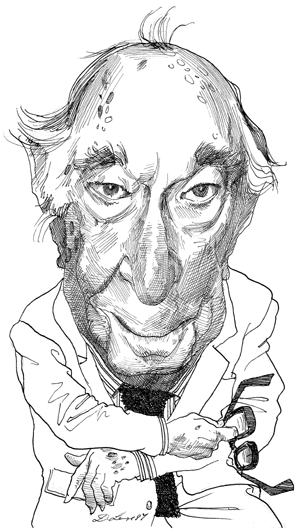
1.
What does one say when one says “psychology”: James, Wundt, Binet, or Pavlov? Freud, Lashley, Skinner, or Vygotsky? Köhler, Lewin, Lévy-Bruhl, Bateson? Chomsky or Piaget? Daniel Dennett or Oliver Sacks? Herbert Simon? Since it got truly launched as a discipline and a profession in the last half of the nineteenth century, mainly by Germans, the self-proclaimed “science of the mind” has not just been troubled with a proliferation of theories, methods, arguments, and techniques. That was only to be expected. It has also been driven in wildly different directions by wildly different notions of what it is, as we say, “about”—what sort of knowledge, of what sort of reality, to what sort of end, it is supposed to produce. From the outside, at least, it does not look like a single field, divided into schools and specialties in the usual way. It looks like an assortment of disparate and disconnected inquiries classed together because they all make reference in some way or other to something or other called “mental functioning.” Dozens of characters in search of a play.
From inside it doubtless looks a bit more ordered, if only because of the byzantine academic structure that has grown up around it (the American Psychological Association has forty-nine divisions), but surely no less miscellaneous. The wide swings between behaviorist, psychometric, cognitivist, depth psychological, topological, developmentalist, neurological, evolutionist, and culturalist conceptions of the subject have made being a psychologist an unsettled occupation, subject not only to fashion, as are all the human sciences, but also to sudden and frequent reversals of course. Paradigms, wholly new ways of going about things, come along not by the century, but by the decade; sometimes, it almost seems, by the month. It takes either a preternaturally focused, dogmatical person, who can shut out any ideas but his or her own, or a mercurial, hopelessly inquisitive one, who can keep dozens of them in play at once, to remain upright amid this tumble of programs, promises, and proclamations.
There are, in psychology, a great many more of the resolved and implacable, esprit de système types (Pavlov, Freud, Skinner, Piaget, Chomsky) than there are of the agile and adaptable, esprit de finesse ones (James, Bateson, Sacks). But it is among the latter that Jerome Bruner, author or coauthor of more than twenty books, and God knows how many articles, on almost as many subjects, clearly belongs. In a breathless, lurching, yet somehow deeply consecutive career spanning nearly sixty years, Bruner has brushed against almost every line of thought in psychology and transformed a number of them.
That career began at Harvard in the Forties, during the heyday of behaviorism, rat-running, the repetition of nonsense syllables, the discrimination of sensory differences, and the measurement of galvanic responses. But, dissatisfied with the piling up of experimental “findings” on peripheral matters (his first professional study involved conditioning “helplessness” in a rat imprisoned on an electrified grill), Bruner quickly joined the growing band of equally restless colleagues, within psychology and without, to become one of the leaders of the so-called “Cognitive Revolution.”
By the late Fifties, this revolution was underway, and “bringing the mind back in” became the battle cry for a whole generation of psychologists, linguists, brain modelers, ethnologists, and computer scientists, as well as a few empirically minded philosophers. For them, the primary objects of study were not stimulus strengths and response patterns; they were mental actions—attending, thinking, understanding, imagining, remembering, feeling, knowing. With a like-minded colleague, Bruner launched a famous series of “New Look” perception experiments to demonstrate the power of mental selectivity in seeing, hearing, and recognizing something. Poorer children see the same coin as larger than richer ones do; college students are either very much slower (“defensive”) or very much quicker (“vigilant”) to recognize threatening words than they are to recognize unthreatening ones.
With two of his students, he carried out a landmark study of abstract reasoning. How do people in fact, rather than in logic, test their hypotheses? How do they decide what is relevant to explanation and what is not? And in 1960, he and the psycholinguist George Miller, another restless soul, founded Harvard’s interdisciplinary Center for Cognitive Studies, through which virtually all of the leading figures in the field, established or in the making, passed at one time or another, and which set off an explosion of similar centers and similar work both here and abroad. “We certainly generated a point of view, even a fad or two,” Bruner wrote of his and his colleagues’ work during this period in his (as it turns out, premature) 1983 autobiography, In Search of Mind. “About ideas, how can one tell?”1
After awhile Bruner himself became disenchanted with the Cognitive Revolution, or at least with what it had become. “That revolution,” he wrote at the beginning of his 1990 Acts of Meaning, a “goodbye to all that” proclamation of a new direction,
Advertisement
was intended to bring “mind” back into the human sciences after a long cold winter of objectivism…. [But it] has now been diverted into issues that are marginal to the impulse that brought it into being. Indeed, it has been technicalized in a manner that even undermines that original impulse. This is not to say that it has failed: far from it, for cognitive science must surely be among the leading growth shares on the academic bourse. It may rather be that it has become diverted by success, a success whose technological virtuosity has cost dear. Some critics…even argue that the new cognitive science, the child of the revolution, has gained its technical successes at the price of dehumanizing the very concept of mind it had sought to reestablish in psychology, and that it has thereby estranged much of psychology from the other human sciences and the humanities.2
In saving the Cognitive Revolution from itself, distancing it from high-tech reductionism (i.e., the brain is hardware, mind is software, thinking is the software processing digitalized information on the hardware), Bruner has raised over the last decade or so yet another banner heralding yet another dispensation: “Cultural Psychology.” What now comes to the center of attention is the individual’s engagement with established systems of shared meaning, with the beliefs, the values, and the understandings of those already in place in society as he or she is thrown in among them. For Bruner, the critical “test frame” for this point of view is education—the field of practices within which such engagement is, in the first instance, effected. Rather than a psychology that sees the mind as a programmable mechanism, we need one that sees it as a social achievement. Education
is not simply a technical business of well-managed information processing, nor even simply a matter of applying “learning theories” to the classroom or using the results of subject-centered “achievement testing.” It is a complex pursuit of fitting a culture to the needs of its members and their ways of knowing to the needs of the culture.
2.
Bruner’s concern with education and educational policy dates from the studies of mental development in infants and very young children that, in his growing resistance to machine cognitivism, he began to carry out in the mid-Sixties, just—such are the workings of the Zeitgeist—as the Head Start program was coming, with Great Society fanfare, grandly into being. These studies led him to an “outside-in” view of such development, one which concerns itself with “the kind of world needed to make it possible to use mind (or heart!) effectively—what kinds of symbol systems, what kinds of accounts of the past, what arts and sciences….” The unfolding of the critical features of human thinking, joint attention with others to objects and actions, attribution of beliefs, desires, and emotions to others, grasping the general significance of situations, a sense of selfhood—what Bruner calls “the entry into meaning”—begins very early in the development process, prior not just to formal schooling but to walking and the acquisition of language.
Infants, it turned out, were much smarter, more cognitively proactive rather than reactive, more attentive to the immediate social world around them, than had been previously suspected. They emphatically did not inhabit a world of “buzzing blooming confusion”: they seemed to be in search of predictive stability from the very start.
The Head Start program began with a rather different, in some ways complementary, in others contrasting, view of early development based on a rather different set of scientific investigations: those showing that laboratory animals raised in “impoverished environments,” ones with few challenges and reduced stimulation, did less well than “normals” on such standard learning and problem-solving tasks as maze running and food finding. Transferred, more metaphorically than experimentally, to schooling and to school children, these inquiries led to the so-called “cultural deprivation hypothesis.” Children raised in an “impoverished” cultural environment, in the ghetto, for example, would, for that reason, do less well in school. Hence the need for corrective action to enrich their environment early on, before the damage was done. Hence Head Start.
Aside from the fact that the idea of correcting for “cultural deprivation” depends on knowing what such deprivation consists in (what it has most often been taken to consist in is departure from the standards of an idealized, middle-class, “Ozzie and Harriet” American culture), such an approach seems to assume that “cultural enrichment” is a good to be provided to the deprived child by the wider society, like a hot lunch or a smallpox injection. The child is seen to be lacking something, not to be seeking something; regarded as receiving culture from elsewhere, not as constructing it in situ out of the materials and interactions immediately to hand. Bruner was a sometime advisor to Head Start, and he is still a defender of its very real successes and its possibilities for extension and reform (it is, after all, an “outside-in” program). But he argues that the results of his sort of research into the mental development of children—grown by now into a field in itself, turning up more and more evidence of the conceptual powers of the very young—renders the “deprivation” approach obsolete. Seeing even the infant and the preschooler as active agents bent on mastery of a particular form of life, on developing a workable way of being in the world, demands a rethinking of the entire educational process. It is not so much a matter of providing something the child hasn’t got as enabling something the child already has: the desire to make sense of self and others, the drive to understand what the devil is going on.
Advertisement
For Bruner, the critical enabling factor, the thing that brings the mind to focus, is culture—“the way of life and thought that we construct, negotiate, institutionalize, and finally (after it’s all settled) end up calling ‘reality’ to comfort ourselves.”Any theory of education that hopes to reform it, and there hardly is any other kind, needs to train its attention on the social production of meaning. The terms upon which society and child—the “reality” already there and the scuttling intellect thrust bodily into it—engage one another are in good part worked out in the classroom, at least they are in our school-conscious society. It is there that mentality is most deliberately fashioned, subjectivity most systematically produced, and intersubjectivity—the ability to “read other minds”—most carefully nurtured. At least in the favorable case, not perhaps entirely common, the child, “seen as an epistemologist as well as a learner,” moves into an ongoing community of discoursing adults and chattering children where “she…gradually comes to appreciate that she is acting not directly on ‘the world’ but on beliefs she holds about that world.”
This turn toward concern with the ways in which the understandings abroad in the larger society are used by the schoolchild to find his feet, to build up an inner sense of who he is, what others are up to, what is likely to happen, what can be done about things, opens Bruner’s “cultural psychology” to a host of issues normally addressed by other disciplines—history, literature, law, philosophy, linguistics, and most especially that other hopelessly miscellaneous and inconstant science, anthropology. Such a psychology, rather like anthropology, has an eclectic perspective and a vast ambition built directly into it. It seems to take all experience for its object, to draw on all scholarship for its means. With so many doors to open, and so many keys with which to open them, it would be folly to try to open all of them at once. That way lies knowing less and less about more and more. The door Bruner, sensitive as always to the practicalities of research, wants to open, not altogether surprisingly in view of recent developments in “discourse theory,” “speech-act analysis,” “the interpretation of cultures,” and “the hermeneutics of everyday life,” is narrative.
Telling stories, about ourselves and about others, to ourselves and to others, is “the most natural and the earliest way in which we organize our experience and our knowledge.” But you would hardly know it from standard educational theory, trained as it is upon tests and recipes:
It has been the convention of most schools to treat the arts of narrative—song, drama, fiction, theater, whatever—as more “decoration” than necessity, as something with which to grace leisure, sometimes even as something morally exemplary. Despite that, we frame the accounts of our cultural ori-gins and our most cherished beliefs in story form, and it is not just the “content” of these stories that grip us, but their narrative artifice. Our immediate experience, what happened yesterday or the day before, is framed in the same storied way. Even more striking, we represent our lives (to ourselves as well as to others) in the form of narrative. It is not surprising that psychoanalysts now recognize that personhood implicates narrative, “neurosis” being a reflection of either an insufficient, incomplete, or inappropriate story about oneself. Recall that when Peter Pan asks Wendy to return to Never Never Land with him, he gives as his reason that she could teach the Lost Boys there how to tell stories. If they knew how to tell them, the Lost Boys might be able to grow up.
Growing up among narratives, one’s own, those of teachers, schoolmates, parents, janitors, and various other sorts of what Saul Bellow once mordantly referred to as “reality instructors,” is the essential scene of education—“We live in a sea of stories.” Learning how to swim in such a sea, how to construct stories, understand stories, classify stories, check out stories, see through stories, and use stories to find out how things work or what they come to, is what the school, and beyond the school the whole “culture of education,” is, at base, all about. The heart of the matter, what the learner learns whatever the teacher teaches, is that “human beings make sense of the world by telling stories about it—by using the narrative mode for construing reality….” Tales are tools, “instrument[s] of mind on behalf of meaning making.”
3.
Most of Bruner’s book, a collection of essays and addresses rather than a systematic treatise, is dedicated to tracing out the implications of this view of narrative as “both a mode of thought and an expression of a culture’s world view.” There are inquiries into the teaching of science, into “folk pedagogy,” into the collaborative nature of learning, and into the child’s construction of “a theory of mind” to explain and understand other minds. Autism as the inability to develop such a theory, the formal features of narrative, culture as praxis, and the approaches to education of Vygotsky, Piaget, and Pierre Bourdieu, related to Bruner’s but in some tension with it, are all discussed. So are recent developments in primatology, cross-cultural studies of education, IQ testing, the role of the teacher, “metacognition” (“thinking about one’s thinking”), relativism, and the uses of neurology. It is all rather on the wing; a wondrous lot goes by wondrously fast.
This is not that serious a fault in a series of forays designed to open up a territory rather than to chart and settle it. But it does leave even the sympathetic reader at a bit of a loss to discover where it all is going, what “cultural psychology” amounts to as a field among fields, a continuing enterprise with a budget of issues and an agenda for confronting them. One can, of course, get something of a sense of this by looking up Bruner’s dozens upon dozens of technical investigations or by hunting down his even more numerous citations to studies by colleagues on everything from “the child’s understanding of number” and “oral versions of personal experience” to “benefit-cost analysis of pre-school education” and “impaired recognition of emotion in facial expression following bilateral damage to the human amygdala.”
But since most of this “literature,” wrapped in statistics and enfolded in protocols, is scattered through professional journals and disciplinary symposia, few besides specialists are likely to find the patience for such a task. Genuine treatises, more summary and thus more accessible synthesizing works, written by students, co-workers, and followers of Bruner, are beginning to appear in increasing numbers, and from them one can get a somewhat clearer picture of where the whole enterprise is at the moment and what progress it is making. 3 And in the final chapter of this book, called, with uncertain surety, “Psychology’s Next Chapter,” Bruner himself undertakes to lay out the directions in which cultural psychology should move and to describe how it should relate itself to other approaches to “the study of mind.”
As usual, his attitude is conciliatory, eclectic, energetic, upbeat:
Can a cultural psychology…simply stand apart from the kind of biologically rooted, individually oriented, laboratory dominated psychology that we have known in the past? Must the more situated study of mind-in-culture, more interpretively anthropological in spirit, jettison all that we have learned before? Some writers… propose that our past was a mistake, a misunderstanding of what psychology is about…. [But] I would like to urge an end to [an] “either-or” approach to the question of what psychology should be in the future, whether it should be entirely biological, exclusively computational, or monopolistically cultural.
He wants to show how
psychology can, by devoting its attention to certain critical topics, …illustrate the interaction of biological, evolutionary, individual psychological, and cultural insights in helping us grasp the nature of human mental functioning. [The] “next chapter” in psychology [will be] about “intersubjectivity”—how people come to know what others have in mind and how they adjust accordingly…a set of topics…central to any viable conception of a cultural psychology. But it cannot be understood without reference to primate evolution, to neural functioning, and to the processing capacities of minds.
This is all very well, the sort of balanced and reasonable approach that softens contrasts, disarms enemies, skirts difficulties, and finesses hard decisions. But there remains the sense that Bruner is underestimating theexplosiveness of his own ideas. To argue that culture is socially and historically constructed; that narrative is a primary, in humans perhaps the primary, mode of knowing; that we assemble the selves we live in out of materials lying about in the society around us and develop “a theory of mind” to comprehend the selves of others; that we act not directly on the world but on beliefs we hold about the world; that from birth on we are all active, impassioned “meaning makers” in search of plausible stories; and that “mind cannot in any sense be regarded as ‘natural’ or naked, with culture thought of as an add-on”—such a view amounts to rather more than a mid-course correction. Taken all in all, it amounts to adopting a position that can fairly be called radical, not to say subversive. It seems very doubtful that such views, and others connected with them—perspectivism, instrumentalism, contextualism, anti-reductionism—can be absorbed into the ongoing traditions of psychological research (or indeed into the human sciences generally) without causing a fair amount of noise and upheaval. If “Cultural Psychology” does gain ascendancy, or even serious market share, it will disturb a lot more than pedagogy.
For it is in fact the case that not only is cultural psychology evolving rapidly, gathering force, and amassing evidence, but so as well are its two most important rivals, or anyway alternatives—information-processing cognitivism and neurobiological reductionism. The introduction into the first of distributive parallel processing (which Bruner dismisses at one point as but a “veiled version” of behaviorist associationism)4 and computer-mediated experimentalism—interactive video and artificial activity systems—has given it something of a second wind. A technology-driven spurt in brain research, the extension of evolutionary theory to everything from morality to consciousness, the emergence of a whole range of post-Cartesian philosophies of mind, and perhaps most important the dawning of the age of the absolute gene, have done the same for the second. In the face of all this, and of the moral and practical issues at stake, courteous, to-each-his-own dividing up of the territory does not look to be in the cards.
“Psychology’s Next Chapter” is more likely to be tumultuous than irenic as computational, biological, and cultural approaches grow in sophistication and power sufficient enough to assure that they will have transformative impacts upon one another. The simple assertion that biology provides “constraints” upon culture, as it does, and that computationally based cognitive science is incompetent to deal with “the messiness of meaning making,” as it is, will hardly suffice to resolve the deep issues that, by its very presence, cultural psychology is going to make unavoidable. Bringing so large and misshapen a camel as anthropology into psychology’s tent is going to do more to toss things around than to arrange them in order. At the climax of what is surely one of the most extraordinary and productive careers in the human sciences, a career of continuous originality and tireless exploration, Jerome Bruner may have produced a more revolutionary revolution than even he altogether appreciates.
This Issue
April 10, 1997

This Issue
April 10, 1997
-
1
Jerome Bruner, In Search of Mind: Essays in Autobiography (Harper and Row, 1983), p. 126. ↩
-
2
Jerome Bruner, Acts of Meaning (Harvard University Press, 1990), p. 1. ↩
-
3
Two such works have just now emerged: Michael Cole, Cultural Psychology: A Once and Future Discipline (Belknap Press/Harvard University Press, 1996), and Bradd Shore, Culture in Mind: Cognition, Culture, and the Problem of Meaning (Oxford University Press, 1996). Cole, a developmental psychologist moving toward social anthropology, traces the history of cross-cultural research in psychology, in which he has himself played a major role, and develops a conceptual frame for the integration of anthropological and psychological inquiry based on “the romantic science” (“the dream of a novelist and a scientist combined”) of the Russian psychologists Alexei Leontiev, Alexander Luria, and Lev Vygotsky. ↩
-
4
In distributive parallel processing, information is not processed serially, one stage after another along a line to a final output, as it is in ordinary computers; it is apportioned among different sorts of interlinked processing units, which process it simultaneously to produce a joint output. This provides various advantages (and disadvantages) in message transmission, and permits somewhat more persuasive accounts of some aspects of nervous-system functioning. But whether it overcomes the obstacles facing computer models of the mind remains a matter of intense dispute. ↩
