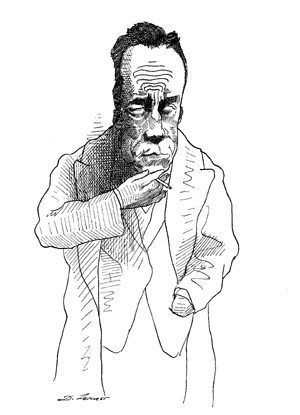
The subtle but radical change that separates the intellectual atmosphere of the Fifties from that of the Sixties could well be measured by one’s attitude towards the work and the person of Albert Camus. During his lifetime he was for many an exemplary figure; his work bears many traces of the doubts and agonies that such an exalted position inevitably carries with it. He has not ceased to be so: In several recent literary essays, written by men whose formative years coincided with the period of Camus’s strongest influence, the impact of his presence can still be strongly felt. On the other hand, one can well imagine how he might prove disappointing to a new generation, not because this generation lacks the experience that shaped Camus’s world, but because the interpretation he gave of his own experience lacks clarity and insight. That Sartre and Merleau-Ponty, different from each other as they are, seem more closely attuned to the modern temper is by itself no proof of their superiority. Nor indeed does this make Camus necessarily the defender of permanent values. Before we can blame our times for moving away from him, we must clarify our notion of what he represents.
The publication of the Notebooks is a useful addition to the understanding of a writer who, in his fiction, always chose to hide behind the mask of a deliberate, controlled style or behind a pseudo-confessional tone that serves to obscure, rather than to reveal, his true self. The “I” that addresses the reader in The Stranger and in The Fall, and the collective “we” of The Plague, are never to be directly identified with the voice of Camus; in accordance with the tradition of the novel, the author reserves the right to keep his interpretations of characters and events implicit and ambivalent. The genre of the novel is, by definition, oblique, and no one thinks of blaming Cervantes for the fact that, up to this very day, critics cannot agree whether he was for or against Don Quixote. More contemporary figures, however, are not allowed the same immunity especially if, like Camus, they openly intervene in public and political matters and claim to experience personal conflicts that are typical of the historical situation in general. In such cases, one is certainly entitled to look for utterances in which the true, commitment (or the true uncertainty) of the writer is revealed.
Camus’s Notebooks do not offer an easy key to the understanding of an irresolute man. In this second volume of his private notes—the first volume of the Notebooks, covering the period from May 1935 to February 1942, has also been published in English—Camus’s personal reserve has increased rather than diminished, and the lack of intimacy or of self-display is both admirable and unusual. There is nothing here of the abandon, the indiscretion of many intimate journals, very little self-justification or, for that matter, self-analysis. The second volume of the Notebooks deals with the period from January 1942 till March 1951, during which the main events in Camus’s personal, public, and literary life took place: his forced stay in occupied France after the Allied landing in North Africa, his participation in the Resistance and subsequent political activity as editor of Combat, the considerable success of his novels and plays, which made him one of the most influential writers of the post-war era. It is during this period that he wrote The Plague and the ambitious essay Man in Revolt (The Rebel in its American edition), which interprets the modern predicament as a historical conflict of values. It was also during this period that Camus’s inner conflicts and hesitations gained in intensity, leading to a growing retreat from public action, the eventual break with Sartre, and the combination of bitterness and lucidity that one finds in The Fall.
Obviously it was a very rich and complex period—but only the remotest echoes filter through to the pages of these notebooks. Readers who expect revelations, strong opinions, anecdotes, and the like will be disappointed. Even the most unsettling personal episodes in Camus’s life appear in remote and indirect perspectives. For instance, when he suffered an unexpected recurrence of his early tuberculosis in 1949, his reaction to the event appears in the Notebooks only in the form of a poignant note quoted from one of Keats’s last letters, written while he was dying in Rome of the same disease. The example, one among many, shows how remote the notebooks are from a personal journal. They are essentially workbooks, comparable to the sketchpads that certain painters carry with them, in which reactions to the outside world are recorded only insofar as they are relevant to the work in progress.
The Notebooks consist primarily of outlines for future plays or novels, notes on current reading, early versions of passages, records of situations or remarks observed at the time and stored away for later reference. Camus made considerable use of these notes: many key passages from later books first appear here, frequently as brief notations without further comment or reflections. For a student of Camus’s work, the Notebooks thus contain much important information. The present collection will prove indispensible, especially to interpreting The Plague and The Rebel. Together with the notes and variants established by Roger Quilliot for the Pléiade edition of the novels and plays, the Notebooks give us the kind of information about the genesis of Camus’s writing that is ordinarily made available only many decades after an author’s death.
Advertisement
But the Notebooks can also serve a less specialized function, and help towards a general consideration of Camus’s development. No matter how rigorous the reserve, how decorous the self-restraint, a fuller image nevertheless shines through these pages, though more by what they leave unsaid than by what they bring to light. One is struck, for instance, by the considerable difference in tone between the later pages of the Notebooks and those contained in the previous volume. The earlier remarks frequently had the spontaneous, lyrical quality of ideas and impressions revealed for their own sake. No deep gulf separates the actual person from the writer, and what is of interest to the one also serves the other. When, in 1940, Camus describes his reactions to the city of Oran he does so with a vivacity of perception that brings the city to life even more effectively than in the opening pages of The Plague. The pages on Oran in the 1940 notebook are felicitous in themselves and useful to his later work as well. As the notebooks progress, and especially after the war, such happy conjunctions between the writer’s experience and his literary work become less and less frequent: Camus deliberately tore himself away from his natural inclinations and forced upon himself a number of alien concerns. As a result, the Notebooks reflect an increasing feeling of estrangement and solitude. One feels an almost obsessive commitment to work, a rejection of any moment of private experience as self-indulgence. The man and the writer have less and less in common, and the writer owed it to his avocation to keep repressing his personal life:
Only by a continual effort can I create. My tendency is to drift toward immobility. My deepest, surest inclination lies in silence and the daily routine…But I know that I stand erect through that very effort and that if I ceased to believe in it for a single moment I should roll over the precipice. This is how I avoid illness and renunciation, raising my head with all my strength to breathe and to conquer. This is my way of despairing and this is my way of curing myself.
The resolution undoubtedly has moral grandeur, but it requires the constant rejection of a personal quality which is, in fact, not just oriented towards silence and mechanical routine. Outcries of rebellion against solitude punctuate the notebooks and give them a more somber tone than is found in any of Camus’s dramatic or fictional works. Optimistic assertions about the necessity of dialogue and the ultimate value of the individual are interspersed with notations of despair: “Unbearable solitude—I cannot believe it or resign myself to it”; “Utter solitude. In the urinal of a major railway station at 1 a.m.” The spontaneous elation that inspires the pages on Algiers, Oran, and the cities of Italy in the early notebooks has been replaced by this note of despair and alienation: for the solitude that torments Camus is most of all an estrangement from what he considers his authentic former self. The more he gets involved with others, with social issues and public forms of thought and action, the more he feels a loss of contact with his true being.
This evolution is so frequent in modern literature that it certainly does not, by itself, warp Camus’s interpretation of his times. His loneliness is genuine, not a pose; the scruples that haunted him while he was being increasingly rewarded by a society in which he participated so little are apparent in many passages of the Notebooks. It cannot be said of him, as of the hero of The Fall—who is an amalgamation of several contemporaries with certain personal traits of Camus himself—that he lived in bad faith, buying a good conscience by substituting for genuine abnegation the stance and the rhetoric of sacrifice. If one suspects that Camus was thriving on his exposure of contemporary nihilism, enjoying an intellectual position that claimed to suffer from the absurdity of the age while making this absurdity fashionable—then the note of real disarray sounded throughout the Notebooks should dispel such doubts. The paradox in which Camus was caught is both more interesting and more intricate: it is not his good faith but the quality of his insight that is to be questioned.
Advertisement
Camus very rightly made his own isolation the basis of his negative diagnosis of the present course of history. He then interpreted this isolation as a conflict between the individual and history. There never is any doubt in his mind that the source of all values resides in the individual, in his ability to resist the monstrous encroachments that history makes upon his integrity. And for Camus this integrity, which he strove to shelter from totalitarian and deterministic forms of thought, is founded in man’s capacity for personal happiness. Camus’s concern for others is always protective: he wants to keep intact a potential happiness, a possible fulfillment that every individual carries within him. Socialism is for him an organization of society that safeguards this potentiality: hence his enthusiasm for Belinski’s “individualistic socialism” against Hegel’s claims for totality and universality. The source of this conviction, however, is to be found in Camus’s own experience, and the quality of his thought depends, finally, on the intrinsic quality of his inner experience.
On this point, early works such as Noces and especially the earlier Notebooks dating from before The Stranger, are highly instructive. Camus’s sense of personal fulfillment is perhaps most clearly revealed in the exalted pages he wrote in September 1937 during a visit to the cities of Tuscany:
We lead a difficult life. We don’t always succeed in adjusting our actions to our vision of things…We have to labor and to struggle to reconquer solitude. But then, one day, the earth shows its primitive and naive smile. Then it is as if struggles and life itself were suddenly erased. Millions of eyes have contemplated this landscape before, but for me it is like the smile of the world. In the deepest sense of the term, it takes me outside myself…The world is beautiful, and nothing else matters. The great truth the world patiently teaches us is that heart and mind are are nothing. And that the stone warmed by the sun, or the cypress magnified by the blue of heaven are the limits of the only world in which being right has meaning: nature without man…It is in that sense that I understand the word “nakedness” [dénuement]. “To be naked” always contains a suggestion of physical freedom and I would eagerly convert myself to this harmony between hand and flower, to this sensuous alliance between the earth and man freed of humanity if it were not already my religion.
These passages have the intensity of a writer’s most personal vision. They stand behind Camus’s entire work and reappear at the surface at those moments when he speaks in his own voice: when Rieux and Tarrou free themselves of the historical curse of the plague in a regenerative plunge into the sea; when the snow falls on Amsterdam at the end of Clamence’s confession in The Fall. We can see from these passages that what Camus calls solitude in the later notebooks is not, in fact, solitude at all, but the intolerable intrusion of others upon the sacred moment when man’s only bond with reality is his bond with nature. In Camus’s mythology, the historical parallel to this moment is Greece and he laments at length the disappearance from our own world of Hellenic simplicity—as he laments the disappearance of landscapes from his own books. He quotes Hegel: “Only the modern city offers the mind the terrain in which it can be conscious of itself” and comments: “Significant. This is the time of big cities. The world has been amputated of a part of its truth, of what makes its permanence and its equilibrium: nature, the sea, etc. There is consciousness only in city streets!” And yet cities play an important part in Camus’s novels: The Plague and The Fall are intensely urban in spirit; Amsterdam and Oran are far more than a mere backdrop; they play as central a part as any of the characters. But in Camus’s cities a man does not come to know himself by contact with others even by experiencing the impossibility of such contact. In their inhuman anonymity, they are the nostalgic equivalent of the unspoiled nature that has departed from this earth. They have become the haven of our solitude, the link with a lost Arcadia. When city and nature unite in a landscape of nostalgia at the end of The Fall, his hero’s outcry seems natural enough: “Oh sun, beaches and the isles under the seawind, memories of youth that cause one to despair!” Baudelaire knew a similar nostalgia in the midst of the modern city, but he set himself sharply apart from those who gave in to it, extending to them only pity. The Notebooks make it clear that, on this point, there is no distance between Camus and his fictional characters. And whereas the nostalgic figures in Baudelaire feel the attraction of a homeland that has really been theirs, Camus feels nostalgia for a moment that is ambivalent from the outset.
For if one considers this moment, to use his own words, as an instant of “physical freedom” when the body fits within the balance of the elements, then it would be a legitimate assertion of natural beauty on a rather primitive level. “The world is beautiful and nothing else matters.” The sentence expresses an idyllic state that does not involve other people and stands outside time—Adam not only before the Fall but before the birth of Eve. In this condition “love is innocent and knows no object.” Solitude is no burden since so little consciousness is present; on the contrary, it protects us from alien intrusions. One could compare the feeling with passages in D. H. Lawrence or understand in its terms Camus’s affinity with certain aspects of the early Gide. It could be the basis for an amoral and asocial anarchism: Camus explicitly stresses that this encounter can only take place between nature “without man” and man “freed of humanity.” This “nakedness” is an athletic freedom of the body, an Arcadian myth that the romantic neo-Hellenists could only have treated in an ironic mode. Camus’s use of irony and ironic narrative devices never put this fundamental vision in doubt; in the privacy of his Notebooks, it asserts itself even more powerfully as an act of indestructible faith. Camus protests against history as a destroyer of nature and a threat to the body. History is a diabolical invention of German philosophers, a modern curse: “The whole effort of German thought has been to substitute for the notion of human nature that of human situation and hence to substitute history for God and modern tragedy for ancient equilibrium…But like the Greeks I believe in nature.” In this respect, Camus is indeed as remote as possible from existential modes of thought, and one can understand his irritation at being so frequently associated in people’s minds with Sartre. In a remark that anticipates their future quarrel, Camus accuses Sartre of wanting to believe in a “universal idyll”—apparently unaware that he is himself the prisoner of an idyllic dream that differs from the one he attributes to Sartre only in the respect that it is personal rather than universal. There is no evidence that he ever woke up from this dream.
Camus’s work, however, does not display a consistent development of this single vision. Even in the quoted passage from his earlier notebooks, when his naive Hellenism asserts itself in its purest form, a word play on the term dénuement introduces the other aspect of his thought. The “nakedness” implied by the nu in dénuement suggests the barrenness of a human condition that is essentially unsheltered and fragile—not man’s “physical freedom” but his subservience to the laws of time and mortality. Camus has a sense of human contingency. The Notebooks record many brief episodes, imagined or observed, in which the frailty of the human condition is suddenly revealed when everyday routine is interrupted by an unexpected confrontation with death or suffering—as when he records his mother’s horror at the thought of having to face the War years in the dark because of the blackout, or notes the expression on people’s faces in a doctor’s office, or tells of the death of an old actor. On a larger scale, the nightmarish aspects of the last War have the same effect, but several notebook entries reveal Camus’s sensitivity to this kind of experience well before the war.
His best essay, The Myth of Sisiphus, develops from observations of this kind. His particular moral sense, one of protectiveness, is rooted in this awareness of man’s “nakedness.” But this nakedness has nothing in common with “physical freedom.” A reconciliation of the two notions is not easily achieved; it comes about only in the highest manifestations of art or thought. And the first step in such a reconciliation always involves the renunciation of the naive belief in a harmony at the beginning of things. When Camus characterizes Greek art as a “benign barrenness” (un dénuement souriant), he does not seem to realize that this equilibrium is the final outcome, and not the starting point, of a development that is anything but “natural.” Rooted in a literal and physical notion of unity, his own thought falls apart, on the one hand, in a seductive but irresponsible dream of physical well-being and, on the other, in a protective moralism that fails to understand the nature of evil. Camus never ceased to believe that he could shelter mankind from its own contingency merely by asserting the beauty of his own memories. He made this assertion first with proud defiance in The Stranger, and later, with more humility but no essential change, in The Fall. He always considered himself exemplary, the privileged possessor of a happiness the intrinsic quality of which he over-estimated. Others, whose sense of happiness was deeper and clearer than his own, had long since understood that this gave them no increased power over their own destiny, let alone over that of others. His work contains some beautiful flights of lyrical elation along with some astute observations on the incongruity of the human condition. It is lacking however, in ethical profundity despite its recurrent claims to high moral seriousness. And it is entirely lacking in historical insight: ten years after its publication The Rebel now seems a very dated book. The Notebooks make the reasons for this failure clearer. Without the unifying surface of a controlled style to hide them, the contradictions are much more apparent than in the novels or the essays. The figure that emerges is attractive in its candor, but not authoritative in its thought.
When Camus was a young man, he used to be a goalkeeper for a student soccer team and he wrote articles, in the club paper, extolling the joys of victory or, even more eloquently, the melancholy of defeat. The goalkeeper of a soccer team is, to some extent, a favored figure: the color of his shirt differs from that of his teammates, he enjoys the privilege of touching the ball with his hands, etc. All this sets him apart from the others. But he has to pay for this by accepting severe restrictions: his function is purely defensive and protective, and his greatest glory to avoid defeat. He can never be the agent of real victory and, although he can display style and elegance, he is rarely in the thick of things. He is a man of flashy moments, not of sustained effort. And there is no sadder sight than that of a defeated goalkeeper stretched out on the field or rising to retrieve the ball from the nets, while the opposing attackers celebrate their triumph. The melancholy that reigns in the Notebooks reminds one of Camus’s youthful sadness on the soccer field: too solitary to join the others up front, but not solitary enough to forego being a member of the team, he chose to be the goalkeeper of a society that was in the process of suffering a particularly painful historical defeat. One could hardly expect someone in that difficult position to give a lucid account of the game.
This Issue
December 23, 1965
This Issue
December 23, 1965
