
The comment on our policy in Vietnam most frequently heard in Washington in the summer of 1965 consists of two questions: How did we ever get into this mess, and since we are in it, and cannot get out through negotiations, what can we do but stay? These questions deserve an answer; for the answers will shed light upon the nature of our policy in Vietnam. They will show that we have consistently confounded the shadow of national power with its substance, the prestige of the nation with the actuality of its power, ephemeral public reactions with the stability of the national prestige, the prestige of policy-makers with the prestige of the nation. We are here in the presence of a central misunderstanding of the nature of foreign policy and, in consequence, of a persistent dilettantism in trying to cope with the problem of Vietnam. This central fault in our thinking is responsible both for our general predicament and for our day-by-day failures, and it provides a common explanation of certain glaring deficiencies in a foreign policy otherwise inexplicable.
The prestige of a nation is its reputation for power. That reputation, the reflection of the reality of power in the mind of foreign observers, can be as important as the reality of power itself. What others think about us is as important as what we actually are. Thus all nations, and especially those active in foreign policy, must see to it that the mental picture other nations form of their power at least represents faithfully the actuality of their power, if it does not excel it.
It is at this point that the policy of prestige must guard against two pitfalls. If it exceeds that actuality by too much, prestige will become bluff, and a policy based upon such a misreading of reality will fail, as did Mussolini’s in the Second World War. On the other hand, prestige that makes a nation appear to be less powerful than it actually is reduces the influence the nation might in fact exert. The impotence of the United States in the inter-war period is a case in point. Thus wisdom lies in seeing to it that the shadow that a nation’s power casts in the form of its prestige is neither too large nor too small, but always retains a rational relationship to the substance of power. It is here that our policy in Vietnam is at fault. It illuminates the peculiar immaturity of our relationship to power by erring both ways: it claims both too much and too little in view of the substance of our power.
The prestige of a nation is not determined by the success or failure of a particular operation at a particular moment in history. Quite the contrary, it reflects the sum of a nation’s qualities and actions, of its successes and failures, of its historic memories and aspirations. The pages of history record many examples of nations which, secure in their possession of great power and recognized as such by their peers, have suffered defeat or retreated from exposed positions without suffering a loss in prestige. When was the prestige of France higher: when it fought wars in Indochina and Algeria which it could neither win nor thought it could afford to lose, or after it had liquidated these losing enterprises? And how much did American prestige suffer in the long run from the debacle of the Bay of Pigs, as thorough and spectacular a failure as one would wish only one’s enemy to suffer, and as humiliating a revelation of governmental incompetence as one would not want perhaps even one’s enemy to reveal? When France demonstrated the wisdom and courage to liquidate two losing enterprises on which it had staked its “honor,” its prestige rose to heights it had not attained since the beginning of the Second World War, and the Bay of Pigs has weighed little in the scales of American prestige, heavy as they are with power and success. To say, then, that we ought not to be in Vietnam but cannot leave because our prestige would suffer, is to confound ephemeral fluctuations of public opinion with the lasting foundation of national power and prestige and to think little of American power and of the American prestige which reflects that power.
Yet the same fear that anticipates a disastrous loss of prestige from a temporary setback engenders an overestimation of national power, and a need to transform a losing into a winning position. The sense of inferiority, which underestimates our national power and prestige, calls forth a policy of bluff. Obsessed with the fear of the permanent loss of prestige which we imagine would follow a temporary setback, we have become oblivious to the much more serious loss of prestige which would ensue, and has already ensued, from the continuation and escalation of a losing enterprise. Can anyone who has followed foreign public opinion carefully and with at least a measure of objectivity doubt that our prestige throughout the world has declined drastically since the beginning of 1965? Nobody questions our physical power to destroy Vietnam, South and North. Yet in even so friendly a country as Germany, which depends upon a commitment of our physical power to its defense, there are people within and outside the government who question our ability to honor this commitment when we have sent the flower of our armed forces to Vietnam without having a chance to win. Everywhere people question, sometimes under their breath and sometimes loudly, the wisdom and morality of the government of the United States. And what will our prestige be if hundreds of thousands of American men are bogged down in Vietnam, still unable to win and unable to retreat?
Advertisement
Unaware as we are in general of the nature and the greatness of our power, we have become negligent of its limits in dealing with Vietnam. Thus our judgments and actions are at odds with empirical reality. On the one hand, our knowledge of reality counsels us to liquidate a losing enterprise, and thus we try to negotiate our way out; but the negotiating conditions we stipulate always limp a couple of months behind reality, and thus our attempts consistently fail. For, on the other hand, our policy makers are dominated by a state of mind combining a sense of inferiority with a sense of invincibility, which has made us decide that we cannot afford to retreat and that we must and can win. Since a rational assessment of empirical reality contradicts this decision, we are compelled to disregard reality and to invent a mythological reality which supports our decision.
Our perception of reality is crystallized in, and our policies have evolved from, three myths which have proved to be impervious to empirical scrutiny: a binding commitment to the Saigon government that engages our “honor”; aggression from the North against a people anxious to have us defend their national independence; and the identity of the interests and policies of the Vietcong, North Vietnam, and China.
Both Presidents Eisenhower and Kennedy interpreted the American commitment to South Vietnam as a matter of military assistance and not of waging war on behalf of the Saigon government. As President Kennedy put it in September, 1963: “In the final analysis, it is their war. They are the ones who have to win it or lose it. We can help them, we can give them equipment, we can send our men out there as advisers, but they have to win it—the people of Vietnam against the Communists.” Yet this commitment, regardless of its content, was made not with a sovereign power but with an agent of ourselves. In referring to Diem Look magazine wrote on January 27, 1964: “John Foster Dulles picked him, Senator Mike Mansfield endorsed him, Cardinal Spellman praised him, Vice President Nixon liked him, and President Eisenhower OK’d him.” Finally, even if there had been an explicit commitment obligating the United States to go to war on behalf of the Saigon government, it would have to yield to considerations of the national interest. I have dealt with this problem, citing the authority of Alexander Hamilton’s “Pacificus” and “Americanus” articles, in In Defense of the National Interest, pp. 14ff., and in my first address to the Washington Teach-in, the proceedings of which will be published by Basic Books
The administration clings to the view that the war was caused essentially by “aggression” sponsored by Hanoi in concert with Communist China. It has made no difference that virtually all independent observers and experts have demonstrated that the Vietcong revolt originated in the disintegration of the Diem regime and was then given aid and abetted by the North; that the Vietcong was at that time relatively independent from both North Vietnam and China in its interests and policies; and that although this independence has been diminished in the course of the war it has not been completely destroyed. I would mention here only the latest and one of the best of these demonstrations, Le Vietnam entre deux paix, by Jean Lacouture, correspondent of Le Monde.*
From this same failure to acknowledge realities stem the misjudgments and miscalculations which with frightening persistence have led us from failure to failure in Vietnam. By assuming an identity of interests among the Vietcong, Hanoi, and Peking, we have foreclosed the possibility of exploiting the differences among them, and so have put artificial obstacles in the way of settlement. And just as we had left our chances for success and our prestige in the hands of Diem, whose follies had assured his and our failure, so we have consistently misunderstood the nature of guerrilla war and the distribution of political and military power between the Saigon government and the Vietcong. We thought we could deprive the Vietcong of popular support by herding unwilling peasants into strategic hamlets; it did not occur to us that, as I pointed out in a lecture to a government agency at the time, by uprooting the peasants we helped the Vietcong to recruit them. We thought that what stood between the Saigon army and victory was a lack of competent military advisers; this view was not altered by the fact that the situation continued to deteriorate. It would be uncharitable to quote here again the often-quoted prophecies of imminent victory with which the Secretary of Defense and a succession of American ambassadors tried to bolster our morale, and actually lowered our prestige.
Advertisement
The latest of these miscalculations has inspired the bombing raids on North Vietnam. They have the political objective—I shall deal with the military objective later—of bringing the government of North Vietnam to the conference table. Thus we have measured the damage which we intend to inflict very carefully, attempting to make it big enough to induce the North Vietnamese government to enter into negotiations, but not so big as to encourage it to enter the war with the full force of its armies. In consequence we have inevitably failed in our political purpose. We have fallen into the same error in which Prime Minister Baldwin fell when he applied sanctions against Italy during the Ethiopian War, and which Winston Churchill defined thus: “First the Prime Minister had declared that sanctions meant war; secondly he was resolved that there must be no war; and thirdly he decided upon sanctions. It was evidently impossible to comply with these three conditions.”
Finally, we are forced into that astounding demonstration of our capacity for self-deception and for the deception of others, which serves as a vital defense against the intrusion of empirical reality into our world of myths. One could write the history of our involvement in Vietnam in these terms. A few examples must suffice. On April 24, 1964, the Secretary of Defense stated at his news conference:
I still believe we can win, as you put it, following the current program, and I don’t believe that anyone in the government of South Vietnam or our government believes that the addition of U. S. ground combat troops in South Vietnam or the introduction of such troops in South Vietnam would favorably affect the situation there. That situation is one that the South Vietnamese themselves must solve.
Ambassador Henry Cabot Lodge, before returning to Saigon, told reporters in Washington on June 30, 1964, what he thought the consequences of massive American military involvement in Vietnam would be:
Well, that means we become a colonial power and I think it’s been pretty well established that colonialism is over. I believe that if you start doing that you will get all kinds of unfortunate results: you’ll stir up anti-foreign feeling; there’ll be a tendency to lay back and let the Americans do it and all that. I can’t think that that’s a good thing to do.
Applying the myth of foreign aggression to military operations, we have been blockading the coast of South Vietnam since May 12, 1965, with a force of 3,500 men deployed in the air and on the sea. According to Keyes Beech, writing in the Chicago Daily News of July 27, 1965, the results have been as follows:
In terms of tangible results, it would seem that seldom has so much time and effort been expended for so little…Yet all Operation Market Time has to show for its efforts so far is: one junk captured with five Viet Cong, one of them a woman, and two junks scuttled. Not one firearm has been seized.
Applying the same myth, we have since February, 1965, launched innumerable bombing raids against North Vietnam in order to interdict the access routes to the South. But, as an American officer put it, these raids have had about the same effect upon the operations of the Vietcong as a failure of air conditioning would have upon the operations of the Pentagon. Since June, 1965 to the moment of this writing in the middle of August, 1965, 240 of our B-52 strategic bombers have unloaded in eight raids what must have been enormous amounts of bombs upon jungles in South Vietnam. According to James McCartney, in the Chicago Daily News of August 4, 1965, “The grand total of proven dead is three—and that is also the known number of wounded.”
The world of fantasy in which those who govern us live inevitably begets failure in action; for the facts are what they are, and they are not to be trifled with. Just as inevitably, it begets dissimulation; for the world of fantasy must be protected from the world of reality. Thus the late President Kennedy asked the publisher of The New York Times to recall Mr. Halberstam from Vietnam not because Mr. Halberstam had not told the truth, but exactly because he had told it. Thus the official spokesman for the United States mission in Saigon, according to Newsweek of August 2, 1965, could state: “My directive says that our policy is one of minimum candor.” Thus when I stated in a television debate on June 21, 1965, that the recruits of the Saigon army were then defecting at a rate of about 30 per cent and that in the war zone Da Nang 40 per cent of the combatant units had recently defected, the President’s Special Assistant on National Security Affairs could say that I was “wrong on [my] facts as to the desertion rate.” Yet I had received this information on the day of the debate from a high and unimpeachable government source. Two weeks later, I received from an even higher and equally unimpeachable government source the information that the desertion rate among the recruits of the Saigon government was 50 per cent. In the same television debate I quoted from L’Express, Le Figaro, and The Economist in order to show how some of the most respected unofficial sources of information see reality differently from the way the government of the United States sees it, and I was again told that I was “wrong.” But I had only quoted from publications which are open to public inspection.
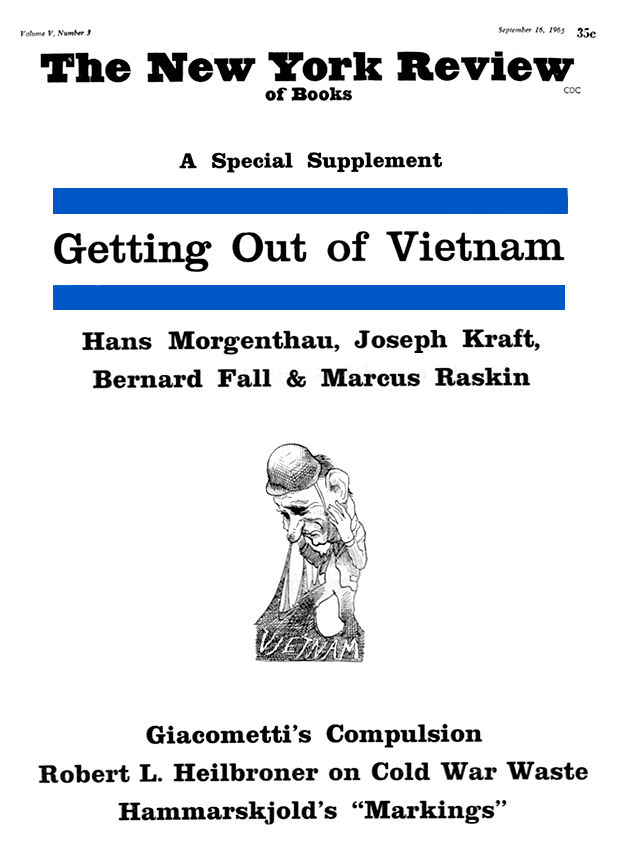
The patent absurdity and unworthiness of arguments such as these are not primarily the result of the personal failings of those who make them. These officials are under a compulsion to protect their imaginary world at all costs, intellectual and moral, from contact with the real one and they must force themselves and the world to believe that their imaginary world is real, that their myths are the truth. For if they did not do that, they would have to change their policies radically and admit that they had been consistently wrong for years and that they could not be trusted with the fate of the nation. Thus, in the end, disastrous policies consistently pursued serve to protect those who have initiated or inherited them. We are here in the presence of an issue not of foreign policy or military strategy, but of psychopathology. The result is the personalization of the fear of losing prestige, so that in the end it is not only the prestige of the nation that is at stake, but the prestige of the policy maker himself, his ability to retain his power, and his place in history. The commitment which the American policy maker feels he cannot escape is not so much to the government of South Vietnam as to public opinion in the United States. It is not in fact difficult to visualize a series of diplomatic steps that might honorably be proposed in order to bring the war to an end. One such proposal is published in this issue of The New York Review, and others are possible. But American leaders have so far been extremely reluctant to take the political risks involved in advocating proposals of this kind.
Reports on the deliberations preceding the expedition to the Bay of Pigs clearly show how this defense mechanism works. There were many policy-makers then, as there are many now, with grave doubts about the soundness of the policies pursued. Nobody in the high councils of government then and now has had the courage to jeopardize his career by opposing what he knows to be wrong. Nobody wants to appear to be “soft on Communism,” nobody wants to admit that we cannot win if we only put our minds to it, even though all the facts point to the contrary.
Thus the same psychological mechanism which led to the Bay of Pigs leads us ever deeper into Vietnam. The expedition into the Bay of Pigs was a spectacular debacle, lasting a day. The expedition into Vietnam is a creeping debacle, more insidious for not being spectacular, conjuring up immense risks and narrowing with every step the avenues of escape. And the greatest risk we are facing is neither political nor military. It is the risk to ourselves, to our mission in the world, to our very existence as a distinct nation.
I have spoken of the prestige of the nation and of the prestige of those who govern it, that is, of the mental image which others have of us. Yet there is another kind of prestige: the image we have of ourselves. That image will suffer grievous blemishes as we get ever more deeply involved in the war in Vietnam. This war is a guerrilla war, and such a war, supported or at least not opposed by the indigenous population, can only be won by the indiscriminate killing of everybody in sight, that is, by genocide. The Germans proved that during the Second World War in occupied Europe, and they were prevented from accomplishing their task only because they were defeated in the field. The logic of the issue we are facing in Vietnam has already driven us onto the same path. We have tortured and killed prisoners; we have embarked upon a scorched-earth policy by destroying villages and forests; we have killed combatants and non-combatants without discrimination because discrimination is impossible. And this is only the beginning. For the logic of guerrilla war leaves us no choice. We must go on torturing, killing, and burning, and the more deeply we get involved in this war, the more there will be of it.
This brutalization of the Armed Forces would be a serious matter for any nation, as the example of France has shown. It is intolerable for the United States. For this nation, alone among the nations of the world, was created for a particular purpose: to achieve equality in freedom at home, and thereby set an example for the world to emulate. This was the intention of the Founding Fathers, and to this very day the world has taken them at their word. It is exactly for this reason that our prestige has suffered so disastrously among friend and foe alike; for the world did not expect of us what it had come to expect of others. This is indeed, as Keyes Beech put it, “the dirtiest war Americans ever had to fight,” with the sole exception of the wars against the Indians, which, however, were not foreign wars. Cam Ne and Chau Son are not in the line of succession to Lexington and Concord and the other great battles of American history; they give the lie to that tradition. War, the wanton killing of human beings, can only be justified by a transcendent end; this makes a war just. There is no such end and there is no justice here. Those who are so concerned about our collective and their personal prestige might take a moment to reflect on the kind of country America will be when it emerges from so senseless, hopeless, brutal, and brutalizing a war.
This Issue
September 16, 1965
This Issue
September 16, 1965
-
*
Reviewed by Joseph Kraft, NYR, August 5, 1965, and to be published in translation as Vietnam Between Two Truces by Random House in January. ↩
