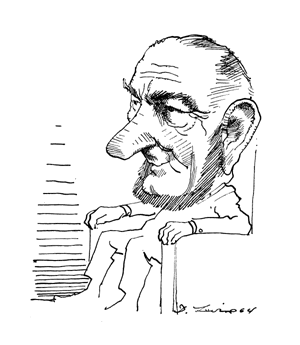
Whatever William S. White lacks as a biographer he more than makes up as a plastic surgeon. His most striking operation occurs in his chapter on civil rights. There he says that “as early as March of 1949, as the very new and junior Senator from Texas with a plurality of less than a hundred votes in his pocket,” Johnson went on record against racial discrimination. “Perhaps no prejudice,” he quotes Johnson as saying, “is so contagious or so unreasoning as the unreasoning prejudice against men because of their birth, the color of their skin or their ancestral background…” White does not tell the reader that the quotation is taken from a speech against civil rights legislation, and in defense of the filibuster. “I say frankly,” Johnson had declared in the same speech, “that the Negro…has more to lose by the adoption of any resolution outlawing free debate in the Senate than he stands to gain by the enactment of the civil rights bills.” He had pictured Fair Employment Practices legislation as if it would repeal the Emancipation Proclamation. “If the law can compel me to employ a Negro,” Johnson then argued, “it can compel that Negro to work for me.”
Another example of White’s face-lifting occurs when he tries to explain Johnson’s vote for the Taft-Hartley Act. White says Johnson had become convinced that labor had moved “from a place of too great weakness to a place of too great power.” So “in 1935 he had voted, without a qualm for the Wagner Act, Labor’s ‘Magna Charta.’ In 1946, while his career in the House was drawing to a close, he voted, again without a qualm, for the Taft-Hartley Act—sometimes called, though most unfairly so, ‘the slave labor bill.’ ” Johnson never voted for the Wagner Act. If the reader turns back from this glowing portrait of the perfect moderate on page 155 to page 136, he will see that Johnson was not elected to Congress until 1937, two years after the Wagner Act was passed.
Marx once wrote that history is a form of politics; White seems to be taking this maxim literally. He rearranges even the dates. The fact is that though elected in 1937 as a 100 per cent New Dealer, Johnson soon joined forces with the anti-labor Southerners. When they finally achieved their objective in the Smith-Connally Act of 1943, Johnson voted to override FDR’s veto as four years later he voted to override Truman’s veto of Taft-Hartley. This anti-labor record was so pronounced that when Johnson first ran for the Senate in 1948, Texas labor for the first time in a half-century endorsed a candidate for the Democratic nomination, picking his right-wing opponent, “Coke” Stevenson. White pictures his hero as the aggrieved victim of what White calls an “Orwellian” plot to represent Johnson “as the tool of reactionary employers.” He does not mention that Johnson by his program and his sponsorship left Texas labor nowhere else to go. Johnson opened his campaign by advocating right-to-work laws. One of the most reactionary employers in Texas, Herman Brown of Brown & Root of Houston, sat approvingly on the platform behind him in Austin when he did so. White mentions the brothers Herman and George Brown only as the old friends to whose country home in Virginia Johnson was motoring when stricken by his heart attack in 1955. They deserve fuller treatment. Their contracting firm was long one of the biggest non-union employers in the country. They are among Johnson’s oldest backers and he has reciprocrated their devotion, notably in his first term as Senate majority leader when he knocked out of an $8 billion highway bill a provision requiring fair labor standards.
White calls labor’s opposition to Johnson in the 1948 campaign “a towering absurdity.” But his record in the Senate proved little different from that in the House. In August 1959, Johnson was still boasting to employer constituents in Texas1 that he had always favored “strong, effective regulatory legislation to protect Americans from improper labor practices.” The context of this letter was one of those legislative miracles under Johnson’s Senate leadership which White does not mention.
It was quite a feat. The Congressional elections in the fall of 1958 were a landslide for the Democrats, particularly those with liberal and labor backing. Yet a powerfully organized business lobby managed to get through this liberal Congress a major piece of legislation severely restricting labor unions, the Landrum-Griffin Act.
How could labor suffer so sharp a defeat in the wake of so notable a victory? The McClellan Committee investigation into labor racketeering had created a favorable climate for anti-union legislation. Johnson, in that same letter to selected Texas constituents, claimed credit for this. He wrote that it was he who asked the Senate to set up the committee and recommended McClellan for the chairmanship. The anti-labor crowd’s ambitions seemed to be thwarted when the Senate passed a moderate regulatory measure, the Kennedy-Ives bill, over the opposition of McClellan and Goldwater, the ranking Republican on his committee. There then occurred one of those Johnson sleight-of-hand performances in which the hand was faster than the eye. The House in a close vote—229 to 201—substituted the more restrictive Landrum-Griffin bill. A funny thing happened on the way to the Forum when that substitution was voted. The two leaders, Johnson in the Senate and Rayburn in the House, were on record for the Kennedy-Ives bill. Yet eighteen members of their own twenty-two member Texas delegation deserted Johnson and Rayburn in the vote to substitute. Had these eighteen Texans voted the other way, the outcome would have been 211 to 219 against Landrum-Griffin. A book2 has just been published on this curious episode in legislative history. It supports the belief in labor circles that Johnson signaled the Texas delegation to vote for the harsher measure. Its main features won approval in the conference of the two Houses and the bill finally enacted in September 1959, was praised by McClellan and Goldwater. George Meany attacked it as “the most damaging anti-labor bill since Taft-Hartley.”
Advertisement
The biggest scoop of the White biography is that it was Johnson who “engaged McCarthy and defeated him.” White says McCarthy’s downfall “was Johnson’s achievement, personally, to an almost incredible degree.” The incredibility is undeniable. This, if true, was the most successfully guarded secret of the McCarthy era. It comes as a surprise to all of us who covered his heyday and downfall. It appears in none of the books on McCarthy, not even in White’s own 1956 book on the U.S. Senate (Citadel) which discusses the affair at some length. It appears to be one of those happy tricks of memory—like Johnson’s vote for the Wagner Act. On the other hand, while Johnson now remembers defeating McCarthy, he and White seem completely to have forgotten Johnson’s successful use of McCarthyite tactics to smear and defeat the late Leland Olds for reappointment to a third term as chairman of the Federal Power Commission. The oversight is odd, since this was Johnson’s biggest exploit as a freshman Senator. Johnson was chairman of a special sub-committee which rehashed stale Red charges to drive Olds from public life. He was a man whose integrity had earned him the enmity of the utilities and the oil and gas industry.
The White book must be read in broader context. The swiftness with which Johnson changed his “image” within a short few months of taking office as President is a triumph of razzle-dazzle unequaled in the annals of Madison Avenue. The press and opinion-makers of all kinds were wooed at a temperature and tempo no office-holder has ever achieved before; one famous columnist even heard the maid announce one day that the President, unexpected, was at the door. White’s is one of five (four new and one reissued) campaign biographies3 tailored to the man’s enormous vanity and to his need for a new liberal look.
This personality cult chorus is a pity, for Lyndon B. Johnson’s true story is fascinating, the rough-and-tumble rise of a poor boy to the Presidency by hard work, an innocence of all scruples, and a sure instinct for which way the wind was blowing. It should be written by a Dreiser; it belongs beside The Titan and The Financier; its robust realities are far superior to the anemic falsities dished up by his hangers-on. All kinds of marvelous characters are smuggled out of the story in their expurgated versions. One is Roy Miller, the legendary lobbyist for Texas Gulf Sulphur, who helped Johnson get his first job in politics and guided him on his way upward. Another is the unrepentantly feudal George Parr, boss of those latifundista regions along the Mexican border which turned in the fantastically one-sided returns that finally gave Johnson his 87-vote victory over “Coke” Stevenson in 1948, and the sobriquet of Landslide Lyndon. These figure in the stories LBJ himself must tell to his innermost circle over the bourbon-and-branch-water.
All five of these pseudo-biographies are remarkable for the complete absence of any mention of Bobby Baker, Johnson’s right-hand man in the Senate since 1951, his lieutenant in the fight for the nomination in 1960. White in his earlier book on the U. S. Senate thought it cute that Democratic Senators as august as George of Georgia consulted the then twenty-seven-year-old Baker on matters as momentous as Quemoy-Matsu in 19554 . But Baker becomes an un-person in White’s biography, though a writer as close to Johnson as Helen Fuller only two years ago in her book Year of Trial respectfully included “Robert G. Baker, Secretary to the Senate Policy Committee” in the most intimate circle of advisers to whom Johnson turned when asked to run for Vice President. Never was a major scandal buried with greater dispatch. Yet it might have been wiser to air at least a little of the painful story to lessen the risk of its rising to haunt Johnson in the coming campaign.
Advertisement
Biographies like White’s do him a disservice altogether. They create a reaction so sharp as to overlook his virtues. In the highest offices a man’s past is not always a clue to his future; the Presidency and the Supreme Court are full of surprises. The White House is LBJ’s last chapter, and he wants desperately to make it a great one. His awe-inspiring energy has been put behind the search for peace, an attack on poverty, and civil rights. The means may be inadequate and the commercials flamboyant; the Far Eastern brink a dizzy place to search for peace. But the Grand Design is there. The trouble with disguising this crafty moderate conservative as a liberal and taking the liberals into camp is that this deprives his program of the push that an opposition to left of him would give it. He will be callous toward Latin America, tricky in handling the regulatory commissions, and determined that the big interests are protected in the control of basic resources and in the tax structure. But he also knows the forward motions that the times require. It is an asset to have so able and persuasive a Southerner in the White House at so crucial a moment in the history of American race relations. De Gaulle’s genius at flim-flam enabled him to free Algeria against the wishes of those who brought him to power. Johnson’s may reconcile the South to equality for the Negro.
This Issue
July 30, 1964
This Issue
July 30, 1964
-
1
In a letter which leaked to the United Mine Workers Journal and was reprinted in The New York Times, Jan. 6, 1960 ↩
-
2
Alan K. McAdams: Power and Politics in Labor Legislation. Columbia University Press, 1964, $7.50 ↩
-
3
The others are Clarke Newlon’s LBJ: The Man from Johnson City (Dodd Mead, $3.75); Harry Provence’s Lyndon B. Johnson (Fleet, $4.50); Kurt Singer and Jane Sherrod’s Johnson, Man of Reason (Denison, $3.95), the silliest of the lot—it confuses Carl Vinson of Georgia, who helped Johnson’s rise, with Fred Vinson of Kentucky; and Booth Mooney’s The Lyndon Johnson Story (Avon, 60 cents, a fair price), the revised edition of a 1956 campaign biography by an LBJ employee now working for H. L Hunt, the right-wing oil man. Laurence Stern in the Washington Post last February 16 analyzed the amusing changes in the two editions, especially the omission of earlier slurring references to the “left-wing ADA.” ↩
-
4
In case the reader is curious, what Baker said was, “Senator, I can tell you this: I for one haven’t lost a single damned thing on Quemoy or Matsu.” Baker was cautious about his investments. ↩
