1.
As soon as the shock of the terror attacks on New York and Washington was felt, commentators began saying that September 11, 2001, marked the beginning of a new era in world affairs. It is a misleading interpretation of a horrible event. What was new was the demonstration that a small number of well-organized conspirators could cause thousands of victims in the territory of the “only superpower” and thus show that the US was not any safer from attack than far less mighty nations. But the change of scale and the location of the targets do not represent a transformation of international relations. The terrorists brutally drew our attention to a phenomenon that had long been partly hidden from sight by the cold war and by decolonization, two historical developments that were quite traditional: an epic contest between two great powers, and the troubled birth of a large number of (more or less shaky) new states.
While these struggles went on, something drastically new was emerging: a global society in which states were no longer the only or even the essential players. Insofar as they keep the appearance and trappings of sovereignty, the states are still, on the surface, the shapers of their foreign policies. But unlike in the dominant model of world affairs taught to future academics, statesmen, and businessmen, the goals of states are now only partly “geopolitical,” consisting of territory, resources, security from rivals, prestige, etc. States have increasingly had to take into account the demands and wishes of their people—jobs, welfare, ethnic or religious sympathies and hatreds, protection from internal or external wars, etc. Governments that neglect such preferences and pressures do so at considerable peril. Nothing is purely domestic or purely international anymore.
Even more important has been the recent emergence of a global civil society, made up of people and groups that operate across borders and whose decisions and acts sharply reduce the freedom of maneuver of governments: not only multinational corporations, secular and religious nongovernmental organizations, and investors able to move their money at lightning speed from one stock market to another (and thus to shake up domestic currencies), but also drug cartels, mafias, and terrorists. The distinction between state and civil society is of course artificial. Many of the components of civil society want governments to adopt measures aimed at satisfying their demands, whether for education, pro-tecting the environment, or treatment of AIDS or other illnesses; there are very few “private” actors who do not need and obtain financial or political support from governments. But global civil society has suffered both from neglect by students of world affairs, and from being even more unmanageable than a world of states with only a fragmentary collective governance. The shock of monetary crises in the 1990s was fortunately not strong enough to destroy the world economy. The shock of September 11 has been so great because it resulted from an attack; it was not, moreover, an attack by anonymous speculators on national currencies but by a small group of minimally armed terrorists on the national security and sense of confidence of the world’s greatest power. Suddenly, rogue states lost their status as the greatest potential threat. A world of millions of private actors means a world of virtually unlimited vulnerability.
This is, paradoxically, especially frightening for the United States, the country that has done most to destroy borders and walls, to shape a world market, to promote freedom of communications, information, and movement. Americans have known, since the Vietnam War, that awesome firepower does not guarantee victory against a determined small nation. Concentrated will and the ability to accept casualties can compensate for inequality in economic and military might. The fact that American power was partly unusable (as with nuclear weapons), and partly ineffective when used, was disturbing enough when the foe was a relatively small state. It is even more disturbing to think that a few thousand terrorists may have the same effect: Gulliver no longer tied by Lilliputians, but assaulted by clever gnats. The weapons of economic and military warfare (including for mass destruction) are now available not merely to states, but to the peoples of the world.
2.
How do we deal with this change? The Bush administration has shown a great deal of schizophrenia. On the one hand, the President himself has declared war on terrorists and regimes that support them, thus evoking images of large-scale campaigns fueled by the huge American arsenal. And he has proclaimed that whoever does not support us will be considered to be against us. On the other hand, this grand display of threats has been tempered by the increasingly numerous references by cabinet members to the duration, complexity, and uncertainty of this war; to the financial and other nonmilitary aspects of it; and to the fact that we expect certain states to support us for some tasks, and other states for different ones. This schizophrenia reflects both division within the administration and the difficulties of the task.
Advertisement
The first question that comes to anyone’s mind has still not been answered. Whom are we fighting? If it is bin Laden and his associates, formidable as they may be, we risk finding that dismantling their network is likely to be a slow and frustrating task in a world without walls, and that even successes in this particular struggle will not put an end to many other murderous forms of terrorism. To proclaim a war on terrorism in general, even if one means only terrorist cells and forces not directly sponsored by states, is ambitious indeed, for we need to distinguish among types of terrorists. Some have limited missions and do not see the US as their principal enemy. In Sri Lanka or Northern Ireland, in Corsica or Chechnya, in Palestine or in the Basque province, most terrorists see themselves, convincingly or not, as “freedom fighters.” It is hard to imagine US forces acting directly against them. It is the groups that have declared war on America, or on the entire Judeo-Christian world, that the US must respond to.
Many insist that the US make war against states that serve as hosts and helpers of terrorists. Here again distinctions are essential. Are all the states in which terrorists operate their willing accomplices? In this case, the category includes states incapable of exerting control because they are too weak (Lebanon) or because they are insufficiently vigilant (the US and many of its democratic allies). Should the “war” be directed only against the states that sheltered or aided Bin Laden? This risks sending us into an Afghan quagmire of disastrous proportions, causing a huge new exodus of miserably poor people, and creating revulsion and perhaps revolt among the Pakistanis, or at least some factions among them. Should the US make war against those whom it has declared to be terrorist, or terrorist-sponsoring, states, even if their links to bin Laden are hypothetical or dubious? This list includes states that have now promised to help the US (Syria, Sudan) as well as longstanding enemies (Iraq) or semi-enemies (Iran); trying to “punish” these could all too easily boomerang and reduce international support for the US. A determined project of ridding the world of all rogues and terrorists is a dream that would be seen abroad as a demonstration of rabid imperialism. The US has to be more modest in its goals.
The second question concerns the means by which war is carried on. The administration’s recent emphasis on diversity of tactics has been wise. Terrorism should be fought as a crime against the innocent, just as organized crime is at home. More effective than military operations are likely to be the instruments of police and counterintelligence, including the patient collection of information, the silent penetration of cells, the cutting-off of financial support, the dismantling of the communications used by the networks. Military attacks risk causing both political damage, by weakening regimes that would let us operate from their soil or friendly governments whose domestic support is shaky (Pakistan, Egypt, Saudi Arabia), and what is euphemistically called collateral damage, i.e., killing innocent victims, among whom the terrorists have been living. Indeed, the very scope of our military forces makes surprise attacks difficult. Small teams of US special forces are reported to be inside Afghanistan; but it seems likely that by the time our planes and combat forces arrive, training camps and former hiding places for terrorists will be empty. This is particularly the case in Afghanistan, as many past attackers have found out: there, more is definitely less.
As Reverend J. Bryan Hehir has argued, attacks that do not take every precaution against killing the innocent or destroying the infrastructure of the society in which the civilian population lives would be both immoral and counterproductive.1 This brings us to the third question. How can we fight terrorism without undermining our position in a world where the support of other governments and peoples is essential? One reason for prudence in punishing governments that help terrorism is that we can hardly avoid punishing their societies as well (and in doing so we may sharply increase popular hostility to ourselves). At worst we’ll be faced, after the collapse of those currently in power, with the formidable task of finding new leaders who will not appear as our puppets. Our choice of local allies during the cold war days has often been sufficiently catastrophic that we should now be dubious about the kind of nation-building, or rebuilding, we could undertake in regions we don’t understand. After all, the Taliban derived from programs supported by the CIA and the American-supported Pakistanis not so long ago. Should the Taliban’s rule collapse, it is far from clear that an eighty-six-year-old exiled former king and a Northern Alliance that has little support in much of Afghanistan (and that Pakistan dislikes) could provide very effective rule. There are more than enough tribes, factions, and animosities in Afghanistan to make an extremely cautious policy desirable.
Advertisement
To demand that the often besieged governments of other countries be with us, or else, makes sense only if they are in a position to be with us without committing suicide or reinforcing their internal enemies. Such a demand may be far less than successful in getting hostile or critical governments to side with us out of fear of American power. It may push friendly but frightened governments to seek a fence to sit on out of fear of their domestic foes.
3.
Another question concerns American unilateralism. Commentators may have announced its demise too soon. In a situation infinitely more complex than the one we faced when one unpopular leader, Saddam Hussein, invaded and annexed a small Arab state, we must ask how the coalition that Secretary of State Powell has been skillfully building is being seen by his colleagues in the government. Do they see it as a partnership in which our allies will not only provide various forms of support, but also take part in the major decisions? As often before in NATO, the danger is that we will look at our allies as junior partners of our firm, asked to supplement our forces and to pay for the common good.
There are two reasons to worry about this. One is that we have a large enough number of critics in the world, as well as old friends who do not want to be seen as protégés of the US, to need and seek a seal of international legitimacy (especially at a time when Russia, as in 1990, is cooperative and China discreetly nonhostile). That legitimacy could be provided by the Security Council of the United Nations, and the administration has acted wisely in suspending its suspicion of the UN and in persuading the council to pass on September 28 a resolution obliging UN members to cooperate in combatting terrorism. If ours is the cause of humanity, if terrorism against civilians is something that threatens everyone, if security from terror attacks is a universal public good, we should behave not as a country that seeks revenge for what it has endured, and has the power to twist arms throughout the world, but as a country that seeks a broad mandate by accepting the norms and constraints of international law. The Security Council resolution is a step in that direction, although it contains no definition of terrorism and provides for no specific action by the UN itself.
A considerably more direct involvement of the UN in the campaign against terrorism would have legal and practical advantages. Legally, the International Criminal Court (resisted so reflexively by American “sovereign-tists”) should be allowed to extend its jurisdiction to crimes against humanity committed by terrorists. A UN agency or office against terrorism could facilitate—especially among states that are not particularly friendly with one another yet have their own reasons to combat terrorism—exchanges of intelligence and arrangements for cooperation. There may also be a need for a temporary UN trusteeship over a post-Taliban Afghanistan, to preserve peace, to rebuild an administration, and to reconcile factions.
Another reason to resist the itch of unilateralism and of what I have elsewhere called bossism2—the use of international and regional institutions to impose our views—is that in order to succeed, the struggle against terrorists and the states that support them needs to begin with an adequate understanding of our adversaries’ grievances, if only to allow us to shape a perceptive policy and to avoid acting in a self-destructive way. Reading newspapers and listening to public officials and commentators since September 11 has been a disconcerting experience. While the press and television in friendly countries have, mostly without animosity, discussed why the US is the target of so much hostility (and not only in the Islamic world), in the US the question has largely been dismissed. Or the answer has been self-serving, simplistic, and summary—it’s the virtues of democracy, or of capitalism, or of an open society, that make others envious and angry.
It would be far better to realize that this hostility toward the US has many layers. Some of the terrorists and their supporters are religious fanatics who see in the US, the West, and Israel a formidable machine for cultural subversion, political domination, and economic subjection. The kind of Islamic revanche bin Laden projects in his statements is both so cosmic and based on so peculiar an interpretation of the Koran that there is very little one can do to rebut it. But there is a great deal one can do to limit its appeal. This kind of an ethics of conviction feeds—like so many other forms of totalitarianism—on experiences of despair and humiliation, and these can be understood and to some degree addressed.
But there are more limited bills of indictment against the US, focused on specific American policies. Sometimes, the targets are the corrupt or brutal regimes that have been propped up by American economic and military assistance. Sometimes there is solidarity with the Palestinians’ demand for an end of occupation and, at last, genuine self-determination. Sometimes there is concern for Iraq’s children, who are claimed to be victims of US sanctions. Sometimes it is a sense of having been used and discarded—acute among many Pakistanis after the end of the war against the Soviet Union in Afghanistan. Throughout the developing world, resentment of American wealth is accompanied by protest against the misery of refugees, or continuing mass poverty.
It is dangerous to confuse those different categories and lump them as anti-American. We have tended, in the last ten years, toward a form of self-congratulation that can be grating for others: we are the “indispensable nation,” the carriers of a globalization that will bring peace, democracy, prosperity, etc., the champions of an economic system that will eventually lift all boats, the catalysts of world order. We have not been sufficiently sensitive to other peoples’ fears for their cultures, and to others’ sense of shock at the inequities that come with capitalism and globalization.
No policy the US adopted would affect the implacable hatred of bin Laden. But we need to know why others sometimes feel threatened by us. We have been celebrating the solidity of our status as the dominant nation after the collapse of Soviet power and of the Soviet threat. There are, when it comes to overall power, no rivals in sight, and benign American hegemony, we often say, provides a modicum of order without threatening anyone. And yet a powerful country can both attract and repel.3 By conventional measures of power we may be unbeatable, but those who feel threatened by us or annoyed by our self-righteous, ostentatious, and opulent predominance can do us great harm. We need not only to protect ourselves better at home (instead of waiting for a decisive victory abroad), but also to understand why even nonterrorists sometimes feel smothered by America’s cultural, economic, political, and military omnipresence.
Who will wage “America’s new war”? The (mainly civilian) professionals of violence, or those who realize the limits of our power? A prudent policy would concentrate on the bin Laden networks of underground plotters and the financial manipulations that support them. It would use minimal military force only when the chances of success are good, aiming at isolating and neutralizing the Taliban regime rather than at immediately overthrowing it (and risking thereby a worsening of the sufferings of the Afghans)—unless it disintegrates through desertions and divisions. It would draw as much as possible on the expressed willingness of UN members to cooperate in actions against terrorism. But it would not let the present need for allies against it obliterate our efforts to combat human rights violations by regimes, for example on Afghanistan’s northern borders, whose repressiveness risks driving more of their victims into terrorism.
Such a policy would give diplomatic priority not only to coalition building but to resuscitating the Israeli– Palestinian peace process. It would also show that, after the atrocities of September 11, we can listen both to the imperative of justice and to the views of others. It would avoid turning the lurid predictions of a “clash of civilizations” from a gloomy fantasy into a high risk. It could take advantage of the opportunity offered by the tragedy of September 11 to try to strengthen control over the most dangerous and elusive part of global civil society. But this should be done not only by states (in a porous world) or through interstate cooperation (always dependent on momentary circumstances) but by international and regional agencies.
Some US leaders have expressed verbal support for such a policy. Let us hope they have the commitment, patience and skill to make good on their words and will not plunge into military action that will kill innocent people. Let us also demand of them the intelligence and compassion to understand that beyond lining up allies against terror, the national interest means seeking partners in a quest for the many and differing solutions to the pursuit of life, liberty, and happiness in a bewildering world. We should now realize that we cannot safely enjoy these values at home if others, abroad, cannot hope for a share of them.
—October 3, 2001
This Issue
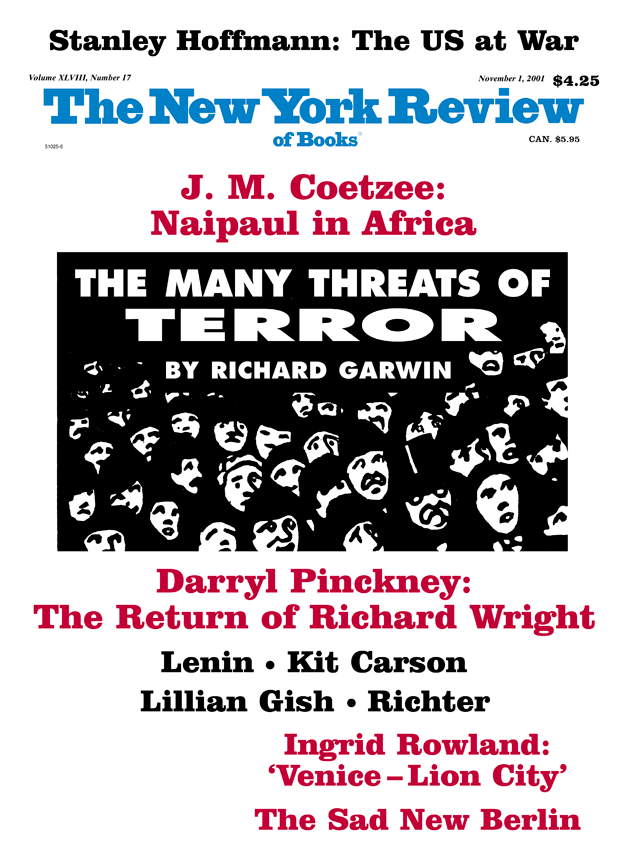
November 1, 2001
This Issue
November 1, 2001
-
1
“What Can and Should Be Done?” America, October 8, 2001. ↩
-
2
See “The US and International Organizations,” in Eagle Rules?, edited by Robert J. Lieber (Prentice-Hall, 2001), pp. 342–352. ↩
-
3
See Philip C. Wilcox Jr., “The Terror,” in The New York Review, October 18, 2001, p. 4, and Joseph S. Nye, “Defending our Homeland,” The New York Times, September 25, 2001, p. 29A. ↩