1.
At the climax of Oscar Wilde’s comic masterpiece, The Importance of Being Earnest, we learn that a baby has been mistaken for a book. Until that improbable revelation, however, the play—Wilde’s wicked exposé of the artificiality of conventional morality, and his one unequivocally great work—is concerned less with procreation than with recreation. Earnest follows two fashionable young heroes, Algernon Moncrieff and Jack Worthing, as they lead elaborate double lives, complete with false identities and imaginary friends, that allow them to seek unrespectable pleasures while presenting a respectable face to their local societies: London for Algy, whose fictional invalid friend, Bunbury, provides frequent excuses to escape to the countryside; Hertfordshire for Jack, whose assumption of a fictional identity of his own (that of a ne’er-do-well brother named Ernest) allows him to misbehave in town.
Those artificial façades start crumbling when both men fall victim to natural impulses. Jack has fallen in love with Algy’s cousin, Gwendolen Fairfax, and Algy becomes besotted with Jack’s young ward, Cecily Cardew, during a mischief-making visit to Jack’s country house. (He arrives pretending to be the black-sheep brother, Ernest—which is just as well, since Cecily, like Gwendolen, has always yearned to marry a man named Ernest—and Jack can’t expose Algy without exposing himself.)
But Jack’s matrimonial aims are seriously impaired by the fact that he has no pedigree. As he sheepishly reveals during an interview with Gwendolen’s mother, the formidable Lady Bracknell, he was discovered, as an infant, in a large handbag in the cloakroom in Victoria Station, and subsequently adopted by the kindly gentleman who found him.
Just how the baby got into the handbag is revealed in the play’s final moments, when it evolves that Miss Prism, the tutor currently employed by Jack to educate Cecily, was once a nursemaid in the employ of Lady Bracknell’s sister—the same nursemaid who’d gone for a promenade with Algy’s elder brother twenty-eight years ago and subsequently disappeared, along with her charge. As the shocked company looks on, Prism describes how, “in a moment of mental abstraction,” she had switched the baby she was taking care of and the manuscript of the novel she was writing, placing the former in her handbag, which she deposited in the railway station cloakroom, and the latter in the pram, which she took for a stroll. On realizing that she’d lost the baby, Miss Prism fled London and never returned.
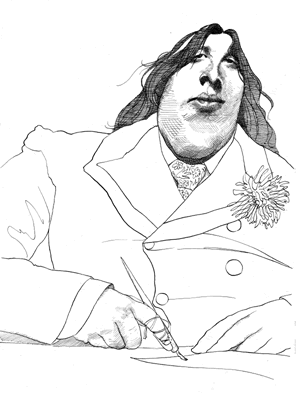
Miss Prism’s inability to distinguish between a human being and a work of fiction may have been the result of mental abstraction, but for Oscar Wilde, the conflation of life and art was always deliberate. The result, for us, is that it has never been easy to separate how Wilde led his life—particularly his personal craving for notoriety—from his aesthetic and creative impulse to subvert. As early as the 1870s, before he’d left Oxford for London, the Dublin-born student of both Pater and Ruskin was playing the young artiste with a flair for self-promotion that caught the attention of the wider world: the character of Bunthorne in the Gilbert and Sullivan operetta Patience was based on him; his post-collegiate debut as a public figure was at the splashy opening of the new Grosvenor Gallery, which the twenty-two-year-old Wilde attended in a coat cut to look like a cello.
Not everyone was seduced by the precocious youth and his attention-getting shenanigans. “What has he done,” the actress Helen Modjeska complained, “this young man, that one meets him everywhere?… He has written nothing, he does not sing or paint or act—he does nothing but talk.” Nonetheless, Wilde had become sufficiently famous as a proponent of Aestheticism by his mid-twenties that he went on a two-year lecture tour of the United States, during which he gave tips to the colonials on how to make life more aesthetic. “The supreme object of life is to live,” went Wilde’s refrain. “Few people live.”
By “living,” Wilde in his Aesthete mode meant living beautifully, down to the last detail. Despite its apparent superficiality—or indeed, because of its apparent superficiality—the insistence that every aspect of lived life be exquisite and unconventional was part of a philosophical and artistic project of subversion; the emphases on surfaces, appearances, and style flew in the face of conventional middle-class Victorian sensibility, with its leaden earnestness and saccharine sentimentality. This creed was intended to be a red flag waved in the face of bourgeois society, and was understood as such by those sophisticated enough to see what he was up to. (“So much taste will lead to prison,” Degas murmured while Wilde visited Paris just before Earnest opened early in 1895.)
Wilde’s life was intended to be a demonstration of his artistic philos-ophy—was intended, that is to say, to seem like a work of art. The self-consciously dandyish clothes, the flowing locks that he wore provocatively long, the promenades down Piccadilly holding a lily, the unconventional all-white décor in the house at 16 Tite Street, where he eventually lived with his wife, Constance, and their two children, and which, like the famous blue china that adorned his Oxford rooms, was the subject of much comment; the polished epigrams he kept in a notebook at the ready (“you have a phrase for everything,” a disapproving Walter Pater scolded him): all these suggested that there was not a little truth in that famous claim to Gide, one that—typically of Wilde, for whom “a truth in art is that whose contradictory is also true”—assumed a distinction between art and life even as it sought to blur that distinction. “I have put my genius into my life,” he declared. “I have only put my talent into my works.”1
Advertisement
The statement was probably true of everything except Earnest. Even at Oxford, where he showed extraordinary promise as a Classics student, it was clear that Wilde saw his intellectual gifts as a passport to celebrity; that he happened to be brilliant enough to earn fame in any number of honorable ways was merely a means to an end. “God knows,” the young Magdalen graduate replied, when asked what he wanted to do after university. “I won’t be a dried-up Oxford don, anyhow. I’ll be a poet, a writer, a dramatist. Somehow or other I’ll be famous, and if not famous, notorious.”
He got everything he hoped for. Like many Victorian youths who had a literary bent and a restless nature, Wilde set out to be a poet. His early efforts were not without some success: he won the prestigious Newdigate Prize at Oxford with a poem called “Ravenna.” Yet for all their surface dazzle and facility, and despite a patent eagerness to shock with “decadent” material—in “Charmides” a youth makes love to a statue of Athena, who takes predictably severe revenge—Wilde’s verse was always studied, and now seems dated, lacking the epigrammatic crispness and fluency of his prose, which by contrast seems surprisingly modern. (Punch dismissed his first volume of poems as “Swinburne and water.”) Pater had sensed early on that Wilde’s real voice was the sound of speech, not song: “Why do you always write poetry?” he chided Wilde. “Why do you not write prose? Prose is so much more difficult.” One answer was that it was as a poet that the young Wilde thought he could garner the most attention; his early career suggests he loved posing as a littérateur as much as he loved writing. “Pour écrire il me faut du satin jaune,” he announced; he insisted on writing the draft of his early play The Duchess of Padua on fabulously expensive stationery.
It was in prose that Wilde found his real voice, which was clearly that of a critic. The provocative titles of some of the essays—“The Truth of Masks,” “The Decay of Lying,” “The Critic as Artist”—suggest, in ovo, the scope and character of his future artistic and philosophical project, which Wilde’s biographer Richard Ellmann succinctly characterized as “conducting, in the most civilized way, an anatomy of his society, and a radical reconsideration of its ethics.” The most ambitious prose vehicle for that project was The Picture of Dorian Gray, which, for all its haphazard construction, still suggests—with its almost prurient and (whatever his post-facto demurs) never quite unadmiring portrait of beauty wholly divorced from morals—why Gide could have thought of Wilde as “the most dangerous product of modern civilization.” That judgment may seem excessive to our modern ears, but in the wake of Dorian—and of Wilde’s French-language drama Salomé, written at the same time and characterized by the same self-conscious desire to shock by means of decadent sexuality—it would have seemed quite justifiable. “Since Oscar wrote Dorian Gray,” Constance Wilde sighed in 1890, when her husband’s novel was being denounced as decadent and immoral, “no one will speak to us.”
Five years later, people weren’t merely speaking to Wilde, they were begging for him. By then, it was evident that even Dorian Gray, with its famous inversions of substance and reflection—of life and art—hadn’t been the ideal vehicle for his gifts; Wilde himself knew perfectly well he wasn’t really a novelist. “I am afraid it is rather like my own life—all conversation and no action,” he said of Dorian Gray. But what is a weakness in a novel can be a strength in a play. Helen Modjeska had been prescient: Wilde was, at bottom, a great Irish talker, and his true métier, as the course of his career would soon demonstrate, was dialogue—real dialogue, rather than the rococo verses he’d put in the mouths of his early characters. It’s the voice of Wilde the brilliant talker—amusing, incisive, economical, wicked, feeling, fresh, contemporary, right—that you hear in the plays. (And in the letters, too, which have the same quality of intellectual vivaciousness and delightfulness of expression that his best dialogue has.2 ) It wasn’t until he allowed that real-life voice to be heard in his work that Wilde achieved true distinction in art as well as life, however briefly. “Talk itself is a sort of spiritualised action,” he declared in May of 1887, at a time when he’d begun writing down narratives and dialogues as a kind of training for his mature dramatic work, of which Earnest—with its razor-like epigrams and perfect inversions of the natural and the artificial, of life and art, of babies and books—was the most exquisite, and devastating, expression.
Advertisement
2.
Typically, the creative breakthrough marked by Wilde’s great comedy was deeply entwined with another, personal watershed: his authentic artistic self emerged into view at the same time that his authentic emotional self was being revealed. After being initiated into homosexual sex by the precocious Robbie Ross in 1886—Ross was seventeen, Wilde thirty-one—Wilde became increasingly involved in enacting the Greek love to which he’d always enjoyed alluding, even when he didn’t actually practice it. (He’d scandalized his fellow Oxford undergraduates by observing, of a school athlete, that “his left leg is a Greek poem.”) Wilde’s marriage had begun to unravel after his wife’s second pregnancy, which left him physically repelled: “I… forced myself to touch and kiss her…. I used to wash my mouth and open the window to cleanse my lips in the open air.” By the late Eighties and early Nineties, he was spending his free time first with Ross, and then, after their fateful 1891 meeting, with the pale-skinned, fair-haired Lord Alfred Doug- las—“Bosie.” And, soon after, with the telegraph boys and rent boys and other lower-class youths of the homosexual demimonde, whose company gave Wilde—the gay among straights, the Irishman among Englishmen—the delicious, gratifying thrill of danger: “like feasting with panthers.”
Wilde’s consummation of his Hellenic urges, after such a long courtship, put an end to all kinds of unresolved tensions. The art/life dialectic that Wilde made the basis of so many of his on- and offstage pronouncements was just one of many that structured his life and work; temperamentally, he preferred to hesitate between such poles rather than commit to either one. Just as he had hovered endlessly on the verge of conversion to Catholicism as an undergraduate, just as he could never quite choose between Ruskin’s moralistic aesthetics or Pater’s pagan “gem-like flame,” he had vacillated, from his earliest youth, between the classical and the medieval, the Greek and the Gothic. Between, that is to say, the form, the style, the profane “sanity” of his beloved Greeks on the one hand, and religious feeling combined with Romantic exaltation on the other. One of the things that “Ravenna” is about is, indeed, the keenly felt tension between the Hellenic and the Gothic; its narrator wobbles between ecstatic apostrophes of Greece (“O Salamis! O lone Plataean plain!”) and invocations of Gaston de Foix and “huge-limbed Theodoric, the Gothic king.” “To be Greek one should have no clothes: to be mediaeval one should have no body: to be modern one should have no soul,” he wrote. But it was to the Greeks that he eventually returned.
It is tempting to read Wilde’s “anatomy of his society”—his “radical reconsideration of its ethics” by means of a playful reordering, even deconstruction, of key terms—as the product of his Greek rather than his Gothic side; Hellenism was the rubric under which his intellectual and emotional passions could, for once, coexist in peace. In an essay he wrote at twenty-five for the Oxford Chancellor’s Prize, he entwines style, illicit sexuality, and the classical exaltation of form above all things:
The new age is the age of style. The same spirit of exclusive attention to form which made Euripides often, like Swinburne, prefer music to meaning and melody to reality, which gave to the later Greek statues that refined effeminacy, that overstrained gracefulness of attitude, was felt in the sphere of history.
Wilde identified the Greek aesthetic as “essentially modern,” and inasmuch as he, in his Greek mode, became the first popular modern writer to attempt to divorce aesthetics from morality, he was accurate. The Wilde we love, the Wilde of the epigrammatic wit, the Wilde who so devastatingly skewers puffed-up convention by turning his fictive worlds inside out, is the pagan, the Greek Wilde. The forms with which we identify him today—epigram, satire, the conventionalized situational comedy—are classical forms. The Romantic Wilde, the deeply nineteenth-century Wilde, the Wilde of the cloying sonnets and the highly perfumed blank verse of early plays like Véra, or The Nihilists and The Duchess of Padua, we tend to ignore. It was—significantly—only after his disgrace, in the bitter, belated paroxysm that was eventually published as De Profundis, that Wilde (who’d once remarked that the chief argument against Christianity was the style of Saint Paul) championed spirituality in its traditional “medieval” forms, emphatically rejecting his erstwhile allegiance to classical style, to
the dreary classical Renaissance that gave us Petrarch, and Raphael’s frescoes, and Palladian architecture, and formal French tragedy, and St. Paul’s Cathedral, and Pope’s poetry, and everything that is made from without and by dead rules, and does not spring from within through some spirit informing it.
Indeed, even in the Wilde that we do treasure, particularly the three English-language plays that precede Earnest—Lady Windermere’s Fan (1892), A Woman of No Importance (1893), and An Ideal Husband (1895)—it’s clear that the author belonged as much to the dying century as he did to the one that lay ahead. The spirit of these works, which seek to subvert stuffy conventions, may look forward to the twentieth century, but the plays themselves are, essentially, clanking nineteenth-century melodramas, with their illegitimate births suddenly revealed, their plots that hinge on stolen jewels and letters, their eleventh-hour revelations. Even Wilde’s contemporaries were able to see this: after attending a 1907 revival of A Woman of No Importance, Lytton Strachey described the play to Duncan Grant as “a complete mass of epigrams, with occasional whiffs of grotesque melodrama and driveling sentiment…. Epigrams engulf it like the sea.” In almost every dramatic work but Earnest, we feel the two Wildes—the sentimental, “Gothic” Wilde, and the crisp, classical Wilde—at war. It was only in Earnest, with its improbable symmetries, its self-consciously toy-like, artificial characters, its bejeweled style, that he achieved the ideal “Greek” harmony in which form and content were entirely at one.
Still, if Earnest is a perfect vehicle for the expression of Wilde’s intellectual and aesthetic concerns, it can also be read as an allegory for the writer’s life—one that was torn between a hunger for acceptance and a flair for subversion. (“Le bourgeois malgré lui” was Whistler’s canny description of his one-time friend.) Like the drama of his life, much of the drama that Wilde wrote was concerned with the tension between the public masks we wear and the messy private impulses that they often hide; with sudden reversals of fortune and last-minute recognitions; with true natures—and true identities—ruefully revealed at the last minute.
This is particularly true of the two works whose debuts early in 1895 marked the apogee of his professional life and the onset of his personal disintegration: An Ideal Husband and The Importance of Being Earnest. The former premièred to delirious reviews in January 1895; the latter, on Valentine’s Day of the same year. Four days later, the marquess of Queensberry, Bosie’s father, left his famously misspelled calling card referring to Wilde as a “somdomite”; two months later, Wilde had been condemned for “gross indecencies.”
Unsurprisingly, both plays use the same structural devices (switched identities, long-buried secrets) and both treat identical themes (the catastrophic tensions between public and private selves), and yet they are radically different in tone, temperament, and style. An Ideal Husband seems, indeed, to belong to the nineteenth century, and looks backward to what we may call the “Gothic” Wilde. Its interest lies, if anywhere, in its imperfections: the famous epigrams (“To love oneself is the beginning of a life-long romance”) sparkle brightly, but are at odds with the melodramatic structure and patent sentimentality—and with overwrought passages in which the playwright seems to be using his characters as mouthpieces for personal concerns. When the play’s tortured main character, a man revealed to have a terrible secret in his past, addresses a series of lengthy, impassioned, and nakedly illogical pleas for sympathy to his wife—a woman whom he goes on to chastise for having insufficient sympathy for his flaws—it is impossible not to think of Wilde himself.
Earnest, on the other hand, has the elegance and efficiency of a theorem: in this case, a theorem about art and society. Here, significantly, all emotion, all feeling—all real “life”—have been purposefully pared away. With its nihilistic inversions of surface and content, attitude and meaning, triviality and seriousness, the play flashes and gleams dangerously like the scalpel it was meant to be, the instrument with which Wilde dissected Victorian ethics, thereby making twentieth-century aesthetics—an aesthetics divorced from false sentiment—possible.
3.
The story of the paradoxical process by which Wilde evolved from a poseur who put life before art into a real artist, from the composer of florid poems on ostentatiously lofty themes into the author of comedies whose flippancy concealed a serious intellectual and critical purpose, is a fascinating one. So it is a great irony that Wilde’s life story has come to overshadow his work in a way that has blunted our understanding of just what it is that made him an interesting artist. Today we think of Wilde as an icon of martyrdom in the cause of sexual freedom; and yet our seeming familiarity with him—our sometimes too-hasty sense that we know what he’s about, which happens to be something we’re interested in today—has dulled our appreciation of his creations. This is nowhere more apparent than in the recent film version of The Importance of Being Earnest. It was directed by the Englishman Oliver Parker, who also directed the 1999 film version of An Ideal Husband; in both films, a knowing familiarity with Wilde the icon has all too frequently transformed his artistic creations into the opposites of what they were intended to be.
In order to get The Importance of Being Earnest right—to convey the danger, as well as the delight, inherent in those artfully constructed double lives, danger and delight that Wilde himself knew so well, and which ultimately destroyed him—you need to maintain its artificiality, the self-conscious conventionality of form that the playwright uses to highlight his ideas about the artificiality of social and moral conventions. In Anthony Asquith’s flawless 1952 film version of the play, the director emphasizes the theatrical nature of his material: the movie opens with an image of people being seated at the theater, followed by the appearance of a title card reading, “Act 1. Scene 1. Ernest Worthing’s Room in the Albany.” The performances themselves—particularly those of Joan Greenwood as Gwendolen and Dorothy Tutin as Cecily—are shaped to be as robotic as possible. The young women tinkle their slyly nonsensical lines (“Mamma, whose views on education are remarkably strict, has brought me up to be extremely short-sighted”) like the wind-up toys they are.
In his new film version of Earnest, by contrast, Oliver Parker does what many filmmakers do when translating plays onto celluloid, attempt to “open out” the work. This allows him to present many splendid images: of the grotesquely ornate residence in which Lord and Lady Bracknell live; of Jack’s impressive country seat, where Algy arrives by means of a hot-air balloon; and of Lady Bracknell’s awesome hats, which appear to have been constructed in an aviary. But film’s inherent tendency to naturalize what it shows us works, if anything, against the grain of the play—as does the inevitable tendency of film to translate into images motifs and ideas that are conveyed on stage by means of words. The latter is particularly unfortunate when treating the work of a great talker; the visual temptations of film make nonsense of some of Wilde’s sharpest and best-known lines. “I never travel without my diary,” Gwendolen says with glacial sweetness on meeting Cecily at Jack’s country house. “One should always have something sensational to read in the train.” Parker’s film makes you wonder just when she gets to read that famous document, since in this version she prefers to motor down from London in a clanking automobile which she can barely keep on the road. This makes for visual interest, but dampens the comic point.
It may be that the purpose of showing Gwendolen’s perilous drive is to demonstrate her independence of mind. (Parker writes in a scene in which we see her having the name “Ernest” tattooed on her derrière.) But, of course, Gwendolen has no “mind,” or at least not in the sense Parker thinks she does. The most salient aspect of Gwendolen’s character is, if anything, her artificiality of mind: it is her and Cecily’s inane, lifelong yearning to marry men named “Ernest” that drives the perverse action of the play, forcing both Jack and Algy to maintain their elaborate double lives as Ernests.
Indeed, Parker’s eagerness to give his characters inner lives often means that his direction is at odds with the directions Wilde provides. Like all of Earnest’s females, young Cecily is as tough as nails beneath an elaborate, doll-like politesse; this is part of Wilde’s satire of contemporary expectations that high-born girls be hothouse flowers. Jack understands his creator’s important point, and goes so far as to articulate it—one of the rare moments in the play when a character says, and means, something that happens to be true: “Cecily is not a silly, romantic girl, I am glad to say. She has got a capital appetite, goes on long walks, and pays no attention at all to her lessons.”
Parker, however, has ideas of his own. His Cecily is the opposite of Wilde’s—a dreamy young thing who, during long, beautifully photographed fantasy sequences, imagines herself as a misty Burne-Jones heroine, decked out in medieval gowns while tied to a tree awaiting rescue by hunky knights. Wilde’s point is that contemporary artistic fantasies of young maidenhood run counter to some tough natural truths; Parker’s joke is that—well, there is no joke.
Of course, the two young women are merely embryonic versions of the most artfully constructed of all of Wilde’s females, Lady Bracknell, that epigram- breathing dragon of self-assurance. Like all great humor characters, she is utterly without a past or future, without motivation or reason of any kind: like the mandarin systems of class and taste and privilege that she represents, she merely, monstrously, is. Parker, however, gives her a sordid past as a lower-class showgirl who (as we see in a flashback) entrapped Lord Bracknell into marriage by getting pregnant—a scenario as unlikely as it is, ultimately, unilluminating. However clever, such details undermine the entire nature of Wilde’s dramaturgy, which always proposes as being quite “natural” that which is the most artificial of motivations, and vice versa.
Parker’s failure to understand the structures and meanings of Wilde’s play is clearest in his direction of the final scene—the dénouement in which Miss Prism tells all, and all ends happily. At the end of the play, after it is established that Jack is the long-lost child of Lady Bracknell’s sister—and hence Algy’s brother—there is a frantic scrambling to find out what his real given name had been. (Remember, Gwendolen will only marry an “Ernest.”) All that Lady Bracknell can recall was that the child was named for its father, the late General Moncrieff, whose first name she can no longer remember. Jack eagerly consults the Army Lists, where he triumphantly discovers that his dead father’s name was Ernest John, and hence that both his real and his assumed names are, in fact, “true”—so that Jack has been both Ernest and “earnest” all his life. “It is a terrible thing,” he declares at this revelation, “for a man to find out suddenly that all his life he has been speaking nothing but the truth.” It is this discovery that prompts his newfound aunt’s withering final observation: “My nephew, you seem to be displaying signs of triviality.” The disdain she evinces for the discovery of this authentic “Ernest” mirrors Wilde’s disdain for all that is “earnest.”
Bizarrely, Parker contorts this concluding moment, with its typically Wildean condemnation of earnestness, into its exact opposite. In his Earnest, we see Jack’s finger going down the list of entries in the Army Lists and landing on the name “Moncrieff,” but the first name here is “John”; nonetheless—in order to win the hand of Gwendolen—he tells everyone that his late father’s name was Ernest. Lady Bracknell sees the deceit, but still goes on to make her disdainful closing remark about her nephew’s “signs of triviality,” with the result that in this version, her barb is directed not at Jack’s “earnestness,” but at his deceitfulness. For her to condemn the deception doesn’t merely miss the point, it inverts it: Parker’s film implicitly endorses the conventional morality that the play—a drama, let us not forget, by the author of “The Truth of Masks” and “The Decay of Lying”—so hilariously lampooned.
4.
The reasons for Parker’s failure—the reasons his Earnest is cute rather than lethal—are not hard to locate, and may best be understood by comparing two other films having to do with Wilde. Like the two film versions of Earnest, one dates from the Fifties and one is very recent; both are biographies of Wilde himself. The 1959 Ealing Studios picture Oscar Wilde, starring Robert Morley as the corpulent Wilde and Ralph Richardson as his forensic nemesis, Sir Edward Carson, dwells on Wilde’s tragedy. Nearly a third of this movie—which came out when Regina v. Wilde was still a living memory for some people—is devoted to the trials, the almost Greek-tragic climax of which was one small comment made by Wilde during the course of his cross-examination. Asked whether he’d kissed a certain boy, Wilde disdainfully replied that he had not, as the boy in question was “singularly plain.” This, we now know, was the turning point of the trial: by suggesting that Wilde would have kissed the boy had he been pretty, it gave Wilde’s foes the ground they needed to condemn him.3 In a final, terrible failure to distinguish between reality and art, Wilde’s need to perform, to amuse the spectators, came at the cost of his freedom—and, eventually, his life.
The film ends, as Wilde’s life did, ignominiously, with a drunken Wilde drinking absinthe in a French bar, cackling dementedly to himself. If the film focuses on the tragic repercussions of Wilde’s actions (“Why did I say that to Carson?” he cries), it does so no more than Wilde did himself. “I thought life was going to be a brilliant comedy,” Wilde wrote from prison to Bosie in the immensely long, tortured letter of recrimination (and self-recrimination) that became De Profundis. “I found it to be a revolting and repellent tragedy.”
Brian Gilbert’s 1997 film Wilde, by contrast, ends not in defeat but in erotic victory. By the time Gilbert made his film, anyone who remembered the sordid reality of Wilde’s humiliation and defeat had died; living memories had been replaced by a political and cultural need to see Wilde purely as a martyr—not as a self-destructive hero-martyr, in the Greek-tragic mold that Wilde would have understood, but as a wholly passive victim, a role that erases everything interesting about what happened to him from a moral and psychological point of view. (You wonder how many people recall that it was Wilde, in a moment of monumental delusion, who sued Queensberry for libel; it was during his prosecution that it was revealed, in a way that the earlier film showed but the more recent one does not, that the marquess’s “libel” was true.)
Gilbert’s biopic is intended above all as a celebration of “the love that dare not speak its name”; only a few moments are devoted to the trials—presumably because we all take for granted that Wilde was the hapless victim of Victorian sexual hypocrisy. This film ends not with the end of Wilde’s life, but with his reunion with Bosie in Italy after his release from prison. As Wilde stands in a sunlit piazza, the beautiful face of Jude Law, who plays Bosie, comes into view, smiling ecstatically. Freeze-frame, then credits. This puerile moment isn’t so much misleading as dishonest. In real life, as we know, the grossly mismatched love between what Auden called “the underloved and the overloved” failed miserably to conquer all, and the awful squabbles between Wilde and the dreadful Bosie continued, as did the terrible arguments about money.
You can’t understand why Wilde was important, and you certainly can’t understand why Earnest is great, without recognizing the aspect of danger and tragedy that lurked beneath the glittering surface of his best comic creation—and of his life. Wilde the classicist understood that the flip side of Earnest, with its misplaced baby and last-minute recognitions between near relations, was Oedipus Rex. The stylistic master of dualities, of truths that were also their own opposites: in order to do justice to Wilde, to both the life and the art, we must always strive to see not only the exaltation but the humiliation, not only the pathos and suffering but the hubris and arrogance, not only the dazzling clarity of vision about the flaws in his society but a penchant for self-deception that suggested a profound self-destructiveness, not only the beauty but the peril. Wilde himself saw it all too clearly, if too late: an intricate appreciation of the complex and often deceptive relationship between things as they really are and things as we wish them to be is, after all, the whole point of his final work for the stage.
The recent film biography’s failure to understand what Wilde’s life was about is mirrored, in Parker’s film of Earnest, by a failure to understand what his art was about. Both movies are characterized by a certain familiarity, a certain presumptiveness, about who Wilde was and what he meant. It’s significant that Parker’s direction constantly underscores the most famous witticisms and inversions of the normal (“her hair has gone quite gold with grief”) with intense close-ups—the cinematic equivalent of winking. Parker isn’t doing Wilde; he’s doing “Wilde.” Our own need to see Oscar Wilde as one thing only—as a cartoon martyr, as the poster boy of a modern-day movement—has dulled our vision, and reduced Wilde, both as a man and as an artist. In an irony that Wilde himself would have appreciated, we have all become too earnest to do Earnest.
This Issue
October 10, 2002
This Issue
October 10, 2002
-
1
Quoted in Colm Toíbín’s excellent and sympathetic recent essay, “Oscar Wilde: Love in a Dark Time,” in Love in a Dark Time: Gay Lives from Wilde to Almodóvar (Scribner, 2002). ↩
-
2
See the superb recent edition edited by Merlin Holland and Rupert Hart-Davis, editors, The Complete Letters of Oscar Wilde (Holt, 2000). ↩
-
3
The organizers of the British Library exhibition “Oscar Wilde, 1854–1900: A Life in Six Acts,” which opened late in 2000 and subsequently traveled to the Morgan Library in New York City, also realized this point: the exhibition featured a copy of the official court transcript of Wilde’s trial, opened to the page on which this crucial remark appears. Queensberry’s calling card was also on display. ↩