
1.
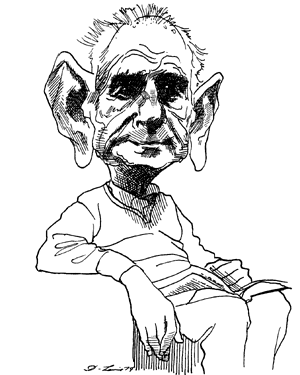
Karl Popper, who died in 1994, was one of the most influential philosophers of the twentieth century—as much outside the profession of philosophy as within it (Chancellor Helmut Schmidt, Sir Peter Medawar, and Sir Ernst Gombrich were ardent Popperians). An emigrant from Vienna in 1937, who had fled the Nazis, Popper spent his early academic years in New Zealand before obtaining a post at the London School of Economics in 1945, where he taught until he re-tired. (Popper’s early years are comprehensively covered in Malachi Haim Hacohen’s The Formative Years.) Polymathic, prolific, strong-willed, he made his mark in both the philosophy of science and political philosophy, later developing distinctive views in the philosophy of mind and even Greek philosophy.
His initial philosophical impetus came from the Vienna Circle, a group of scientifically inclined philosophers and scientists who flourished in the interwar years and who espoused the philosophy that came to be known as “logical positivism”—a view best defined as against religion and traditional metaphysics and for empir-ical science (A.J. Ayer’s Language, Truth and Logic introduced this philosophy to the English-speaking world in 1946). However, Popper said that he diverged profoundly from the Vienna Circle, particularly over the nature of scientific method: while they took empirical verifiability as the touchstone of science (and hence intellectual respectability), Popper took the notion of falsification as the essential mark of scientific discourse. This key idea was to have a large impact on the philosophy of science, as well as on the whole issue of what constituted reputable discourse. The recent books devoted to Popper attest to the vitality of the ideas he introduced.1 While not being a guru within the narrow confines of analytical philosophy, when compared, say, to Wittgenstein, he continues to be a major intellectual figure in the world beyond.
There is an impressive and attractive unity to Popper’s thought. In his philosophy of science, his general theory of knowledge, his philosophy of biology, and his political philosophy the same basic ideas recur. For Popper, everything revolves around the solving of problems by means of the critical elimination of attempted solutions. In “The Logic and Evolution of Scientific Theory,” the first essay in the aptly named All Life Is Problem Solving, a collection of his later lectures and essays, Popper offers us a three-stage model of learning, which he takes to apply to animal learning as well as to the upper reaches of scientific research: first there is the problem (Popper is very fond of the emphatic use of italics); then there are the attempted solutions; finally there is the elimination of those solutions. Epistemic progress works by trial and error.
In the case of scientific knowledge this three-stage model assumes the familiar Popperian form: the scientist is confronted by a problem in accepted theory, occasioned by a faulty prediction or explanatory weakness, which leads to the need for a new theory; she generates, by means of imaginative creativity, a range of conjectures or guesses as to what might be a preferable theory; she then sets about trying to falsify these conjectures, until only one is left standing. In this way objective scientific knowledge grows.
According to Popper it is not that scientists work by observing the world, performing inductive inferences, and confirming hypotheses, which then get added to the stock of permanent truths. Science does not begin with observation at all, but with problems. Theories are not derived from data by some inference such as induction (if you observe a number of white swans you are entitled to infer that all swans are white), but rather are the free products of human creativity; and scientists do not confirm or verify hypotheses, but refute them. Scientific knowledge is essentially negative: what we know is that certain conjectures are not true—those that have been falsified; we never have any positive reason to believe a hypothesis, since confirmation is not what science is about.
Induction, for Popper, is simply logically invalid, since you cannot infer that all swans are white merely from having observed that all the ones you have come across are; and anyway induction is not actually used by scientists. The best we can say of a theory is that it has not (yet) been refuted. Thus there is no room for dogmatism in science; modesty is the only sensible attitude. Science consists of conjectures that have not been rejected, not of accepted facts derived from observation of the world.
Popper suggests that this three-stage process has its counterpart in the behavior of organisms:
At bottom, this procedure [the falsifying of attempted solutions to problems] seems to be the only logical one. It is also the procedure that a lower organism, even a single-cell amoeba, uses when trying to solve a problem. In this case we speak of testing movements through which the organism tries to rid itself of a troublesome problem. Higher organisms are able to learn through trial and error how a certain problem should be solved. We may say that they too make testing movements—mental testings—and that to learn is essentially to try out one testing movement after another until one is found that solves the problem. We might compare the animal’s successful solution to an expectation and hence to a hypothesis or a theory.
The difference between the amoeba and Einstein, Popper says, is that the latter organism uses the critical method: arguments are expressed in language and subjected to self-consciously critical scrutiny. Thus science is a rational enterprise, engaging an objective world of reasons, argument, and truth (what Popper calls “World 3”). But in basic structure the scientist is as much a trial-and-error learner as the amoeba; the three-stage model is a biological universal. Moreover, Popper argues, this model applies also to Darwin’s theory of evolution. The species encounters a problem of adaptation as a result of a change in the environment; it needs to evolve genetically or become extinct. Mutations spontaneously occur, which in Popper’s view function as possible solutions; most are fatal to the organism in question, which is then eliminated. But a mutation may prove resistant to elimination, and hence come to characterize the species—until a new problem of adaptation comes along. A mutation is like a new conjecture that invites refutation; natural selection consists in the elimination of bad conjectures. Biological evolution is just more conjecture and refutation, bold stabs in the dark followed by summary ejection. But this seemingly negative process produces magnificent results—just as it does in science.
Advertisement
Even in politics Popper applies the same template. The “open society” is one that invites and encourages critical discussion: there are no inviolable ideologies, like Marxism, only a plurality of perspectives, each subject to critical evaluation. The essence of democracy is not “rule of the people” whereby government decisions reflect the collective will, but rather the possibility of (peacefully) removing a government that does not stand up to critical appraisal—as it were, falsifying the policies pursued by the government. Hitler and Stalin were, among other things, dogmatic ideologues in the grip of theories they made no effort to falsify, and they produced governments in which criticism and peaceful replacement of a government were not tolerated.2
The open society is like a scientific conference in which everyone is critical of his own current conjectures, and helpfully critical of others, and in which authority can be transferred according to general consent. Peace and happiness result from a willingness to admit error, from an accepted fallibility. The Cartesian ideal of secure foundations, unquestionable certainty, is not only a philosopher’s mistake; it is, for Popper, the root of the dogmatism that produced the worst excesses of the twentieth century. We should not be trying to arrive at beliefs that can be guaranteed to be true, but rather freely creating conjectures that we are keen to see refuted. Detecting error is the primary virtue, not proving truth.
There is in the sweep of these ideas a large vision, both romantic and hardheaded, that can be captivating: the scientist as a bold adventurer, living out his biological destiny, bringing his open-mindedness and free creativity to a confused and oppressed world—who can fail to be touched by such an image? These ideas produce an exhilaration akin to that produced by the Vienna Circle, with whom Popper had a troubled relationship. The members of the Vienna Circle, too, were politically liberal and impressed with science as a model of all that is good and noble. They were also much concerned with the nature of scientific method. Once scientific method was properly understood, and this method applied across the board, we should, they thought, be able to liberate ourselves from pseudo-science, dogmatic religion, and political ideology, thus opening the way to a free and open society.
This ideal—science as the model of civilization and genuine knowledge—Popper fully shared, but he also took himself to have demolished logical positivism. There are two main reasons for this. First, he thought he had shown that science does not proceed by verifying hypotheses, as by observing a number of white swans and concluding that the hypothesis that all swans are white is true; indeed, he thought he had shown that there is no such valid form of reasoning—since induction is logically indefensible (you can’t derive an “all” from a “some”). Rather, science proceeds by falsification, which is logically impeccable, since the observation of a single black swan decisively refutes the hypothesis that all swans are white.
Secondly, the positivists took empirical verifiability, the apparent confirmation of a hypothesis by experiment and observation, to mark the boundary between sense and nonsense, so that traditional metaphysical questions such as whether God exists or time is real are strictly meaningless—a result they enthusiastically welcomed. Popper, by contrast, took his falsifiability criterion as marking the line between what was science and what was not—with no imputation that the empirically unfalsifiable lacked all sense. Therefore metaphysical issues—such as the question of whether the mind is separate from the body or whether numbers are independent of the mind—are meaningful and pursuing them was a potentially worthwhile enterprise. Psychoanalysis for Popper was also meaningful, but he declared it a pseudoscience because he did not believe its propositions could be subjected to falsification.
Advertisement
Popper’s divergences from the Vienna Circle should not be exaggerated, however, despite his frequent protestations that he was not at all a positivist. He is still proposing as a mark of science a criterion that stresses empirical testability—but for him the tests aim at the empirical rejection of theories instead of showing their empirical acceptability. And the difference in their views of the status of what lies outside science is not in practice as great as it might appear: for Popper, too, took his criterion as having a normative dimension—to wit, that what failed it was less respectable than real science. Hence his assault on Marxian and Freudian theory as pseudosciences—bodies of thought that should not be taken seriously. Popper’s entire outlook falls squarely within the general frame laid down by the Vienna Circle.
2.
There is an odd irony here, concerning Ludwig Wittgenstein. In Wittgenstein’s Poker, a lively, well-written work of philosophical biography, David Edmonds and John Eidinow set out to compare and contrast Popper and Wittgenstein, both Austrian expatriates, living mainly in England, each dominating and influential, yet with very different philosophical styles and backgrounds (Wittgenstein from a family of very rich industrialists of Jewish background, Popper the struggling bourgeois). The authors center their story on an incident in which Wittgenstein may or may not have threatened Popper with a poker during a heated meeting of the Moral Science Club in Cambridge, at which the nature of philosophical questions was under discussion. (In Popper’s much-disputed version of what happened, Wittgenstein demanded a statement of a moral principle and Popper replied, “Not to threaten visiting lecturers with pokers,” whereupon Wittgenstein left the room.) The authors tell of Popper’s obsession with Wittgenstein’s philosophical prowess and Wittgenstein’s lofty indifference toward Popper—and of their contrasting views of what the job of a philosopher should be. For Wittgenstein it was to dissolve conceptual puzzles generated by the misuse of language; for Popper, it was to solve genuine theoretical problems about reality.
They also report extensively on the relations of both philosophers to the Vienna Circle. While Popper was barely tolerated by its members, Wittgenstein was hailed as its presiding genius and guiding light—though he seldom deigned to attend their meetings. Wittgenstein’s Tractatus, published in 1921, had laid the philosophical and logical foundations of positivism, at least in the eyes of the Circle, by providing a theory of what could meaningfully be said. The irony in this is that Wittgenstein’s doctrines in that book, and even more so in his later work, were radically at variance with the views of the Circle—far more so than Popper’s ever were. For Wittgenstein rejected their denigrating of what lies outside the strictly meaningful and scientific—such as ethics, aesthetics, and religion. So Popper, the self-styled slayer of positivism, was much more of a positivist than the philosopher taken to have provided the inspiration for positivism.
Wittgenstein did, it is true, divide discourse into what can be “said”—i.e., what can depict an object or possible combination of objects—and what cannot be said; but what cannot be said, he argued, could nevertheless be “shown” in his own technical sense of the word. Roughly, he was referring to thought that can reveal itself in language but cannot be stated in explicit, rigorous propositions that picture a fact. Wittgenstein took such thought—including ethics, aesthetics, religion, much philosophy itself—to be at least as important as what can be literally said—principally natural science and history. There is no attempt in the Tractatus to discredit what cannot be said but only shown; indeed, the realm of the showable is accorded great respect. (No doubt this is why when Wittgenstein attended the Circle’s meetings he would turn his back on those present and read poetry to them.)
The positivists simply misunderstood Wittgenstein, adapting him to their purposes (there isn’t even a commitment to the verificationist theory of meaning in the Tractatus). Wittgenstein never idolized science in the manner of the positivists—or in the neo-positivist manner of Popper. Indeed, for Wittgenstein, one of the great dangers of the age was the prestige associated with science, along with the idea that science was the model of all responsible inquiry.
3.
What should be said of Popper’s ideas? How well do they hold up? Two central Popperian doctrines are surely correct: that, contrary to the empiricist tradition, scientific theories are not derived in any simple or mechanical way from observations, but are creative products of the human intellect; and that criticism, especially self-criticism, is an important feature of science—the attempt to find fault with even our most successful theories. But these undoubted insights are consistently exaggerated by Popper, thus producing a distorted picture of scientific practice. First, there is his wholesale rejection of induction as a type of reasonable inference. It is, of course, true that the inference from “all the swans that have been observed are white” to “all swans are white” is not deductively valid, since it is logically possible that some unobserved swans are black (or pink or yellow, or flightless, or not subject to gravity); but, as many critics have insisted, this does not show that induction is not a reasonable form of inference—it is just not a form of deductive inference.
Induction isn’t deduction—so what? Granted, there is a skeptical problem about induction (can it be given any non-question-begging justification?), usually credited to Hume; but there are also Humean skepticisms about the external world, other minds, the past, and anything else that is not deductively provable. Hume despaired of rationally establishing the existence of an objective world beyond our perceptions. Why then is Popper not a skeptic in these other matters? What’s so especially bad about induction? As Hume himself recognized, we use induction all the time, and it is hard to see how we could avoid using it: we assume that the future will be like the past, that the laws of nature will not change, that bread will nourish and fire burn. Popper’s distrust of induction seems to be an overreaction to an abstract skeptical problem about inferring the future from the past—as if only a reason for belief that produces cast-iron certainty could be a reason at all.
But there is a worse problem for Popper’s philosophy: he is committed to inductive verification himself. Suppose we are testing the hypothesis that all swans are white: we come across what we think is a falsifying instance—an apparent black swan. In order to use this instance to reject the generalization we need to be convinced that we are indeed confronted by a genuine black swan. But this means that we need to verify that a black swan is really before us. This is an act of verification, not falsification, and it requires that we make an inductive inference, since the hypothesis that this animal is a swan itself implies all sorts of things about its anatomy, evolutionary history, and future behavior. We only count it a swan on the basis of inductive generalizations about swans—that they have long necks, feathers, and a distinctive squawk. There are many inductive consequences of its being a swan, and these must be taken to be verified before we can be convinced that we really have a swan that isn’t white—as opposed to something that merely looks like a swan.
Popper might reply that the statement “this is a black swan” is itself a conjecture, which can be falsified but never verified; but then we have lost the sole point of empirical purchase on scientific theories, since now we will just have one conjecture versus another. We have to know that “this is a black swan” is true before we can use it to reject “all swans are white”; the mere logical inconsistency of the two statements gets us nowhere. But then, contrary to Popper, we have to be able to verify statements that have inductive consequences.
Consider, too, that falsifying experiments have to be repeatable so that other researchers can duplicate the alleged finding. We have to be able to infer that if a falsifying result has been found in a given experiment it will be found in future experiments; without this science would be hobbled. But this is clearly an inductive inference: if you repeat the experiment, you will come up with the same falsifying result. If a theory predicts that mixing two chemicals together will produce a particular chemical reaction, and this reaction does not occur, we normally take it that it will not occur if the experiment is repeated; but this is plain and simple induction. If the reaction started to occur in future experiments, contrary to the initial experiment, we would infer that there was something wrong with the initial experiment: so falsification needs to be inductively justified if it is to serve as a means of testing theories.
It is generally so justified, of course, but this is not something that Popper can consistently incorporate into his conception of science. The simple fact is that induction is deeply embedded in science and common sense, and there is no convincing reason why we should declare it irrational. An adequate account of scientific method would recognize both verification and falsification as necessary procedures, not insist on one at the expense of the other. And there is something contrived and artificial about setting up an opposition here: for falsifying a statement is equivalent to verifying its negation. If I make an observation that falsifies the statement that Jones is in the next room (I go there and have a look), I thereby verify the statement that Jones is not in the next room. A reason to reject a statement is a reason to accept its negation; so it cannot be that rational inquiry consists solely in the rejection of statements. Some statements we reject as false; others we accept as true: it is perverse to try to build a model of knowledge in which only the former ever happens.
This criticism is connected with two other questionable Popperian theses. One is that science does not consist of established facts but of tentative conjectures. This is exaggerated and partial at best: some of science is as solid as the plainest statement of fact, such as that London is the capital of England. It is not a tentative conjecture that water consists of H2O molecules or that, at sea level, it boils at 100 degrees centigrade: these are hard facts, if anything is. It is absurd to suggest that basic high school science consists of mere guesses that no one has yet managed to refute. The other Popperian thesis is that observation plays no role in the production of theories as opposed to their falsification, that all we ever do is freely conjure up imaginative problem-solving hypotheses that we go on to try to falsify. Take the old hypothesis that the earth is flat: clearly, people came up with this theory because it looks flat from where we are on its surface—just as it looks spherical from above the atmosphere. Perception sometimes suggests theories of the world, true or false. Of course, much theory goes far beyond what we can observe of the world, but it is wrong to suggest that science has no place for observation in suggesting theories. (Of course, as Popper would agree, observation has a role in testing theories once they have been put forward.) The best model of scientific practice we have is that we make observations and then try to come up with theories that explain these observations—as, for example, when we observe the ebb and flow of the tides and come up with the theory that the moon’s gravitation is what explains what we observe. Observation poses a question of explanation, and creativity gets to work to produce the needed theory.
Popper’s aim in proposing his criterion of falsifiability as a mark of science was to answer what he called the “demarcation problem”—the problem of distinguishing science from nonscience. Does this criterion work? The intuitive idea behind it is that if a theory cannot be tested we can have no reason to accept or reject it, since we have no way to decide whether it is true or false. This sounds reasonable enough, at first sight, but it raises thorny issues. Statements of mathematics can be falsified by the method of disproof, but Popper does not want to include mathematics as an empirical science; and the same might be said of philosophy, which also admits of refutation by means of discursive argument. So what Popper means is empirical falsification, not any kind of falsification. But what precisely is this special kind of falsification? The usual answer is falsification by experience. This is vague and open to question, but the important point is that now it is this notion of empirical experience that is doing all the work in demarcating science from nonscience, not the notion of falsification itself.
Furthermore, Popper’s criterion of falsification can still be applied to such subjects as history, language translation, and common-sense psychology. Historical statements can be falsified by the examination of records and other traces of the past; so history is a science by Popper’s standards. Similarly for statements about other people’s motives: there can be empirical evidence against an attribution of (say) greed to someone. But this doesn’t sound much like science: there isn’t enough in the way of laws of nature, rigor, and explanatory depth. So Popper’s criterion is not by itself sufficient to make something count as a science; what is missing is some notion of explanatory power and organized predictive theory.
But is it even a necessary condition for being a science? Here is where Popper’s positivist colors show: he is wedded to the idea that a statement can only count as scientific in content if we can somehow test its truth. This amounts to an epistemological test of reality: a statement can only be a true or false claim about the natural world if we can decide whether it is true or false. But what about statements concerning matters that human beings cannot investigate—for example, statements about the unknowable past or future, such as the prediction that “there will never be a city in the Sahara desert”? This is not like a statement about God or the immortal soul. It has a definite truth-value, whether or not we can discover what that is. Falsifiability reflects as much on our investigative powers as it does on the content of the statement in question. Popper’s criterion (like the positivists’ verifiability criterion) amounts to saying that a statement is scientific only if it happens to fall within our investigative capacities, as if the natural world were limited by our ability to know about it.
There is a more fundamental point: What exactly is the purpose of providing such a criterion anyway? There is a clear purpose if the aim is to denigrate and banish what fails the test, as the positivists aimed to do. But Popper claims that he is not doing that, since he is not in principle opposed to traditional metaphysical questions, as the positivists were. He is more than happy to assert the metaphysical doctrine that there is a third abstract world of numbers and theories over and above the physical and psychological worlds. The question threatens to turn into a verbal issue about how we are going to use the word “science” (a fairly recent coinage anyway). Matters are tolerably clear when we are branding what fails the test as pseudoscience, as with Marxism and Freudianism; but if what fails the test consists of statements that are not pseudoscience and have their own claims to be true—as with mathematics, Popper’s own metaphysical views—then there is nothing distinctively honorific about the label “science.” I think Popper would have been better off abandoning the question of what makes something a science and instead simply insisting on the difference between falsifiable and unfalsifiable statements: that distinction surely does matter, but it will count mathematics and metaphysics in the same category as physics and biology, since rational criticism and rejection can occur in mathematics and metaphysics—as Popper clearly believes.
The important question is what is worth debating, and this (for Popper) will be what is open to falsification—or, put more generally, to rational criticism. The question of what counts as science strikes me as uninteresting, especially when history and social studies pass the test. The so-called sciences differ markedly among themselves—from the formal sciences to the empirical sciences, from the science of the inanimate world to the science of organisms, from the natural sciences to the social sciences. What prompts the use of the word “science” in all these disparate cases is simply that the discourse in question has achieved a certain vaguely defined level of rigor and system; there is no deeper meaning than that to the term.
Popper’s lasting achievement consists not so much in the details of his critique of positivism or in his own falsificationist philosophy of science as in his emphasis on the importance of criticism. We should always be on the alert for error, prejudice, complacency; refutation is a reason to celebrate, because it moves thought forward. At the same time, some new conjectures, bold and imaginative, should be regarded as objects of esteem and interest, not as threats. There is nothing quite like a brilliant and beautiful theory that has been decisively refuted.
This Issue
November 21, 2002
This Issue
November 21, 2002
-
1
Routledge has also recently reissued, in attractive paperback form, most of Popper’s main works: The Logic of Scientific Discovery, Conjectures and Refutations, and The Poverty of Historicism. ↩
-
2
Karl Popper: Lesson of This Century contains a series of essays about twentieth-century politics that blends historical judgment with general principles, thus applying the ideas of The Open Society and Its Enemies. ↩