1.
One hundred and seventeen years after his first appearance in print, in the pages of Beeton’s Christmas Annual for 1887, fans and nonbelievers alike seem to feel compelled to try to explain Sherlock Holmes’s lasting appeal, marveling or shaking their heads at it, or both, as if the stories of the adventures with Dr. Watson were a system, like semaphore or the pneumatic post, that ought long since to have been superseded. Such explanations make the case, with varying success, for clever and competent plotting, or the bourgeois thirst for tidy adventure, or nostalgia for a vanished age (Victorian, or adolescent), or the Holmes–Watson dynamic (analyzed perhaps in terms of Jungian or queer theory), or the underlying and still-palpable gentlemanliness of Sir Arthur Conan Doyle, or even, of all things, for the quality of the writing itself, so much higher than it ever needed to be. Inherent in these explanations, buried or explicit, among apologists and critics alike, is a feeling that maybe the fifty-six stories and four short novels that make up the so-called canon (so-called by Sherlockians, about whom more later) are not worthy of such enduring admiration.
Like the flaw in the kabbalists’ universe, doubt about the literary merit of the Holmes stories has been present from the first, and the fault lies squarely with the author. It would be foolish to argue that Conan Doyle despised his Holmes work; it is well known that he regretted it, and disparaged it, saying of Holmes, “I have had such an overdose of [Holmes] that I feel towards him as I do toward pâté de foie gras, of which I once ate too much, so that the name of it gives me a sickly feeling to this day.” In 1893, in “The Final Problem,” a story that reads very much like the act of a desperate man, he made a sincere attempt to have Holmes murdered (by Dr. Moriarty at Reichenbach Falls). But even the first Holmes story, A Study in Scarlet, suffers from the author’s lack of faith in his creations, since for most of its second part it wanders forlornly, sans Holmes or Watson, amid the Mormon wastes of Utah, where the assassin, later trapped by Holmes, loses the girl he loved.
The next Holmes adventure, The Sign of Four, opens with a chapter that features the first of many metacriticisms the detective would offer about the literary efforts of his companion and, by extension, of the cash-strapped young doctor who held their strings: “I glanced over it,” Holmes remarks to Watson, referring to A Study in Scarlet, and continues,
Honestly, I cannot congratulate you upon it. Detection is, or ought to be, an exact science, and should be treated in the same cold and unemotional manner. You have attempted to tinge it with romanticism, which produces much the same effect as if you worked a love-story or an elopement into the fifth proposition of Euclid.
Some of us feel, of course, that the fifth proposition of Euclid would only be improved by a nice juicy elopement. This is a typical bit of good-humored self-mockery, with Conan Doyle displaying the sly wit for which he is too rarely, even by his most ardent admirers, given credit.
While he was busy scorning the Holmes stories and planning Holmes’s death, and nursing the suppurating pride of a would-be Walter Scott condemned, first by necessity and then by success, to write popular fiction, Conan Doyle was also, from the beginning, tangibly having fun. It seems to have been characteristic of the man that, as in the above passage, he was usually having it at his own expense.
Like most writers, Conan Doyle wrote for money. His misfortune as an artist was to make piles of it, and become famous around the world, by writing stories he did not consider worthy of his talent, while receiving less credit or pay for works that meant more to him; and to be so freehanded in his philanthropy, wild schemes, and spending habits, and so well-endowed with children, that the piles of money were never quite tall enough. Few writers wrote more determinedly for cash than Conan Doyle each time he surrendered his pen to the further elaboration of Sherlock Holmes. That the results of this arrant and effective hack work have endured so long testifies, in my view, not only to Conan Doyle’s art and storytelling gift, and to the magic of the central heroic duo, but to the quickening force, neglected, derided, and denied, of money and the getting of it on a ready imagination.
2.
Secret sharers, deception and disguise, imposture, buried shame and repressed evil, madwomen in the attic, the covert life of London, the concealment of depravity and wonder beneath the dull brick façade of the world—these are familiar motifs of Victorian popular literature. In 1889, J. M. Stoddart, American editor of Lippincott’s Magazine, took Oscar Wilde and another writer to lunch, over which he proposed that each man write a long story for his publication. One of his lunch guests that memorable day went off and dreamed up a tale of an uncanny, bohemian, manic-depressive genius who stalks the yellow fog of London, takes cocaine and morphine to ease the torment of living in this “dreary, dismal, unprofitable world,” and abates his drug habit by compulsively scheming to peel back the commonplace surface of other people’s lives, betraying secret histories of violence and vice. Stoddart published Conan Doyle’s second Holmes novel as The Sign of Four. Wilde, for his part, turned in The Picture of Dorian Gray.
Advertisement
The Victorian habit of seeing double, of reading hidden shame and secret feelings into ordinary human lives, reached its peak with the detective stories of Sigmund Freud, and persists down to our time. It is tempting to read Conan Doyle’s biography as a classic Victorian narrative of this kind, of success haunted by shameful failure, marital fidelity that conceals adulterous love, robust scientific positivism that masks deep credulity.
Conan Doyle’s life was founded, beginning with his surname, on a series of braided pairs: Irishman and Scotsman, Celt and Englishman, doctor and novelist, anonymous failure and celebrated knight, athlete and aesthete, loving family man and callous wanderer, steadfast husband and hopeless swain, champion of truth and inveterate concealer, advocate of divorce law reform and anti-suffragist, fife-playing eulogist of Agincourt and heartbroken mourner of the Somme. The series was perfected by an archetypical pair who have only Quixote and Sancho as rivals in the hearts of readers and in the annals of imaginary friendship, that record of wildly limited men who find in each other, and only in each other, the stuff, sense, and passion of one whole man.
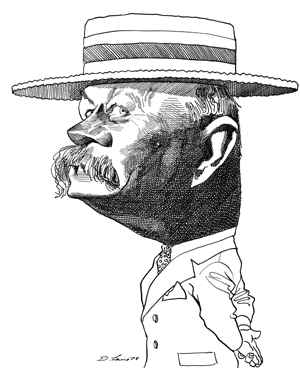
Arthur Conan Doyle was the grandson of a caricaturist, the nephew of the designer of the original cover for Punch, and the son of Charles Doyle, an architect and painter who died, in a private sanatorium, of drink and of the kind of bitter, self-aware madness that sees itself as damnation through an excess of sanity. His was the kind of madness that reads the random text of the natural world and finds messages and secret connections, the agency of elves and demons and other liminal beings. Charles Doyle burdened his son with a legacy of failure and a treasure as rich and irrelevant as the ritual left by Sir Ralph Musgrave to his baffled heirs: an eccentric way of looking at the world, of making it, against all reason, cohere. The father’s fecklessness, epilepsy, alcoholism, and eventual commitment to an institution were for Conan Doyle the black axioms of existence, never acknowledged, sometimes denied.
Conan Doyle’s mother, Mary, whom he always called “the Ma’am,” seems to have been a model of Victorian motherhood, beribboned, cased in whalebone. She was also a storytelling Irishwoman who thrilled and terrified her children by the fireside, on long winter evenings, with ghost stories and legends of heroes and the sidhe. A mother of ten (seven surviving childhood), a model of propriety, modesty, and self-sacrifice, she nonetheless maintained a lifelong relationship with a male lodger fifteen years her junior. Evidence of a sexual liaison between her and the lodger, a pathologist named Bryan Waller, is scanty but suggestive.
Waller’s residence in the Doyle house predated the institutionalization of Conan Doyle’s father, as did the birth of Mary’s last child, a girl who was carefully labeled with the name of Bryan Julia Doyle, Julia being the name of Waller’s mother. It does not require “the most perfect reasoning and observing mind the world has ever known” to draw the readiest conclusion. When Waller bought a house in the Yorkshire countryside, he took Mary and Bryan Doyle to live with him. He supported young Arthur financially, and Conan Doyle’s fateful decision to attend medical school was almost certainly determined by the wishes of his mother’s mysteriously powerful lodger. A reading of Daniel Stashower’s biography of Conan Doyle suggests that Bryan Waller was, in practical terms, the most important personage in Conan Doyle’s early life. And yet in all his subsequent published autobiographical writings and letters he never mentioned him, not once, neither to thank him nor to settle a score. There is an enigmatic reference in his memoirs: “My mother had adopted the device of sharing a large house, which may have eased her in some ways, but was disastrous in others.”
A number of Holmes stories center around the activities of sinister lodgers in boarding houses, machinating stepparents, or people who keep their loved ones locked away. Reproachful ghosts of the immured father, imprisoned for his own supposed good, can be glimpsed in the eponymous figure of “The Adventure of the Blanched Soldier”—the Boer War veteran hidden in a “detached building of some size” on the family estate in the belief that he had contracted leprosy in Africa. It can be seen as well in the forlorn inhuman visage of the mysterious captive in “The Yellow Face,” and in the ruined figure of “The Crooked Man,” a former soldier who haunts and kills the English officer who, years ago in India, betrayed him into the hands of torturers. Detective Freud might well conclude that Conan Doyle never entirely recovered from the pain and humiliation first of watching his mother cuckold his demented father in his own house, and then of being obliged to stand by as the old man was packed off to the Montrose Royal Lunatic Asylum, never to return.
Advertisement
The braided pair of Conan Doyle’s family history and home life played out in a city that precisely mirrored its duality and duplicity. Even more than London, Edinburgh in the nineteenth century embodied the Jekyll-and-Hyde impulses of the Victorian mind. In London the evil and the good, the public and the private, tended to be presented as near neighbors. They even, as with Henry Jekyll and Edward Hyde, shared the same body. London was figured in jumbles like The Old Curiosity Shop, or Krook’s in Bleak House, in landscapes made uniform by fog and mud. Edinburgh, in the time of Conan Doyle’s childhood, consisted of two distinct cities, the Old Town and the New. The old medieval center of Edinburgh, “this accursed, stinking, reeky mass of stones and lime and dung,” as Thomas Carlyle called it, was notorious throughout Europe for its foulness. Beginning at the end of the eighteenth century it had, like Charles Doyle, been supplanted, though not fully replaced, by a stately city of gray stone, erected on a ridge to the north of the old burgh.
This partly successful act of deliberate moral self-improvement by a city proud of its recent intellectual and commercial accomplishment, and anxious to shed the stigma of its grim parochial past, produced a city with a secret sharer, a striving, rationalistic city whose grid of streets concealed an anxious memory of the bloody old Scots abyss. It also reflected the predicament, and the achievement, of Conan Doyle himself, who lived his dreary and anxious childhood among failure, genteel poverty, and the unimaginable oblivion of his father, on the one hand, and the relative fame and splendor of his successful, artistic Doyle grandfather and uncles in far-off London; between the ever-present specter of ruin and disgrace and the glittering future he dreamed of (and later achieved); between the weird, Irish-Catholic world of his mother’s hearth tales and the overtly empirical, Protestant narrative of urban Victorian Scotland.
In medical school at the University of Edinburgh, in the grim Gormenghast heart of the Old Town, Conan Doyle got a decisive demonstration that his father’s way of reading the world for messages could be combined with his mother’s gift for making a story. In the fall of 1876, he began attending lectures and working as a clerk in the Royal Infirmary, presided over by Dr. Joseph Bell, FRCS, an ingenious practitioner of what might be called narrative diagnostics. We might also call it prose fiction, or the science of detection.
Joe Bell was a legend at the medical school. His favorite trick—he relished, like the character he would one day inspire, the coup de théâtre—was to diagnose patients in the waiting room of the infirmary without even speaking to them or directly examining them. As Dr. Harold Emery Jones recorded it in a memoir:
Gentlemen, a fisherman! You will notice that, though this is a very hot summer’s day, the patient is wearing top-boots. When he sat on the chair they were plainly visible. No one but a sailor would wear top-boots at this season of the year…. He is concealing a quid of tobacco in the furthest corner of his mouth and manages it very adroitly indeed, gentlemen…. Further, to prove the correctness of these deductions, I notice several fish-scales adhering to his clothes and hands, while the odor of fish announced his arrival in a most marked and striking manner.1
The principle behind these feats of inspired guessing, of taking the sum of a set of physical facts, many of them not apparent to the untrained eye, and checking them against an internal reservoir of knowledge based on prior observation—the point of Bell’s showmanship—was to awaken the young doctor to the wealth of signs, symptoms, and shortcuts a patient provided. The patient came in spouting and strewing great fiery gouts of information; he or she was a petri dish of facts that it required only patience and a highly trained eye to read and diagnose.
But such observational and interpretational skills were not the whole of the doctoring game, any more than they are for writers or detectives. To succeed as a narrative diagnostician, or a novelist, or a detective, you also needed the art that, if you were Arthur Conan Doyle, you learned from your mother: you needed the feeling for story, both for the “history” to be inferred from the signs and symptoms and for the way that story could be reconstructed, in therapeutic terms, for the benefit of the patient. Bell treated his patients, in part, by telling them their own stories, as if threading a coherent narrative were itself a kind of therapy.
Though Conan Doyle’s celebrated failure as a medical practitioner appears to have been exaggerated, it seems clear that he had little luck, and took as little pleasure, in his chosen career. (At least one writer has suggested that Conan Doyle might have managed to kill a patient, through Charles Bovary–like ineptitude or more sinister motives; he subsequently married the dead man’s sister, and took control of the income that she inherited from her brother.2 ) Like so many Scotsmen of his time, those engineers, overseers, managers, merchant princes, foot soldiers, and rationalizers of the Empire, Conan Doyle had a powerful taste for adventure. In seeking to elude the fate that Waller, his personal Moriarty, had determined for him, Conan Doyle made two inconclusive or ill-fated attempts at becoming a ship’s doctor, and a rash and doomed decision to abandon general practice for the study, in Germany, of ophthalmology, in spite of the fact that he barely understood German.
In his late twenties Conan Doyle found himself stuck in a series of difficult, tedious, or failing medical practices, with a young wife whose health was poor and the first of his eventual five children to support, indebted, shut out of the high-end Harley Street clientele, too proud in his agnosticism to go to his devout Doyle relations for help, yearning for the kind of true adventure that his mother’s stories had kindled in him. His horizons were lowering, his promise going unredeemed. He may very well have begun to see himself as lost. He had witnessed Joseph Bell work a kind of salvation, through storytelling, in the infirmary at Edinburgh. It may have been inevitable that his thoughts would turn to Bell now as, trapped in his desolate consulting rooms, like Holmes taking up the cocaine needle, he took up his pen.
I know I run the risk of hokum in dwelling very long on the connection, at least as old as Rabelais and arguably traceable to the shaman retailing trickster tales by the campfire, between doctors and literature, storytelling and healing. So I’ll just mention that when the first dozen Holmes stories were collected and published in The Adventures of Sherlock Holmes, a book that made Conan Doyle famous and rich, and saved him forever from the life that he had never resigned himself to living out, they came dedicated to Dr. Joseph Bell.
—This is the first of two articles.
This Issue
February 10, 2005

This Issue
February 10, 2005