
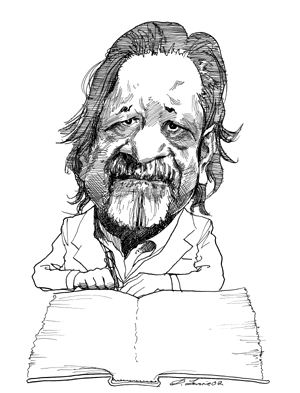
V.S. Naipaul’s books are not Fabergé eggs. They are not made out of, and not intended for, detached aesthetic contemplation; they are passionately engaged with the world. They have also proved to be, in at least two ways, prophetic. First, what at one point seemed a lonely body of work can now be seen as explaining an entire field of study that is known as Postcolonialism, which examines the writing, politics, history, and modes of thought of the developing world. Postcolonialism as a field is dominated by left-leaning academics, with whom Naipaul has almost nothing in common; but he is nonetheless a crucial, minatory, alarming writer for anyone with any interest in the field, not least because he dissents from all its orthodoxies.
Second, and more importantly, the world has caught up with Naipaul’s great preoccupation with how people’s lives turn in unexpected directions, especially the way in which the pressures of modern society and social fragmentation have caused a terrible longing for old certainties, reassuring fantasies, and violence. His account of a journey through the Islamic world, Among the Believers (1981), is, in this respect, a central book. It has become a truism to point out that fundamentalist religion is a very modern phenomenon, and in particular to point out how many of the ideologues of militant Islam had their formative experience in a violent reaction against the individualistic, secular modern life of the West; but if this analysis has become a truism it is one that was first, best, and most clearly set out by Naipaul.
The diptych formed by Half a Life (2001) and now Magic Seeds sees Naipaul again tackling these subjects. Their main character is Willie Chandran, a weak, soft, lost, hapless, but strangely difficult to dislike Indian writer or sort-of writer. He is another of Naipaul’s men caught between worlds, no longer at home in India and not fully a man of the West: dislocated, semi-assimilated. It is a status caught even in his name, about which we heard right at the beginning of Half a Life:
Willie Chandran asked his father one day, “Why is my middle name Somerset? The boys at school have just found out and they are mocking me.”
His father said without joy, “You were named after a great English writer. I am sure you have seen his books about the house.”
“Without joy”—Naipaul has a great gift for such crushingly economical observations. It turns out that the story of Willie’s birth and naming is a cross-cultural tragicomedy. Willie’s father, a descendant of priests, became overexcited by the example of Gandhi, and decided “nothing less than to make a sacrifice of myself.” He makes a point of going up to a lower-class girl and sitting with her while she is in a tea shop. That gesture, repeated over a series of days, is all it takes to throw away his life chances. The girl’s family hears about the non-courtship and her uncle, a union activist, threatens to mount a demonstration against the boy for caste oppression. She bullies him into finding a place for her to hide—this is the first time she ever speaks to him—and he eventually ends up taking a vow of silence and sitting in the temple grounds.
He becomes a local celebrity and a semi-famous holy man. It is in this capacity that Somerset Maugham, in India gathering material, meets him, is enraptured by his silent example, and goes on to put him in The Razor’s Edge as an example of the timeless wisdom of the East. Attention from the West earns Willie’s father enough respect for him to collect donations from pilgrims and enables him also to marry the lower-caste girl, who is Willie’s mother. (We never learn her name, or her husband’s.)
It is as if Willie’s life never quite gets over the mixture of misunderstanding and farce attendant on his birth. His father bombards Westerners for introductions for his son, and one of them arranges a place for him at the university in London. Willie falls in with a bohemian group of recent immigrants, including Marcus, a West Indian émigré to West Africa, whose single ambition in life is to have a white grandchild, and who lets no conversation pass without telling his interlocutor, apropos the genetics of race, that “the Negro is recessive.” He also meets Roger, a barrister who writes for newspapers on the side, and Roger encourages Willie to write. Willie already has produced a few short pieces about India, and at Roger’s prompting adds several more stories, which he creates largely by stealing plot fragments from Hollywood films and then setting them in an ambiguous semi-Indian location, with dialogue influenced by Hemingway. The stories find a publisher, but even before they have done so Willie is finished as a writer. He doesn’t have enough of a self to write seriously; it’s all just a phase.
Advertisement
Willie’s book—again, we never learn its name—seems to vanish without trace, but not without having one big effect on his life. A Portuguese African woman called Ana, clearly though unstatedly from Angola, admires it, and arranges to meet Willie. They click; she sees in him the same sense of loss and deracination she feels in herself. So, in the unthought-through, half-cocked way in which Willie does everything, he marries her, goes to Angola with her, and lives there with her for eighteen years, while the colony collapses and the war of independence is won by the rebels.
Naipaul is at his best in describing the moral, physical, and economic disintegration of the Portuguese presence in Angola. As the life of the colony begins to fade, so Willie gradually falls out of his marriage: he has affairs, loses interest, and for no really clear reason—but it would not be Willie if there were a clear reason—decides that he wants to leave Ana and Angola and go to see his sister Sarojini in Berlin. And that is what, at the end of the novel, at the age of forty-one, he does. Half a life indeed.
The two Willie Chandran novels are, in the grand old manner, suffixed with their dates of composition: March 1999 to August 2000 for Half a Life, September 2002 to September 2003 for Magic Seeds. These dates tell more than one story, and one of the stories they tell is that the second novel was written after the September 11 attacks. Naipaul may well have planned a second novel about Willie—the title Half a Life is a heavy hint, and so is the way the book ends in mid-current, with its hero stranded in Berlin; but the book is nonetheless heavily marked by the time of its composition. The first and most salient sign of this is that in Magic Seeds Willie becomes, of all things, a terrorist.
It happens like this: Willie’s sister Sarojini is, and always has been, an angry political radical—a “firebrand,” like their union-activist uncle. She is, and always has been, a handful. “All I can hope for Sarojini is an international marriage,” her father had said, and he got his wish when Sarojini married Wolf, a radical German documentary film maker. He and Sarojini embarked on a life of traveling and making films about radical and insurrectionary groups—their first subject being a Cuban “with a Goan name, Govia or Govara.” By the time Willie gets to Berlin, Sarojini has a firm diagnosis of his problem. (Sarojini is the type who always has a clear view of everybody’s else’s problem.) She points to the example of a young Tamil hawking flowers to raise money for the civil war back in his homeland:
Those Tamils selling roses in Berlin in order to buy guns have thrown off a great weight of history and propaganda. They have made themselves a truly martial people, and they have done so against the odds. You must respect them, Willie.
Willie listens to this “in his blank way.” Sarojini begins to talk about an Indian revolutionary called Kandapalli:
When, in a hundred years, the definitive history of the twentieth-century revolution comes to be written, and various ethnocentric prejudices have disappeared, Kandapalli will be up there with Lenin and Mao.
Kandapalli’s big insight is that revolution has “to come from below, from the village, from the people. There was to be no place in this movement for middle-class masqueraders.” Fortified, or undermined, by “the daily mental exercise of thinking himself back into more desperate places of the world he had seen or known,” Willie begins to see the Western world of Berlin as less real, or less authentic, than the life of Angola or India:
For the first time in his life he began to experience a kind of true pride. He felt himself, so to speak, taking up space when he walked in the streets; and he wondered whether this was how other people felt all the time, without effort, all the secure people he had met in London and Africa. Gradually, with this pride, there came to him an unexpected joy, which was like further reward, the joy of knowing that he rejected everything he saw. Sarojini had told him that the people he saw lived for pleasure alone. They ate and watched television and counted their money; they had been reduced to a terrible simplicity. He saw the unnaturalness of this simplicity; at the same time he felt the excitement of the new movements of his heart and mind; and he felt above everything around him.
And it is, again, as simple as that. Willie heads off for India to join Kandapalli’s revolutionary army.
Advertisement
Do we believe this? Yes and no. The paragraph quoted above is convincing as an account of what happened to a man like, for instance, Mohamed Atta. When we read the story of what happens to turn soft, lost, gentle, forty-one-year-old Willie Chandran into a revolutionary Marxist insurgent fighting in the Indian jungle, the reader’s disbelief cannot be said to be fully suspended. Still, Naipaul’s intention is not fully realistic, not quite. Willie is a person, but he is also an allegorical figure—a half-man, living a half-life. His turn to violence is emblematic of the kind of turn that can be taken by a man who doesn’t know himself, doesn’t fully possess his own life. It is a subject Naipaul has written about before. His point here is to show just how easily it can happen: how the move from East to West, the encounter between them, can cause a man to lose himself, and how that in turn can make him ready to believe anything, do anything. This kind of self-loss is, for Naipaul, only a short distance from violence.
Willie’s adventures with the terrorists are farcical; also tragic. For a start he seems to have been put in touch with the wrong gang—not Kandapalli’s guerrillas but an opposing group of thugs and fantasists. He is made a courier, because of his ability to fit in anywhere. That, it turns out, is the one thing his life has suited him to do: “For some reason Willie looks at home everywhere.” (The reason, we know, is that he isn’t at home anywhere.) Passing that test, Willie is sent to join an active guerrilla unit, which immediately runs into absurdity and disaster. He and another would-be revolutionary, nicknamed Einstein because of his prowess at mathematics, set about negotiating the terms of their surrender. The process is complicated, not least because guerrillas who surrender are, bizarrely, allowed to claim the bounty offered by the Indian government for their own arrest. The negotiations are successful, and Willie ends up in prison, where, he reluctantly admits to himself, he is happy: he enjoys “its blessed order, its fixed timetable, its protecting rules, the renewal it offered.” Years pass. Sarojini, by now back in India running her father’s old ashram, pulls some strings to have him moved to a more comfortable hospital ward; then Roger, Willie’s old London friend, starts a campaign to have him released. The cru-cial lever in Roger’s campaign turns out to be Willie’s new-found status as “a pioneer of Indian postcolonial writing.” Willie is amnestied, and ends up back in London.
This is where, for a British reader, the fun starts. Naipaul has never written a truly caustic portrait of his adopted homeland; has never portrayed England with the same dyspeptic rage given to India in An Area of Darkness (1964) or the Caribbean in Guerrillas (1975) or West Africa in In a Free State (1971). He has now, though. This perhaps is the second story told by those aforementioned dates of composition. Some of Naipaul’s admirers, and some of his detractors too, have thought that there was a muted quality to his more recent books, not unconnected to his perceived keenness to win the Nobel Prize. The allegation has been that Naipaul was keen not to give offense to the mages of Stockholm. A work often mentioned in this context is the strangely eirenic India: A Million Mutinies Now (1990), which offers a vision of the subcontinent that bears little relation to the one given in Naipaul’s blazing earlier works of reportage.
But apart from September 11, the other thing that happened between the composition of Half a Life and Magic Seeds is that Naipaul, in December 2001, finally was awarded the Nobel Prize. After that, so the argument goes, he could now feel free to be as abrasive as he likes. There may be nothing to this theory—how could anyone really know about such alleged motives?—but there’s no denying that Magic Seeds is wonderfully, bracingly offensive about contemporary Britain, a country in which “most people… have a streak of commonness.”
The main vehicle for this vision of Britain is Roger. He is in the grip of not one but two difficult affairs, one with an appallingly snobbish, crude, rich banker, another with a working-class woman called Marian. Roger’s affair with Marian is an orgy of duplicity, bad faith, snobbery, and every other kind of ill-will, especially all those connected with class. The attraction, of course, has to do with sex; but the sex is, even by the standards of the ultra-bleak sex in Naipaul’s oeuvre, spectacularly gloomy. This is the first time Roger and Marian have sex:
She said in her cool way, looking down at me, “Aren’t you going to bugger me?”
I didn’t know what to say.
She said, “I thought that was where you were going.”
I still didn’t know what to say.
She said, “Did you go to Oxford or Cambridge?” And with a gesture of irritation reached across the bed for her bag. Easily, as though she knew where it was, she took out a tube of lip salve.
I hesitated. She passed the lip salve to me, saying, “I am not doing this for you. You do it.”
I hadn’t thought it possible for a naked, exposed woman to be so imperious.
She commanded. I obeyed. How well I did I didn’t know. She didn’t tell me.
Naipaul’s vision of working-class life, as seen through Roger’s affair with Marian, is dystopian. She gives Roger “fragments, developing after a time into a full picture, of a frightening and brutal council-estate life I had never really known.” Marian herself is one of four “mistakes,” i.e. children, whom her mother had by three different fathers. “At no stage was Marian’s mother required by anyone in authority to live with the material or financial consequences of her decisions. There was always a council house available, and always a benefit of some sort.” For Roger, all this adds up to a revelation about Marian:
I knew the council estate where the bad drama of her childhood had been played out. To her, at that time, that drama would have seemed unending. I had passed many times the very ordinary place where she had been taken into care and from which she had tried to run away. It was as though, for her, but not for me, who drove by unseeing, unknowing, unthinking, existing almost in a separate age, an exact moral parallel of the Dickens world still existed. That parallel was concealed from the rest of us by the bright paint of the council houses, the parked motor-cars, and our too easy ideas of social change.
No “too easy ideas” as to be expected from Naipaul. His truly outrageous suggestion for the cause of this miserable condition is that it is caused by servants:
There was a time when a substantial portion of the population was in domestic service…. The servant class has vanished. No one knows what they have metamorphosed into. One thing we can be sure of is that we have not lost them, that they are still in varying ways with us, in culture and attitudes of dependence. In every town and large village we now have ancillary council estates, clusters of subsidised dwellings meant originally for the poor. These clusters are recognisable even from the train. They have a deliberate socialist ugliness, a conscious suppression of those ideas of beauty and humanity that rise naturally from the heart. The theories of socialist ugliness have to be taught. People have to be trained to think that what is ugly is really beautiful. Ancilla in Latin means a nurse, a slave girl, a maid, and these ancillary council estates, meant to give the poor a kind of independence, quickly developed into what they had to be: parasitic slave growths on the main body. They feed off general taxes. They give nothing back. They have, on the contrary, become centres of crime. You may not guess it when you see them from the train, but they are a standing assault on the larger community. There can be no absolute match of one age with another, but I wouldn’t be surprised if the percentage of people at one time in domestic service isn’t matched now by the numbers on the council estates.
It is especially sly of Naipaul to put these ideas in the mouth of Roger—it’s such an Indian vision, one in which working as a servant is not merely a form of labor but a mark of caste, inherited and ineradicable. If we consider such remarks as serious social analysis, they need not detain us too long; but there is a kind of exuberant despair at work here. There are times in Naipaul’s work where we feel him being driven by rage, and other moments when we can feel the glee of a happy Cassandra: an enjoyment at being the man to give us the bad news, to tell us what we don’t want to hear. Magic Seeds is full of those moments.
As for Willie, during his time in London he comes to see that the life of the West is not so simple after all, but a collective achievement, the record of a history and a process: “it wasn’t simply there.” As he absorbs this insight he becomes more and more interested in architecture, and the way it may represent the accumulated knowledge and expertise of a culture, its technical expertise and its growing understanding of people’s needs. His fellow students, however, don’t get it:
To the man from Multan (and to others on the course as well, as Willie had noticed during the week) little of that story mattered: they had been sent by their countries or companies to get at knowledge that was simply there, seemingly divinely provided, knowl-edge that had for a long time been unfairly denied them for racial or political reasons but was now, ina miraculously changed world, theirs to claim as their own. And this newly claimed knowledge confirmed each man in the rightness of his own racial or tribal or religious ways. Up the greasy pole and then letting go. The simplified rich world, of success and achievement, always itself; the world outside always in disturbance.
The novel ends with Willie and Roger attending a wedding. Marcus, their old African acquaintance from decades ago, has finally achieved his wish, and has a white grandchild—“as white as white can be” by a “pure-white aristocratic lady,” Willie writes to his sister—whose parents are now getting married. (“It is the fashion here, babies before wedding bells.”) The description of the wedding is like a festival of negativity, Naipaul vying with himself in the accumulation of details designed to make the entire occasion seem as desolate as possible. The once-grand house of the bride’s family outside London has been allowed to rot: “Complacency perhaps, or genetic failure,” notes Roger. “Chickens had recently been kept here, and there was a faint smell for those who could recognise it.” Marcus’s son the groom is “big-chested, thuggish-looking, with Africa more than half scrubbed off him” (a description that, to this reader at least, seems to have an edge of racial nastiness).
The priest had a faraway plebeian accent…. He chewed up his words; their fineness seemed to embarrass him.
Someone from one side read a speech from Othello, and someone from the other side began to read a Shakespeare sonnet. Before the sonnet was through, one of the pages farted, and no one knew whether it was the dark page or the fair one. But the guests lined up correctly on this matter: the dark people thought the dark child had farted; the fair people thought it was the fair child.
Marcus’s white grandchild begins to cry, Marcus goes to console her, and
an old lady, seeing the old grey-haired black man running to the distressed white child, imagined old sentimentalities and involuntarily clapped, very delicately; then someone else clapped; and then Marcus and his grandchild were walking to general applause.
It is a moment that only Naipaul would make seem so phony. The very loud Dutch Antillean band begins to play, and Roger announces, “I’m getting a migraine.” He’s not the only one; the reader may find this wedding party hard to bear. But one gets the impression that Sir Vidia wouldn’t mind that, not one little bit.
This Issue
April 28, 2005

This Issue
April 28, 2005
