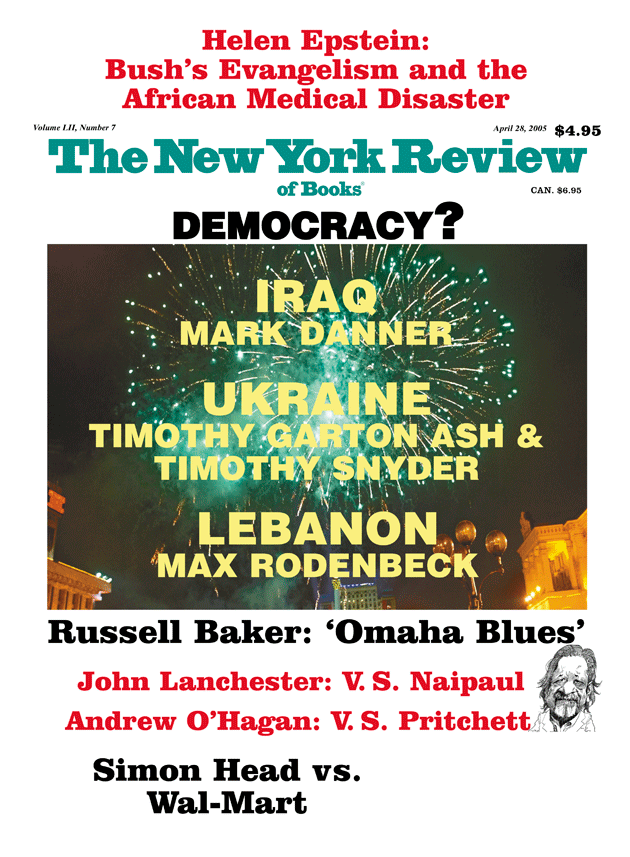
Last autumn, Ukraine imprinted itself on the political consciousness of the world for the first time in its history. In what was christened the “orange revolution,” vast crowds wearing orange scarves gathered in subzero temperatures in Kyiv’s Independence Square to demand a fair election for president. They won. Under its new president, Viktor Yushchenko, Ukraine can move toward what he and his allies hope will be a working democracy and market economy under the rule of law, and toward membership in the European Union.
Observers have placed Ukraine’s “orange revolution” in a sequence of peaceful democratic revolutions stretching from the “velvet revolutions” of 1989 in Central Europe, through the “rose revolution” in Georgia in 2003, to what some are already calling the “cedar revolution” in Lebanon. Many Ukrainians are understandably delighted by this attractive labeling, so different from the largely negative or nonexistent image they have had in the past. Yet we must look beyond the news headlines to discover how and why this change has come about, and what its consequences may be.
1.
The history of Ukraine begins a thousand years ago, when the rulers of a trading state based in Kiev—or Kyiv, to use the Ukrainian spelling—converted to Byzantine Christianity. After the Mongol invasions, Kyiv and surrounding lands were absorbed by the then combined state of Poland-Lithuania, in which Ukrainians were exposed to the influence of the Renaissance and the Counter-Reformation. As Russian power extended westward, educated Ukrainians offered their services to the Russian empire. The Ukrainian language, related to both Polish and Russian, allowed them to assimilate easily. As nationalism emerged in the nineteenth century, Russians came to see Ukraine as a branch of their own nation. At the same time a Ukrainian national movement began to articulate a distinctive Ukrainian culture.
However, Ukraine failed to achieve independence in 1918. Attempts by Ukrainians to found a state were blocked by Bolshevik and Polish forces. Woodrow Wilson did not think Ukraine was a nation, and the Western powers conceded Ukrainian lands to the Russian White Armies in the hope that they would defeat Bolshevism. In 1921, Ukraine was divided up between the Bolsheviks and Poland.1 The Bolsheviks granted Ukraine generous space within the new Soviet Union, but the peasantry in Soviet Ukraine was destroyed by the collectivization of agriculture, while the Orthodox Church was subordinated and corrupted, and the intelligentsia was decimated. Among Stalin’s worst crimes was the organized famine of 1932–1933, which took the lives of at least three million people in Soviet Ukraine. His regime was displaced in 1941 by the Nazis, who regarded Ukrainians as racially inferior, and brutally treated them as such. Ukraine’s Jewish population was all but eliminated in the Holocaust, in which the German occupiers were aided by the collaboration of a minority of Ukrainians. Some Ukrainian nationalists attacked and killed local Poles. Hundreds of thousands of Ukrainian soldiers starved to death in German camps. Yushchenko’s father, who survived Auschwitz, was one of the lucky few.
With the return of Soviet power at the end of the war Ukrainian lands were gathered into one political unit. In 1945, Stalin annexed western Ukraine from Poland, thereby bringing people with a different experience of politics into the Soviet Union. Some of them came from Galicia, a part of Austria between 1772 and 1918 that was incorporated into Poland. These Ukrainians were mostly Greek Catholics, their “uniate” church combining an Eastern liturgy with subordina-tion to the Vatican. Between the two wars the Galicians had been citizens of Poland, which, while an increasingly authoritarian state, generally allowed free expression and accepted the rule of law. After 1945 Nikita Khrushchev, the Communist official in charge of Ukraine, took control of the Soviet pacification of its western part. It was he who added the Cri-mean peninsula to Soviet Ukraine in 1954, giving the country its present shape.
Soviet power weakened or eliminated in Ukraine those elements of civil society—private farms, churches, the intelligentsia—that had helped to prepare the way for the velvet revolutions in its more fortunate neighbors, such as Poland and Czechoslovakia. Still, when the USSR collapsed in 1991, Ukraine had a name, a capital, a place on the map. But its independence arrived without a major popular movement to shape it.2 Its foundations were fragile. Many in Russia refused to accept the reality of Ukrainian independence.
2.
During the 1990s, Ukraine was an electoral democracy undergoing a shaky transition to a post-Soviet version of capitalism. Between 1994 and 2004, the regime of President Leonid Kuchma, in which the President appointed almost everybody that mattered, adopted increasingly corrupt, brutal, and undemocratic methods. Kuchma pioneered what has been called “the blackmail state.”3 Having itself encouraged widespread corruption, his administration blackmailed officials and private citizens by threatening them with evidence of wrongdoing gathered by the secret police—such evidence being known as kompromat, the old Soviet term for “compromising material.” Kuchma also cultivated intimate relations with some of Ukraine’s new industrial barons, letting them take over state assets—particularly coal, steel, and natural gas—and giving them other favors in return for their political support. The system seemed to work.
Advertisement
After World War I, the Ukrainian conservative Vyacheslav Lypyns’kyi had an optimistic thought: even a corrupt Ukrainian state, if it lasted, could create a Ukrainian nation. The rich would adapt to its laws and seek connections with state officials. Those with no cultural attachment to Ukraine would see themselves as citizens of a Ukrainian state if they had a stake in its institutions.4 The 1990s put these ideas to the test. Agile businessmen and women took over former state assets, created and exploited monopolies, and made lucrative investments. In far-eastern Ukraine, near the Russian border, Rinat Akhmetov, the son of a miner, accumulated a fortune now estimated at more than $3 billion, starting with coal and steel. By financing political parties, these oligarchs—generally Russian speakers from the east—got themselves elected to parliament. Many of them moved to Kyiv and courted favor with President Kuchma. One of them, Viktor Pinchuk, married Kuchma’s daughter. Such oligarchs had a vested interest in the survival of Ukraine. In an enlarged Russia, or a restored Soviet Union, they would have been small fish in a big pond, their connections of little value.
Kuchma’s Ukraine endorsed the institutions and the symbols of independent statehood. It had embassies, an army, its own police. The national anthem used by the briefly independent Ukrainian People’s Republic after World War I was restored in 1992, and amended in 2003. Every night on television people saw the outline of their country on the weather map. Ukrainian was the state language. Foreign journalists were asked to use the word “Kyiv” rather than “Kiev.” Teachers at elite schools used Ukrainian in their classes, and the texts of civil service and university exams were in Ukrainian. Even as much of the political elite continued to speak Russian off camera, the public use of the Ukrainian language became a sign that the state was established.5 Kuchma himself published a book entitled Ukraine Is Not Russia.
In 2004, the Kuchma system outdid itself. Viktor Pinchuk and Rinat Akhmetov acquired the privatized Kryvyi Rih steelworks, although their bid was $800 million lower than that of a consortium led by US Steel. One favor deserves another, so Akhmetov helped to finance the presidential campaign of Kuchma’s prime minister and handpicked successor, Viktor Yanukovych. Had Yanukovych become president, Ukraine would have remained independent, but its resources would have been even more tightly controlled by a few oligarchs. However, Kuchma’s system had two major flaws. First, Ukrainians had the right to vote. Both Kuchma’s regime and its candidate, a supremely uncharismatic politician with two criminal convictions in his youth, were unpopular. Second, not everyone with money and political power was satisfied.
Julia Tymoshenko, for example, was an oligarch with a grievance. An economist from the east Ukrainian industrial center Dnipropetrovsk, she made her money speculating in natural gas, exploiting loopholes that allowed state-owned firms to pay for energy with goods that could be resold rather than in cash. In this way middlemen (or women) could amass their own fortunes. Tymoshenko was known as the “gas princess.” Then, as a government minister between 1999 and 2001, she closed those very loopholes, and forced the energy sector to become part of the cash economy. Along with the former central banker Viktor Yushchenko, then prime minister, she worked to reform Ukraine’s economy. Kuchma fired them both, and put Tymoshenko in prison. Her courage and her refusal to be cowed made her an appealing figure. She was soon freed. However, it was Yushchenko who became the most popular Ukrainian politician. He was able to attract those entrepreneurs who believed they could prosper in an economy where connections with the regime counted for less and the rule of law counted for more.
3.
In November 2000, the headless body of Heorhiy Honhadze, a journalist known for his criticism of Kuchma, was discovered in woods outside Kyiv. Audiotapes purportedly leaked by one of Kuchma’s bodyguards recorded a voice that sounded like Kuchma’s giving orders that Honhadze be done away with. For a few months, Ukrainians took to the streets to demand a “Ukraine without Kuchma.” Protesting students built a tent city in Kyiv. Although their movement failed, this popular mobilization was a new experience for thousands of Ukrainians.
Three years later, Viktor Yushchenko led a candle-lit vigil in memory of the millions of victims of the Stalinist political famine of 1932 and 1933. The presidential campaign was well underway, and many Ukrainians admired the way Yushchenko asked quietly for public remembrance of the national past. But his opponent, Prime Minister Viktor Yanukovych, had Kuchma’s support, financial backing from oligarchs, and unlimited television coverage. With little access to television, Yushchenko campaigned everywhere in person. He countered televised attacks on him by making personal visits to villages, shaking hands, showing his face.
Advertisement
Last September, several weeks before the election, he was poisoned by a dose of dioxin. The first symptoms appeared after he had dinner with senior secret police officials, although no connection with the poisoning has yet been definitively established. He returned to the campaign with his formerly handsome face horribly ravaged by severe acne and scar tissue. This, he said, “is the face of Ukraine today.” The Kuchma administration secretly instructed television channels to call the claim of deliberate poisoning a “bare-faced lie” and a campaign trick.6 A TV channel owned by Viktor Medvedchuk, an oligarch close to Kuchma, suggested that Yushchenko’s illness was caused by questionable personal habits.
Despite all these obstacles, Yushchenko won a plurality in the first round of presidential elections last October 31. On Sunday, November 21, during the second round, the Kuchma regime coordinated a campaign to falsify the voting results. That evening, it announced a victory for Yanukovych with a margin of about 3 percent. President Vladimir Putin hurried to congratulate him. However, independently commissioned and Western-funded exit polls made it clear that Yushchenko had won a decisive victory.
And so the orange revolution began—with protests against the rigged election. While the Kuchma regime dominated television, the student movement that called itself Pora7—“It’s time”—used the Internet, googling information about the ways other protests had been organized, from Slovakia to Georgia. This use of the Web was something new in the history of East European velvet revolutions. “I’m not a child of the Internet,” a Belgrade student demonstrator said in 1997, “but I’d like to be.”8 When Ukrainian students started erecting tents on Kyiv’s main shopping boulevard in the early hours of Monday morning, their Web site immediately announced this fact to the world, in English, at 02:33:11 AM. They later explained that they had expected the regime to falsify the results of the second round, and had therefore prepared their next moves well in advance. That same Monday, many Ukrainian diplomats, both in Kyiv and abroad, announced their “total and unconditional support” for Yushchenko. Their statement was e-mailed around the world.
What changed everything, however, was the response of ordinary people. At first thousands of Kyiv’s citizens demonstrated, then hundreds of thousands; soon after, people from the rest of the country answered the call to come to Kyiv. Warming himself by a brazier of burning timber on one of those freezing winter nights, Svyatoslav Smolin, a burly, pasty-faced man in a khaki jacket, explained to one of the authors how he came to be living in the improvised revolutionary “tent city,” having abandoned his usual job, which is to check the radiation levels around Chernobyl. On that Monday evening, he heard through the single opposition television channel that thousands of people were gathering in the capital to protest against the “stealing” of the second round of the presidential election. He turned to his wife and said, “I just have to go.” Vasil Korkhuda, from a village near the Carpathian mountains, where he runs a small travel agency, made the same spontaneous decision. So did Elena Mayarchuk, an attractive young woman in a fur coat and the by-now obligatory orange scarf, who runs the Mary Kay beauty shop in a small town in western Ukraine.
Here were ordinary people doing an extraordinary thing. One was irresistably reminded of Prague in 1989 or Poland during the first Solidarity revolution in 1980 and 1981. But where in Poland a quarter-century before it was workers and peasants who were in the vanguard, here it was a fledgling middle class—students, travel agents, the owner of a beauty parlor.
During those revolutionary days last autumn, Yushchenko and Tymoshenko usually appeared together on the platform in Independence Square: he a tall, solid, reassuring figure, the horrible pockmarks on his face from the dioxin poisoning now the stigmata of a national hero; she a small, intense woman often in Ukrainian national dress, with her blonde-dyed hair braided in faux-peasant style. The “gas princess” became the “goddess of the revolution,” though all the time looking more like Marie-Antoinette.
The orange revolutionaries’ first commandment was: never use violence. This is the feature that most plainly distinguishes velvet revolutions from the Jacobin and Bolshevik models of 1789 and 1917. As in several other cases during and since 1989, members of the security forces stepped back from the very brink of using force against the protesters.9 Yushchenko, Tymoshenko, and their allies kept Independence Square full, they maintained peaceful blockades around government buildings, and they waited for the chance to negotiate.
The Supreme Court ordered the central election commission not to make any announcement of victory, pending an investigation of fraud. On December 3, the Supreme Court found that fraud had indeed taken place, and ordered that the second round of elections be repeated by December 26. Meanwhile, aided by international mediators at a series of “round table” meetings, Yushchenko made a deal with outgoing president Kuchma, who agreed to step aside and to stop supporting Yanukovych. Yushchenko, for his part, agreed to a reduction of presidential power. Parliament passed the appropriate constitutional amendments on December 8. So even as the revolution proceeded, the outlines of a healthy separation of powers emerged: a judiciary with remedial authority, an executive branch with less power, and a legislature with more.
Yushchenko won the December 26 repeat of the second round of the elections, and was inaugurated as president in January. Tymoshenko was confirmed as prime minister on February 4. Their new government is attempting to move Ukraine closer to Western European standards of economic and political behavior. After returning some corruptly privatized companies to public control, to be offered for sale again, the new government will undertake to enforce property rights. Yushchenko has proposed an amnesty for people who have acquired fortunes by dubious means, the better to collect their taxes. In Europe’s fastest-growing economy, with 9.6 percent GDP growth in 2003 and an estimated 12 percent in 2004, there is plenty of new wealth to go around.
Oligarchs who originally opposed the newly elected leaders seem to be giving their grudging assent to the new order. Speaking to one of the authors at the World Economic Forum in Davos this January, Pinchuk said that he would support the new powerholders if they do not resort to illegal actions, and he thought that Rinat Akhmetov, the supreme oligarch in eastern Ukraine, would do the same. All they asked for, said Pinchuk, was respect for the law. To anyone who knows their record, this may sound like humbug; but it is useful humbug.
4.
Much has been made of a supposedly sharp religious, historical, and linguistic division between the Ukrainian western half of the country and the Russian eastern half. The reality is more complicated. Ukraine is a country with a variety of religions, including considerable numbers of Greek Catholics, but Orthodox believers are a large majority, and their votes were split between the two candidates. Culture and history influence today’s political outcomes, but they do not dictate them—contrary to the argument of Samuel Huntington’s Clash of Civilizations. A Ukrainian historian has observed that after the fall of the Soviet Union, the longer a particular part of Ukraine was ruled by Poland in the past, the more likely were its voters to support candidates emphasizing Ukrainian patriotism. In the first presidential elections in 1991, the candidate of the Rukh independence movement won provinces that had been ruled by Poland for five hundred years. In 1994, the pro-Western candidate gained provinces ruled by Poland for three hundred years. In 2004, Yushchenko added those ruled by Poland for only one hundred years.10 Western Ukraine keeps expanding eastward.
“The whole country speaks Russian!” said a plainly irritated President Vladimir Putin during the orange revolution.11 In fact, the country is bilingual. Soviet policies ensured that educated Ukrainians spoke Russian, a kindred but quite distinct Slavic language. Today there are young people in western Ukraine who cannot spell in Russian, and there are many Ukrainians and Russians in the south and east who never speak Ukrainian. But most people speak both languages, and many of them shift between the two languages to suit the mood or circumstance—often, disarmingly, in midsentence. Political preferences, not language, determined the outcome of the elections. Yushchenko had decisive majorities in provinces where Russian is the major spoken language: in Chernihiv he won 71 percent of the vote, in Poltava 66 percent, in Sumy 79 percent, and in Kyiv 78 percent.
Kyiv is a Russian-speaking city whose people know when to speak Ukrainian. Kyivans always pronounce the name “Independence Square” in Ukrainian, even when they are speaking Russian. During the campaign, Yushchenko and Tymoshenko spoke in Ukrainian at their public appearances. Declaring victory for the revolution on December 8, Yushchenko led the crowd in singing the national anthem with his hand on his heart—a habit only recently acquired, apparently from watching US presidents. Across the square, Russian-speaking Kyivans put their hands on their hearts and sang it too, or at least tried to sing it, in Ukrainian: “The glory and freedom of Ukraine live on/Fate my young brothers will smile upon us yet/Our enemies shall vanish like dew in the sun/And we shall rule, brothers, in our own land….”
Yushchenko and Tymoshenko speak better Ukrainian than Kuchma and Yanukovych do. They also speak better Russian. They are both easterners, proof that Ukrainian identity is not limited to the west. Yet they know that they have to make their case to the miners and steelworkers in the east. Immediately after the revolution each traveled to Donetsk, Akhmetov’s eastern bastion, to face the doubters. The “goddess of the revolution” appeared on Akhmetov’s television station. Facing hostile questions in Russian, she held her own. “The whole country speaks Russian!”—the words may not be as comforting to President Putin as he seemed to believe.
5.
Putin’s government angrily accused the United States and the European Union of stirring up the orange revolution from abroad. Almost daily, the Dutch foreign minister—the Netherlands then held the rotating presidency of the European Union—received angry telephone calls from his Russian counterpart.
Yushchenko leaves no doubt that he wants his country to be part of Europe. In Independence Square, he said, “The world has seen that Ukraine can already be called European.” Speaking in Davos, he said, “Our application for EU membership is intended to be filed in the near future.” The EU contributed to the revolution simply by its attractiveness as a club that so many want to join. This is an enduring feature of postwar European politics. Konrad Adenauer, the founding father of the Federal Republic of Germany, spoke as early as the 1950s of Magnet Europa.
Some members of the European Union—Britain and the Netherlands were singled out by one Ukrainian activist—gave significant direct support to election monitors as well as to Ukrainian students, professionals, and other groups from civil society. In May 2004, the EU enlarged its membership to take in eight Central and East European countries, including the Baltic states, which, like Ukraine, had been Soviet republics until 1991, and neighboring Poland. This brought the magnet to the Ukrainian border. Under its Dutch presidency, the EU was uncharacteristically sharp in its denunciation of November’s electoral fraud. The EU’s “high representative” for foreign policy, Javier Solana, the nearest thing the EU has to a collective foreign minister, then played a leading part at the “round table” negotiations with Ukrainian leaders in Kyiv. Also at the table was the Lithuanian president. However, the informal chair of the talks was Aleksander Kwaså«niewski, the president of Poland, the country that in 1989 had pioneered round-table talks as a method of achieving regime change.
The Poles came early to the revolution. A large Polish delegation arrived in Independence Square during its first week, to loud cheers, bearing aloft both the red-and-white Polish flag and, significantly, the yellow-on-blue star-spangled banner of the European Union. The Polish presence in Kyiv was the latest evidence of a sustained strategy. In the 1970s, back when Poland was still a Soviet satellite, the influential émigré monthly Kultura, based in Paris, proposed a new policy for Poland after the end of communism. Poles should accept the new postwar eastern borders, even though Stalin had seized half of their country. If Poles accepted these borders in advance and did not demand the return of their former lands, they could better cooperate with the democratic opposition movements in the neighboring Lithuanian, Belarusian, and Ukrainian Soviet Republics, and establish friendly relations with them when the Soviet Union collapsed.
These premises were accepted by the anti-Communist Polish opposition in the 1980s, and after 1989 they were central to the foreign policy of the Solidarity-led governments of Poland.12 Warsaw treated Soviet Ukraine as an independent state even before the collapse of the Soviet Union in 1991. Then Poland quickly signed a treaty with independent Ukraine that recognized the current borders and protected national minorities in both countries.
After 1995, Poland’s president, Aleksander Kwaså«niewski, a former Communist, adopted the strategy developed by an anti-Communist, émigré magazine, and pioneered by Solidarity. Along with President Kuchma, Kwaså«niewski jointly commemorated the national tragedies of both Poles and Ukrainians. That he developed a close relationship with Kuchma is one reason Kwaså«niewskii was an acceptable mediator for both sides in the most critical moments of the revolution. Poland has constantly lobbied for a more generous approach by the EU to Ukraine. In addition to the reluctance of older EU members to accept a relatively poor Eastern European country, the main problem was the Kuchma regime. Now Kwaså«niewski can speak in bolder tones. Sharing the podium with Yushchenko at Davos, Kwaså«niewski delivered a passionate appeal for EU membership for Ukraine, “this wonderful country…a great nation with great leaders.”
What of the American involvement in the election? The US government—and individual American donors—did more to support Ukrainian democrats than Western Europeans did. The US State Department has said it spent $65 million in Ukraine over the last two years. George Soros’s foundation in Ukraine, the International Renaissance Foundation, reported on October 20, 2004, that it had allocated $1,201,904 to nongovernmental organizations for “elections-related projects.” Most of these US dollars (like West and Central European funding) went to NGOs, including groups that provided training for student activists and support for an independent press and television, as well as an election-monitoring organization and two independent exit polls. As we have noted, these exit polls had a significant part in helping to start the revolution.
Was all this activity “intervention in the country’s internal affairs,” as the old Soviet Union would have put it? It certainly was. So were the very large sums poured into Yanukovych’s campaign by Russian sources, which have been estimated in the Russian press to amount to some $300 million. So were the Russian political advisers who helped design the dirty campaign against Yushchenko. So was the summons delivered to Tymoshenko by Russian authorities demanding that she submit to interrogation on criminal charges. (She responded: “Please do not hinder the struggle for liberation of the Ukrainian nation.”)13 So were the two campaign appearances in Ukraine by Putin, supporting Yanukovych. The investigation of the poisoning of Yushchenko continues, with the initial evidence suggesting that the toxin likely came from Russia.
Some “interventions” by foreigners are justifiable, some are clearly not. There should be an open debate about the ground rules of external, mainly financial intervention to promote democracy, just as there is already a sophisticated debate about the criteria for military intervention on humanitarian or other grounds.14 But American and European policies in Ukraine were well inside morally defensible limits. The orange revolution was not made in Washington, or imposed by Brussels. The West helped citizens of Ukraine to do what they wanted to do for themselves.
6.
After he was elected, Viktor Yushchenko went on holiday in the Carpathian mountains with Mikheil Saakashvili, who last January became president of Georgia after that country’s “rose revolution.” The two issued a Carpathian Declaration, hailing the changes in their two countries as the beginning of “a new wave of liberation of Europe which will lead to the final victory of freedom and democracy on the European continent.” In an article in the Financial Times, President Saakashvili made it clear that this “third and final wave of the European liberation” should embrace “the whole post-Soviet region.”15
Wishful thinking? Perhaps. Yet some conservatives in Moscow seem to agree. During the Ukrainian events, Rossiskaia gazeta, a journal close to the Kremlin, wrote:
Russia cannot afford to allow defeat in the battle for Ukraine. Besides everything else, defeat would mean velvet revolutions in the next two years, now following the Kyiv variant, in Belarus, Moldova, Kazakhstan, Kyrgyzstan and possibly Armenia.16
As we write, Kyrgyzstan is in turmoil after a rigged parliamentary election. One young Kyrgyz told the BBC, “We want to be more like Europe.” On March 25, Belarusian students took to the streets, defying their dictator by waving the EU flag.
Ukraine’s “orange revolution” will also have a direct impact on Putin’s increasingly undemocratic state. If nothing else, the free press and television of a large, Russian-speaking neighbor will challenge his regime’s control of information. In a poll commissioned by a Russian news service, Russians were asked, “Do you think a political crisis similar to that in Ukraine is likely to occur in Russia?” Some 42 percent replied, “never,” 35 percent said, “yes, but not now,” and 17 percent, “yes, and it will happen soon.”17 In a conversation this January, Viktor Pinchuk claimed his Russian business partners, his brother oligarchs, are envious of the world esteem being enjoyed by their Ukrainian counterparts. Then he recalled a joke heard recently in Moscow: “Leonid Kuchma wrote a book called Ukraine Is Not Russia. Now Putin is writing a book called Russia Is Not Ukraine.”
—March 30, 2005
This Issue
April 28, 2005
This Issue
April 28, 2005
-
1
Smaller parts of today’s Ukraine fell to interwar Romania and Czechoslovakia. ↩
-
2
The pro-independence movement Rukh set the terms of debate during 1991, but failed to win elections. ↩
-
3
Keith A. Darden, “Blackmail as a Tool of State Domination: Ukraine Under Kuchma,” East European Constitutional Review, Vol. 10, Nos. 2/3 (2001), pp. 67–71. ↩
-
4
See Ivan L. Rudnytsky, Essays in Modern Ukrainian History (Edmonton: Canadian Institute for Ukrainian Studies, 1987), pp. 447–461. ↩
-
5
See Oxana Shevel, “Nationality in Ukraine: Some Rules of Engagement,” East European Politics and Societies, Vol. 16, No. 2 (2002), pp. 386– 413. ↩
-
6
Text in “Temnyk po khvorobi Iushchenka,” Ukrains’ka pravda, October 1, 2004. A temnyk was a secret instruction issued by Kuchma’s aides to television stations, guiding the presentation of certain topics. ↩
-
7
This was a reference to a well-known line by the poet Ivan Franko, “It’s time to live for Ukraine!” But “it’s time” was also a slogan in Belgrade in 2000 and Prague in 1989. ↩
-
8
See Timothy Garton Ash, “In the Serbian Soup,” The New York Review, April 24, 1997. ↩
-
9
C.J. Chivers, “How Top Spies in Ukraine Changed the Nation’s Path,” The New York Times, January 17, 2005. ↩
-
10
This modifies slightly Iaroslav Hrytsak, “Re: birth of Ukraine,” Krytyka (Kyiv), 1–2, 2005. ↩
-
11
Online edition of Pravda, December 3, 2004. ↩
-
12
For a fuller treatment of this theme, see Timothy Snyder, The Reconstruction of Nations: Poland, Ukraine, Lithuania, Belarus, 1569–1999 (Yale University Press, 2003). ↩
-
13
Reported in Rzeczpospolita, January 27, 2005, p. 6. ↩
-
14
See Timothy Garton Ash, “The $65 Million Question,” in The Guardian, December 16, 2004, and Michael McFaul, “What Democracy Assistance Is…and Is Not,” in Hoover Digest, No. 1 (2005). ↩
-
15
Financial Times, December 20, 2004. On earlier Polish-Ukrainian-Georgian liberation projects, see Timothy Snyder, Sketches from a Secret War: A Polish Artist’s Mission to Liberate Soviet Ukraine (Yale University Press, forthcoming). ↩
-
16
Quoted by Richard Pipes in National Review, December 27, 2004. ↩
-
17
RBC News, January 10–11, 2005, 6,130 respondents. ↩
