
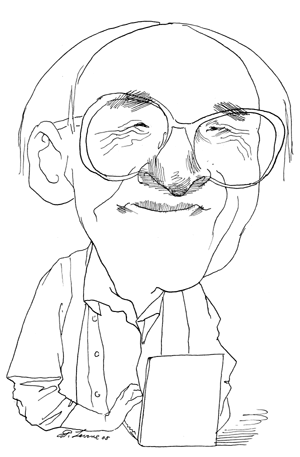
I first became aware of Ko Un in 1988, when I was in Seoul, Korea. Writers from all over the world had gathered to discuss issues of censorship and freedom of speech. One night I was taken to a local university campus, where there was an evening of poetry and music. These were the last years of the succession of military dictatorships which had ruled the Republic of Korea since the end of the Korean War. The reading was sponsored by a student democracy movement which also supported the reunification of Korea, though it was a crime in those years to mention the possibility in public. That night the air was charged with the energy that precedes a political breakthrough: it felt more like a political rally than a poetry reading. As the students sang and read their poems, my attention was drawn to a wiry, vigorous man on the back of the stage, gray-haired, barefoot, dressed like a peasant farmer, who was pounding a traditional Korean drum. There was something enormously graceful and droll in his movements, and my eyes kept drifting back to him. He seemed to be having a wonderful time. Finally I turned to my guide, a Korean novelist. “Who is that guy whacking the drum?” “That,” he said, “is the best poet in the Korean language.” My first sighting of Ko Un.
The first volume of Maninbo, or Ten Thousand Lives, must have just been published the previous year. The story of its genesis has the quality of legend. Ko Un was born in 1933 and attended school under a Japanese colonial administration that outlawed the teaching of the Korean language in Korean schools. He studied Chinese classics at school and learned to read and write Korean surreptitiously from a neighbor’s servant. Rejected for the draft because he was so thin, he escaped combat in the Korean War, but the good luck of his early malnourishment did not save him from witnessing its extraordinary violence. At seventeen he had a dockside job with the US Army keeping track of the munitions that were doing the killing, after which he was given a job transporting corpses to their burial places. At nineteen he entered a Son (Zen) Buddhist monastery and threw himself into the rigors of Son training.
He published his first book of poems in 1960. In 1963 he wrote an essay disavowing monastic life and denouncing its laxness and corruption. He lived in Seoul for a while, taught school on a remote island where he established a public high school, and by his own account was as drunk as possible as much as possible. He also read existentialist philosophy and tormented himself with the nothingness of existence while he wrote essays and poems that expressed his restlessness and torment.
Sometime in the early 1970s something in him changed and he became, within a few years, one of the leading figures in the resistance movement against the Republic’s military dictatorships. He was imprisoned four times, tortured, as a result of which he lost the hearing in one ear, and during his third imprisonment in 1980, when he had been sentenced to life in prison, while in solitary confinement in a cell so pitch dark he could not see the glint of the coffee can that served as a latrine, he began to make a mental inventory of the faces of everyone he had ever known and conceived a long poem, or series of poems, that would begin in his childhood village and expand to include everyone he had ever met, including figures vivid to him from history and literature. The project, still ongoing, has reached twenty volumes. Ten Thousand Lives is the first full sampling of that work to appear in English translation.1
Ko Un was released from prison on the occasion of a general pardon in 1982. In 1983 he was married for the first time, at the age of forty-nine, to Lee Sang-wha, a professor of English literature. They settled in the country two hours outside Seoul and they had a daughter in 1985. Ko Un, always prolific, set to work on the Maninbo poems. He also produced a narrative poem in several volumes on the Korean independence movement against Japanese rule, Paektu Mountain, a best-selling novel, The Garland Sutra, in 1991, and several books of small, aphoristic Son poems, which return his poetry to its youthful roots in Buddhist practice. In the midst of this immense productivity he had plunged into the movement for the reunification of the Korean peninsula, becoming chairman of the Association of Korean Artists from 1989 to 1990 and president of the Association of Writers for National Literature from 1992 to 1994. In 1989, as a symbolic act, he attempted to visit North Korea without government permission and was jailed, briefly, for a fourth time. In his foreword to the translation of Ko Un’s Buddhist poems, Beyond Self, Allen Ginsberg describes him as a “jailbird,” a title he has earned, and also as “a demon-driven Bodhisattva of Korean poetry, exuberant, demotic, abundant, obsessed with poetic creation.”
Advertisement
There was not much of Ko Un to be read in English in 1988, or of any other contemporary Korean poet. Since 1988 two volumes of his work have appeared: The Sound of My Waves: Selected Poems of Ko Un, translated by Brother Anthony of Taizé and Young-moo Kim and published in the Cornell East Asia Series in 1996, and Beyond Self: 108 Korean Zen Poems, also translated by Brother Anthony and Mr. Kim, and published by Parallax Press in 1997. It became possible for one to get a sense of him and the extraordinary arc of his career.
American readers, for the most part, know almost nothing about Korean culture and still less about Korean poetry. Though the lives and fates of the Korean and American peoples have been intertwined for some time, the one study of classical Korean poetry in English, The Bamboo Grove: An Introduction to Sijo, by Richard Rutt, an Anglican bishop living in Korea, published in 1971, provides a way in. Sijo is the classical Korean song form; it consists of three fourteen-syllable lines—long lines, that tend to break in half, so that the translations seem to turn naturally enough into five- and six-line poems in English. Here, in Rutt’s translation, is a poem from the sixteenth century that has some of the qualities of Chinese Buddhist work. It comes from a group of poems called The Nine Songs of Ko San:
Where shall we find the ninth song!
Winter has come to Munsan;
The fantastic rocks are buried under snow.
Nobody comes here for pleasure now.
They think there is nothing to see.
And this poem from the eighteenth century has one of Ko Un’s themes and something of his colloquial pungency:
A boy comes by my window
shouting that it’s New Year’s.
I open the eastern lattice—
the usual sun has risen again
See here, boy! It’s the same old sun.
Come tell me when a new one dawns!
Let me juxtapose this to a passage from the preface Ko Un wrote in 1993 to Beyond Self:
The whole world renewed! I want to offer water to all who thirst for a new world. I want to light a fire so they can warm themselves on a cold evening.
I long to give them bars of iron to hold on to, to prevent them from being swept away by raging storms. But people made of mud cannot cross streams, people made of wood cannot go near a fire. And people made of iron will rust away in less than a century.
Here stands a good-for-nothing who let himself get soaked until the mud dissolved, set fire to himself so the wood disappeared, and whose iron finally rusted away in the wind and the rain. Go now. The new world is found wherever new life comes to birth.
The hopefulness in this, and the bardic sense of responsibility, and the irony and absence of irony seem to belong to a particular kind of historical moment. They put me in mind, because of my long experience of translating Polish poetry, of something Czesl/aw Milosz said: “Woe to the poet born to an interesting piece of geography in a violent time.”
The parallels between the geographic and cultural situations of Poland and Korea are very striking. Given their long histories as the playgrounds of imperial powers and the kind of suffering that has come from it and the impact it’s had on poetry, I don’t think it’s an accident that important work in poetry in this last half-century has come from Poland and Korea. Such suffering is not a fate anyone wishes on anyone and it doesn’t mean that every time there is a catastrophe, poetry rises to the occasion. But in the case of Korea, it seems to have done so in interesting ways. The reason is not, I think, that it is dramatic to live inside violence or terrible injustice, but that it is numbing and that numbing incites a spirit of resistance. Not only were limitations placed on the Korean literary tradition by the immense human suffering of the war years, there was also an active pressure by the Japanese colonizers between 1910 and 1945 to eradicate Korean culture.
Milosz has said that the difficulty with writing in Polish was that, for historical reasons, the blossom of every tree in a Polish poem was a Polish blossom. My sense is that something quite similar happened to Korean poetry. Because the Japanese spent almost fifty years trying to extinguish Korean culture, the pressure to preserve a national tradition must have been enormous and likewise the pressure to preserve traditional literary forms. On the other hand, Korean poetry had opened itself to the influence of the West, particularly to French poetry, just as Japanese poetry had, and a sort of symbolist lyric entered Korean literature. The mix of a modernizing idiom with colonialism must have been complicated for poets to negotiate. My impression is that the best early-twentieth-century Korean poets tried to solve the problem by fusing the symbolist lyric formally with the folk tradition. But that lyric itself was transformed by the historical situation, so that a certain delicacy and intense melancholy, which were not particularly political in late-nineteenth- century French poems, were quite political in Korean.
Advertisement
The vagueness of French symbolist poetry, its desire to detach word from thing, to give the mind a little room to float and make up new values, was in only that broad sense political in French poetry. In Korean, however, especially in early modern Korean poetry, suggestiveness became a kind of code which could both acknowledge and subvert a severe censorship. This was apparently intensified by the use of rhythms that echoed a folk tradition. In the last few years, as more Korean poetry has become available in translation, notably The Columbia Anthology of Modern Korean Poetry, edited by David R. McCann,2 and Three Poets of Modern Korea, translated by Yu Jung-yul and James Kimbrell,3 it has been possible to get a sense of these tendencies. According to McCann, the central figure in Korean poetry in the early years of the century was Kim Sowol, who was born in 1902, published a single volume of poems, Azaleas, in 1925, and worked as a journalist in Seoul until his death from an opium overdose in 1934. The title poem from that book, “Azaleas,” is among the best-loved of all Korean poems. McCann describes it this way:
The title poem is an exquisitely balanced yet oddly unsettling lyric with a prophetic rather than reminiscent point of view. Formerly presented in Korean school textbooks as expressive of the resigned sadness of the Korean in the 1920’s following the unsuccessful demonstrations of 1 March 1919 for Korean independence, it is now appreciated for its aesthetic, literary qualities rather than its nationalistic sentiments.
Neither the political nor the aesthetic qualities of “Azaleas” are apt to be apparent to readers of an English translation. Here is McCann’s:
When you go away
Sick of seeing me,
I shall let you go gently, no words.
From Mount Yak in Yongbyon
An armful of azaleas
I shall gather and scatter on your path.
Step by step away
On the flowers lying before you,
Tread softly, deeply, and go.
When you go away,
Sick of seeing me,
Though I die; No, I shall not shed a tear.
Not much comes across, or probably could be brought across. If the form of the poem represents a stubborn and beautifully achieved effort to preserve a specifically Korean form of expression when the literary pressure was to be modern and Japanese, this effect is something we can only imagine. If azaleas, the gorgeous and delicate late spring wildflowers of a mountainous countryside, carry some poignance akin to the wild orchids or snowy woods of Robert Frost’s New England, they are lost on a foreign reader. And the fact that the poem is seen as the expression of a whole nation’s experience of colonialism has to be taken on faith. History can do that to poetry. It is easy to imagine how Kim Sowol’s one book could look like a career cut short and the circumstances of his death like political despair, but reading the poem itself, in translation, feels a bit like being given a small glass bottle of a stranger’s tears.
A striking translation of a poet in the generation before Kim Sowol has recently appeared, which seems another instance of the pattern of private intensity and political longing in Korean poetry. Han Yong-un, whose pen name is Manhae, was a Buddhist priest and a leader of the resistance to the Japanese occupation. In 1926 he published another of the classic books of early Korean modernism. Its title is usually translated as The Silence of Love. Like Kim Sowol’s Azaleas, it is a private book that has been read as a political one. Manhae was some ten years younger than William Butler Yeats. Like Yeats, he was influenced by the Bengali poet and 1913 Nobel laureate Rabindranath Tagore. Manhae read him in Korean translation. In Korean, Tagore was presented in a sort of rhapsodic prose. There is no tradition of mystical eroticism in Asian poetry equivalent either to the Christian or the Hindu traditions, and so Manhae, writing a sort of rhythmic prose in the manner of Tagore, produced something quite new in Korean literature, a book of intensely spiritual love poems. The situation of the lovers is not clear; even the gender of the beloved is not clear, and Manhae wrote a preface to the book which invited allegorical readings:
The loved one is not only the beloved; it is also everything yearned for. If all living beings are the beloved for Sakyamuni, philosophy is the beloved for Kant. If the spring rain is the beloved for the rose, then Italy is the beloved for Mazzini.
Han Yong-un’s career as a poet begins and ends with this one mysterious book, and its intensities have been read by several generations of poets as an allegory of political oppression, and in the postwar years the beloved became a Korea made whole again. Erotic anguish has become political anguish and also a text in Buddhist spirituality. Han Yong-un died in 1944, just before Korea was liberated from the Japanese by the bombs at Hiroshima and Nagasaki. Francisca Cho, in her fresh and intelligent rendering of the book, has retitled it Everything Yearned For: Manhae’s Poems of Love and Longing.4 By translating the Korean word nim, “love” in English, with the phrase from Manhae’s preface, “Everything Yearned For,” she has sidestepped the somewhat sappy diction of previous translations and suggested that muffled and painful quality of longing with which the poems are suffused.
If Kim Sowol was the traditionalist of early-twentieth-century Korean poetry, Yi Sang was the modernist, and in that role he has been embraced by young Korean readers. One of his translators reports hearing in a taxi a DJ on a Korean pop radio station shout, “Yi Sang is the greatest poet of the twentieth century!” He was born in Seoul in 1910, studied architecture, cultivated a bohemian existence in Seoul, and wrote his poems and stories principally in Japanese. According to McCann, even a significant portion of Yi Sang’s Korean-language poems may have been written in Japanese and then translated into Korean. His death, like Kim Sowol’s, is emblematic and it carries its own dark irony. On a trip to Japan in 1937, he was arrested for “thought crimes” and died of tuberculosis in Fukuoka Prison.
Here, from the translations of Yu and Kimbrell, is a poem called “Distance.” If Kim Sowol’s is a poem of separation echoing the rhythm of a folk lyric, Yi Sang’s looks like a Surrealist prose-poem in the manner of Max Jacob:
—a case in which a woman absconded—
Lines of a railroad laid out on white paper. This is the diagram of my mind cooling. Each day, I send a telegram in which untruths are written down: arrival tomorrow evening. Each day, I send my necessities by parcel post. My life is becoming better acquainted with this distance that resembles nothing so much as a disaster area.
So there was a struggle inside poetry between the old and the new, in a situation which might have caused any writer to feel ambivalent about both, since it was not evident how either could convey the historical experience of the Korean people in the twentieth century. In such a literary moment, somebody has to be the dog that bites through the leash; somebody has to be the one who says what has to be said. If those who do it are also artists of enduring power, they will find ways of refocusing the lens of a tradition. Reading modern Korean poetry in translation, reading through the evolution of Ko Un from his early poems to Maninbo, I began to suspect that this is what must have happened in his case.
It is striking to see the kind of tuning fork he has been, reinventing himself in every decade through the turns in Korea’s postwar political and social history. It is my impression that in his early work he was writing in some version of the received tradition of Korean nature lyric with symbolist overtones, touched by the Korean folk tradition and touched by Son Buddhism, which, compared to the sense of refinement in Zen Buddhist poetry, seems earthy and intellectually tough. In the period between 1962 and 1973, less well documented in the existing translations, after he left his life as a monk, the poetry seems to change. The vision of this work is dark, but the poems themselves have a sense of naturalness and spontaneity, even a cultivated raggedness, not unlike American experimental poetry of the same period.
Between 1973 and his imprisonment in 1980 was a period of intense political involvement. It can be a disaster artistically for a poet to write an explicitly engaged political poetry, however morally admirable the impulse is, and the wariness of poets is well founded. Ko Un, like Whitman or Neruda, seems to have had no aesthetic difficulties with the idea of giving himself and the trajectory of his art to a national project. The project had several elements. One was resistance to censorship. A deeper one was resistance to the series of military dictatorships underwritten by the United States. And the third was an intense longing—necessarily metaphorical in the culture of the Republic—for the final healing of the wounds of colonialism and war that would come from the reunification of his country. The poet who had thrown himself into this project was the one I’d seen that night pounding the drum on the stage at the university. Maninbo seems to have been his way of turning the quarrel inside the Korean literary tradition into poetry. A Korean critic, Choi Won-shik, described it this way:
The unique space where anti-traditional modernism and anti-Western traditionalism meet is where the poetry of Ko Un originates.
Here is a poem from Ko Un’s first book, published in 1960. It’s called “Sleep”:
No matter how deeply I sleep
The moonlit night
Remains as bright as ever.
If I wake with a start
Turn
And nestle down again
Once my eyes have closed
The moonlight trapped inside them
Becomes part of me.
But are the clouds washed pure?
Pure enough for the moon
As it drops behind the western hills?
Now my sleep is a shadow of sleep,
A shadow cast on a moonlit night.
This is an inward poem, quietly beautiful. As English readers, we’re deprived of any sense of what it reads like or sounds like in Korean. It seems like mid-century American free verse, put to the use of plainness or clarity. The sensation of the sleeper, having opened his eyes and closed them with a feeling that he was still holding the moonlight, is exquisite. The turn in the poem—the shadow cast by the hunger for an entire purity—seems Rilkean.
Here is a poem from 1974 called “Destruction of life”:
Cut off parents, cut off children!
This and that and this not that
and anything else as well
cut off and dispatch by the sharp blade of night.
Every morning heaven and earth
are piled with dead things.
Our job is to bury them all day long.
(translated by Brother Anthony of Taizé and Young-moo Kim)
This has, to my ear, the toughmindedness of Korean Buddhism and the kind of raggedness and anger I associate with American poetry in the 1950s and 1960s, the young Allen Ginsberg or Leroi Jones. I’ve read that Korean poetry is not so aesthetically minded as Japanese poetry partly because it has stayed closer to oral traditions rather than traditions of learning, which may be what gives this poem its quality. It’s more demotic than “Sleep,” more spontaneous and tougher, less satisfied to rest in beauty.
Maninbo seems to flow from a fusion of these traditions. For anyone who has spent even a little time in Korea, the world that springs to life in these poems is instantly recognizable, and for anyone who has tried to imagine the war years and the desperate poverty that came after, these poems will seem to attend to a whole people’s experience and to speak from it.
Not surprisingly, hunger is at the center of the early volumes. Their point of view is the point of view of the village, their way of speaking about the shapes of lives the stuff of village gossip. They are even, at moments, the street seen with a child’s eyes so that characters come on stage bearing a ten-year-old’s sense of a neighborhood’s Homeric epithets: the boy with two cowlicks, the fat, mean lady in the corner house. The poems have that intimacy. Most of them are as lean as the village dogs they describe; in hard times people’s characters seem to stand out like their bones and the stories in the poems have therefore a bony and synoptic clarity.
Terrifying legends of cannibalism are one moral pole of this world and a sweet and clear-minded kindness is another. The stories are as pungent as kimchee, the Korean pickled cabbage, and one of the things that gives them their poignancy is the wide net they cast. We are always aware that their social world is defined by an individual’s effort to recall every life that has touched his, to make a map of the world that way. It’s what makes an early poem in the sequence, “The Women from Sonjei-ri,” so affecting. Here’s the beginning of it:
In darkest night, near midnight, the dogs
in the middle of Saet’o begin their raucous barking.
One dog barks, so the next one barks
until the dogs at Kalmoe across the fields
follow suit and start barking as well.
Between the barking of the dogs,
scraps of voices echo: eh ah oh…
Not unlike the sound which the night’s wild geese
let fall upon the bitter cold ground
as they fly over, high above,
not unlike that splendid sound
echoing back and forth.
It’s the women from Sonjei-ri on their way home
from the old-style market over at Kunsan
where they’d gone with garlic bulbs by the hundreds
in baskets on their heads,
there being a lack of kimch’i cabbages
from the bean-fields.
Now they’re on their way home,
after getting rid of what couldn’t be sold
at the clearing auction at closing time—
several miles gone,
several miles left to go in deepest night!
It’s hard to think of analogs for this work. The sensibility, alert, instinctively democratic, comic, unsentimental, is a little like William Carlos Williams; it is a little like Edgar Lee Masters’s Spoon River Anthology or the more political and encyclopedic ambitions of Charles Reznikoff’s Testimony. The point of view and the overheard quality remind me of the Norwegian poet Paal-Helge Haugen’s Stone Fences, a delicious book that calls up the whole social world of the cold war and the 1950s from the point of view of a child in a farming village. For the dark places the poems are willing to go, they can seem in individual poems a little like the narratives of Robert Frost, but neither Masters’s work nor Frost’s has Ko Un’s combination of pungent village gossip and epic reach.
The characters, village wives, storekeepers, snake catchers, beggars, farm workers, call up a whole world. Here is “The Wife from Kaesari”:
Although she brought up three sons
as stout as big fat toads,
the wife from Kaesari never so much as once
coughed out loud after getting married.
No matter what anyone said,
her only reply was a reluctant mmm
and even that didn’t really leave her lips,
a tiny sound, eager to crawl back in again.
Among the neighborhood women
no one had ever been seen with such a tiny voice
as the wife from Kaesari.
Once her eldest son was married,
she never spoke harshly
to her daughter-in-law
but merely stitched away at a torn hemp jacket.
She took care that no one heard the sound
of her blowing out the kerosene lamps.
The wife from Kaesari
went into a decline in her last year of life.
No one knew just what was wrong with her.
When she was dying, her three sons were in her room
waiting for the end to come.
Knowing no eloquence in her lifetime,
she was incapable of any decent last words.
She was more or less heard to say
the lid of the soy-sauce jar up on the terrace
ought to be opened to the daylight
and also, it seems,
that the lining in father’s jacket ought to be replaced.
Then in a flash she expired.
Even with the generous selection of poems in the first volume of Maninbo, we do not have the whole shape of the work in hand, and perhaps it is enough to notice the fertility of Ko Un’s poetic resources. One would think that the poems would begin to seem formulaic, that the ways of calling up a life would begin to be repetitive, and they never are. In that way it is a book of wonders in its mix of the lives of ordinary people, people from stories and legends, and historical figures. They all take their place inside this extraordinarily rich reach of a single consciousness.
Ko Un is a remarkable poet and one of the heroes of human freedom in this half-century. American readers have often been drawn to poetry in translation because of the dramatic political circumstances that produced it rather than by the qualities of the work itself. But no one who begins to read Ko Un’s work will doubt that what matters here is the work itself.
This Issue
November 3, 2005
This Issue
November 3, 2005
-
1
Ko Un’s Ten Thousand Lives, translated by Brother Anthony of Taizé, Young-moo Kim, and Gary G. Gach, will be published in October by Green Integer, with this essay, in somewhat different form, as the introduction. ↩
-
2
Columbia University Press, 2004. ↩
-
3
Sarabande Books, 2002. ↩
-
4
Wisdom Publications, 2005. ↩
