1.
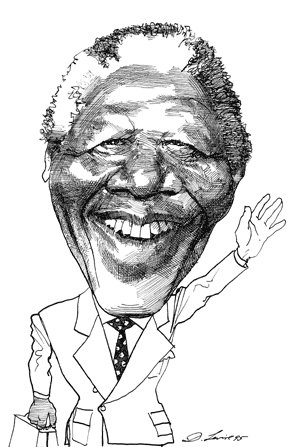
This may seem a strange time for the autobiography of Nelson Mandela to appear. He has only recently been elected president of South Africa; presumably, his days will continue to be packed with newsworthy if not historic events for the next few years at least. Mandela’s life, however, has already been so full, so improbably long and mythologically complete, that his current employment can almost be read as a postscript. Certainly Long Walk to Freedom does not give the impression of being a premature work. It is, in fact, timely in that some of its main themes—the complex alliance between South African Communists and African nationalists, the generational conflicts within the democracy movement, the tension between rural traditionalists and Westernized city folk—prefigure major political issues in the new South Africa. More than that, the book answers, not always intentionally, some fundamental questions about the extraordinary Mosaic figure who has become South Africa’s first democratically chosen leader.
He was born in 1918 in the Transkei, a beautiful, deeply impoverished, green-hilled region on the Indian Ocean coast which is the home of the Xhosa-speaking people. Mandela’s father, a local chief, was a member of the royal house of the Thembu tribe, whose kings he served as a counselor. Although illiterate, he was a celebrated public speaker: his son, Rolihlahla, who only got the name Nelson from a teacher on his first day at school (Rolihlahla is Xhosa, we are told, for “trouble-maker”), so admired his father, who had a tuft of white hair above his forehead, that he used to rub ashes into his own hair to get the same effect.
His father was stripped of his chieftainship, however, after challenging the authority of a local white magistrate, and he died when Nelson was nine. Mandela was taken into the household of the acting Thembu regent, a relatively grand, cosmopolitan place at a Methodist mission station where people wore Western clothes and the young Mandela was free to watch the royal court conduct its business in long, colorful, public meetings whose style of consensual decision-making he still admires. The regent saw in Mandela a future royal counselor and made sure he went to school. At the same time, Mandela had a traditional rural Xhosa boyhood: hunting birds with slingshots, working as a shepherd, and being ritually circumcised in public at the age of sixteen. (It was, he writes, “a sacred time; I felt happy and fulfilled taking part in my people’s customs….”)
The story of Mandela’s youth serves various purposes. As the country boy progresses from the outermost precincts of what were then called “the reserves” through a series of mission schools and colleges, each more sophisticated than the last, on to the University College of Fort Hare (the only residential university for blacks in South Africa at the time), and finally, in early 1941, to the modern city of Johannesburg, his story reveals as much about the emerging complexity of African society, particularly the great and growing distance between rural and urban life, as it does about Mandela’s education and growth. It also helps to explain the mature revolutionary’s surprising solicitude in later years toward traditional leaders and their followers—when few of his comrades had any time for hereditary chiefs and kings.
Mandela’s political awakening was slow and halting. The first speech that he ever heard denouncing the oppression of blacks in their own land was given by a chief after his circumcision, and he was horrified. “At the time, I looked on the white man not as an oppressor but as a benefactor,” he writes, “and I thought the chief was enormously ungrateful.” College friends who declined to kowtow to whites also upset him. His ambition was to become a civil servant in the Native Affairs Department, not a career for the defiant. Something of a tribal chauvinist, he made his first Sothospeaking friend at college, and, he writes, “I remember feeling quite bold at having a friend who was not a Xhosa.” But Mandela became involved in student politics at Fort Hare, where his classmates included Oliver Tambo, the future ANC president, and he came into conflict with the school’s white principal. His guardian, the Thembu regent, ordered him to capitulate to the principal, and then announced, unrelatedly, that he had arranged for Mandela a traditional marriage. Mandela, unwilling to marry (or capitulate), fled in secret to Johannesburg. It was his first act of rebellion in what became a lifetime of it.
Scrambling to survive in Johannesburg, he lived in a dirt-floored shack in the violent, overcrowded township of Alexandra. He worked briefly as a mine policeman, and then met Walter Sisulu, a self-educated young realestate agent and ANC activist, also from the Transkei. Sisulu, learning that Mandela now hoped to become a lawyer, arranged a job for him as a clerk at a liberal Jewish law firm. Mandela worked hard, studying at home by candlelight. He made his first white friend, a young Communist Party member and fellow law clerk, and in 1942 received his BA by correspondence. (He completed his apprenticeship and became a lawyer in 1951.)
Advertisement
Politically, he was still on the sidelines. While he marched in support of the great Alexandra bus boycott of 1943, he worried that activism might hurt his future career as a lawyer. And yet he found himself drawn gradually into politics.
I had no epiphany, no singular revelation, no moment of truth, but a steady accumulation of a thousand slights, a thousand indignities, a thousand unremembered moments, produced in me an anger, a rebelliousness, a desire to fight the system that imprisoned my people.
Mandela joined the ANC, which had been fighting for African rights since 1912, and fell under the sway of Anton Lembede, a fiery young African nationalist who distrusted Communists, especially white Communists, and believed that the ANC, then under the leadership of Dr. A. B. Xuma, had become complacent. With Lembede, Sisulu, Tambo, and others, Mandela helped found, in 1944, an ANC Youth League, dedicated to opposing white-minority rule with renewed militancy. Though many ANC members were Communists, Mandela opposed joint campaigns with the Party. Like his fellow African nationalists, he believed that because of their superior educations white and Indian leftists, many of them Communists, tended to dominate alliances with Africans. He even feared they were trying to take over the ANC: the Youth League sought, without success, to have Communists expelled from the ANC.
Mandela rose rapidly within the Congress. Although he had reconciled with his former guardian, the Thembu regent, it was already clear that Mandela was destined for a career in national, not tribal, politics. Then, in 1948, the Afrikaner-nationalist National Party, running on a rabidly racist platform known as apartheid—“apartness”—won the white general election, and the stakes in the freedom struggle were drastically raised.
Mandela’s account of the first fifteen years of Nationalist rule provides a fascinating self-portrait of the young politician maturing under fire. We see the government’s repression from the receiving end: the nightmare wave of post-1948 apartheid legislation, the outlawing of the Communist Party, the disastrous state takeover of black education from the missions, the “banning” of dissidents (including Mandela). He describes the grotesque and seemingly endless trial (it started in 1956, and lasted more than four years) of 156 resistance leaders for treason (all, including Mandela, were acquitted, the state having totally failed to convince a three-judge panel that the defendants had conspired to violently overthrow the government), and the banning of the ANC in 1960, after which its leaders were hounded into prison and exile.
We see, too, from an inside perspective, the ANC’s response: the move to mass civil disobedience, the creation of a united front with the banned Communists, and the replacement of the Xuma leadership by Mandela and his peers, who mounted campaigns against the pass laws and the inferior education given to blacks. Nonracialism became the movement’s dominant creed, causing African nationalist groups to break away (the rival Pan-Africanist Congress was the product of one such breakaway).
During this time Mandela was steadily gaining confidence as a speaker and leader, outgrowing his fear of white and Indian domination of the ANC. He studied Marxism (and accepted Communists as allies), becoming an ardent nonracialist—and losing his faith in the law.
As a student, I had been taught that South Africa was a place where the rule of law was paramount and applied to all persons, regardless of their social status or official position. I sincerely believed this and planned my life based on that assumption. But my career as a lawyer and activist removed the scales from my eyes…. I went from having an idealistic view of the law as a sword of justice to a perception of the law as a tool used by the ruling class to shape society in a way favorable to itself.
Mandela describes in detail the internal debates over resistance strategy, with himself surprisingly often on the losing side. He advocated, for instance, ANC participation in the Bantustan administrations when they were created, a proposal that was roundly rejected. On another occasion, in 1953, the national leadership censured him for a speech that implicitly rejected the official policy of nonviolent protest. Recounting these events, Mandela is bitingly self-critical. “I was a young man who attempted to make up for his ignorance with militancy” is his judgment on an argument he had with ANC elders after he accused them of being afraid of whites.
He makes no effort, moreover, to gloss over the ill effects of his activism on his private life. His law practice, in partnership with Oliver Tambo, degenerated from being a thriving concern—the first African law firm in the country—to losing money and clients until it expired. His first marriage suffered a similar fate. His wife, who could not understand why her husband wouldn’t simply return to the Transkei to practice law and live in provincial prosperity, turned to evangelical Christianity and, in 1956, while Mandela was briefly in jail awaiting arraignment, she left him. Now, nearly forty years later, the pain of this breakup and of the separation from his first three children still lingers in Mandela’s account.
Advertisement
A certain solemnity, even sententiousness, sometimes creeps into his book when he seeks to extract a simple moral from events. This off-note is usually signaled when he uses the term “freedom fighter,” as in, “It is important for a freedom fighter to remain in touch with his own roots,” or “The children of a freedom fighter also learn not to ask their father too many questions.” But this puffed-up tone is nicely cut by the vinegar of his candor about his own fears, vanities, blunders, and ambivalences, and by occasional flashes of an anarchic sense of humor. When, for instance, he and scores of his comrades, including the entire executive leadership of the ANC, were arrested for treason in 1956 and made to stand naked in a cold prison courtyard for more than an hour, Mandela was amused.
Despite my anger, I could not suppress a laugh as I scrutinized the men around me. For the first time, the truth of the aphorism “clothes make the man” came home to me.
That he could laugh at himself and his comrades while in prison would later serve him well.
The regime banned the ANC in the wake of the 1960 Sharpeville massacre, and Mandela and his comrades were driven underground. Many went into exile, and in 1961 the ANC decided to take up arms against the state. An armed wing, known as Umkhonto we Sizwe (“The Spear of the Nation”), was founded, with Mandela as its commander. In early 1962 he slipped out of the country and traveled across Africa, seeking the backing of newly independent states for the ANC’s armed struggle. He visited Oliver Tambo in London, where Tambo was establishing the movement in exile, and received two months of military training in Ethiopia. On August 5, 1962, shortly after returning to South Africa, Mandela was captured near Pietermaritzburg. He does not believe, as many have suggested, that the CIA had a hand in his arrest. In any event, he was firmly in the grasp of the enemy now, and would remain there for the next twenty-seven years.
2.
More than two hundred pages of his autobiography are devoted to Mandela’s years in prison. Most of that time he spent on Robben Island, a notorious place where all the guards were white, all the prisoners black, and conditions were almost medievally harsh. Mandela and his fellow prisoners were put to work for thirteen years in a primitive lime quarry where the dust and ferocious light—for years they were not permitted sunglasses—permanently damaged his eyes. And yet his tone while recounting the physical horrors of incarceration is modest, even discreet to a fault. I only know of the damage to his eyes, for instance, because I read about it in a newsmagazine; it is not in the autobiography. Recalling an all-night, thousand-mile trip with four other prisoners in a windowless van, he notes simply, “It is not an easy or pleasant task for men shackled together to use a sanitary bucket in a moving van.” Even so, the account of prison life given here is harrowingly concrete. It is full of small suggestive details such as the way prisoners would sprinkle sand along the corridor to their cells so they could hear an approaching guard’s footsteps.
Some of Mandela’s closest comrades, including Walter Sisulu, Govan Mbeki, and Ahmed Kathrada, all of whom were captured in a raid near Johannesburg in 1963, were imprisoned with him. Evidence seized in the raid, including the ANC’s plan for guerrilla warfare, was used to put Mandela, who had been sentenced originally to five years for inciting workers to strike and for leaving the country illegally, on trial again, this time for sabotage and conspiracy. It was a group trial and all of the accused, including Mandela, received life sentences.
Communication among the Robben Island political prisoners was brutally discouraged—virtually all conversation was forbidden, as was singing (or whistling) while at work in the quarry—and prisoners devised some ingenious evasions: writing messages, for instance, in milk that disappeared when the milk dried but reappeared when a cell disinfectant was sprayed on the page. While the extreme restrictions on speaking, reading, and writing were eased over the years, it is clear from Mandela’s account that the esprit de corps among his ANC comrades remained crucial to his own psychological survival.
Not that harmony necessarily came easy. Again, Mandela describes the internal debates they held on a range of questions, from the relationship between the ANC and the Communist Party to minute points of conflict with the prison authorities; and again Mandela was regularly overruled by his mates. When his nephew, K. D. Matanzima, who had become the prime minister of the “self-governing” Transkei bantustan, wanted to visit Mandela, for example, Mandela was inclined to permit it, believing he might persuade his nephew to stop cooperating with the regime. But the visit was vetoed by the other prisoners, who believed it would only help Matanzima politically.
As restrictions on studying by correspondence were eased, Robben Island became known, Mandela reports, as the University. In truth, it was known as Mandela University, particularly after the Soweto student uprising of 1976 brought a new generation of captured revolutionaries to sit, as it were, at Mandela’s feet. The importance of this convergence can scarcely be overstated. The student leaders of the 1970s were nearly all members of the Black Consciousness movement, with a dim understanding at best of the ANC, which had been virtually invisible within South Africa for their entire political lives (and was not thriving in exile either). Their ideology was in fact closer to the African nationalism of the Pan-Africanist Congress, many of whose leaders were also imprisoned on Robben Island. But the influence of men like Mandela and Sisulu proved decisive in winning over many key figures of the younger generation, such as Patrick Lekota, who is today the premier of the Orange Free State, to the nonracial line of the ANC. As this generation was gradually released during the 1980s, its members spread the word, and as a result the ANC and its allies were greatly rejuvenated.
But the education the prisoners received on Robben Island cut both ways. Mandela and his peers kept abreast of resistance politics by talking to the new arrivals, including captured fighters from Umkhonto we Sizwe. They were sometimes taken aback by the militancy of the younger radicals, who clearly regarded the older men as ineffectual moderates. Mandela fretted about developing “a mind-set that was no longer revolutionary.” He looked forward, always, to the day when he would be free, and on that day, “I did not want to appear to be a political fossil from an age long past.”
He also fretted, seemingly constantly, about his family. The conflicting loyalties he felt between the liberation struggle and his family responsibilities had continued to torment him in his second marriage, to Nomzamo Winnifred Madikizela, even though she had become, both under his tutelage and in his absence, a committed activist herself. Mandela was racked with guilt about the hardships Winnie and their children had to face without him, especially once the state began to harass her. Cruel restrictions on letters and visits meant that he hardly knew his own children, and for twenty-one years he and Winnie did not so much as touch hands. (The restrictions were relaxed considerably after he was moved from Robben Island to Pollsmoor prison, on the mainland, in 1982.) Even so, he turned down every suggestion from the regime that his sentence might be reduced in exchange for political concessions, such as his recognizing the legitimacy of the Transkei government or renouncing the armed struggle.
The story of the secret negotiations between Mandela and the government that began in the mid-1980s has been ably told elsewhere, 1 with special emphasis on a point that Mandela himself does not mention: by accepting Mandela’s invitation to talk, the government clearly hoped to split the ANC, counting on hard-liners, including Communists, and on exiles generally—among whom the fantasy of total victory still had some adherents—to react badly to the news that he was meeting with the enemy.
As usual, the regime underestimated its opponent. Within the resistance there were tensions and suspicions on the subject, and Mandela, who was by now housed separately at the Pollsmoor prison, knew well that he was carrying on talks without a mandate from the ANC; but he took pains to reassure Tambo and other leaders that he would not allow himself to be manipulated. Indeed, when Mandela discovered the depths of ignorance about the ANC among some of the government’s envoys, his sessions with them turned briefly into history lessons on the democracy movement in South Africa.
He offered no concessions, only explanations. To the regime’s idée fixe that white and Indian Communists secretly controlled the ANC, he finally replied,
You gentlemen consider yourselves intelligent, do you not? You consider yourselves forceful and persuasive, do you not? Well, there are four of you and only one of me, and you cannot control me or get me to change my mind. What makes you think the Communists can succeed where you have failed?
He also reassured the government that the ANC had no intention of driving whites into the sea. He was ultimately granted a meeting with President P. W. Botha, a meeting that, in view of Botha’s usual irascibility, went surprisingly well. And yet the government seemed paralyzed, caught between, on the one side, the immense pressure—domestic, international, economic, political—to release and lift the bans on its opponents, and start down the road to democracy, and, on the other, the sheer terror of majority rule among its constituents. In the end, this logjam was broken by Botha’s ouster. His successor, F. W. de Klerk, quickly faced up to reality and in October 1989, a month after he took office, he released Walter Sisulu and seven other prominent political prisoners. In February 1990 he freed Mandela, simultaneously lifting the bans on the ANC, the PAC, and the Communist Party.
Mandela’s account of his life since he was released is flatter and sketchier than the rest of the autobiography (which he had started writing while in prison). This may be because he was released into such an overwhelming blaze of public attention, or because he simply no longer has time for lengthy reflection. In any case, while he soon showed that he was no political fossil, traveling the globe with superhuman energy, dazzling world leaders, and obtaining unprecedented international support for the unfinished anti-apartheid struggle, there was a sense in which Mandela did seem to travel inside a subtle but unmistakable time warp. He was like an African liberator from another era—the era of Léopold Senghor and Julius Nyerere, the era of unlimited African hope. When he visited the United States a few months after his release, drawing huge crowds at every stop, he met American political culture (and politicians) at a distinct angle, mesmerizing people here with his formal manners, his elegance, precision, and seriousness. He was, one realized then, the world’s last major pre-television politician. He is an African liberator from another era. His ten thousand days in prison preserved him, in important ways, in political aspic.
It seems now that his survival may itself have forced history’s hand. That is, the two main combatants in the interminable South African struggle each seemed to come to believe they needed Mandela to play their respective endgames. The white-minority regime saw him, probably rightly, as more accommodating than his likely successors, while Mandela’s ANC comrades, including those who mistrusted his “moderation,” clearly recognized him as the only leader with enough personal popularity to ensure an ANC victory at the polls when democracy finally came. Thus both sides had, along with everything else driving them forward, a powerful interest in reaching an agreement on elections sooner rather than later.
Mandela’s decades in prison had also preserved him, in a sense, from the worst of the regime’s battering of its opponents. He and his comrades convicted in 1964 had been lucky not to be executed. (Sabotage was a capital offense, and they had vowed not to appeal a death sentence.) Over the ensuing years torture, deaths in detention, political executions, and extra-judicial executions became defining features of the South African political landscape.2 Steve Biko, perhaps the only black leader in the next generation with abilities comparable to Mandela’s, was savagely murdered in jail by the police. Mandela, while brutally silenced all those years, lived on to fight another day.
His marriage to Winnie Mandela did not survive his release, however, and their breakup is one of the few subjects on which Mandela seems an unreliable reporter.3 His choice not to write about his marital miseries is understandable, of course; his refusal to criticize his estranged wife is, in this age of celebrity divorce, admirable; and the parable he uses to express his anguish—about a beautiful tomato plant he grew on Robben Island, which inexplicably died—is deeply affecting.
Yet the “Winnie crisis” was not merely a private matter. Trouble started years before Mandela’s release, when Winnie’s growing thuggishness and lack of political discipline made her a pariah within the resistance, while giving a great deal of political ammunition to the regime and its supporters. In 1989 Mandela had to intervene from prison to convince her to release two kidnapped youths whom she was holding at her house.4 The leader of her bodyguards was later convicted of murdering another kidnapped youth. In a trial that was tainted by intimidation of witnesses, Mrs. Mandela herself was convicted of kidnapping and accessory to assault and sentenced to six years in prison, although the assault conviction was later overturned on appeal, and her prison sentence suspended.
Beyond the extensive damage to the integrity and credibility of the anti-apartheid movement caused by these events, they provoked a deep rift within the resistance. Mr. Mandela refused to repudiate his wife for many long months after his release and sought to rally support for her among ANC leaders. Only some of them were willing to overlook her behavior, which also included blatant corruption and highly visible (and for Mandela extremely humiliating) extramarital affairs.5 The couple finally separated in late 1991; their estrangement was announced publicly in April 1992.
By then, Mandela’s leadership had been badly dented, and his relations with ANC leaders who had taken a firm stand against Winnie—including Cyril Ramaphosa, one of the top candidates to succeed Mandela as ANC president—had been seriously strained. (It is no coincidence that, after the election, Ramaphosa was not made a member of Mandela’s cabinet. He has since stayed out of government, serving as ANC secretary-general. And it has not helped matters that Mrs. Mandela has forced her way into the cabinet as a deputy minister of arts, culture, science, and technology. She reportedly was able to do so because of her popularity with angry township youth.) The problem with his wife, moreover, had substantially distracted Mandela’s attention from the historic business at hand—the negotiated transition to democracy—for at least two years. While his failure to describe this awful sideshow may be defensible in an autobiography, it distorts recent South African history.
The negotiations were successfully concluded, of course, and the great democratic threshold was finally crossed on April 27, 1994. Mandela’s judgment on his chief opponent in both the negotiations and the country’s first universal elections (and his co-recipient of the 1993 Nobel Peace Prize), F. W. de Klerk, is unsentimental.
Mr. de Klerk was by no means the great emancipator. He was a gradualist, a careful pragmatist. He did not make any of his reforms with the intention of putting himself out of power. He made them for precisely the opposite reason: to ensure power for the Afrikaner in a new dispensation.
After his election victory, President Mandela made de Klerk one of his two deputy vice-presidents in a “government of national unity.” This arrangement is scheduled to last until 1999, at which time full majority rule will commence.
If history is customarily written by the victors, then Long Walk to Freedom is a highly traditional book. But what sort of book is it really? That is, how was it written, in view of the phenomenal pressure of events in Mandela’s recent life? He tells us that he first wrote his autobiography on Robben Island in the 1970s, and that this effort formed the core of the present volume, on which Richard Stengel, a contributing writer at Time, collaborated with him. According to the material accompanying an excerpt published in Time, Stengel interviewed more than fifty of Mandela’s friends, colleagues, and relatives. So Stengel’s hard work helps to explain how the book was finished. It also suggests that this was in large measure a publisher-driven venture. But to Stengel’s credit, Long Walk to Freedom never reads like an as-told-to book. While clearly intended to sustain the legend of its author’s life, it has an easy, transparent eloquence. With its memoir-like intimacy and its historical sweep, it sounds like Mandela.
And yet it does not end on the triumphal note one might expect. Having become his country’s president, Mandela is in a position to know that “with freedom come responsibilities.” The challenges of governance will allow him no rest, and they will rarely offer the moral clarity that opposition to apartheid did. Indeed, some of the issues now taking up the attention of the Mandela administration—how to attract and retain foreign investment, how to end the long-running rent boycott in the black townships, how to deal with traditional African leaders, what to do with the profitable, apartheid-generated arms industry—are full of political and ethical ambivalence. Some of these issues also seem tailor-made to sow dissension within the ranks of the ANC, where both Communists and African nationalists are unhappy with many of the new government’s policies, particularly its collaboration with large white-owned businesses.
Beneath the account of new challenges and burdens at the end of Mandela’s book, however, is a deeper note: a heavy feeling of simple loneliness. His longing for the comforts of family life is one of his story’s major refrains, and it seems to have gone unfulfilled. Characteristically, he blames himself, writing that “my commitment to my people, to the millions of South Africans I would never know or meet, was at the expense of the people I knew best and loved most.” It is a harsh but not an overblown self-judgment. Mandela’s identification with South Africa as a whole is remarkable. While in prison, he reports, he read and reread War and Peace, and he was particularly taken with the character of General Kutuzov, who “defeated Napoleon precisely because he was not swayed by the ephemeral and superficial values of the court, and made his decisions on a visceral understanding of his men and his people.” Mandela defeated apartheid in much the same way.
This Issue
February 2, 1995
This Issue
February 2, 1995
-
1
See Allister Sparks, “The Secret Revolution,” in The New Yorker, April 13, 1993. For a fuller version of this story, see his forthcoming Tomorrow Is Another Country: The Inside Story of South Africa’s Road to Change (Hill and Wang, 1995). See also David Ottaway, Chained Together: Mandela, De Klerk, and the Struggle to Remake South Africa (Times Books, 1993), pp. 25-31. ↩
-
2
Gross human rights abuses also occurred in ANC training camps, prisons, and residences in Angola, Tanzania, Zambia, and Uganda. See Amnesty International, South Africa: Torture, ill-treatment and executions in African National Congress camps (London, December 1992). In October 1992 the ANC published the report of an internal commission of inquiry into the abuses, with Mandela, who had by then succeeded Tambo as ANC president, speaking for the leadership and taking full responsibility for the horrors uncovered. No ANC officials have been charged or punished to date, however. ↩
-
3
Another is the ANC’s behavior in a bloody shootout in downtown Johannesburg shortly before the April 1994 elections. Fifty-three people died, most of them members of the ANC’s Zulu-nationalist rival, the Inkatha Freedom Party. In one incident, ANC security guards fired into a crowd of Inkatha marchers, killing at least eight. ↩
-
4
See Ottaway, Chained Together, pp. 144-145. Ottaway writes, “Whatever the cause, or combination of causes, Winnie Mandela by 1990 appeared to be truly mentally ill” (p. 140). ↩
-
5
See Mary Benson, Nelson Mandela: The Man and the Movement (Norton, 1994), pp. 214, 252, 258, 263. Also see Ottaway, Chained Together, pp. 158–159. ↩