1.
Allen Ginsberg died on April 5, 1997, in the loft on East Thirteenth Street that he had purchased a couple of years earlier with money raised from the sale of his vast archive to Stanford University. Although his collection of drafts, letters, journals, and photographs had been assessed as worth over $5 million, such a sum could only have been realized if Ginsberg had agreed to split up his holdings and hive them off to different institutions. He hated this idea, and decided instead to settle for the cool million offered by Stanford. All parties involved in the deal agreed not to divulge the price for fear it might attract adverse publicity, but Ginsberg, never a great secret-keeper, volunteered the figure to the first reporter who got wind of the sale, and this ignited one of the innumerable mini press controversies that, since the trial of “Howl” in 1957, had done so much to make Ginsberg into a household name, even in households utterly uninterested in poetry. This being the Nineties, it was his membership of NAMBLA (the North American Man/ Boy Love Association) rather than his denunciations of US foreign policy or use of obscene words or promotion of illegal drugs or antinuclear protests that generated the headlines: “Pro-Pedophile Poet Paid $1M by Stanford” was the story line.
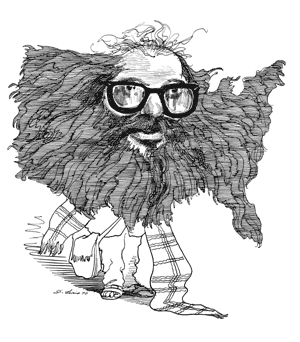
Meanwhile, liberals were still sniping at him for having appeared, the year before, cross-legged before his household shrine in a Gap advertisement promoting a style of loose-fitting khaki trousers. The $20,000 he received for this went toward shoring up the shaky finances of the Naropa Institute, the Buddhist university in Boulder, Colorado, founded by the Tibetan Lama Chögyam Trungpa, who functioned as Ginsberg’s spiritual adviser from 1974 until the holy man’s premature, alcohol-fueled death in 1987. Although Ginsberg had insisted that the ad include a disclaimer stating that all proceeds would go to support Naropa, inevitably he found himself presented as yet another lapsed counterculture hero succumbing to what “Howl” calls “the nitroglycerine shrieks of the fairies of advertising.”
The purchase of the loft on East Thirteenth Street, in a building owned by the painter Larry Rivers, was not Ginsberg’s first venture into real estate. In 1967 he bought a seventy-acre spread in upstate New York near Cherry Valley, despite the dilapidated state of the farmhouse, which lacked heating and water, and shortly after that purchased twenty-four acres of land in the Californian Sierras, on which, in 1974, he and Peter Orlovsky and friends built a cabin they called Bedrock Mortar. At heart, however, Ginsberg was a city dweller, and a wanderer, and he spent little time in either of his pastoral retreats. He abandoned the Cherry Valley farm in 1985, and seven years later sold his land in the Sierras to Gary Snyder, whose property it adjoined.
One of the many fascinating aspects of Bill Morgan’s I Celebrate Myself: The Somewhat Private Life of Allen Ginsberg is the insight it provides into the poet’s relationship with money, a subject addressed directly in the poem “American Change,” composed in 1958 during Ginsberg’s return by sea to New York after a year and a half spent in North Africa and Europe: “Money, money,” he declares, while contemplating a nickel, a dime, a quarter, and a $5 bill, “reminder, I might as well write poems to you—dear American money—O statue of Liberty I ride enfolded in money in my mind to you.” It was Bill Morgan, Ginsberg’s archivist and bibliographer, who negotiated the sale of the poet’s papers to Stanford. He was also one of an ever-expanding backroom team that helped run the poet’s affairs like a small cottage industry out of an office rented on Union Square. By the early Nineties there were as many as seven or eight people on the Ginsberg payroll, and yet, Morgan notes, “Allen was able to create more work than they could all handle.”
Ginsberg’s artistic enterprise, like that of Andy Warhol, was essentially a communal one. (There is an amusing description in Jane Kramer’s Allen Ginsberg in America, first published in The New Yorker in 1968, of a meeting between the two in the backroom of Max’s Kansas City. “Hare Krishna,” intones Ginsberg, giving Warhol a hearty slap on the back, at which the artist winces slightly. “Wow” is the only word Warhol utters in response to Ginsberg’s enthusiastic description of a poetry reading by Basil Bunting, and then to a barrage of insults from Gregory Corso.*) Both Warhol and Ginsberg depended on the creation of an environment in which visionary comrades and ancillary support staff collaborated to project a particular style of living and a shared aesthetic and moral (or, in the case of Warhol, amoral) agenda.
In broad outline such projects can be seen as replicating many of the principles and ideals of the Founding Fathers, and certainly more than once reading I Celebrate Myself I was reminded of John Winthrop’s stirring address to his fellow Puritans on the deck of the Arbella in 1630:
Advertisement
Wee must be knitt together in this worke as one man, wee must entertaine each other in brotherly Affeccion, wee must be willing to abridge our selves of our superfluities, for the supply of others necessities, wee must uphold a familiar Commerce together in all meekeness, gentlenes, patience and liberality, wee must delight in eache other…for wee must Consider that wee shall be as a Citty upon a Hill, the eyes of all people are upon us.
Of course Warhol, whose career began with “the fairies of advertising,” had no qualms about allowing his work to circulate in the intertwined economies of celebrity and financial exchange that the Factory both emulated and parodied. For Ginsberg, however, brought up a Communist, his fame founded on denunciations of Moloch (“whose blood is running money!…whose soul is electricity and banks!”), the issue of how much he should be allowed to earn and spend was never clear-cut. The eyes of all people were upon him, and when in 1985 he sold the rights to his Collected Poems to Harper and Row, with the full permission of, and due dividend paid to, Lawrence Ferlinghetti of City Lights, Time magazine unkindly and unjustly took advantage of the Bell’s palsy that afflicted the poet’s left eye to characterize him as a shrewd and hypocritical financial operator:
It requires vision and careful work to make a life, let alone leave a literary legacy. This follower in Whitman’s footsteps has shown that he is capable of both. One can see it in his eyes: one wide and innocent, gazing at eternity; the other narrowed and scrutinizing, looking for his market share.
Morgan reveals in full detail just how extraordinarily—at times even foolishly—generous Ginsberg was throughout his life. For many years he refused to accept payment for readings, living on a shoestring on his royalties, but in 1964 founded an organization he called the Committee on Poetry—COP for short—in order to generate funds to fight the New York authorities’ attempt to crack down on the burgeoning underground scene, which even involved insisting that coffeehouses such as Le Metro buy prohibitively expensive cabaret licenses if they wanted to stage poetry readings. COP took on the City License Department, and won.
Thereafter the committee metamorphosed into an action group that supported similar anticensorship causes, such as the defense of Lenny Bruce, and then into a permanent not-for-profit foundation that would make grants to poets in need—i.e., Ginsberg’s myriad artistically inclined friends. In 1966 he decided he would demand fees for poetry readings, but all payments would go to COP, which began disbursing money to people such as Herbert Huncke (a Times Square hustler much mythologized by the Beats), Gregory Corso (who, like Huncke, spent most cash that came his way on drugs), a hippie friend known as Maretta to fund a spiritual pilgrimage to Outer Mongolia, and so on. It was with COP funds that he bought his land in the Sierras and the Cherry Valley farm, which he envisioned as an exemplary community in a “lonely Eden,” rather as the Puritans figured their first settlements as beacons of right living in the Promised Land.
Not all, of course, agreed that this move was groovy. In Allen Ginsberg in America Kramer describes a meeting of the radical Diggers that Ginsberg attended in Haight-Ashbury. Her account gives an illuminating sense of the kinds of resentment that Ginsberg’s success generated among others in the counterculture. “What does a guy like me do who’s making some bread and decides he wants to buy a little piece of land?” Ginsberg demands when berated by an enraged Digger. “Let’s cut the money,” the Digger responds fiercely. “Say I make beads and you make sandals—we’ll trade them.” “Who’s going to decide how much each of Allen’s poems is worth?” inquires another. They bat this to and fro awhile, until the angry Digger ends up declaring contemptuously, “Allen’s just a rich Jewish merchant.”
2.
Ginsberg’s life must be more exhaustively documented than that of any other poet of the twentieth century. His record-keeping began early, and he is engagingly frank about its origins: “Began writing to (I suppose) satisfy my egotism,” opens his journal entry for May 22, 1941, when he was still only fourteen. Morgan describes Ginsberg’s outsized ego as one of his “greatest problems,” although it was also, as the journal entry acknowledges, the source of his urge to write: “I want to be known as the most brilliant man in America,” he confesses in “Ego Confessions,” as well as “to set surpassing example of sanity as measure for late generations.” Both biographer and poet proffer Whitman as the template for Ginsberg’s compendious self-celebrations, though one can read Leaves of Grass many times without feeling one knows its author at all, whereas there is nothing mysterious or withheld about the Ginsberg poetic persona as it develops in the course of the 1,161 pages of his Collected Poems.
Advertisement
“Howl” is undoubtedly the watershed moment, the “breakthru” poem that changed his life, and is now being marketed as “The Poem That Changed America” too. Paradoxically, its impact on the culture at large depended to a great extent on the absurd attempt of the San Francisco collector of customs, one Chester MacPhee, to have the book banned as obscene: “You wouldn’t want your children to come across it,” he opined of a poem destined to become one of the most widely taught in American history. “I suppose the publicity will be good,” observed Ginsberg, who had spent several years in his twenties working in marketing, in reply to a letter of Ferlinghetti’s informing him of the Customs’ swoop and seizure of 520 copies of the second printing.
The trial attracted large crowds and was covered extensively in the press. The prosecution mustered only two somewhat dubious witnesses: David Kirk, an assistant professor of English at the University of San Francisco, declared “Howl” of “negligible” literary value because too closely imitative of Whitman—but such an assessment hardly justified banning the poem; and one Gail Potter, after distributing little brochures announcing the lessons she offered in speech and diction, and revealing, to the gallery’s great amusement, that she had rewritten both Faust and Everyman, complained of Ginsberg’s poetry that “you feel like you are going through the gutter when you have to read that stuff. I didn’t linger on it too long, I assure you.”
As in other famous twentieth-century obscenity trials, such as that of the nonexistent Australian poet Ern Malley or that of Lady Chatterley’s Lover, proceedings often verged on the farcical: “What are ‘angelheaded hipsters’?” demanded the deputy district attorney of the literary critic Mark Schorer, who was then asked to paraphrase lines such as “Who got busted in their pubic beards returning through Laredo with a belt of marijuana for New York” and “With dreams, with drugs, with waking nightmares, alcohol and cock and endless balls.” Even Ginsberg’s right to use the word “bullshit” was queried. In his final ruling Judge Clayton Horn insisted that to impose “vapid innocuous euphemism” on Ginsberg’s graphic and figurative language would be to violate the First and Fourteenth Amendments.
Many of the contributors to Jason Shinder’s collection of essays celebrating the poem’s fiftieth anniversary begin by recalling when and where they were when they first came across the poem: novelist Rick Moody was introduced to it by a punk rocker he calls Mike Velocity while he hung with a band of Providence vagrants by a wall in front of the Hospital Trust Bank; Amiri Baraka (formerly LeRoi Jones) was stationed in Puerto Rico with the US Air Force; Luc Sante, Anne Waldman, Phillip Lopate, Kurt Brown, and Mark Doty were thirteen or fourteen and in school, and on all it had a catalytic effect. Their testimonies do much more to capture the originality and energy of the poem than professional literary critical scrutiny, to which Ginsberg’s poetry seems to me largely immune.
Perhaps the most important thing he learned from his studies at Columbia in the late Forties was how much he hated the literary critical establishment, especially that segment of it presided over by Lionel and Diana Trilling. “Howl,” both the poem itself and its success in the world, proved that poetry might have a life outside the groves of academe, might be written without a knowing wink to other poet-critics brought up on Cleanth Brooks’s The Well-Wrought Urn and William Empson’s Seven Types of Ambiguity. “The stance,” as Baraka puts it, summing up the responses of so many searching for something beyond the “oatmeal lying” culture of the Fifties; “The sense of someone being in the same world, the defiance.”
Many of Ginsberg’s greatest hits are to be found in this first volume: in “Dream Record: June 8, 1955,” he is visited by the ghost of Joan Burroughs, “her/face restored to a fine beauty/ tequila and salt had made strange/before the bullet in her brow.” The bullet had, of course, been put there by her husband four years earlier in the course of a tragic game of William Tell played out in Mexico City. Ginsberg questions her:
—Joan, what kind of knowledge have
the dead? can you still love
your mortal acquaintances?
What do you remember of us?
She
faded in front of me—The next instant
I saw her rain-stained tombstone
rear an illegible epitaph
under the gnarled branch of a small
tree in the wild grass
of an unvisited garden in Mexico.
In “A Supermarket in California” he imagines running into his greatest poetic hero while out shopping:
I saw you, Walt Whitman, childless, lonely old grubber, poking among the meats in the refrigerator and eyeing the grocery boys.
I heard you asking questions of each: Who killed the pork chops? What price bananas? Are you my Angel?
I wandered in and out of the brilliant stacks of cans following you, and followed in my imagination by the store detective.
We strode down the open corridors together in our solitary fancy tasting artichokes, possessing every frozen delicacy, and never passing the cashier.
And in “America” he perfects the mixture of naive outrage and hyperbolic absurdity so crucial to his unique brand of comedy:
America I’ve given you all and now I’m nothing.
America two dollars and twentyseven cents January 17, 1956.
I can’t stand my own mind.
America when will we end the human war?
Go fuck yourself with your atom bomb.
I don’t feel good don’t bother me.
I won’t write my poem till I’m in my right mind.
America when will you be angelic?
When will you take off your clothes?
When will you look at yourself through the grave?
When will you be worthy of your million Trotskyites?
America why are your libraries full of tears?
America when will you send your eggs to India?
I’m sick of your insane demands.
When can I go into the supermarket and buy what I need with my good looks?
Even in the course of his most bitter jeremiads Ginsberg never quite loses faith in the possibility of an America reshaped according to his utopian ideals. Much of his poetry’s effectiveness depends, as a character in a Saul Bellow short story of 1974 called “Him With His Foot in His Mouth” points out, on a fusion of the traditional Jewish role of “comic self-degradation” with an unassailable American optimism: “Under all this all-revealing candor (or aggravated self-battery) is purity of heart,” Bellow’s narrator muses:
As an American Jew he must also affirm and justify democracy. The United States is destined to become one of the great achievements of humanity, a nation made up of many nations (not excluding the queer nation: how can anybody be left out?). The U.S.A. itself is to be the greatest of poems, as Whitman prophesied. And the only authentic living representative of American Transcendentalism is that fat-breasted, bald, bearded homosexual in smeared goggles, innocent in his uncleanness. Purity from foulness…. The man is a Jewish microcosm of this Midas earth whose buried corpses bring forth golden fruits.
Hence the comically defiant and determined ending of “America”: “America I’m putting my queer shoulder to the wheel.”
Ginsberg’s poems repeatedly invite us to participate in his own physicality, which even in old age he presents as “unashamed wide open for joy.” In “Sphincter,” written in 1986, he celebrates his “rubbery muscular” anus, which, despite AIDS and “occasionally a small hemorrhoid” (these get much worse in the Nineties as his death nears), is still “active, eager, receptive to phallus/coke bottle, candle, carrot/ banana & fingers”:
out with the dumps, in with the condom’d
orgasmic friend
Of course not all Ginsberg’s poems successfully alchemize his flesh so that it brings forth golden fruits. After “Kaddish,” his great lament for his mother, who suffered from paranoiac delusions and was eventually lobotomized, an operation Ginsberg himself had to authorize, the misses begin to outnumber the hits.
On a good day his compositional mantra of “First thought, best thought” could result in verse of enchanting freshness and freedom, but it also allowed much that is footling, windy, and banal to find its way into print. The problem was partly with Ginsberg’s quite extraordinary celebrity, and the multiple roles he assumed as a counterculture figurehead; increasingly he had less and less time to write—and hanging out with Bob Dylan and the Beatles also began to make him wonder if poetry was the best way of reaching the kinds of audiences he yearned for. His description of a Beatles concert at Portland Coliseum in 1965 conveys envy as well as excitement, and the occasional traces of exasperation in Morgan’s on the whole highly admiring account of Ginsberg’s extraordinary life normally concern his fantasies of being a rock star.
Certainly dreams of fame vanquished the quest for inner enlightenment in November of 1975, when he canceled plans to spend a month at a Buddhist meditation center in Vermont to join the motley crew assembled by Dylan for his Rolling Thunder Revue. In Renaldo and Clara, the four-hour film that emerged from this tour, Ginsberg is cast as the alchemist king whose role is to awaken America to its spiritual redemption. He plays the part convincingly enough while trading gnomic utterances with Dylan beside the grave of Kerouac in Lowell, Massachusetts, but the size of the task confronting him is made painfully clear in a rather unkind scene shot in a New England resort hotel: here Ginsberg reads “Kaddish” to an assembly of mahjongg-playing grandmothers, who pay him almost no attention; the clicking of their tiles almost drowns out the poem.
3.
The spiritual, and sexual, revolution of which Ginsberg dreamed was to be fomented initially by the lives and writings of a set of friends he made during his time at Columbia. He met Burroughs in December of 1943, Kerouac a few months later, and Neal Cassady shortly after the “cocksman and Adonis of Denver” arrived with his sixteen-year-old wife LuAnne in late 1946. Street smart, a compulsive liar, blessed—or cursed—with an insatiable sexual appetite, Cassady soon figured out how to impress the thrill-seeking Upper West Side intellectuals who were to ensure his Beat immortality. In truth, winning over the somewhat geeky and love-hungry young Ginsberg seems not to have been too difficult, once the irresistibly handsome Cassady had decided a night of gay sex was adequate “compensation to you,” as he put it in a letter to Ginsberg, “for all you were giving me,” by which he meant intellectual stimulation. The night in question, one of all too few as far as Ginsberg was concerned, is graphically described in “Many Loves,” which perhaps also offers some insight into Ginsberg’s lifelong propensity to fall in love with straight men:
I first touched the smooth mount of his rock buttocks, silken in power,
rounded in animal fucking and bodily nights over nurses and schoolgirls….
Morgan reports Ginsberg “puzzled” by the fact that the “manly attachments,” to borrow a phrase of Whitman’s, that he coveted were nearly all with heterosexuals. This aspect of his sexual makeup led to much grief, and terrific feats of rhetorical and amative ingenuity: he became adept at talking men such as Cassady and Peter Orlovsky into bed with him, but then faced the problem of sustaining his beloved’s sexual interest. “Group sex,” Morgan explains,
seemed to be the best solution for Allen, since he loved straight men so much. Even if a young man was unwilling to get into bed with Allen, he might be willing to wind up naked with him if there were one or two women involved. Then during love play Allen could focus his attentions on the man instead of the woman.
Drugs also helped, as did fame: many a poem from the years he spent teaching at Naropa recounts his delight at finding young straight would-be poets willing to extend their education into the maestro’s bedroom: “Mind tender, he loves girls / Sees me as poetry master / His pubic hair’s soft curls / press my breast to rapture,” he enthuses in a typical example of this genre, “The Guest.”
It was while living as Ginsberg’s guest in New York in 1953 that William Burroughs decided that he wanted to take full possession of Ginsberg’s heart and body and soul—an absorptive process he called “schlupping.” Although an enormous admirer and promoter of Burroughs’s writing, Ginsberg found the idea of being schlupped by him abhorrent, brutally telling his erstwhile mentor and analyst he didn’t want his “ugly old cock” anywhere near him. Ginsberg was, however, fascinated by accounts of the hallucinogenic effects of a plant called yagé that Burroughs had traveled earlier that year to the Amazon to find and sample. In the course of this trip Burroughs wrote Ginsberg a series of letters (first published by City Lights in 1963) that present some of the earliest glimpses of the persona that The Naked Lunch would launch upon the world some six years later. Here he is in Pasto, Columbia, for instance:
I saw working behind the bar what looked at first like an attractive boy of 14 or so (the place was dimly lit owing to a partial power failure). Going over by the bar for a closer look, I saw his face was old, his body swollen with pith and water like a rotten melon.
Yagé itself makes Burroughs vomit uncontrollably and collapse into numb dizziness: “Larval beings passed before my eyes in a blue haze, each one giving an obscene, mocking squawk (I later identified this squawking as the croaking of frogs).” His letters maintain a tone of caustic disaffection that is at the opposite pole from the hopped-up enthusiasm that characterizes so much Beat writing. In 1960, Ginsberg set off into the Peruvian hinterland in search of his own yagé-inspired mystical visions, and under the influence of the drug (again after much vomiting) saw “what I thought was the Great Being, or some sense of It, approaching my mind like a big wet vagina.” A confrontation with death ensues, and this leaves Ginsberg feeling “lost” and thinking of “poor Peter who depends on me for some Heaven I haven’t got, lost.”
Poor Peter…despite the ménages à trois or more, the 1977 publication by City Lights of his Clean Asshole Poems and Smiling Vegetable Songs, the celebrity he gained from stripping onstage during readings, despite Ginsberg’s unwavering financial support and steady flow of poetic tributes and willingness to put up with frequent drug and drink binges, Peter Orlovsky emerges from Morgan’s biography as increasingly thwarted and unhappy. By the Eighties he had a serious addiction problem, and spent his time shuttling between mental institutions, Buddhist retreats, and Ginsberg’s all-smothering love. On one occasion he rampaged through their building wielding a tire iron, causing $10,000 worth of damage.
Throughout his life Ginsberg surrounded himself with people in need and in trouble, perhaps, as Morgan speculates, as a way of expiating the guilt he felt at his mother’s condition and his own collusion in the doctors’ drastic solution to her problems. In 1985, for example, he invited Harry Smith, the filmmaker and compiler of the legendary Anthology of American Folk Music, to occupy the spare room of his New York apartment, where the by now seriously disturbed and cantankerous Smith proceeded to create paintings with his own feces and collect his urine in milk bottles. Ginsberg’s own “surpassing example of sanity” seemed to depend on some level on being surrounded by those on the edge of, or even destroyed by, madness. For if he knew how to play the role of the holy fool, “the madman bum and angel beat in Time,” his own poetry is an utterly sane exploration of the subject he knew best, a point made explicitly in the short poem “Objective Subject,” composed a few weeks before his death:
It’s true I write about myself
Who else do I know so well?
Where else gather blood red roses & kitchen garbage
What else has my thick heart, hepatitis, or hemorrhoids—
Who else lived my seventy years, my old Naomi?
and if by chance I scribe U.S. politics, Wisdom
meditation, theories of art
it’s because I read a newspaper loved
teachers skimmed books or visited a museum.
This Issue
September 27, 2007
This Issue
September 27, 2007
-
*
Jane Kramer, Allen Ginsberg in America (Random House, 1969), p. 180. ↩