1.
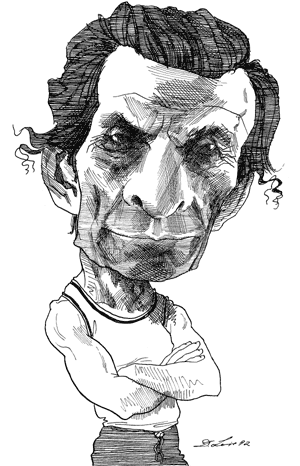
The murder of Pier Paolo Pasolini, like much of his life’s work, seems to have been designed expressly to provoke shock, moral outrage, and public debate. His mutilated corpse was found on a field in Ostia, just outside of Rome, on November 2, 1975. He had been repeatedly bludgeoned and then, while still alive, run over by his own car. The next day, the Roman police received a confession from a seventeen-year-old street hustler named Giuseppe Pelosi, nicknamed “Pino la Rana” (“Joey the Frog”). Pelosi claimed that Pasolini had tried to rape him, and that he had killed the famous filmmaker and writer in self-defense. But the physical evidence showed that most of Pelosi’s story had been fabricated—including, most significantly, his assertion that he and Pasolini had been alone.1
If at first Pelosi’s story did not seem far-fetched, it was only because the openly homosexual Pasolini had a well-publicized, if largely exaggerated, reputation as a sexual predator. On three occasions he had been charged with sexually assaulting underage boys—and on one of these occasions charged with armed robbery as well—but he had never been convicted. He was not secretive about his predilection for cruising, and had often been seen at the train station in Tiburtino, a well-known gay pickup site outside Rome where he had met Pelosi. Pasolini had devoted much of his life’s work—his films, novels, poems, and journalism—to Rome’s violent underworld, which he researched firsthand, so it seemed to many that after flirting with danger for so long, he had finally gone too far and been killed. If Pelosi wasn’t telling the truth about being alone with Pasolini, then perhaps his accomplices were other street hustlers and local delinquents.
But perhaps not. In view of Pasolini’s bitter public feuds with the Christian Democratic government, the fascists, the Communists, the Church, and the Mafia, many Italians suspected that Pelosi was simply a pawn in a much larger conspiracy. The theories that soon emerged were passionate and wildly divergent. Many friends of Pasolini, including Oriana Fallaci, Italo Calvino, Bernardo Bertolucci, and the actress Laura Betti, believed that he had been murdered by members of the neofascist party, which had a long history of violently assaulting him. The official neofascist newspaper, meanwhile, wrote that Pasolini had been “killed by the Marxists” for increasingly “becoming a reactionary writer.” After all, despite identifying himself as a Communist, Pasolini had battled against many of the progressive reforms of the late 1960s, speaking out against the student rebellions of 1968, feminism, sexual permissiveness, and the legalization of abortion and divorce.
A third theory implicated the Sicilian Mafia, whom Pasolini had been investigating for a documentary film about prostitution, and whom he claimed had infiltrated the upper ranks of the Christian Democratic Party. Finally, some suspected the government’s own secret service. A week before his death, Pasolini had demanded in the Corriere della Sera, Italy’s most prominent newspaper, where he had a regular column, that the leaders of the Christian Democratic government be prosecuted for misuse of public funds, for covering up neofascist bombings in Milan, Brescia, and Bologna, and for conspiring with the military, the CIA, and the Italian secret service to menace leftist organizations.2
More than thirty years after Pasolini’s murder, these theories continue to receive attention. So much so that the mystery of his murder has often overshadowed discussions of Pasolini’s prodigious body of work.3 In 2005, the most far-fetched theory to date—that he was not murdered at all, but wanted to be killed—provided the basis for “P.P.P.: Pier Paolo Pasolini and Death,” a major retrospective exhibition at Munich’s Pinakothek der Moderne. The theory’s author is Giuseppe Zigaina, a painter and a lifelong friend of Pasolini’s, who argues that “Pasolini himself was the ‘organizer’ of his own death, which, conceived as a form of expression, was intended to give meaning to his entire oeuvre.” Zigaina means, quite literally, that Pasolini staged his own death, had been planning it for many years, and had planted secret codes in his work that revealed when and how it would occur.4
Zigaina is not the first writer to examine Pasolini’s work for clues to his death. Just after it happened, Alberto Moravia, who had been Pasolini’s close friend for more than thirty years and who wrote a book about his murder in 1977, said that he recognized the murder scene in Ostia from Pasolini’s descriptions of similar landscapes in his two novels, Ragazzi di vita (The Ragazzi) and Una vita violenta (A Violent Life), and in an image from his first film, Accattone. (Pasolini had actually shot footage of the site a year earlier, for use in his film Il fiore delle mille e una notte [A Thousand and One Nights].) But Zigaina is the first to interpret these connections as anything more than poetic irony.
Advertisement
These conspiracy theories reflect, in part, the tug-of-war over Pasolini’s legacy that began as soon as he was confirmed dead. The Italian Communist Party, the PCI, organized his lying-in-state, which was held within sight of Party headquarters, and its leaders posed for photographs with his casket. The founder of the Italian Radicals, a libertarian offshoot of the Italian Liberal Party, described Pasolini as a “lay saint” who died in order to “save his assassins.” The Italian right even tried to claim him as one of their own for his attacks on the Communists. When one looks beyond the controversy over Pasolini’s mysterious death, it becomes clear that a larger question is being debated: Who was the real Pasolini, and what did he stand for?
2.
There are two English-language biographies of Pasolini, and it is a sad reflection on the state of his legacy in the United States that both are out of print. The first was written just three years after his death by a friend, the literary critic Enzo Siciliano. Though marred by overly speculative, and often psychoanalytic, interpretations of Pasolini’s motivations, Siciliano’s book creates a harrowing portrait of the man’s ferocious passions, hatreds, and frustrations. The second, Barth David Schwartz’s Pasolini Requiem (1992), is the work of an author obsessed by his subject, a labor of love that is meticulous—sometimes to a numbing degree—in its research, which was conducted over a period of fifteen years. One hundred pages are devoted to Pasolini’s death; six of these pages alone describe the neighborhood and the restaurant in which Pasolini had his last meal—and that’s before he even walks in the door. (He ordered a beefsteak and fried potatoes, no pasta.) But the passion of Schwartz’s writing overcomes these excesses and, to a greater degree than Siciliano’s book, Pasolini Requiem is admirable for the careful way it examines Pasolini’s work within the evolving social and political situation in which he lived.
In Pasolini’s youth, that meant fascism. He was born in 1922, the year Mussolini came to power, to Carlo Alberto, an army artillery lieutenant, and Susanna Colussi, a peasant girl from the small farming town of Casarsa in the Friuli region of northern Italy. Pier Paolo was named after his uncle, Carlo Alberto’s brother, an aspiring poet who had drowned at sea at the age of twenty. (Pasolini’s younger brother, Guido, also died at twenty, killed by Communist partisans near the end of World War II.) Siciliano describes Carlo as living “in a dream of military ideals, even after his discharge. He was the ‘officer’ in the family.” Repelled by his father’s authoritarianism, Pasolini grew particularly close to his mother, and spent his summers with her family in Casarsa.
Neither parent was particularly religious. Carlo Alberto attended church out of a sense of social duty, while Susanna rejected the Catholic Church as devoid of spirituality, but Pier Paolo showed an early fascination with the image of Christ. In a 1946 diary entry, he described a recurrent fantasy to
imitate Christ in his sacrifice for other men and to be condemned and killed despite being innocent. I saw myself hanging on the cross, nailed up. My thighs were scantily wrapped by that light strip, and an immense crowd was watching me. My public martyrdom ended as a voluptuous image and slowly it emerged that I was nailed up completely naked.
As an adolescent, he suppressed the sexual and violent desires exhibited in this fantasy, but his identification with the suffering of Christ permeates his early poetry.
His first published work was Poesie a Casarsa (1942), a collection of poems written in a variant of Friulian, a regional dialect closer to Latin than the standard Tuscan Italian. The Friulian spoken in Casarsa was so obscure that it had never before been written down. Pasolini printed each poem in the dialect, accompanied by an Italian translation. The poems are wistful, romantic, and unspectacular—odes to nature, to youth, to young love that were derived in no small part from the pastoral verse of Giovanni Pascoli, the turn-of-the-century poet who was the subject of Pasolini’s Ph.D. thesis. The poems also bear the influence of the early-nineteenth-century writer and critic Ugo Foscolo—whom Pasolini called, in a letter written in 1941, “my author, my master and guide.” Whereas Foscolo promoted the struggle for Italian independence, Pasolini supported the (unsuccessful) movement for Friulian regional independence, by distinguishing the unique qualities of the local culture and language.
One doesn’t need to speak Italian to see the effects of his rendition of Friulian. Take, for instance, the first stanza of his poem “Ploja tai cunfìns” (“Pioggia sui confini” in Italian, or “Rain on the Borders” in English):
Advertisement
Fantassút, al plòuf il Sèil
tai spolèrs dal to paìs,
tal to vis di rosa e mèil
pluvisìn al nas il mèis.
Giovinetto, piove il Cielo
sui focolari del tuo paese,
sul tuo viso di rosa e miele,
nuvoloso nasce il mese.
Giovenetto, the sky rains
on the hearths of your country,
on your rosy and honeyed face,
the month is born cloudy.
Pasolini’s Friulian is purposefully blunt, truncated, and cacophonous. His use of this rough language—an unlikely vessel for such tender sentiment—was not a matter of convenience. Despite growing up in the region, Pasolini was raised speaking standard Italian according to middle-class convention. He had to pick up the dialect from conversations with local children and by using techniques in linguistic textbooks he borrowed from the library.
A prominent critic, Gianfranco Contini, wrote an enthusiastic review of the collection and its use of Friulian, but failed to find a newspaper willing to publish it—editors were afraid that an endorsement of a regional language might be seen as antifascist. Pasolini heard about this, and was naturally insulted: “Fascism—to my great surprise—did not admit that in Italy there were local particularisms, and dialects of stubborn unwarlike people.” But the experience was not entirely negative. Pasolini had discovered, in his expression of sacred and romantic themes through a crude vernacular, a successful formula for provocation.
3.
In 1949, Pasolini, now twenty-seven years old, disappeared from a dance party in Friuli with four younger boys, all of them sixteen or younger; soon after, the boys’ families accused him of “corrupting minors” (the charges were later dropped for insufficient evidence). The ensuing public scandal led to his expulsion from the Communist Party, and forced him to flee with his mother to Rome, a move that many critics believe determined the course taken by his life and art thereafter.
Certainly the move caused a major upheaval in Pasolini’s life, but the character of his subsequent fiction shows that he continued to develop the same artistic strategy he used in his early poems: to capture the sacred through a scrutiny of the profane. His technique remained the same too, as he began to research the street slang spoken by working-class Roman youth.5 Their dialect, Romanaccio (literally, “ugly Roman”), became his new Friulian. He hung around with street boys—or ragazzi di vita—in the shantytowns on the outskirts of the city, where he had settled with his mother. In return for their company and patience, he bought them slices of pizza. Ragazzi di vita (1955), the novel that first established his reputation as an unblinking chronicler of Roman street life, follows a group of young hoodlums as they encounter a series of prostitutes, gamblers, and con artists, and engage unapologetically in petty crime and random acts of violence. Una vita violenta (1959), his second novel, is the story of a youth named Tommaso Puzzilli who drifts from crime to prostitution, and from fascism to communism, before he is redeemed by a final act of heroism. Accattone (1961), his first film, is about a boy from the Roman slums, struggling to break free from a life of crime.
In “The City’s True Face,” an essay translated in an excellent recent collection of his short fiction and journalism from that period called Stories from the City of God, Pasolini calls Rome “the most dramatically contradictory city.” It is, he writes,
surely the most beautiful city in Italy, if not the world. But it is also the most ugly, the most welcoming, the most dramatic, the richest, the most wretched.
The same kinds of contrasts shape Pasolini’s fiction and early films. His ragazzi may be ragged and cruel, but they’re also symbols of purity and even classical beauty. In “Roman Nights,” a story that follows a group of ragazzi prowling the slums of Rome, Pasolini constantly likens the boys to angels, Greek gods, and statues—he uses this last metaphor alone seven times (“boys as brown as statues stuck in mud”; “the hip that spirals like a baroque statue”; “his hair sticks to him exactly like the hair of statues”). In Accattone, he choreographs acts of violence to Bach’s Brandenburg concerti, and in Mamma Roma (1962), his second film, a whore (Anna Magnani) who sells herself in order to give her son a “respectable life” becomes a beatific martyr of the working class. In these juxtapositions, the sacred and glamorous—the exclusive night clubs of the Via Veneto, for example—become sordid and petty. But in the filthy Roman underworld, Pasolini finds passion, sensuality, and, to borrow the title of one of his poems, “desperate vitality.”
Ragazzi di vita made Pasolini one of the nation’s most visible writers, but its gritty portrayal of the working classes infuriated both the left and the right. A Communist critic complained that “Pasolini apparently depicts the world of the Roman sub-proletariat, but the real focus of his interest is his morbid taste for the dirty, abject, discomposed, and turbid.” Italy’s prime minister, the conservative Christian Democrat Antonio Segni, had the novel confiscated from bookstores and tried to prosecute Pasolini and his publisher for “publishing obscene material.” (The case was thrown out of court.)
Pasolini’s other early works aroused similar controversy. At the Roman première of Accattone, neofascist youths who said they were incensed by what they claimed was the film’s immorality assaulted the audience, set off stink bombs, and threw ink bottles at the screen, setting a precedent that was repeated at the première of virtually every film Pasolini made. At the Venice Film Festival, the local police confiscated Mamma Roma for obscenity—the words “piss” and “shit,” as well as the sound of farting, are heard—and Pasolini became the subject of another much-publicized trial. He was acquitted.
Pasolini’s reaction to these attacks reveals much about his motivations: once he had found his line of provocation, he took it further, making his social criticisms more explicit. His short 1962 film La ricotta starred Orson Welles as a director making a movie about Jesus Christ. Although Pasolini included a disclaimer at the beginning of the film declaring that “the story of the Passion is for me the greatest story ever told,” audiences were not convinced. At one point in the film, Welles declares, “Italy has the most illiterate masses and the most ignorant bourgeoisie in Europe…. The average man is a dangerous criminal, a monster. He is a racist, a colonialist, a defender of slavery, a mediocrity.” In a single speech, Pasolini had managed to offend not only Italians on the right and the left, but everyone else in between. Upon the film’s release in March 1963, Pasolini was prosecuted again, for “insulting the religion of the state.” This time he was convicted, but the conviction was overturned on appeal.
The attacks were growing increasingly personal. A year earlier, in June 1962, in the midst of his third trial for sexual assault, an agency called Stampa Internazionale distributed a psychological analysis of Pasolini, written by a professor at the University of Rome, to the editors in chief of every major newspaper. The report concluded that “Pasolini is an instinctual psychopath, he is a sexual deviant, a homophile in the most absolute sense of the word…a socially dangerous person.” If the subsequent newspaper headlines are to be believed, the Catholic nation was scandalized by this homosexual filmmaker who publicly declared his atheism.
It is no surprise, then, that Pasolini struggled to find an investor for his next project, a feature-length film about Jesus Christ called The Gospel According to Saint Matthew. In fact the film, Pasolini’s masterpiece, would never have been made were it not for the blessing of a most unlikely ally—the Catholic Church. Recent large-scale reforms at the Vatican, following the election of the liberal Pope John XXIII in 1958 and the creation of the Second Vatican Council in 1962, had encouraged the Church to look for new ways to spread its message. In this spirit, John XXIII had ordered the Pro Civitate Christiana, or Citadella, a Franciscan study center at Assisi, to help “lead society back to the principles of the Gospels” by encouraging better relations between the Church and prominent cultural figures. Pasolini accepted an invitation to attend a Citadella conference in 1962, and after reading a copy of the gospels in his room, he was inspired to make The Gospel According to Saint Matthew. The Franciscan leaders of the Citadella were persuaded, and their endorsement encouraged reluctant investors.
Pasolini was not undergoing a religious conversion. In a letter to the director of Citadella’s Ufficio Cinema, he admitted, “I do not believe that Christ was the Son of God, because I am not a believer—at least not consciously.” In a letter several years later, he wrote about the film, “It’s not a practicing Catholic’s work, it seems to me an unpleasant and terrifying work, at certain points outright ambiguous and disconcerting, particularly the figure of Christ.” Yet in the film the part of Christ has great power. In Pasolini’s words, his Christ is a “revolutionary.”
To Italian viewers, the film’s locations would be immediately recognizable as the primitive, impoverished villages of southern Italy—Crotone, Matera, and Massafra—all of which in the 1960s could be made to resemble biblical Judea, Galilee, and Jerusalem. The cast was made up primarily of local peasants, and there are numerous sequences, including the opening scene, in which Pasolini’s camera passes methodically from one face to another, as if seeking spiritual meaning in their rough features. Pasolini did not coach his actors and wrote no original dialogue, so the line readings of the gospel’s text tend to be blunt and sometimes even crude.
Pasolini deemphasizes the supernatural elements of the story whenever possible. His Christ, played by a scruffy Spanish economics student named Enrique Irazoqui, is less a divinity than a political reformer; he gathers a following not through miracles but through his persuasive revelations about the evils of class injustice. Whereas Pasolini’s fiction and his earlier films sought the sacred qualities in the most profane characters and settings, he uses the story of Christ to illustrate the suffering of those on the lower rungs of contemporary Italian society. Instead of bringing the sacred to the slums, he had brought the slums to the sacred.
The Church was enthusiastic about the results. The international Catholic film commission gave The Gospel According to Saint Matthew its highest prize, and when it was specially screened for a group of Vatican prelates, it received a twenty-minute ovation. Many Communists, however, were shocked by Pasolini’s decision to make a “counterrevolutionary” religious film. For its part, the right-wing press was furious that Pasolini had won the support of the Church. An editorial in one Roman daily suggested that the Citadella be renamed “Pro Civitate Comunista.”
The merging of political ideology with religious and classic mythology distinguishes the films that followed: Teorema (1968), in which the appearance of a beautiful, seemingly godlike young man forces a Milanese factory magnate and his family to confront the emptiness of their lives; Porcile (1969), which juxtaposes the story of a disaffected son of a former Nazi with the tale of a band of wandering cannibals in medieval Spain; and Oedipus Rex (1967), in which Oedipus, seduced by the wealth of his kingdom, betrays his impoverished constituents, who revolt.
All three dramatize the emptiness of a life spent in pursuit of wealth and social prestige, yet they are not propagandistic or didactic in tone. It’s worth noting that each film features haunting and strikingly beautiful images of man isolated in nature: the cannibal in the opening scenes of Porcile, combing the slopes of Mount Etna for any signs of edible life; the factory magnate in the final scene of Teorema who strips naked in Milan’s Central Station and wanders out onto a volcanic wasteland (also shot on Mount Etna); or young Oedipus, walking the long road to Thebes. The natural landscapes are vast and grimly barren, yet each man, despite being filled with dread and despair, has a triumphant, mystical aura. Cut off from all possessions and ties to society, these characters undergo what Pasolini describes as a “crisis which is, however, a form of salvation.”
Besides emerging as an internationally renowned filmmaker, Pasolini had become in Italy an influential and widely read political commentator. It was an unusual development. Moravia, who called his friend “the most important Italian poet of the second half of the century,” pointed out in an interview that Pasolini’s political engagement “distinguishes him from the great majority of Italian writers, who as a rule confine themselves to being ordinary citizens.”6 Pasolini’s political views were never predictable. He greeted with skepticism the progressive political and social reforms of the 1960s—which made Italy one of the most economically successful countries in the world—and his public statements grew increasingly contradictory. In a 1966 interview, he announced that he was declaring war “on two fronts, against the petite bourgeoisie and against that mirror of it that is represented by a certain conformism of the left.” Following the Italian student revolt of May 1968, he published a poem in the weekly newspaper L’Espresso that mocked the students and defended the police:
I sympathize with the cops!
Because the cops are sons of the poor.
They come from the outskirts, whether peasant or urban.
He even began, in 1973, to write a column for the leading establishment newspaper Corriere della Sera; his first article was titled “Against Long Hair.” Still, in an interview in Le Monde, he said, “I can no longer believe in revolution, but I can’t help being on the side of the young people who are fighting for it.” More revealingly, he added, “I no longer believe in dialectics and contradictions, but in pure opposition.”
His next three films, “the trilogy of life” (The Decameron, 1970; The Canterbury Tales, 1971; and A Thousand and One Nights, 1974), broke with his previous cinematic work in their use of lavish sets and bright colors, and their fantasies. Even as his journalism was growing increasingly bitter and confrontational, these films were, in Pasolini’s words, “happy, comic, without implicit problems,” and inspired by “the sheer joy of telling and recounting…away from ideology.” The trilogy avoids historical pomposity, while celebrating the earthiness and pleasures of the traditional tales he draws on—sex, in particular. And yet they take on an ominous aspect when one considers what Pasolini made next: arguably the darkest and most disturbing film ever made.
4.
Salò (1975) is Pasolini’s adaptation of the Marquis de Sade’s The 120 Days of Sodom, set in Salò, the town that served as the capital of Mussolini’s puppet government, which was reinstalled by the Nazis from 1943 to 1945. In Pasolini’s version, Sade’s four libertines are interchangeable fascist autocrats, who order the military to kidnap young boys and girls to bring to their palace. In their zealous pursuit of depravity, the libertines subject their victims to an increasingly horrific progression of sexual violations, from incest to rape to torture. There is a clear parallel here between the fanatical rigor of the libertines’ scheme and the brutal efficiency of totalitarianism. The film opens with the four fascist leaders devising an elaborate book of laws meant to govern their ritual orgies. “Everything is good when it’s excessive,” says one of the men in the film’s opening line.
Pasolini’s approach is just as cold as that of the libertines. The film progresses by mechanically rejecting one moral, social, or political convention after another. The joys of sensuality, of the human body—the subject of his “trilogy of life” films—are the first to be subverted. In the opening scenes, we see the naked bodies of beautiful young people lined up like cattle and prodded to determine their quality. Consensual heterosexual sex is punishable by loss of limb. Any act of religion is cause for execution. Even the sanctity of the dead is mocked. After the victims have been annihilated in a final horrifying torture sequence set in the palace courtyard, the camera moves back upstairs, where, in a moment of disconcerting beauty, two young fascist guards embrace each other and dance cheek to cheek.
Salò is not simply a condemnation of fascism. It is also a condemnation of the excesses of mass consumption (Pasolini claimed that the infamous coprophilia scene, in which the libertines and their slaves feast on a banquet of human excrement, was an attack on the fast food industry), of religion, of the rule of law, of bureaucracy, of sexual liberation, of sexual traditionalism, of free will, of totalitarianism, of life, of death. In many ways it is inconsistent with much of what he had written and said at earlier points in his career. But in its total iconoclasm and its inflamed provocation, it is the work that comes closest to revealing the driving force of Pasolini’s creative genius. He died three weeks before the film’s première.
How would Pasolini have followed Salò? One possibility can be glimpsed in his unfinished third novel, Petrolio. The plot is extraordinarily complicated and illogical, filled with doppelgängers and alternate realities, obscure references and unusual syntax, and wild flights into fantasy and myth. In a letter to Moravia, Pasolini explained that he intended the work “to recall the language of treatments or screenplays rather than that of classic novels.” He died before he could complete this further act rejecting artistic convention, but the manuscript pages and notes that he left behind, and which were published posthumously, may accomplish his goal as well as any “finished” work might have.7
5.
In May 2005, shortly after the Munich retrospective and the publication in book form of Zigaina’s provocative thesis, Pasolini again made newspaper headlines. “Pino” Pelosi, his alleged murderer, gave an interview on Italian television in which he recanted his original testimony and declared himself innocent. He claimed that three men “with southern accents,” cursing the “dirty Communist,” were Pasolini’s real murderers. In response, Sergio Citti, Pasolini’s longtime collaborator, gave an interview to La Repubblica claiming that a confidential source told him that five men, not three, had murdered Pasolini; that the crime was not committed in Ostia, though Pasolini’s corpse was dumped there; and that Pelosi was used “as bait” to lure Pasolini. Following these two interviews, Italian magistrates reopened the murder case, only to decide, several months later, that there was insufficient evidence for a new trial. The true story of what happened that night will probably never be known.
On the last day of his life, Pasolini was asked by a journalist why he fought battles against “so many things, institutions, persuasions, people, and powers.” Rejection, Pasolini replied, is the shaping force of society. “The saints, the hermits, the intellectuals… the ones that shaped history, are the people who said no. This refusal should not be small or sensible but large and total.” From all these refusals, we know what Pasolini stood against—political ideologies of all kinds, the complacency inherent in the established social order, the corruption of the institutions of church and state. If Pasolini could be said to have stood for anything it was for the struggles of Italy’s working class—both the rural peasants and those barracked in the urban slums at the edges of Italian cities—whose humanity he evoked with great eloquence and nuance. But it is his refusals that animate his legacy with an incandescent rage, a passionate and profound fury that did not, as Zigaina suggests, cry out for death—but for just the opposite.
This Issue
September 27, 2007
This Issue
September 27, 2007
-
1
Although Pasolini had suffered numerous mortal wounds and large blood loss, Pelosi had no serious bruises, and his clothes showed no sign of struggle. Two items of clothing found in Pasolini’s car did not belong to either man, nor did numerous footprints found at the crime scene. ↩
-
2
See “Perché il processo,” reprinted in Pasolini: Saggi sulla politica e sulla società, edited by Walter Siti (Milan: Mondadori, 1999), pp. 668–673. Some of Pasolini’s suspicions of high-level conspiracy were vindicated by later revelations of the existence, in the 1960s and 1970s, of a clandestine Freemasonic lodge called Propaganda Due (P2). P2’s membership included several powerful newspaper editors, forty-four members of Parliament, bankers, and military brass, who plotted to repress the rise of the left. The recent Italian prime minister Silvio Berlusconi joined P2 in 1978. ↩
-
3
Mondadori has published, in its beautiful Meridiani series, an impressive, definitive collection of Pasolini’s writings—with volumes devoted to his poetry, his essays and journalism, his fiction, and his writing for screen and stage. The complete set runs to ten volumes and over fifteen thousand pages. ↩
-
4
Zigaina’s essay in the exhibition catalog is adapted from his book-length monograph on the subject: Pasolini e la morte: Un giallo puramente intellettuale (Pasolini and Death: A Purely Intellectual Thriller) (Venice: Marsilio, 2005). Zigaina published an earlier version of his theory in the Stanford Italian Review, in 1984, under the title “Total Contamination in Pasolini.” ↩
-
5
His knowledge of Roman street slang was so accomplished that Federico Fellini hired him to write dialogue for the prostitutes in his Le notti di Cabiria (1957). ↩
-
6
Alberto Moravia and Alain Elkann, Life of Moravia, translated by William Weaver (Steerforth Italia, 2000). ↩
-
7
For the English translation of the complete manuscript, outlines, and notes to the novel, see Petrolio, translated by Ann Goldstein (Knopf, 1997). ↩