
“For now I’d just say the justification is the re-election of President Nixon.”
—William H. Sullivan, Deputy Assistant Secretary of State for East
Asia, when asked at a private briefing for congressional aides on March 27 what was Nixon’s legal authority for bombing Cambodia.
I
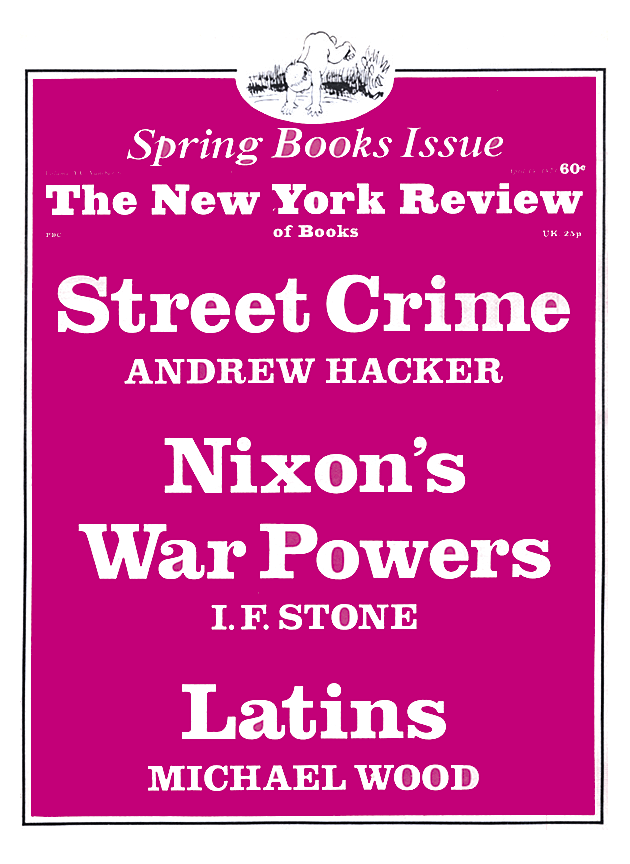
In a landmark case during the Korean War, a liberal majority of the US Supreme Court refused to allow Truman to seize the nation’s steel mills. The Court rejected the White House claim that such action was constitutional under the so-called war powers of the President. “Power to legislate for emergencies,” Justice Jackson then wrote in one of those brilliant concurring opinions for which he is famous, “belongs in the hands of Congress, but only Congress itself can prevent power from slipping through its hands.” This case was the first to deal squarely with presidential claims of “inherent” war powers in the sweeping form that still plagues us in the skies over Indochina.
As a result of the long agony over Vietnam, the longest and most costly “undeclared war” in our history, Congress has been trying for three years to frame new legislation which would restrict the war powers of the President and restore those of Congress. The course of the long debate in Congress has reflected a widespread desire in both parties to curb presidential powers and yet a curious reluctance to grapple with the problem where it is most urgent, in the Indochinese war itself.
Two kinds of war powers legislation await final action in the Senate and the House. One would establish strict limits on the President’s power to take the country into war without specific authorization by Congress, in pursuance of the power to “declare war” given to the Congress by the Constitution. The other, more urgent, would use congressional power to prevent the Executive from taking us into a third Indochinese war. Almost all attention has been focused on the former. The latter has been shelved even while the danger of resumed bombing and intervention has grown.
The dispute over presidential war powers has been classed with impoundment, executive privilege, and freedom of the press as one of the four major questions on which a constitutional crisis has been developing between the White House and the Congress. But this may understate the complexities of the war powers problem. It may run deeper than the Constitution into the mores of the American Republic and people, and this may explain the reluctance of a frustrated Congress really to face the problem, especially where action is most immediately needed.
“Abuse of power by Presidents,” said the historian Henry Steele Commager in his perceptive testimony at the opening of the Senate Foreign Relations Committee hearings on war powers legislation in March, 1971, “is a reflection, and perhaps a consequence of abuse of power by the American people and nation.” Certain political “four letter words” have been avoided in the long debate. The “not nice” terms are “imperialism” and “militarism.” Yet they need to be plainly uttered if we are to begin to understand the full dimensions of the problem subsumed under the war powers of the President.
To begin with, the President’s war powers fall into two quite separate categories, one constitutional, the other physical. Attention has been focused on the former. The distinction may be illustrated by the case of Iceland. So far as I know the President of Iceland may have the most sweeping power to take his little country into war whenever he sees fit. But since Iceland has neither an army nor a navy,1 the war powers of its president remain an abstract problem for its constitutional scholars. Even if he became intensely concerned about Allende’s violation of ITT’s property rights in Chile or the crushing of free enterprise by Castro in Cuba, his ability to do anything about it is limited by the fact that the only force at his disposal is a fleet of six armed fishery protection vessels.
The form taken by the war powers controversy in our country is constitutional. But its roots lie in the enormous growth since World War II in the physical means of war-making at the President’s disposal. It is the swift expansion of the American military establishment and of US imperial pretensions since the cold war began under Truman that has made the problem acute. It is not difficult to find instances of brief military or naval actions which can be termed “undeclared presidential wars” almost as far back as the earliest days of the Republic. But these were no more than brief forays and a minor problem so long as American ambitions and military power were limited.
Presidential war-making powers did not become a substantial threat to the congressional power to declare war until this century with the appearance of what used to be called “gunboat” or “dollar diplomacy” in our relations with our neighbors in Central America and the Caribbean. They termed it Yanqui imperialism. Then, too, as with the undeclared war in Vietnam, this was a bipartisan phenomenon. As summed up three years ago in an eloquent but futile report of the Senate Foreign Relations Committee,2 that earlier experience looks like a dress rehearsal for our involvement in Indochina.
Advertisement
In that earlier period, too, we made and unmade governments to enforce “respect,” Godfather and Nixon fashion. The Foreign Relations Committee report recalled:
President Theodore Roosevelt used the Navy to prevent Colombian forces from suppressing insurrection [which we had arranged, the committee might have added, in order to seize the Canal Zone—IFS] in the province of Panama and intervened militarily in Cuba and the Dominican Republic. Presidents Taft and Wilson also sent armed forces to the Caribbean and Central America without Congressional authorization…. President Wilson [shelled and—IFS] seized the Mexican port of Vera Cruz in 1914 as an act of reprisal, in order, he said, to “enforce respect” for the government of the United States.
Where earlier presidents used gunboats, Nixon used and still uses B-52s. The problem has become chronic with the emergence of the United States after World War II as the biggest military power of all time, claiming—in “the free world”—to be the protector and policeman of virtually the whole globe outside the Soviet bloc and China.3
As the means, the secret commitments, and the occasions for intervention have grown, the power of Congress to make the final decisions of war and peace have dwindled. Until the problem is attacked as a function of imperialism and militarism, constitutional and statutory tinkerings with war powers are likely to prove ineffective. Here and there, in the voluminous hearings, reports, and debates on the pending legislation, this truth occasionally surfaces. The Senate Foreign Relations Committee said some of this when it reported out the Javits-Stennis-Eagleton war powers bill last year.4
If the United States, the committee report said, “is to be continually at war, or in crisis, or on the verge of war, or in small-scale, partial or surrogate war, the force of events must lead inevitably toward Executive domination despite any legislative roadblocks that may be placed in the Executive’s way.” Senator Javits also touched on the more fundamental factors when Senate debate on the measure began last year.5
The Founding Fathers were deeply distrustful of “standing armies.” At the time of the ratification of the Constitution, the United States Army consisted of a total of 719 officers and men. On the eve of the Civil War it was only 28,000 and in 1890 it was only 38,000. Even in 1915, the Army numbered less than 175,000. However, since 1951 [the Korean War] the size of our “standing” armed forces rarely has dipped below 3,000,000 men. These forces under the President’s command are equipped with nuclear weapons…and they are deployed all over the world…. It is the convergence of the President’s role of conducting foreign policy with his role as Commander-in-Chief of the most potent “standing army” the world has ever seen that has tilted the relationship between the President and Congress so far out of balance….
The imbalance will be tilted even further by the completion of the new all-volunteer army, which puts all the armed forces on a professional basis and relieves the President and the Pentagon from the need to rely on the draft except in the case of a major war. The army will no longer be a citizens’ army but a professional force largely enlisted from among the poor and desperate.
As Joseph A. Califano, Jr., who was President Johnson’s assistant for domestic affairs, has pointed out,6
An all-volunteer force that subjects only the ones at the bottom to military service will effectively reduce the need for future rulers to be concerned about the more affluent majority in America and its judgments about foreign adventures, at least until those adventures are so far along that they will be virtually impossible to stop.
II
The character and course of the war powers legislation in Congress show the same weaknesses that have allowed presidential power to grow so strong in the past. One difficulty is that of foreseeing the contingencies under which war may arise. When the Constitution was being written, Congress was first given the power to “make” war, but this was changed to “declare.” The purpose of this change was twofold: to allow the President to repel sudden attacks and to free him as commander in chief from interference by Congress in the day-to-day operations of the armed forces once war had been declared. Too specific a spelling out of presidential powers would either restrict his powers too greatly or give him a blank check in advance for actions that might go far beyond legitimate limits.
Advertisement
Last year both houses of Congress passed war powers bills but they died with the session when the differences between them could not be reconciled. Each passed with majorities big enough to override a veto. The Javits-Stennis-Eagleton bill passed the Senate by a vote of 68 to 16 on April 13, 1972. The Zablocki bill passed the House 344 to 13 last August 14.
The lopsided vote testifies to the wide discontent in Congress. It is not often that Democrats as different as Stennis and Eagleton can agree with a Republican like Javits to merge their respective bills. In the House there are more than a dozen bills to limit the President’s war-making powers. Their sponsors range from Ronald Dellums, the black militant Democrat from California, to John Rarick of Louisiana, who has been described as a Birchite with a Southern accent. But the coming legislative battle will be between revised versions of the Javits-Stennis-Eagleton bill in the Senate and the new Zablocki bill in the House, as they emerge from committee shortly. The contest will be over which bill will prevail in a showdown or fare best in a compromise.
Both bills were extremely cautious in their draftsmanship, though in quite different ways. The House bill7 in its original form won such wide support because it sought to do so little. It merely required the President promptly to inform Congress whenever he committed US military forces to armed conflict abroad “without specific prior authorization by Congress.” A salutary provision of the bill is that it applied not only to the commitment of troops to actual hostilities but also to their deployment abroad, though with a loophole: “except…for humanitarian or other peaceful purposes.” Our purposes are always peaceful. As we shall see, this House bill has now been strengthened.
The Senate bill sought to disarm White House opposition by exempting the Indochina war; it does not apply to “hostilities in which the Armed Forces of the United States are involved on the effective date of this Act.” Whether it would apply after a Vietnam cease-fire and troop withdrawal remains a cloudy question. The bill contains enough loopholes to allow a wide range of future “undeclared” presidential wars. The President is allowed to use troops abroad without a declaration of war in order to repel an attack upon the United States and its possessions, or on its armed forces outside the United States, or “to forestall the direct and imminent threat of such an attack,” or to evacuate citizens from an area in which they are endangered. The last was the excuse for the invasion of the Dominican Republic by Lyndon Johnson.
Such “undeclared” presidential wars are limited to thirty days unless authorized by Congress and may be terminated sooner by act or joint resolution (the latter is not subject to veto) unless the President certifies in writing that “unavoidable military necessity respecting the safety” of these armed forces requires their continued use “in the course of bringing about a prompt disengagement.” Nixon’s disengagement from Indochina is still incomplete after four years.
These loopholes could make the situation worse by giving advance congressional authority to presidential actions of dubious constitutional validity or even patent usurpations. When the bill was reported by the Senate Foreign Relations Committee, Senator Fulbright noted in his “Additional Views” that the provisions authorizing the President “to forestall the direct and imminent threat” of an attack could have been used to justify the Cambodian invasion of 1970 and the Laotian invasion of 1971, “both of which were explained as necessary to forestall attacks on American forces.” Fulbright feared that under these provisions a future President might cite secret or classified data “to justify almost any conceivable military initiative.”
He warned that this authority could be construed “as sanctioning a pre-emptive, or first, attack solely on the President’s own judgment.” Since such a first strike might be nuclear, Fulbright suggested that the bill be amended (in accordance with a proposal advocated by the Federation of American Scientists) to forbid a nuclear first strike under any circumstances “without the prior explicit authorization of Congress.”8 But this was not accepted by the Senate.9
Another weakness in the Javits-Stennis-Eagleton bill is that it does not automatically provide for calling Congress into session once an “undeclared” war begins. The bill says that such “undeclared” wars shall not continue for more than thirty days without specific authorization by Congress. This could prove quite a loophole. Twenty-nine days of sustained bombing would be enough to cripple many a small country which had provoked the chief executive’s ire. Congress could terminate hostilities sooner than thirty days by bill or joint resolution (the latter not subject to presidential veto) unless the President had certified that “military safety for prompt disengagement” made continued fighting necessary. That is another big loophole.
Senator John Sherman Cooper would have substituted for all these elaborate thirty-day procedures a simple joint resolution requiring the President to notify Congress whenever he uses the armed forces abroad in an undeclared war or “believes” that such use is “imminent.” Congress, if not already in session, would convene itself within twenty-four hours and proceed immediately to decide whether to authorize such use of the armed forces “and the expenditure of funds for purposes relating to these hostilities or imminent hostilities.” This would avoid the labyrinthine booby-traps and loopholes of the Javits-Stennis-Eagleton bill and confront Congress immediately with the question of whether it concurred or disapproved.
Cooper said there was doubt whether Congress could constitutionally limit hostilities to thirty days “or any period of time, except by the denial of funds.” But he said there was no question that “a prompt meeting and consideration by the Congress of any involvement in hostilities is the power and the duty of the Congress.”10 The Cooper approach would avoid many constitutional problems and also the danger of providing new loopholes for undeclared presidential wars.
Cooper’s suggestions are not in the Senate bill, but roughly the same approach is taken in the newly revised version of the Zablocki bill, the main bill in the House.11 This is a far stronger bill than last year’s version and may be preferable to the complicated Rube Goldberg contraptions of the Javits-Stennis-Eagleton bill. It reaffirms the congressional right to declare war, recognizes that the President has “in certain extraordinary and emergency circumstances” “authority to defend” the country and its citizens, but limits the exercise of this authority to two kinds of cases. One is to “respond to any act or situation that endangers” the United States or its citizens (but not their property) abroad when the necessity to respond does not allow time for advance congressional authorization; the word “endangers” may be far too broad. The other class of cases is pursuant to specific prior authorization by Congress.
“But at the same time,” the Zablocki bill says, “nothing in this resolution should be construed to represent Congressional acceptance of the proposition that executive action alone can satisfy the constitutional process requirement contained in the provisions of mutual security treaties to which the United States is a party.” Since these treaties cover some forty-three separate nations it is important to make clear—it is dangerously vague now—that they cannot be used to authorize war without specific congressional authorization. Otherwise they become blank checks for undeclared presidential wars.
A similar provision (Sec. 3[4]) of the Senate bill would in effect recall the many blank checks outstanding in existing treaties by requiring specific congressional authorization for the use of troops under them. But both bills leave untouched the special blank checks for war in the Formosa, Middle East, and Cuba resolutions, leftovers from the Eisenhower and Kennedy Administrations.
The new Zablocki bill requires the President to report to Congress and ask its approval not only when he commits armed forces to conflict but when he “commits military forces equipped for combat to the territory, airspace or waters of a foreign nation” or “substantially enlarges military forces already located in a foreign nation.” These contingencies are not covered by the Javits-Stennis-Eagleton bill.
If Congress is not in session, the President under the Zablocki bill must convene it. This differs from the Cooper proposal in that the latter would have the President pro tempore of the Senate and the Speaker of the House reconvene Congress if it were not in session.12 A President in a time of undeclared war might refuse to reconvene Congress, on the claim that this provision was unconstitutional or on some other pretext.
Lest this be thought far-fetched we call attention to the war powers testimony of Charles N. Brower, acting legal adviser of the Department of State, before the House Foreign Affairs Committee on March 13. He objected to any legislation that would require the President to reconvene Congress in the event of undeclared war. “A decision to convene Congress,” Mr. Brower told the House committee, “constitutionally lies within the discretion of the President, and should depend on the circumstances prevailing at the time.” The Framers would have been startled to hear it argued that the President has a constitutional right not to reconvene Congress under circumstances nullifying its constitutional power to declare war.
III
The reconvening of Congress to deal with an undeclared war would merely be the beginning of the battle. No legislation restricting “undeclared wars” can be any better than the will of Congress to stop them. It is the will that has been lacking in the past. Generally speaking Congress has been alert in preventing the last war and slack in dealing with the next one. None of these war powers bills, if enacted, will make much difference if Congress is as supine as it has been in the past.
Senator Cooper, in his “individual views” appended to last year’s Senate Foreign Relations Committee report, recalled that as early as 1954, when the Korean Defense Treaty was under consideration, Senator Stennis, former Senator Watkins, and himself warned that the Senate should make clear in all these so-called mutual defense treaties that the term “constitutional processes” used in them should not be used to send troops into combat without a declaration of war by Congress. These misgivings were brushed aside by the Senate Foreign Relations Committee and the Senate. Later as the blank check war resolutions came up on Formosa, the Middle East, Berlin, Cuba, and Tonkin Gulf, reservations to the same effect were offered in committee and on the Senate floor and rejected. The record showed that Congress had consistently voted away its own constitutional war powers.13
The record was put into longer perspective and in a cynical but more searching light by Secretary of State Rogers during the Senate Foreign Relations Committee hearings on the war powers bills in 1971. Rogers recounted with smug satisfaction the “undeclared” presidential actions as far back as the Mexican war, which triggered American imperial expansion at the expense of our Latin neighbors. He paused especially to savor the undeclared war in which the US Marines occupied and governed Nicaragua from 1926 to 1933. This history, Rogers said, shows an increasing use of presidential powers, “and yet,” he observed, “there was remarkably little complaint from the Congress.”
“It is interesting to speculate,” the secretary went on, “why this is so. It seems to me there may have been several possible factors. In the first place, I suppose that Presidents were acting in the context of a generally popular consensus in the country that the United States should assume a posture consistent with its emerging power, particularly in the Western Hemisphere.” Indeed “big stick” tactics toward our weaker neighbors have been generally popular in our history, and attacks upon this attitude have been a lonely exercise as far back as Lincoln’s opposition, while a congressman, to the Mexican war.
“Secondly,” Rogers said, “a large majority of the nineteenth- and early twentieth-century presidential actions occurred in the Caribbean, where this country’s power was so predominant that there was little or no chance of forcible response to our actions.”14 Tough tactics were applauded, so long as we dealt with nations too weak to hit back. A third element, on which the secretary did not touch, is that almost all of these actions in the Caribbean and Central America were designed to collect debts for American banks and enforce the will of American sugar, fruit, and other interests to which Congress is sensitive (and beholden) both at home and abroad.
In every generation there have been Americans to protest imperialism but they have been in a minority. Henry Steele Commager at the same hearings showed that presidential “undeclared wars” have almost always been used against “small, backward and distraught” peoples. He asked, “Does it really comport with the honor and dignity of a great nation to indulge its chief executive in one standard of conduct for the strong and another for the weak?”15 The answer seems to be that the country rather enjoys it, unless—as in Korea and Indochina—the victim shows an unexpected capacity to resist.
There is no reason to believe that under any of the pending war powers bills—had they then been on the statute books—Truman could not have obtained congressional authorization for the Korean War or Johnson for the Vietnam war. As Arthur Schlesinger, Jr., told the House Foreign Affairs Committee the other day, “All wars are popular the first thirty days.”
Javits, the principal sponsor of the Senate war powers bill, still accepts conventional clichés about the Vietnam war and only turned against it when it became too expensive. As recently as last May 1, in a speech in Chicago, he said,
It is not in the interest of the United States to allow the ARVN to be overrun, and the Thieu government to be overthrown by this current North Vietnamese offensive. But we have already done in Vietnam all that any nation could ever do for an ally in terms of our own casualties and treasure spent…. If the South Vietnamese people want a country, they can have it, because we have equipped them for the purpose. But…we cannot continue for the indefinite future to underwrite the survival and security of South Vietnam.
This embodies the conventional and propagandistic view which identifies the Thieu dictatorship with the people of South Vietnam, and paints our purpose there as one of benevolent concern for their self-determination. It is only the cost that separates Javits from Nixon. In fact, the more one studies the record the more one feels that it is neither lack of power nor lack of information that has led Congress to acquiesce in the war powers of the President but the fact that it usually shares much the same outlook.
Senator Eagleton provided another example of this before the House Foreign Affairs Committee March 7. He said that while the Senate war powers bill would allow presidential military action to rescue endangered citizens, it was tightly worded to prevent a President from using this excuse “to pursue a policy objective over and above their safe evacuation.”
Eagleton cited the Dominican affair when President Johnson expanded a rescue operation “into an invasion” of the Dominican Republic in 1965. “It should be emphasized,” Senator Eagleton said, “that the policy considerations that motivated President Johnson may [italics in original] have been correct. They were, however, legally questionable since Congress was excluded from the decision-making process.” It must make Latin Americans wince to read such stuff from a liberal US senator. We helped to overthrow a constitutional and democratic government, on the pretext that it was in danger of a communist takeover, and thus to replace the liberal regime of Bosch with the repressive regime of Trujillo’s long-time aide, Balaguer. It is hard to arouse Congress over legally or constitutionally questionable acts by the Executive when it agrees with the policy considerations.
The biggest obstacle of all to congressional restraint on the Executive is the instinctive reaction that once war begins, the patriotic duty is to rally behind the war, however disastrous or wrong one may believe it to be. Thus Senator Stennis voiced misgivings about the Indochinese intervention very early in the Sixties but swallowed his doubts once combat operations began.
IV
The time to talk sense, the time to alert the country, is before the shooting starts. This is the test, but recent events show that Congress is still as craven and flabby as in the days when Morse and Gruening alone voted against the Tonkin Gulf resolution.
Despite more than ten years of battle, a half-million US and nobody knows (or much cares) how many Indochinese casualties, and at least $130 billion shot to hell, Congress is still curiously and significantly reluctant to take steps that would prevent resumption of the Indochinese war. The Javits-Stennis-Eagleton war powers bill only won such wide support because it was drafted explicitly to exclude the Vietnam war. All three of the main sponsors decided, as Javits told the Senate February 20, “that if we did not separate the War Powers Act from the Vietnamese situation we would get into serious legal problems, not to mention recriminations as to ex post facto applicability, which would have torpedoed a monumental achievement.” Certainly the bill would not have received the votes of both Scott of Pennsylvania, the Republican Senate majority leader, and Griffin, the Senate GOP whip, as it did if it had threatened to interfere with Nixon’s conduct of the Indochinese war.
The outrage over the resumed bombings of the North at Christmas led to efforts to fill this gap. A nation-wide coalition of peace groups—in which the Friends Committee for National Legislation played a leading role—was formed to prevent resumption of the war. On January 26, Senators Church (D., Idaho) and Case (R., New Jersey) introduced a bill forbidding the use of any funds whatsoever “to finance the reinvolvement of US military forces in hostilities in or over” Vietnam, Laos, or Cambodia “without prior, specific authorization by Congress.” On January 31, the same bill was introduced in the House by Bingham (D., New York) and twenty-three other sponsors. On February 5, Congresswoman Bella Abzug introduced a more comprehensive version, HR 3578, which would have filled an obvious loophole by extending the ban to civilian paramilitary personnel, especially in such programs as that of “pacification,” and to Thailand as well as Indochina.
Many supporters of the Church-Case bill in the House were also supporters of the Javits-Stennis-Eagleton bill. Their strategy was to handle the long-range problem with the latter, and the immediate and urgent problem with the former. Since there was little prospect of passing either bill over a presidential veto, the strategy called for appending Church-Case as a rider to some measure the Nixon Administration needed so badly that it would have to accept Church-Case. What happened is complicated and tricky but instructive, because it shows how hard it is to get preventive peace action out of Congress and the country, and how easy it is for the White House to have its way.
The first thing that happened is that the day after Church-Case was introduced the cease-fire agreement was signed and there was a rapid fall-off of interest not only in Congress but in the country. Everybody wanted to forget Vietnam as soon as possible. Even in the peace coalition attention shifted to what Nixon was doing to domestic programs. The Democratic leadership in both House and Senate passed the word not to “rock the boat” or make any speeches about the Vietnam war until the prisoner exchange was over.
The next development was a split among the “doves” in the Senate which reflected personal pique and rivalry between sponsors of the war powers bill and of Church-Case, though a good many senators originally were for both and saw no contradiction between them: indeed they supplemented each other. To draw off support from Church-Case, Eagleton and Javits staged an odd affair on the Senate floor February 20. Eagleton announced that the day before Stennis was shot, “I had the opportunity to discuss with him on the floor of the Senate the applicability of the war powers bill to Indochina.” Eagleton did not explain that the discussion was not on the record, but his office confirmed this afterward.
The war powers bill says it shall not apply “to hostilities in which the armed forces of the United States are involved on the effective date of this Act.” This was intended to exclude the Vietnam war. But Eagleton said Stennis agreed in their private talk that if on March 28, 1973, “all other provisions of the cease-fire agreement are upheld by the signatory nations, American participation in hostilities within North and South Vietnam will terminate,” and at such time the war powers bill would “apply in full to any reintroduction of American forces to North and South Vietnam.” It would also, they agreed, apply to Cambodia and Laos once cease-fire agreements had come into force in those countries. Javits rose to say that he accepted this interpretation and that it would make unnecessary such “other resolutions” as Church-Case, “which might distract us from the consideration of this historic and fundamental piece of legislation.”
This might indeed be true if (1) Nixon promised not to veto the Javits-Stennis-Eagleton war powers bill and (2) agreed to the same interpretation. Even if the Javits bill passed over his veto, he might interpret “hostilities” differently. He might say that a cease-fire is not a peace treaty, and that any violation of the cease-fire would allow him to resume the hostilities expressly excluded from the provisions of the act. Or he could ignore it as unconstitutional, or resume bombing for twenty-nine days and then make up his mind what to do next. The Executive has other ways to slip out through those loopholes in the act itself on which we have touched.
The best bet to put a stop to resumption of the Indochinese war was to append Church-Case as a rider (as had been planned) to the foreign assistance bill for fiscal 1973 which expires June 30. Foreign aid has proceeded on a continuing resolution ever since last fall when the House (and Nixon) refused to accept the bill with a Case rider subjecting the Azores base agreement with Portugal to Senate advice and consent lest it carry secret commitments to undeclared war in defense of Portugal. The continuing resolution was to expire February 28. On February 26, when the Senate Foreign Relations Committee met to mark up the foreign aid bill, it appended nine different riders but Church-Case was not among them. This reflected a general desire “not to rock the boat”—strongly urged by Mansfield—until the prisoner exchange was over, and also the general fear among senators of doing anything that might be interpreted, in however far-fetched a fashion, as interfering with the prisoner exchange.
In the meantime the Administration made an end-run around the Senate Foreign Relations Committee and the foreign aid bill. It got the House to pass a continuing resolution extending aid until June 30, the end of the fiscal year, without the need for any authorization bill. The Senate had extended the continuing resolution only until April 30, but on February 28, in a conference committee of both houses, the Senate conferees accepted the House bill, killing all hope of using the foreign aid bill to put the squeeze on Nixon.
The chief Senate conferee was Fulbright’s Arkansas colleague and rival, McClellan, who is chairman of the Senate Appropriations Committee. This cute alliance of the White House and conservative Democrats also killed off Fulbright’s main rider to the foreign aid bill. This rider would have shut off all foreign aid funds for the rest of 1973 until Nixon released impounded funds for domestic needs. So Nixon won a double victory, on the impoundment as well as the war powers front—and he won it because in a showdown the Democratic leadership in the House along with Senate Democratic support made it possible. Here we can see through the congressional back door that the problem is not so much a constitutional crisis as the same old Republican alliance with conservative Democratic leadership.
V
But it was not just the conservatives who blocked a chance to legislate against resumption of the Indochinese war. It was also a failure of the liberal Senate Foreign Relations Committee. The committee not only failed to press the Church-Case rider, as we have seen, but it failed to question Secretary of State Rogers about the commitments for resumption of bombing which the Nixon Administration has been making to the Thieu regime in South Vietnam and to the regimes of Souvanna Phouma in Laos and Lon Nol in Cambodia. The nature of these commitments is the biggest immediate question for those who want to prevent a repetition of the Vietnamese agony, the biggest immediate test of congressional resolve to stop undeclared presidential wars.
These commitments should be a special concern of the Fulbright committee. In 1969, it held extensive hearings on the more or less secret commitments which have involved the country in war in the past without congressional knowledge or approval. When the hearings were over, the Senate passed the Fulbright national commitments resolution by an overwhelming vote, 70 to 16. The resolution was designed to block just such a situation as has been developing in Indochina: national commitments for the use of the armed forces without congressional approval.
The current abdication of the Fulbright committee becomes clearer when one contrasts its interrogation of Rogers with the one by the much less prestigious and militant House Foreign Affairs Committee. When the secretary was before the House committee on February 8, the question of resuming warfare in Indochina was broached by Hamilton (D., Indiana), and he was given a cold and revealing brush-off:
Q: Are you able to see any circumstances at present under which the President would recommit American troops to Vietnam?
A: I’m really not going to speculate about the future.
Culver (D., Ohio) tried to open up the same subject with a question about the President’s war powers but Rogers was cross and unresponsive. The secretary said loftily, “I don’t think this is the time to criticize the President for actions which have been so successful.” Fraser (D., Minnesota) then took up the challenge—
Fraser: What you are suggesting is that the question of a continuing commitment by the United States to enforce these [i.e., the cease-fire] agreements [in Vietnam, Laos, and eventually, it is hoped, Cambodia], the question of whether we may reintervene and the manner and extent of such reintervention is at the moment withheld from the public domain because I gather from your feeling that there is no use talking about that at this point.
Rogers: That is correct.
Fraser: On the other hand, in a way it gets back to the problem that Congressman Culver was mentioning and that is the question of what control either the American people or the Congress may have with respect to the reintroduction of American forces in Vietnam, and what you are suggesting is that this is not a matter for public discussion.
Rogers: That is correct.
To echo the title of Senator Fulbright’s best-known book, this was certainly the old arrogance of power showing itself. But neither Fulbright nor any other member of his committee asked a single question about commitments to reintervene by air power or otherwise when Rogers appeared before them on February 21. The only commitment on which the committee questioned Rogers was the nature of the promise to supply reconstruction funds to North Vietnam. On this Rogers assured the committee that Congress would be “consulted,” though just how was not clear.
A related question about which one would have expected the Fulbright committee to be especially sensitive was the nature of the authority the President could invoke to reenter the Indochinese war once our POWs had been returned and our combat troops removed. This would have brought the interrogation to the very heart of the controversy over presidential claims to unspecified, “inherent” powers as commander in chief to make war whenever he sees fit. Even Church and Case made no attempt to raise this question, nor did Fulbright. Instead, in his opening statement, he set the tone of a positive love-in.
The war in Vietnam, Fulbright told the secretary, “is no longer a divisive issue.” He hoped that advantage could be taken of this “to reduce our own tensions in this country. We have been a divided nation for some years…. All of us should want to heal that division as quickly as possible and I assure you,” he told the secretary, “this Committee stands ready to do its part.”
Rogers replied in kind. He hoped for a new national unity “no longer haunted by the past, but committed freely to the opportunities of the future. Then he went off into the same old siren song which has led to intervention in the past and promises new Vietnams in the future. “After a long and frequently frustrating military struggle,” Rogers continued:
there may be some longing among Americans to withdraw from the burdens and responsibilities of an active role in world affairs. Twice before in this century our initial reaction was to pull back and concentrate on domestic affairs. This time, I believe, we will not make that mistake.
Was Rogers talking about UNESCO and the World Bank? Or new armed forays to keep American power “credible”? The senators seemed to be afraid of “rocking the boat” by asking just what he had in mind, and what the new deployments of B-52s and of the seventh fleet foreshadowed.
Rogers’s appearance was a chance to explore the full meaning of the cease-fire agreement and of the unwritten understandings which probably accompanied it. Again the committee did not even try to draw Rogers out. A question on which the cease-fire agreement in South Vietnam may break down is the impossibility of holding free elections under Thieu’s constitution and his rigged election laws. Will the fighting resume in frustration when the promise of free elections breaks down? Don’t the terms encourage Thieu to let it break down in order to trigger renewed American bombing?
At the February 8 House committee hearing, Congressman Ogden Reid (D., New York) displayed the kind of homework and pressed the kind of questions that might have made headlines if put by the more prestigious senators. He asked Rogers about the constitutional provisions Thieu can use to bar communists and neutralists from voting, and the nine categories—no less—of persons barred from voting or candidacies by his election laws. These laws, Reid pointed out, bar all kinds of oppositionists. He wanted to know what steps could be taken to guarantee “genuine self-determination and genuine free elections and I would hope freedom of the press.” Rogers’s circuitous evasions showed that he—and the Administration—couldn’t care less. Reid and several other members wanted to know how free elections were possible when so many opposition leaders were in jail. They met with the same obvious indifference.
None of these matters was explored by Fulbright and his colleagues. No doubt some years hence they will expose the truth, as they did of Tonkin Gulf after the damage was done. How much faith can one have in war powers legislation when even the Fulbright committee is so slack when there is still time? What’s the good of giving Congress new powers when its better members make so little use of those they already have? Are fitful protests, like Fulbright’s over continued bombing of Cambodia as we go to press, a substitute for unremitting and consistent watchfulness?
This Issue
April 19, 1973
This Issue
April 19, 1973
-
1
Actually the island since World War II has been in all but name a protectorate of the United States. Under the NATO treaty, US army, navy, and air force detachments are stationed there as its defense force. See The Statesman’s Year Book. ↩
-
2
Report on S. Res. 85, April 16, 1969, the National Commitments resolution, now out of print, quoted here from page 14 of Documents Relating to the War Power of Congress, The President’s Authority as Commander-in-Chief and the War in Indochina, US Senate Committee on Foreign Relations, July, 1970. ↩
-
3
And since the Peking visit by Nixon we have begun to hear from the Pentagon that we need a big navy in East Asia to protect Communist China against Russia (as well, of course, as Formosa against China). ↩
-
4
Page 22, Sen. Rpt. No. 92-606, 92nd Congress, 2nd Session, February 9, 1972. ↩
-
5
Senate speech, March 29, 1972. ↩
-
6
The Washington Post, March 22, from The New Republic, March 3. Mr. Califano said the effective opposition to the Vietnam war came from the middle class which “would not permit their [italics in original] sons to die in a war which they considered meaningless.” He estimated that even after a generous allowance for inflation, the US would be paying $6 billion more in fiscal 1974 for an all-volunteer force than it paid in 1968 for a force one third larger. ↩
-
7
H. J. Res. 1, 92nd Congress, 1st Session. The text may be found at page 862 of the Senate Foreign Relations Committee hearings on war powers legislation, March 8 to October 6, 1971, 92nd Congress, 1st Session. ↩
-
8
See Fulbright’s “separate views,” pp. 24-27 of the Senate Report No. 92-606, 92nd Congress, 2nd Session, February 9, 1972, on the Javits-Stennis-Eagleton bill. ↩
-
9
There was a response in the House, where on January 31 Dellums introduced H. J. Res. 267, “To clarify Presidential power to order the use of nuclear weapons in declared or undeclared war.” This would forbid first use of nuclear weapons anywhere in the world in any type of war without prior authorization by Congress, thought it would not limit the President’s power to respond in kind to a nuclear attack, “including the irrevocable launch of nuclear weapons by others.” One “whereas” of the Dellums bills says, “The security of this Nation would be strengthened if allies, enemies and neutrals were reassured of the seriousness with which this Nation views the distinction between nuclear and nonnuclear weapons.” ↩
-
10
See “Individual Views of John Sherman Cooper,” on the Javits-Stennis-Eagleton bill, pp. 28-33, of the Senate report cited above in footnote 8. ↩
-
11
H. J. Res. 2, introduced January 3, 1973, by Zablocki, Hays, Nix, Fountain, Fraser, Thomson of Wisconsin, Broomfield, Findley, Fascell, Gibbons, Holifield, and Pepper. ↩
-
12
The Cooper proposal would change the rules of both houses to provide, in substance, that legally they were always in session. The side effects would eliminate pocket vetoes and interim appointments. ↩
-
13
See pp. 31-32 of this report as cited in footnote 4. ↩
-
14
See p. 490 of the Senate Foreign Relations Committee hearings on war powers legislation as cited in footnote 7. ↩
-
15
Ibid., p. 15. ↩