In response to:
A Special Feature: What Is Happening in China? from the October 20, 1966 issue
Hong Kong
In China, the “Great Proletarian Revolution” is quite clearly a political event, and so in his essay “What Is Happening in China” [NYR, Oct. 20, 1966] Franz Schurman is right, I think, to see questions of war and peace bound up in it. There is Aesopian language, certainly; animadversions about western culture and traditional Chinese culture mask comments about political conditions. Nevertheless, cultural issues are really issues to the Mao behind the mask. “Cultural revolution” means something in its own right: it relates to politics, it is not merely another term for politics. Instead of saying, “for culture, read politics, we need to keep culture firmly in mind.
In other words, a little less gossip would do no harm. Hong Kong and all the other tracking stations are buzzing with old-fashioned Chinese speculation about “factions.” Who was the real, the political target behind the hapless “cultural” Wu Han, the author, historian and Deputy Mayor of Peking who was the object of an attack which now seems to have signalled the beginning of the “cultural revolution”? Why was Chou Yang, the leading party propagandist and cultural commissar, the object of a “cultural” attack? (It couldn’t happen to a nicer guy, is the general preamble, but what friends of his are they really after, and who are they?) Still, there are other questions. Why should a Communist movement that once had cosmopolitan associations become so especially nativist now—not just politically prickly (no problem there), but culturally so anti-Western? And, why, just now, should a nationalist movement be so harsh with the national culture, the heritage of the past?
TO TAKE THE LAST QUESTION FIRST. Partly it is a matter of balance: The very intensity of the anti-Westernism compels a corresponding antagonism to traditional Chinese forms. Otherwise, it would be merely xenophobia, a throwback to the anti-foreign Boxer revolutionaries of 1900. And while the Communists grant an honorable place to the Boxers, it is a place in history only. The Boxers are harbingers, not prototypes, of the Communist fighters for Chinese independence. For Boxer xenophobia, while commendably anti-imperialist in political intent, was reactionary in its defense of “feudal” culture. Chinese Communists are Marxist enough to see history as a linear process—it is evolution through revolution, the past does not revolve.
Yet, the problem of today’s special iconoclasm remains. Early twentieth-century radicals, living in a world they never made, were generally hostile to the old values, and Chinese anti-Communists have always seen their enemies as destroyers of Chinese culture. But once in power, the Party seemed to confound them. Iconoclasm was not a prerequisite of Revolution. Restoration was not a counter-revolutionary prerogative. The Communists themselves were “restoring” (in a way), not scuttling the past. Their way was the museum way. The restoration—of imperial palaces or classical reputations—was not a restoration of authority but of a history which the Chinese people (under new authority) could claim as its national heritage. Their historicism enabled the Communists to keep the Chinese past as theirs, but to keep the past passé: the Communists owned the present, and would preside over the future.
Today, however, the museums, literal and metaphorical, are being ransacked. The old books, once assumed to have been sterilized by history of the power to do harm, are disappearing. All kinds of relics are being treated as ominously significant for the here and now; they seem no longer safely dead, or simply historically significant. Even as they threw off the hand of the past, the Communists for a time retained the priceless advantage of conserving traditional culture, to better effect than the modern conservatives did. Why has Peking now thrown the traditional game?
It is because the modern game is a tricky one to play, especially now. Especially in China, where the Confucian amateur-ideal was uncongenial to science, the advancement of science has had revolutionary implications. It has led to specialization, the cultivation of experts. But these are suspect in Communist China—which nevertheless, unlike Confucian China, is absolutely committed to the celebration of science.
It is not just that “scientific socialists” can hardly condescend to science as literary people do. Marxists trade on the prestige of science, and they know quite well that in everyone’s modern world (quite unlike Confucian China), in “bourgeois” countries and anti-bourgeois alike, science has prestige. When the Chinese Communists put scientists down they acknowledge that prestige, they do not impugn it; its very universality, its apparent transcendence of ideology, is a threat to the masters of ideology. Science must be mastered by the ideologues, or their own occupation would be gone. In a world where science cannot be gainsaid, mere experts, practitioners of science, have to be bent to Marxist authority, or Mao, the latest Marxist in line, would lack authority himself. Ideology, the correct ideology, must dominate the ostensibly non-ideological expert. Politics must take command. For, as Mao proclaimed in his Problems of Art and Literature, the very profession of ideological unconcern (“art for art’s sake”) is a classic product of bourgeois ideology.
Advertisement
IN SPITE of all the common “generalism” of the Communist cadre and the confusion official, the latter never believed what the former holds as an article of faith: that one of the reasons for demeaning expertise is the need to erase the distinction—a crucial Confucian distinction—between mental and physical labor. Just as the Confucianist, with his amateur ideal, had displaced the old aristocracy, and then taken on an aristocratic aura (with license to condescend to the technical professional), so the professional in the modern world, having broken the amateur ideal, has the status pride of the aristocrat today. Therefore, the Party must trim him down, to vindicate its won version of autocratic rule.
It is this that creates the impression of a willful cultural provincialism today. The experts are China’s “rootless cosmopolitians”—rootless, since the peasants are the roots (Whence the Red Guards, as a counterweight to the urban, university types); and cosmopolitan, since, with universal science, the experts may see their associations with professional colleagues on the other side of national and ideological walls. And so the climate becomes wintry for the cosmopolitan scientists. Yet the armies and industries need them, after all. The ones who are really blasted by the anti-cosmopolitanism are the expendables in the arts, dispensers of English literature, French music, Hong kong haircuts.
Yes, the armies and industries need the fruits of science, maybe to throw at the Americans. But the armies and industries might be hostages to science and technology, as well as beneficiaries. A war with America now would certainly ravage the scientific complex, and exclusively “expert” advisers would have to counsel peace. Does the deep freeze of the experts, the coldness toward western culture (which was the source of the expertise), mean that the risk of war is going to be accepted, that merely prudential, technical-expert arguments are going to be overruled? Then the old spirit of the Long March and the Yenan days, when the stronger battalions were on the other side, would naturally be invoked, as now they are. Not senile nostalgia, nor a general taste for spiritual athletics, but a conviction of present crisis may be driving the train of events. If the weight of weapons is against China, and yet the weapons may come into play, man’s spirit (a good Maoist anti-expert shibboleth), not weapons, will have to be decisive.
FOR SPIRIT, read ideology, the fantastic drenching in ideology that China is taking now. It comes from a sense of danger, the danger of a war that cannot be left to experts, because they would not choose it and could not win it with their expertise alone. And it is this danger that gives the “cultural revolution” its dual targets, the two cultures, western and traditional. The concurrent attack on the latter confirms danger as the source of attack on the former, on the cosmopolitan spirit which the experts represent. For the tendency to make a museum of the past, instead of rooting it out, belonged to the age of self-assurance. It had not been there in the early days of struggle, when the Communists had the passion of engagement; and it vanishes now in an embattled age of possible destruction. The god of history is a hidden god again. Relativistic historicism, coolly accounting for one-time foes by giving them their proper niches, is out of fashion. The dead are no longer monuments, but “ghosts and monsters” to be slain again.
When they had confidence in historical progress (confidence in their own success in moving from strength to strength), Communists could patronize their Chinese cultural past. But if the pastness of the past is not so certain, because the future is so uncertain, if regress seems possible, then the Communists will cease to be patrons, encouraging curators to restore the past; they will be at action stations instead, finished with contemplation for a while. And regress is the specter, regress seen as furthered by Russian actions (like the withdrawl of technicians) and dramatized by Russian example (“revisionism”). If the essential Marxist notion of progress is not to be abandoned in a general failure of nerve, revolutionary voluntarism, not evolutionary determinism, must be brought to the fore again, and the past be, not relativized, but seen as all too possibly present. Absolutes take command. Impending crisis puts the expert under the gun, with the foreign cultural borrowings that made him. And crisis, too, strips the native cultural heritage of its protective historical color. The Chinese are not listening much to ancestral voices now. But someone in China is prophesying war.
Advertisement
Franz Schurmann replies:
Professor Levenson brings a needed corrective to my article “What Is Happening in China.” He is right in saying that the “cultural revolution” has a specifically cultural aspect. But Levenson’s conception of culture seems to me too abstract. When the Chinese speak of “culture” they mean the spirit of man, the psychological makeup of the people of China. To the Chinese the revolution will not be complete until every part of the structure of Chinese culture has been replaced and until its motivating force—its core—is entirely new. Khrushchev saw the “new Soviet man” coming into being as a consequence of the technological progress leading to Communism. Mao sees no hope for China unless a “new Chinese man” is created now through a cultural revolution.
Who is this new Chinese man? Like everyone else in China, he appears in two forms. He is a poor peasant soldier, like Lei Feng who died young in the service of the people; and he is the foreign doctor, Norman Bethune, who died saving the lives of Red Army soldiers. These legendary figures are the herces of the short essays by Mao that are now being circulated and committed to memory all over China. They symbolize the two great social divisions of China—the cities and the villages. The cities of China are Western, and the spirit that pervades them is bourgeois and not proletarian. It is the educated professional, the “expert,” who creates the modern character of the Chinese city. His roots lie in a cosmopolitan scientific-technological and business-industrial tradition which came in from the West, first directly from Britain and America, and later indirectly through Japan and Russia. But the villages of China are still deeply Chinese, and the spirit that pervades them has roots in a past which may not in fact be really past. It is the peasant who makes the village, and he too appears in two forms: the rich peasant who wants once again to settle into traditional patterns, and the poor peasant who is the carrier of the revolution against the past.
That Mao fears regress to a state in which China would once again be a nation of bourgeois cities and traditional villages is clear. It is also clear from the scope of the current onslaught against cultural “enemies” that Mao is determined to prevent this regression by dismantling the “culture” of the past. But let us remember that the cultural struggle has been going on ever since the beginnings of Chinese Communism. The early leaders of Chinese Communism came out of the great May 4, 1919, student movement which attempted to smash the crumbling structure of traditional culture both by striking against the old men in power who had betrayed China to her foreign enemies and by uniting with the people in continuing revolutionary action.
EVERY PUBLIC CAMPAIGN in Communist China, and there have been hundreds, has gone hand in hand with a cultural struggle. In 1962 the Communists started a relentless “socialist education movement” to transform the peasant. Today “the great proletarian socialist revolution” is doing the same to the men of the cities. Obviously the violent eruptions of the “cultural revolution” are a part of this history. But Professor Levenson obscures the fact that immediate, real issues played a major part in setting the cultural revolution in motion. However, I do agree with him that there is too much gossip. Hong Kong was seething with it when I was there in October, but amid all the rumor and speculation one fact is often neglected. As Professor Levenson concludes “…someone in China is prophesying war,” and nothing is more immediate and real than war.
We could learn a great deal by looking at the simple didactic tales that fill the press and radio in China today, almost all of which carry the same message. There are three main components in these tales: death, war, and the people. The leader fights bravely alongside the brave peasants and dies, encouraging and ennobling them by his sacrifice. The message is clear: War is coming, the leader must join with the masses in a fighting community, and during the struggle—after it has begun but well before it has ended—he will die. When I was in Hong Kong many theaters were showing a film on the August 18th demonstrations that launched the Red Guard movement on a nation-wide scale. It was preceded by a long, dull documentary on irrigation systems in Kwangtung province—as, significantly, the “cultural revolution” took place after six years of careful, rational re-building of the economy following the great crisis of the period after the Great Leap Forward.
The film on the demonstrations began with a brilliant rising red sun, and the singing of “The East Is Red,” the song of the Red Guard movement. Apart from a few brief glimpses of secondary leaders, the prominent figures were Mao Tse-tung, Lin Piao, and Chou En-lai. Mao did not speak, but his alert eyes kept careful watch on everything. He was the silent “helmsman” in a stormy sea. He walked slowly, thus not completely dispelling the rumors that he has been partially disabled. Lin Piao looked thin and white, Chou En-lai extraordinarily handsome. The great square was filled with a million people, most of them under twenty-five. At times, the scenes were reminiscent of the Nuremberg “Triumph of the Will,” though there were no geschlossene Bataillonen. At times, as one Chinese friend put it, it was like the audience at a Beatles concert. After hours of demonstrations, the leaders went among the masses, Mao on the arm of a teen-age girl. The film ended with Chou En-lai, in shirt sleeves, directing the young people, like a choir master, in singing “The East is Red.”
What struck me was the intent of the film’s makers to create the impression that a genuine community of leaders and the Chinese “masses” had been formed that day. Whether this was really so or not cannot be known to an outsider, even if he happened to have been among the many foreign correspondents who were present at the time. A community in the process of formation closes itself off against the outside world, and that is certainly the feeling one gets about China today. There is little foreign news in the mass media, and nothing foreign is praised (except for contemporary friends of China of the Bethune sort). It is difficult to judge how rampant the anti-Western nationalism has become. The Russians, who have deluged their readers with reports about cultural and physical atrocities committed by the Red Guards, see the “cultural revolution” as a violent attack on the whole cultural heritage, not only of the West but of China as well. Atrocities have occurred, but the sources of information are curious, coming mainly from posters (tatzupao) which are pasted all over the walls of Peking and other major cities, and which foreign reporters freely read and transmit through dispatches that are apparently unhampered by censorship (although three Russian correspondents have just been expelled from China). The Chinese don’t seem to care what the outside world thinks, but to care only about the formation of the new community.
THERE IS SOMETHING profoundly anti-organizational in this community of the masses, even anti-ideological, if we think of ideology as a system of ideas. External observers of the Red Guard movement have been trying to find out how it is organized, but its structure seems to be minimal, consisting only of squads of students pouring out from some base point “to carry out the cultural revolution.” This is uncharacteristic of Communism, particularly of Chinese Communism, considering that the Communists have built in China one of the most complex, most successful, and most highly organized societies in history. Similarly, there is no ideology. The attacks on prominent “cultural” personages center on those who are said to have opposed Mao and to have harbored old, bourgeois, and revisionist thoughts; but the attacks give no hint of any new ideology to come. In late 1957 and in 1958, the attacks on “rightists” contained indications of the ideas of the Communist leadership on economic policy; what followed was the Great Leap Forward. By contrast, the recent attacks on the critical economist Sun Yeh-fang accuse him of having advocated a kind of Chinese Libermanism, but give no further indication of current thinking on the economy, although the Five Year Plan supposedly began just this year. So it is relevant here that recent Russian attacks on China charge that the Red Guard movement is dismantling and destroying the Communist party of China, the country’s most powerful organization. There is clearly an anti-organizational element in the attacks on leading Party figures who are accused of being part of an “authoritarian clique.” Chinese Communist anti-bureaucratism always had an anti-organizational quality: During the Great Leap Forward, whole bureaucratic structures were dismantled. But new types of organizational structures arose to replace them. The model for the Great Leap Forward was the Paris Commune, an armed workers community, yet one which incorporated organized state power into itself. The Chinese “people’s communes” were meant to combine organization and community. Perhaps Mao will try this once again, and we will have a new Great Leap Forward. So far, however, there are no signs of it. The stress now is entirely on the scared community of the Chinese people, particularly of the young and the poor.
NINE YEARS AGO no war threatened; with the Russian break through in space and missiles, the balance of power appeared to have swung to the Communist camp. But now the war in Vietnam is reaching a critical point where America may take a grave risk to assure victory. To the north, large Chinese and Russian armies face each other on the world’s longest international boundary. One of the most curious aspects of American China-watching is the tendency to discount the American threat to China as a factor in the present “cultural revolution.” It is usually argued that America has no intention of destroying North Vietnam, that the huge build-up in Southeast Asia is purely for containment purposes, and that the Chinese know this full well. Ergo, if war comes, it will be because the Chinese want it…
However, if one reads British, French, or Japanese reports on China, one finds a very different view: They invariably take serious note of the threat of war facing China, and consider it a major factor in the recent events in China. I refer the reader to an article by Derek Davies in the September 29th, 1966 issue of Far Eastern Economic Review, published in Hong Kong.
I had advanced my thesis of the importance of Vietnam in the Chinese cultural revolution before going to Hong Kong, and I used the trip to gather whatever evidence I could to support or contradict it. The most convincing evidence in support came from conversations with the correspondent for a conservative Japanese paper, who spoke superb Mandarin and had just returned from China. This journalist saw three related elements in the high politics of the “cultural revolution”—the Vietnam war, the issue of the cult of personality, and the handling of the question of the Five Year Plan.
As to the war issue, there was a turning point late in March: a delegation of leading Japanese Communists visited China and conferred with Liu Shao-ch’i, P’eng Chen, Teng Hsiao-p’ing, and K’ang Sheng (the first three have fallen from power and K’ang Sheng has risen, but he also played the least significant role during the meetings). The Japanese Communists, with the full support of the North Koreans and the North Vietnamese, argued that all Communist nations and parties had to close ranks in support of North Vietnam, and that, specifically, the Chinese had to give top priority to the shipment of Soviet militry material to North Vietnam. From information provided by Japanese Communist sources, it appeared that Liu, P’eng, and possibly also Teng agreed. K’ang was opposed, and so was Mao Tse-tung. Almost immediately after this meeting, the “cultural revolution” erupted; P’eng was purged in June, and by late July Liu himself had lost power (the last public statement of Liu Shao-ch’i was in July, and it was a threatening statement about the American bombing late in June of the outskirts of Hanoi and Haiphong). Now the Japanese Communist party has completely broken with Peking; Sino-Japanese contacts go mainly through the “new right” of the Liberal Democratic Party. The North Koreans, the most ardent supporters of the North Vietnamese in the Communist camp, have attacked the Chinese as “Trotzkyites.”
The Japanese journalist believed that the second issue, the “cult of personality,” had both personal and ideological elements. Two groups, or perhaps two basic views on policy, were opposed. One, headed by Liu Shao-ch’i was “Marxist-Leninist”: Liu, the Communist Party’s greatest organizer, advocated emphasis on China’s Communist heritage, the primacy of the Party as it had developed over the years. In Liu’s view, Mao’s role was to be titular and spiritual—a “cult of personality,” but a personality without power. The other group was headed by Mao himself with the support of Lin Piao and the non-professional segment of the army. Mao identifies not only with the Party but with the struggle of the entire Chinese nation. Mao, the nationalist, advocated the primacy of China’s national interests, whereas Liu, the Marxist-Lenist, saw China as a leader in the international Communist movement. To make his nationalism prevail over Liu’s internationalism, Mao once again assumed direct leadership of the country.
So far as the third Five Year Plan was concerned, the Japanese journalist told me that there was a basic disagreement over the future direction of economic development. Japanese businessmen had a strong impression that as late as the beginning of this year the terms of the third Five Year Plan had been fixed; but then, with the cultural revolution, the Plan had been discarded. The same sequence of events took place with the previous Five Year Plan late in 1957.
THESE THREE ISSUES are obviously related. If the third Five Year Plan as drafted was essentially a projection of current economic activities, then we can assume that it was based on the expectation of domestic peacetime conditions. Vietnam put that expectation in doubt. Moreover, if aid to Vietnam was to receive top priority, this would certainly have affected the Plan (at least in the transportation sector). If Liu was indeed the internationalist among the two groups, then perhaps, like the Japanese and North Korean Communists, he took a hard line on Vietnam.
If this analysis is correct, then I think we can begin to see how the general issues of the “cultural revolution” are related to the specific issues that ignited the explosion. The key lies in the character of the Chinese Communist party as it has evolved during the last six years. We may remember that the Tenth Plenum of September 1962 (the last plenary meeting of the Central Committee before the Eleventh Plenum early in August) established Liu Shao-ch’i’s leadership as a major symbolic force in China’s political life. Domestically, the Party recentralized after the disasters of the Great Leap Forward. The stress was once again on expertise, on careful organizational approaches—in short on creating an efficient apparat. It was in the army that Mao’s anti-apparat policy was most ardently pursued (e.g., ranks were abolished, command decentralized). With the rapid development of a modern defense potential, the stress was on talent, and the best talent came from the cities, thus bringing the old professional bourgeois spirit back into the Party via the universities. Internationally, the Tenth Plenum also marked China’s assumption of an active role in the organization of an anti-Soviet international movement; the attack on India, with whom Russia had friendly relations, came shortly after the Tenth Plenum. Moreover China proclaimed itself the leader of revolutionary movements in “The Third World.” Thus, whereas at home the Party was becoming increasingly “expert,” abroad it acted more and more “red.”
I would suggest that Mao Tse-tung is determined to reverse the situation. To do so, the Party must fashen, that is, transform its class identity which, bit by bit, has been becoming urban and accordingly bourgeois. Here too P’eng Chen is a symbol, for he headed the Peking City Party Committee which ruled over all Party members in the vast apparatus of the Central Government. To root out this alien spirit, the culture of the Party had to be profoundly altered, and with this, the leading organizational sectors forming this culture—universities, newspapers, films, theaters, etc.—had to be cleaned out form top to bottom.
Professor Levenson states that “a war with America now would certainly ravage the scientific complex, and exclusively ‘expert’ advisers would have to counsel peace.” If we remember that some of the leading ideological hawks in America come from the universities and from the back rooms of professional politics, we have no reason to think that the “experts” in China would “have to counsel peace.” I think Professor Levenson here confuses the scientific-technical advisers with the professional politicians and ideologists, both of whom are “experts” of sorts. The former play no role in creating policy in China. They do not do so in America either, where the atomic physicists of two decades ago have been replaced as advisers by social scientists. The people who have been purged in China are the ideological “social scientists”—Lu Ting-i, Chou Yang, P’eng Chen, and many other lesser figures of the same type. So far, except for the attacks on the economist Sun Yeh-feng, there have been no major criticisms of scientists or technicians. China needs them if it is going to pursue an “expert” foreign policy—and the development of nuclear and missile capabilities is a matter of expertise. The Chinese have made that point clear by exploding two nuclear devices during critical periods of the cultural revolution.
LET ME END by saying that this turn to nationalism in China does not mean that China is abandoning Vietnam. I think it means that the Chienese now regard the war as too threatening to be seen in ideological terms, for example as a vindication of the theory of people’s war. As the Chinese have said many times, they don’t want war but if it comes they will fight. One can gauge Chinese thinking on the subject by remembering their criticism of Khrushchev’s Cuba missile policy: They were against putting the missiles there, but once the missiles had been installed, they believed that Khrushchev should have stood firm, taking the risk of war. Several times since the beginning of the cultural revolution, Chinese leaders have spoken of the danger of war, always in the same terms: We will not provoke the other side, but if we are provoked we shall fight to the bitter end. The key to peace in Vietnam is not in Peking, but in Washington and Hanoi. The options for escalation lie in Washington’s hands. Meanwhile the Chinese are pessimistic and are indeed “prophesying war.”
This Issue
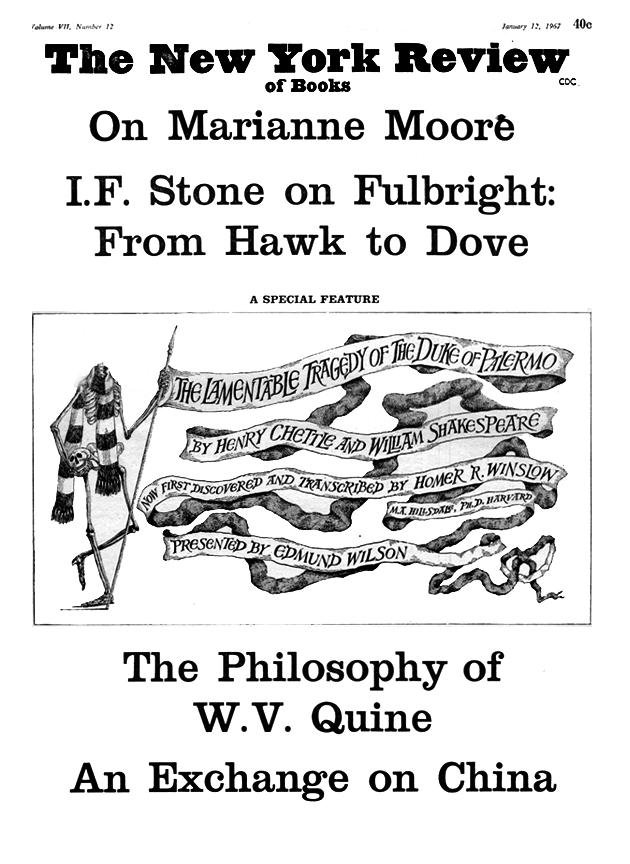
January 12, 1967
This Issue
January 12, 1967