
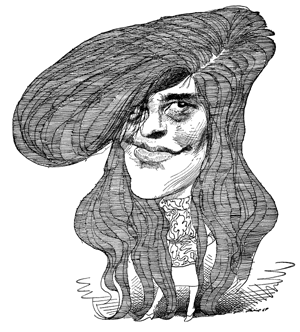
The narrator of Mr. Mailer’s novel is D. J., a foul-mouthed disc jockey in Dallas, “Big D in Tex.” More formally, he is Ranald Jethroe, son of Alice Hallie Lee Jethroe and David Rutherford Jethroe, Hallie and Rusty for short. Officially, he tells of a hunting trip in Alaska, but the narrative voice is louder than the story. D.J. is something of a lay preacher, the plot is his text, and the book itself is theme and variations, mostly variations on politics, big business, Texas, George Hamilton, the CIA, and sundry occasions of venom. On the second page D.J. quotes Thomas Edison out of Marshall McLuhan, but this is a false alarm, he does not continue in that vein. Indeed, we hear no more of books when he goes down to basic concerns, Texan folkways, violence, fathers and sons. Some of these matters are disposed in free-wheeling essays between the narrative sections, but the divisions of interest are informal. Many pages may be construed as D. J.’s advertisements for himself; the whole book, perhaps, as advertisements for William Burroughs and the author of Ulysses, who figures in the text as “Dr. James Joyce.” D. J. is given to horsing around and joycing around, like any good disc jockey in Big D.
But the book is not a charade, nor a ragbag of Maileriana. If it is loosely strung, it is not casual. For convenience we take the story and the voice as if they were independent, but in fact a relation between them is powerfully maintained. D. J.’s voice is the syntax of the novel, in the sense that it commands whatever it invokes. The unity of the book depends upon a commanding voice rather than a controlling consciousness, because there is no gap between subject and object. This is not to imply that D. J. is a fool, but that only enough consciousness is required of him to sustain a powerful rhetoric, continuity of attack, and a hunter’s sense of natural event. Anything more, including a quotation from Edison, is a bonus. So the main aesthetic problem is the double responsibility to the story and the voice. The story is pastoral, a ritual of purification. D. J. and his friend Tex are purified in the Arctic air, going out to kill their bear while the bad ones, Rusty and Big Luke Fellinka, the hunter’s code broken, are already “beginning to smog the predawning air with their psychic glug, glut and exudations.” This is the moral of the story.
But the moral is elaborately orchestrated by voice and style. The style, it should be remarked, is peculiarly American. Josephine Miles has studied the American Sublime, a high style of praise and panegyric lavished upon the American land, its scale and variety. In poetry this style features “a long free cadenced line, full of silences, symbols, and implications.” In prose, I suggest, it comes to us as a voice, recognizable even before we have taken the local meaning of the words. We attend to a voice speaking, rather than to something being said. So the first problem is to deal with the voice, to accept or reject its claim upon our attention. Only later on, and gradually, do we fasten upon the words, their meanings, one by one. Mr. Mailer’s style in the new novel is the American Sublime, but the rhetoric is now inverted. What we hear is a voice denouncing everything shoddy and mean that corrupts the land. In the last chapter of Eras and Modes Miss Miles says of the Sublime in modern American poetry:
It can portend for our poetry a strong sense of ceremony and of public concern, strong personal and passionate comments on public issues, a highly vocal and expressive function of evaluation for the poet—comparable to the role played by Pindar, for example, in his celebration of the Olympic Games—a calling up and praising of great figures of our life, or perhaps a denouncing them, but at any rate a perceiving and portraying them, larger than life, in a great frame of human values and human concerns.
This is Mr. Mailer’s tradition, guardian of his conscience. By temper he is a man of praise. The violence of the new book is a mark of his current relation to the American tradition: a big voice tuned for praise now roars against a world gone wrong, a land in sin. On the last page D. J. says, “I thank you, because tomorrow Tex and me, we’re off to see the wizard in Vietnam…. Vietnam, hot damn.”
THE MEANING of the book, when story and voice join to spell it, is a parable of force. “If the center of things is insane,” D. J. says, “it is insane with force.” The problem is to take the harm out of the insanity, retaining the force as energy. There is a passage near the end when D. J. thinks of the bear and then of God and the two thoughts become one, hardly a thought but a sense of omnivorous force. D. J. is with Tex:
Advertisement
Silence. And they each are living half out of their minds. For the lights were talking to them, and they were going with it, near to, the lights were saying that there was something up here, and it was really here, yeah God was here, and He was real and no man was He, but a beast, some beast of a giant jaw and cavernous mouth with a full cave’s breath and fangs, and secret call: come to me.
The only human answer, the book implies, is to possess the force as energy, translating the rough beast into style. Not energy of mind: Mr. Mailer is not Henry Adams. Perhaps energy of feeling, energy of the right feeling. Style is the right feeling animating the voice. D. J.’s foul mouth is cleansed when he goes above the timberline in Alaska; the scurrilities recede, abashed. In the mountains, there you feel free. Tex, Tex, hold on tight.
Given these concerns, that conscience, and that style, Mr. Mailer can hardly avoid sounding like William Faulkner. The easy difference is that Faulkner’s rhetoric confronting sin and guilt is a way of easing the pain, the words covering, everything even while they mark the wounds. In Mr. Mailer’s book relief is provisional. Alaska is good, but people have to live in Texas. Some of the most memorable passages in the book invoke Faulkner’s The Bear as if to point the harder difference, how far we have come, the further wrongs done on the road. When the hunt begins and Tex shoots the wolf; or again, in Chapter 8, when D. J. and Rusty go off on their own and kill their bear: these passages are not at all diminished in Faulkner’s vocal presence. The sense of force and mystery at large is comparably keen. But in Faulkner there is always something to praise, before and after the guilt. The rhetoric of celebration goes on as long as the rhetorician likes because there is still enough in life to sustain it. Not all the ceremonies of innocence are drowned. But in Mr. Mailer’s book the celebration is fitful, fugitive, even above the timberline. “Herr Dread” and Mr. Guilt are too close. So the long free cadenced line can move only in one idiom, invective. Celebration is a phrase now, a hint; invective is as ready as spleen.
Faulkner, Hemingway, Joyce, Burroughs: these bears have left their prints on Mr. Mailer’s book, but in the last reckoning the book is his own. Coarse, violent, scatological, it often sounds as if it were the text of an underground LP, but there is no bad faith in it. On the contrary, it is a book of great integrity. All the old qualities are here, Mailer’s remarkable feeling for the sensory event, the detail, “the way it was,” his power and energy. Among the new qualities there is a certain directness, a refusal of fuss. In the canon of Mailer’s works the new book is a departure: it has little or nothing in common with The American Dream; rather, it has the angular integrity of Barbary Shore (a maligned book) and more verve than anything by Mailer since The Naked and the Dead. Perhaps what is so fine in the new book is that Mailer now values his own nonsense at its proper worth, no more, and he is willing to replace it by anyone else’s sense or, better still, by his own sense. The book is fortissimo, but not merely loud.
MISS SONTAG’S NOVEL is something else again. She is not a natural writer, certainly not a natural novelist. She writes by insistence, the will doing the work of the imagination. Her inventions read like bright ideas driven into fictional postures; they bear the marks of her chain and move only as far as she drives them. The basic pattern of the fiction was given on the first page of her first novel, The Benefactor, where the narrator said of a certain preoccupation:
When it began, it grew in me and emptied me out. I ignored it at first, then admitted it to myself, then sought consolation from friends, then resigned myself to it, and finally learned to exploit it for my own wisdom. Now, instead of being inside me, my preoccupation is a house in which I live.
The self is invaded by a preoccupation, normally a series of dreams. The dreams are accepted, entertained: allowed to impose a corresponding pattern of conduct. Thus the self escapes from the burden of personality. The escape feels like wisdom, because lightness is all. This pattern is elaborated in Death Kit. Some people are their lives; others, like Diddy the hero of Death Kit, merely inhabit their lives. “Knowing one has a life induces the temptation to give it up.” Death Kit starts from that temptation. Diddy’s aim is to disengage the self: “to be in the present; to be without imagination, unable to anticipate anything; to be.” As Mailer’s joycing D. J. said: “air we breathe is the prez, present dent.”
Advertisement
Now this is an interesting pattern, as patterns go, and the idea is engaging. Indeed, something like the pattern and the idea may be found in P. F. Strawson’s essay in descriptive metaphysics, Individuals (1959). Glossing Leibniz, Mr. Strawson says:
Roughly speaking, the primary conceptual scheme must be one which puts people in the world. A conceptual scheme which, instead, puts a world in each person must be, at least, a secondary product.
This secondary scheme is the one which is deployed in Miss Sontag’s novel. Think of two people or, in Leibniz’s term, two monads: call them Diddy and Hester. But instead of any pre-established harmony, arrange to keep these monads utterly separate, their truths wide apart. Mr. Strawson says that the meaning of the doctrine of pre-established harmony is that “monads harmonize because they belong to the same concept-set.” So: drive them apart; and make one of them, Diddy, spend his life trying to force the sets together. Miss Sontag, rigging the case a little, makes Hester blind, thereby permitting a causerie on McLuhan. Indeed, Death Kit may be read as a fictional gloss upon The Gutenberg Galaxy, its theme the pain of living in a visual culture. Diddy is an advertising man in a firm that sells microscopes. That is, he is a victim of visual abstraction:
Sight permits him to reach conclusions at a distance, before he’s come close enough to touch and be touched. Sight encourages abstractions—a luxury of sighted persons. While for Hester, as for all blind persons, judgment must wait until she closes, in specific contact, with something particular. When nothing has a look, there are no general categories. When nothing has a look, everything becomes concrete, palpable, touchable. It occurs to Diddy that perhaps all his terrors derive from the mixed blessing of being able to see. Because he can see, he can perceive the world abstractly. At a distance. That’s what Diddy has to unlearn. Disband his imagination, which is glued with incredulity upon past images and gazes with apprehension into the tube of the future. That imagination which depletes his vitality, consigning everything to the rack of time.
It occurs to me that perhaps Miss Sontag’s problems as a novelist derive from the mixed blessing of being able to see Mr. McLuhan’s books in every drugstore. Hester is blind, she is sad, she weeps, but on the other hand she knows that her truth and Diddy’s truth cannot be in the same concept-set, and she accepts this as their fate. Diddy does not accept. He forces their truths to coincide, by violence, sex, fantasy. Diddy has murdered a man named Incardona. Or at least he fancies he has murdered him. Hester is properly skeptical. At the end, Diddy murders Incardona again in Hester’s presence, to make her see. “I want to be seen,” he shouts, when Hester cries, “But I can’t, you know I can’t.” Mr. Strawson could have given him sound advice. The monad “represents, or reflects, the entire universe from its point of view.” Space, he says, is “internal to the monad.” So “the views remain, as it were, and correspond to each other in ways which the laws of perspective indicate; but there is nothing of which they are the views.” Hester knows this, in her tactile way. Diddy never learns. The desire remains; to disengage the spirit from the burden of character, personality, isolation, manners, society, and moral choice; either by a kind of levitation or by a collapse into dream.
I find this interesting because ideas are interesting, but it is more rewarding to read them in Mr. Strawson, taking them straight. This runs against the standard assumption that ideas are enlivened when they are involved in dramatic or fictive experience. But the ideas in Mr. Strawson’s book are livelier than their counterparts in Miss Sontag’s fiction. This is an elaborate way of saying that Mr. Strawson is a gifted philosopher with a style congenial to his purposes, and Miss Sontag is a novelist with a style inadequate to her purposes. She is particularly engrossed, for instance, in the experience of uncertainty. Diddy shares this interest. “For the coarse menace of detection and punishment, Diddy has substituted the subtler menace of uncertainty.” Assuming uncertainty, Miss Sontag tries to probe its menace. But she does not possess the imagination of uncertainty. Diddy worries his ideas until they become fantasies and then he finds himself living in that doomed house. But in Death Kit this is the only form uncertainty can take, ideas nagged to fantasy and death. It is not enough. The fault is not in the ideas themselves. With F. H. Bradley’s ideas T. S. Eliot wrote The Waste Land, but only when the ideas had submitted themselves to the rest of his experience, changing and being changed:
I have heard the key
Turn in the door once and turn once only
We think of the key, each in his prison
Thinking of the key, each confirms a prison…
This is the imagination of privacy. What it owes to a figure in the Inferno, an idea in Appearance and Reality, or any other source is academic. Death Kit is an extremely ambitious book, but it is undermined by the fact that its ideas never become its experience: the ideas remain external, like the enforced correlation of dream and act in The Benefactor.
THERE IS MORE to be said. Reading Death Kit I wondered why Miss Sontag ascribes representative status to her monsters, Diddy and Hester; why, thereafter, she concedes every sophistry of will as if it were a legitimate claim of spirit; and why she assumes that the only home for the spirit is in dream and fantasy. Perhaps the great charm of Christina Stead’s new book, in this setting, is its security and justice of critique. Where Miss Sontag is hectic, Miss Stead is poised. But there is no question of inertia. The new book consists of four long short stories, “The Puzzleheaded Girl,” “The Dianas,” “The Rightangled Creek,” and “Girl from the Beach.” They are not all equally fine. “The Dianas” will be hard to recall a month or two from now. “The Puzzleheaded Girl” trades somewhat upon the reader’s interest in the obliquities of character, but it is wonderfully delicate. The distinction of the stories is a quality of perception, the mind bodied against the rush of experience. We find it as a certain tone of voice: in “The Dianas,” for instance, when Lydia is described going off by herself to have a sandwich at an expensive Montparnasse restaurant:
It cost her as much as a real meal, but she enjoyed picking and choosing; she liked the strangeness of being a pretty girl eating lunch alone.
But quotation gives the wrong impression, because the narrative voice never swings away from the story. Mr. Mailer’s cadenzas are exhilarating, but Miss Stead sticks to the score. Her best stories give the impression of having reached her imagination at one leap: she has only to transcribe them, as we fancy her transcribing The Man Who Loved Children. Miss Stead seems to write her stories down, while Miss Sontag writes them up. Or that is a way of putting it, the impression of difference. Miss Stead assumes that it is still possible to get things right, the line accurate, the graph precise. She has her own sense of the way things are, and she sees no good reason to give it up now in favor of anyone else’s nonsense or the common nonsense. Miss Sontag seems to assume that there is nothing by which anything can be measured; as if every straight line were an evasion, every graph an essay in bad faith. She writes as if she had to do everything for herself and all at once and be God as well. Miss Stead writes as if most of the work were already done by God or Satan or the seasons, and now she has only to deliver the materials in reasonable order. In the light of eternity it may emerge that she was wrong, but in the meantime the assumption is good for her art.
The proof, from the new book, is “The Rightangled Creek,” an extraordinary story, fit companion to The Man Who Loved Children. A sort of ghost story, Miss Stead calls it, to indicate from the start, perhaps, that there are more things in heaven and earth than are dreamed of in our positivism. If an easy comparison is useful, Miss Stead’s story is comparable, for power and measure, with a remarkable story by Yvor Winters, “The Brink of Darkness.” Both are ghost stories, in a sense, and both find the ghosts emerging from ordinary occasions, extraordinary now in their reception. There is strong authority for this procedure. Henry James said in the Preface to The Altar of the Dead that it is better not to try to present the prodigious element directly. “We want it clear,” he said, “but we also want it thick, and we get the thickness in the human consciousness that entertains and records, that amplifies and interprets it.” This is Miss Stead’s way of taking prodigies, letting them invade the capable intelligence. Her prodigious element is insidious, but not brash: felt in the blood as an alien presence, but known only after the event, when the pattern is clear; known all along, in “The Rightangled Creek,” to old Thornton, tedious to his neighbors but, at heart, an adept, one of the elect. So there is mystery in the story, but no mystification. Again it is a matter of measure in the narrative, the undeclared war between the ordinary and the weird, richly imagined; like the moment in The Man Who Loved Children when Louie, insulted, shouts over the banisters, “Vengeance is mine, saith the Lord, I will repay, no, vengeance is mine, I will repay.”
Perhaps the moral of our own story is that we can afford the diverse luxuries of Mr. Mailer and Miss Sontag only because we have Miss Stead as security. In the current Babel of tongues it is hard to make things quiet enough to hear her voice. She does not choose to shout. But still, she can be heard.
This Issue
September 28, 1967

This Issue
September 28, 1967
