
Number Six on the bestseller list, The Camerons, by Robert Crichton, is a mystifying work. One understands the sincerity of Herman Wouk, Number Seven, as he tries to impose his stern morality on an alien culture, or even that of the dread Marjorie Holmes, Number Ten, exploiting Bible belt religiosity with what I trust is some degree of seriousness (all those chats with God must have made her a fan). But Mr. Crichton has elected to address himself to characters that seem to be infinitely remote from him not to mention his readers. A UK mining town in what I take to be the 1870s (there is a reference to Keir Hardie, the trade unionist). With considerable fluency Mr. Crichton tells the story of a miner’s sixteen-year-old daughter who goes to the Highlands to find herself a golden youth to give her children. She captures a Highland fisherman, locks him up in the mines for twenty years, and has a number of children by him who more or less fulfill her “genealogical” (as Trevanian would say) dream.
Of all these books this one is closest to the movies. The characters all speak with the singing cadences of Culver City’s How Green Was My Valley. Another inspiration is None but the Lonely Heart, in which Ethel Barrymore said to Cary Grant, “Love’s not for the poor, son.” Mr. Cameron plays a number of variations on that theme, among them “Love, in everyday life, is a luxury.”
One reads page after page, recalling movies. As always, the Mirror Scene. The Food Scene (a good recipe for finnan haddie). There is the Fever Breaks Scene (during this episode I knew that there would have to be a tracheotomy and sure enough the doctor said that it was sometimes necessary but that in this case…). The Confrontation between Mr. Big and the Hero. Cameron has been injured while at work; the mine owner will give him no compensation. Cameron sues; the miners strike. He wins but not before the Confrontation with the Mob Scene when the miners turn on him for being the cause of their hunger. There is even the Illiterate Learning about Literature Scene, inspired by The Corn Is Green in which Bette Davis taught the young Welsh miner John Dall to read Quality Lit so that he could grow up to be Emlyn Williams. Well, Cameron goes to the library and asks for Macbeth and reads it to the amazement of the bitter drunken librarian (Thomas Mitchell).
There is the Nubile Scene (“For a small girl she had large breasts and the shirt was tight and made her breasts stand out, and she kept the jacket near at hand because she didn’t want to embarrass her father if he came into the room. She had only recently become that way and both she and her father weren’t quite sure how to act about it”). Young Love Scene (the son’s girl friend is named Allison from Peyton Place). At the end, the Camerons sail for the new world. The first night out Cameron “wouldn’t go down to her then and so he stayed at the rail and watched the phosphorescent waves wash up against the sides of the ship and explode in stars.”
There is something drastically wrong with this smoothly executed novel and I cannot figure out what it is other than to suspect that the author lacks the integrity the Wise Hack insists upon. Mr. Crichton has decided to tell a story that does not seem to interest him very much. At those moments when the book almost comes alive (the conflict between labor and management), the author backs away from his true subject because socialism cannot be mentioned in bestseller land except as something innately wicked. Yet technically Mr. Crichton is a good writer and he ought to do a lot better than this since plainly he lacks the “integrity” to do worse.
Can your average beautiful teen-age Persian eunuch find happiness with your average Greek world conqueror who is also a dish and aged only twenty-six? The answer Mary Renault triumphantly gives us in The Persian Boy is ne! Twenty-five years ago The City and the Pillar was considered shocking because it showed what two nubile boys did together on a hot summer afternoon in McLean, Virginia. Worse, one of them went right on doing that sort of thing for the rest of his life. The scandal! The shame! In 1973 the only true love story on the bestseller list is about two homosexuals, and their monstrous aberration (so upsetting to moralists like Mr. Wouk) is apparently taken for granted by those ladies who buy hardcover novels.
At this point I find myself wishing that one had some way of knowing just who buys and who reads what sort of books. I am particularly puzzled (and pleased) by the success of Mary Renault. Americans have always disliked history (of some fifty subjects offered in high school the students recently listed history fiftieth and least popular) and know nothing at all of the classical world. Yet in a dozen popular books Mary Renault has made the classical era alive, forcing even the dullest of bookchat writers to recognize that bisexuality was once our culture’s norm and that Christianity’s perversion of this human fact is the aberration and not the other way around. I cannot think how Miss Renault has managed to do what she has done, but the culture is the better for her work.
Advertisement
I am predisposed to like the novel dealing with history and find it hard to understand why this valuable genre should be so much disdained. After all, every realistic novel is historical. But somehow describing what happened last summer at Rutgers is for our solemn writers a serious subject while to re-create Alexander the Great is simply frivolous. Incidentally, I am here concerned only with the traditional novel as practiced by Updike, Roth, Styron, Malamud, Taylor and Erskine Caldwell as well as by the ten writers under review. I leave for another and graver occasion the matter of high literature and its signs.
In The Persian Boy Miss Renault presents us with Alexander at the height of his glory as seen through the eyes of the young eunuch Bagoas. Miss Renault is good at projecting herself and us into strange cultures. With ease she becomes her narrator Bagoas; the book is told in the first person (a device not invented by Robert Graves as innocent commentators like to tell us but a classroom exercise going back more than two millennia: write as if you were Alexander the Great addressing your troops before Tyre). Bagoas’s father is murdered by political enemies; the boy is enslaved; castrated; rented out as a whore by his first master. Because of his beauty he ends up in the bed of the Great King of Persia Darius. Alexander conquers Persia; sets fire to Persepolis. The Great King is killed by his own people and Bagoas is presented by one of the murderers to Alexander who, according to historical account, never took advantage sexually of those he captured. Bagoas falls in love with the conqueror and, finally, seduces him. The love affair continues happily to the end although there is constant jealousy on Bagoas’s side because of Alexander’s permanent attachment to his boyhood friend Hephaestion, not to mention the wives he picks up en route.
The effect of the book is phantasmagoric. Marvelous cities, strange landscapes, colliding cultures, and at the center the golden conqueror of the earth as he drives on and on past the endurance of his men, past his own strength. Today when a revulsion against war is normal, the usual commercialite would be inclined to depict Alexander as a Fag Villain Killer, but in a note Miss Renault makes the point: “It needs to be borne in mind today that not till more than a century later did a handful of philosophers even start to question the morality of war.” Alexander was doing what he thought a man in his place ought to do. The world was there to be conquered.
The device of observing the conquerer entirely through the eyes of an Oriental is excellent and rather novel. We are able to see the Macedonian troops as they appeared to the Persians: crude gangsters smashing to bits an old and subtle culture they cannot understand, rather like Americans in Asia. But, finally, hubris is the theme; and the fire returns to heaven. I am not at all certain that what we have here is the “right” Alexander but right or not, Miss Renault has drawn the portrait of someone who seems real yet unlike anyone else, and that divinity the commercialites are forever trying for in their leaden works really does gleam from time to time in the pages of this nice invention.
August 1914 has already been dealt with at sympathetic but cautious length in these pages, and I shall touch on it only as it relates to other bestsellers. As a fiction the novel is not as well managed as Mr. Wouk’s Winds of War. I daresay as an expression of one man’s indomitable spirit in a tyrannous society we must honor the author Fortunately the Nobel Prize is designed for just such a purpose. Certainly it is seldom bestowed for literary merit, if it were, Nabokov and not the noble engineer Solzhenitsyn would have received it the year the Swedes were in a Scythian mood.
Solzhenitsyn is rooted most ambitiously in literature as well as in films. Tolstoy appears on page three and Tolstoy hangs over the work like a mushroom cloud. In a sense the novel is to be taken as a dialogue between the creator of War and Peace and Solzhenitsyn; with the engineer opposing Tolstoy’s view of history as a series of great tides in which the actions of individuals matter not at all. I’m on Solzhenitsyn’s side in this debate but cannot get much worked up over his long and wearisome account of Russian military bungling at the beginning of the First World War. The characters are impossible to keep straight, though perhaps future volumes will clarify things. Like Winds of War, this is the first of a series.
Advertisement
The book begins with dawn on the Caucasus, towering “so vast above petty human creation, so elemental….” The word “vast” is repeated in the next paragraph to get us in the mood for a superspectacle. Then we learn that one of the characters has actually met Tolstoy, and their meeting is recalled on page seventeen. ” ‘What is the aim of man’s life on earth?’ ” asks the young man. Tolstoy’s reply is prompt: ” ‘To serve good and thereby to build the Kingdom of Heaven on earth.’ ” How? ” ‘Only through love! Nothing else. No one will discover anything better.’ ” This is bestseller writing with a vengeance.
In due course we arrive at the Mirror Scene: “She was not even comforted by the sight of her naturally rosy skin, her round shoulders, the hair which fell down to her hips and took four buckets of rain water to wash.” The Nubile Scene: “She had always avoided undressing even in front of other women, because she was ashamed of her breasts, which were large, big and generous even for a woman of her build.” Wisdom Phrases: “The dangers of beauty are well known: narcissism, irresponsibility, selfishness.” Or “Evil people always support each other; that is their chief strength.” Like Hitler and Stalin? Also, Christian Wisdom Phrases: “There is a justice which existed before us, without us and for its own sake. And our task is to divine what it is.” Not since Charles Morgan has there been so much profundity in a bestseller.
As for the movies, the best Russian product is recalled, particularly Battleship Potemkin. Also, boldly acknowledging the cinema primacy, Solzhenitsyn has rendered his battle scenes in screenplay form with “=” meaning Cut To. These passages are particularly inept. “Mad tearing sound of rifle fire, machine-gun fire, artillery fire!/ Reddened by fire, THE WHEEL still rolls./= The firelight glitters with savage joy/” and so on. The Wise Hack would have been deeply disturbed by the presumption of this member of the audience who ought to be eating popcorn in the second balcony and not parodying the century’s one true art form that also makes money. From time to time Solzhenitsyn employs the Dos Passos device of random newspaper cuttings to give us a sense of what is going on in August, 1914. This works a bit better than the mock screenplay.
At the book’s core there is nothing beyond the author’s crypto-Christianity, which is obviously not going to please his masters; they will also dislike his astonishing discovery that “the best social order is not susceptible to being arbitrarily constructed, or even to being scientifically constructed.” To give the noble engineer his due he is good at describing how things work, and it is plain that nature destined him to write manuals of artillery or instructions on how to take apart a threshing machine. Many people who do not ordinarily read books have bought this book and mention rather proudly that they are reading it, but so far I have yet to meet anyone who has finished it. I fear that the best one can say of Solzhenitsyn is goré vidal (a Russian phrase meaning “he has seen grief”).
A peculiarity of American sexual mores is that those men who like to think of themselves as exclusively and triumphantly heterosexual are convinced that the most masculine of all activities is not tending to the sexual needs of women but watching other men play games. I have never understood this aspect of my countrymen but I suppose there is a need for it (bonding?); just as the Romans had a need to see people being murdered and the Byzantines a passion for chariot racing. Perhaps there is a connection between the American male’s need to watch athletes and his fatness: according to a WHO report the American male is the world’s fattest and softest; this might explain why he also loves guns—you can always get your revolver up.
I had the fortune to be the son, nephew, and stepbrother of All-American football players. This was no burden. At the age of ten I made it clear that I had no interest in anything involving team work. My father thought this reasonable; occasionally, I would go with him to Army-Navy games. I can still recall sitting between my father and Amelia Earhart (who was in love with him; at ten I was in love with her) and knowing that Amelia was as bored as I, but because we were both fond of my father we never complained. We would amuse ourselves with literary problems. “Describe,” she would murmur to me, “the color of the crowd.” “Gray. No, gray and pink. No, there’s too much brown….”
I fear that I am not the audience Mr. Dan Jenkins had in mind when he wrote his amiable book Semi-Tough, but I found it pleasant enough, and particularly interesting for what it does not go into. The narrator is a pro football player who has been persuaded “that it might be good for a pro football stud to have a book which might have a healthy influence on kids.” Question: do young people watch football games nowadays? It seems to me that “jock-sniffers” (as Mr. Jenkins calls them) are of Nixonian age and type—though few have the thirty-seventh president’s nose for such pleasures. The unfat and the unsoft young must have other diversions. One wonders, too, if they believe that “a man makes himself a man by whatever he does with himself, and in pro football that means busting his ass for his team.” This is pure pre-Watergate Nixon.
Semi-Tough tells of the preparation for the big game. Apparently training involves an astonishing amount of drink, pot, and what the narrator refers to as “wool,” meaning cunt. There is one black player who may or may not like boys and the narrator clams up on what is a very delicate subject in jock circles. I am not sure Mr. Jenkins is aware of all the reverberations set off by one of his white player’s jokes. Asked why he is an athlete, the stud says, ” ‘Mainly, we just like to take showers with niggers.’ ” It is a pity Mary Renault did not write this book. And a pity, come to think of it, that Mr. Jenkins did not write August 1914, a subject suitable for his kind of farce. No movie in Semi-Tough. As the Wise Hack knows all too well, sports movies bomb at the box office. Perhaps the Warhol factory will succeed where the majors have failed. SHOWER ROOM—LONG SHOT. CUT TO: CLOSE SHOT—SOAP.
At first glance The Odessa File by Frederick Forsyth looks to be just another bold hard-hitting attack on the Nazis in the form of a thriller masked as a pseudo documentary. But the proportions of this particular bit of nonsense are very peculiarly balanced. First, the book is dedicated “to all press reporters.” The dust jacket tells us that the author worked for Reuters in the early 1960s; it does not give us his nationality but from the odd prose that he writes I suspect his first language is not English. Also the book’s copyright is in the name of a company: a tax dodge not possible for American citizens. Next there is an Author’s Note. Mr. Forsyth tells us that although he gives “heartfelt thanks” to all those who helped him in his task he cannot name any of them for three reasons: Apparently some were former members of the SS and “were not aware at the time either whom they were talking to, or that what they said would end up in a book.” Others asked not to be mentioned; still others are omitted “for their sakes rather than for mine.” This takes care of the sources for what he would like us to believe is a true account of the way Odessa (an organization of former SS officers) continues to help its members in South America and the Federal Republic.
After the Author’s Note there is a Foreword (by the author). We are told who Adolf Hitler was and how he and the Nazis ruled Germany from 1933 to 1945 and how they organized the SS in order to kill fourteen million “so-called enemies of the Reich,” of which six million were Jews. When Germany began to lose the war, “vast sums of gold were smuggled out and deposited in numbered bank accounts, false identity papers were prepared, escape channels opened up. When the Allies finally conquered Germany, the bulk of the mass-murderers had gone.”
Well, one knows about Eichmann, and of course Martin Bormann is a minor industry among bad journalists, so presumably there are other “important” SS officers growing old in Paraguay. But do they, as Mr. Forsyth assures us, have an organization called Odessa whose aim is “fivefold”? Firstfold is “to rehabilitate former SS men into the professions of the Federal Republic,” second, “to infiltrate at least the lower echelons of political party activity,” third, to provide “legal defense” for any SS killer hauled before a court and in every way possible to stultify the course of justice in Western Germany, fourth, to promote the fortunes of former SS members (this seems to be a repeat of the first of the five folds) and, five, “to propagandize the German people to the viewpoint that the SS killers were in fact none other than ordinary patriotic soldiers.”
This is food for thought. Yet why has one never heard of Odessa? Mr. Forsyth anticipates that question: “changing its name several times” (highly important for a completely secret society), “the Odessa has sought to deny its own existence as an organization, with the result that many Germans are inclined to say the Odessa does not exist. The short answer is: it exists….” We are then assured that the tale he is about to tell represents one of their failures. Obviously fun and games; presumably there is no such thing as the Odessa, but in the interest of making a thriller look like a document (today’s fashion in novels) the author is mingling true with “false facts” as Thomas Jefferson would say.
Now for the story. But, no, after the Dedication and the Author’s Note and the Foreword there comes a Publisher’s Note. Apparently many of the characters in the book are “real people” but “the publishers do not wish to elucidate further because it is in this ability to perplex the reader as to how much is true and how much false that much of the grip of the story lies.” The publishers, Viking, write suspiciously like Mr. Forsyth. “Nevertheless, the publishers feel the reader may be interested or assisted to know that the story of former SS Captain Eduard Roschmann, the commandant of the concentration camp at Riga from 1941 to 1944, from his birth in Graz, Austria, in 1908, to his present exile in South America, is completely factual and drawn from SS and West German records.” So let us bear this Publisher’s Note in mind as we contemplate the story Mr. Forsyth tells.
After the fall of Hitler, Roschmann was harbored at “the enormous Franciscan Monastery in Rome in via Sicilia.” There is no such establishment according to my spies in the order. “Bishop Alois Hudal, the German Bishop in Rome” (Mr. Forsyth seems to think this is some sort of post) “spirited thousands [of SS] to safety.” “The SS men traveled on Red Cross travel documents, issued through the intervention of the Vatican.” After a period in Egypt, Roschmann returns to Germany in 1955 under a pseudonym. Thanks to Odessa, he becomes the head of an important firm. He conducts secret research “aimed at devising a teleguidance system for those rockets [he] is now working on in West Germany. His code name is Vulkan.”
Why is Roschmann at work on the rockets? Because Odessa and its evil scientists “have proposed to President Nasser” (whose predecessor Mr. Forsyth thinks was named Naguil), and he “accepted with alacrity, that these warheads on the Kahiras and Zafiras be of a different type. Some will contain concentrated cultures of bubonic plague, and the others will explode high above the ground, showering the entire territory of Israel with irradiated cobalt-sixty. Within hours they will all be dying of the pest or of gamma-ray sickness.”
This is splendid Fu Manchu nonsense (infecting the Israelis with bubonic plague would of course start a world epidemic killing the Egyptians, too, while spreading radioactive cobalt in the air would probably kill off a large percentage of the world’s population as any story conference at Universal would quickly conclude). Next Mr. Forsyth presents us with the classic thriller cliché: only one man holds this operation together. Roschmann. Destroy him and Israel is saved.
The plot of course is foiled by a West German newspaperman and its details need not concern us: it is the sort of storytelling that propels the hero from one person to the next person, asking questions. As a stylist, Mr. Forsyth is addicted to the freight-car sentence: “This time his destination was Bonn, the small and boring town on the river’s edge that Konrad Adenauer had chosen as the capital of the Federal Republic, because he came from it.” (Adenauer came from Cologne but Mr. Forsyth is not one to be deterred by small details: after all, he is under the impression that it was Martin Bormann “on whom the mantle of the Führer had fallen after 1945.”) What is important is that Mr. Forsyth and Viking Press want us to believe that the Vatican knowingly saved thousands of SS men after 1945, that six of the ten high-ranking Hamburg police officers in 1964 were former SS men, that President Nasser authorized a clandestine SS organization to provide him with the means to attack Israel with bubonic plague, and that when this plot failed the Argentine government presumably offered asylum to Captain Roschmann. Caveat emptor.
The boldness of author and publisher commands…well, awe and alarm. Is it possible now to write a novel in which Franklin Roosevelt secretly finances the German American Bund because he had been made mad by infantile paralysis? Can one write a novel in which Brezhnev is arranging with the American army defectors in Canada to poison Lake Michigan (assuming this is not a redundancy)? Viking would probably say, yes, why not? And for good measure, to ensure success, exploit the prejudices, if possible, of American Jewish readers, never letting them forget that the guilt of the Germans (“dreaming only in the dark hours of the ancient gods of strength and lust and power”) for having produced Hitler is now as eternal in the works of bad writers and greedy publishers as is the guilt of the Jews for the death of Jesus in the minds of altogether too many simple Christians. Exploitation of either of these myths strikes me as an absolute evil and not permissible even in the cheapest of fictions brought out by the most opportunist of publishers.
The number one bestseller is called Jonathan Livingston Seagull. It is a greeting card bound like a book with a number of photographs of seagulls in flight. The brief text celebrates the desire for excellence of a seagull who does not want simply to fly in order to eat but to fly beautifully for its own sake. He is much disliked for this by his peers; in fact, he is ostracized. Later he is translated to higher and higher spheres where he can spend eternity practicing new flight techniques. It is touching that this little story should be so very popular, because in its way it celebrates art for art’s sake as well as the virtues of nonconformity; and so, paradoxically, it gives pleasure to the artless and the conforming, to the drones who dream of honey-making in their unchanging hive.
Unlike the other bestsellers this work is not so much a reflection of the age of movies as it is a tribute to Charles Darwin and his high priestess, the incomparable creatrix of The Fountainhead (starring Gary Cooper and Patricia Neal), Ayn Rand.
There is not much point in generalizing further about these bestsellers. The authors prefer fact or its appearance to actual invention. This suggests that contemporary historians are not doing their job if to Wouk and Solzhenitsyn falls the task of telling today’s reader about the two world wars, and to Forsyth and Trevanian tales of the cold war. As Christianity and Judaism sink into decadence, religioso fictions still exert a certain appeal. It will surprise certain politicians to learn that sex is of no great interest to those writers. Only Semi-Tough tries to be sexy, and fails. Too much deodorant.
Reading these ten books one after the other was like being trapped in the “Late Late Show,” staggering from one half-remembered movie scene to another, all the while beginning to suspect with a degree of horror that the Wise Hack at the Writers’ Table will be honored and remembered for his many credits on numerous profitable pix long after Isherwood (adapted “The Gambler” with Gregory Peck), Huxley (adapted Pride and Prejudice with Greer Garson), Vidal (adapted Suddenly Last Summer with Elizabeth Taylor) take their humble places below the salt, as it were, for we did not regard with sufficient seriousness the greatest art form of all time, preferring perversely to write books that reflected not the movies we had seen but life itself, not as observed by that sterile machine the camera but as it is netted by the protean fact of our beautiful if diminishing and polluted language. Kind of dumb, all in all. Like Sam, one should’ve played it again.
(This is the second part of a two-part article on bestsellers.)
This Issue
May 31, 1973
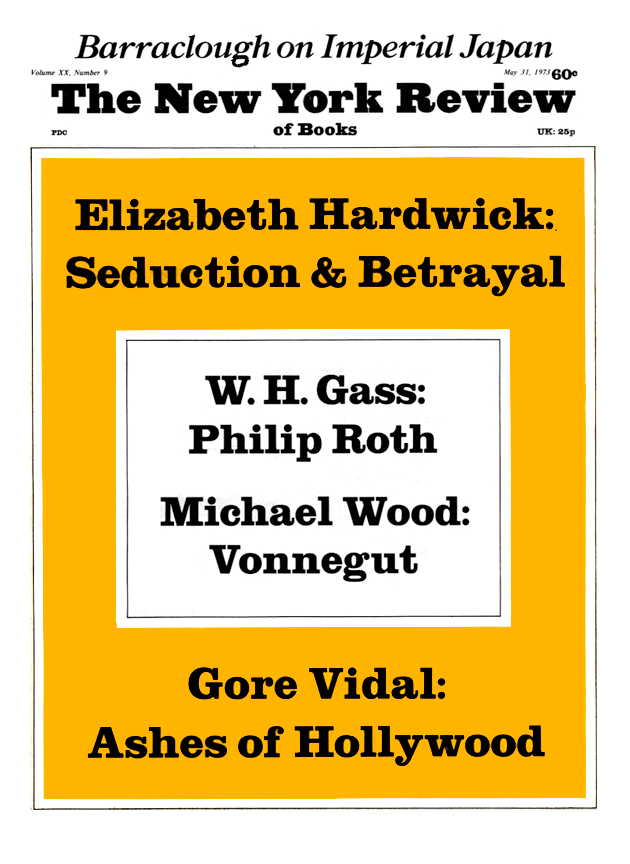
This Issue
May 31, 1973
