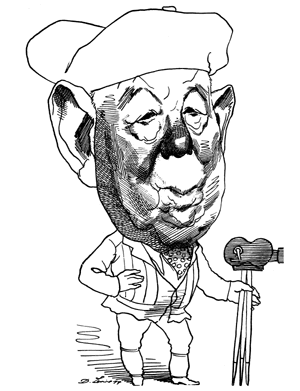
Hugo says that forty is the old age of youth and that fifty is the youth of old age. These summer and autumn moods where perhaps one is most aware of the poignancy of what has been or what is to come, these seasons of accommodation where one plants and where one reaps, seem to me the apt setting, the characteristic boundaries, of Jean Renoir’s gently radiant, gravely humorous art. In the best of his films—even the Indian exoticism of The River, where three nubile girls stand on the threshold of love, the elegant eleventh-hour romps of The Rules of the Game, the last flings and follies of Boudou Saved from Drowning—there’s always that typical Renoir ripeness, the authority of natural forces, natural events, those strains of lyric simplicity and dark but mellow accountability which Renoir makes so much his own.
The particulars of experience and of character, the particular consequences of choosing—these are for him the only absolutes. He is a man who doesn’t “believe there are such things as absolute truths,” but who does “believe in absolute human qualities”—generosity, most especially. And when one is too young, the heart is generous, but usually only to oneself or to another mirroring oneself. When one is too old, the heart has gone dry, campaigns have ended, advice and sour ironies are what’s left. It’s when one is caught in the middle of the journey, in life’s flow, that one is most open, often against one’s will, to the imperatives of others and the world. Jean Renoir is not the ideal director I would choose, say, for either Romeo and Juliet or Krapp’s Last Tape.
He is the ideal director, though, and has been for years, for the sort of film he virtually invented. When Americans were developing genres, Italians those series of white telephone soap operas that fascinated Mussolini, and the Soviets socialist realism, Renoir in the Thirties brought to the French film a subject and a sensibility that had never been there before, the bittersweet, mildly sardonic, reluctant celebration of one’s humanity and one’s fate that is found so often in the tales of Chekhov and Turgenev and Maupassant. “Mou-Mou,” for instance, a story by Turgenev, where a browbeaten serf is cornered by his chattering distracted mistress into doing away with his one companion in the world, his dog, could easily, in its tart severity, have been a Renoir film. One can even imagine his favorite actor, the shambling, crudely sensitive Michel Simon, in the lead, and one of those feathery forlorn Joseph Kosma scores on the track.
Of course there were earlier examples of what Renoir was after in some of the silents of René Clair and Stroheim and Cavalcanti. Stroheim, in particular, is an acknowledged influence. The exteriors and interiors of San Francisco and Death Valley in Greed, the gaudily emblematic Monte Carlo set in Foolish Wives—these taught Renoir the twin uses of the naturalistic and theatrical. Also the absence of cutting in Stroheim’s films, the disavowal of montage, the steady concentration of physical detail, the background that is brought to the foreground, added, surely, to Renoir’s repertoire; for contrary to André Bazin, his countryman did not miraculously happen upon “deep focus” or “the continuation of dramatic space and, of course, its duration,” at the end of the Thirties with The Rules of the Game. Stroheim had broken the ground earlier—and in Hollywood.
But Renoir did go beyond his predecessors, I think, in a number of ways and for a number of reasons. Partly because, though he had been at work in the Twenties, it was only with the advent of sound, which he found exhilarating, that he really hit his stride. (How often what his characters say and how and why they say it seem exquisitely matched.) Partly too because of the expansiveness of his nature, the ease and freedom and rapidity of movement with which he works—and the eccentricity as well. And partly—or most of all—because of the sheer breadth and verisimilitude of his canvas.
Renoir can be both plain and eloquent, joyous and somber, can blend the sweet and salty, the sour and bitter. He has an extraordinary sympathy for the human body, for its failings and its glories, for “the gesture of a laundress, of a woman combing her hair before a mirror, of a street-hawker near a car”—images gleaned, as he says, from a study of his father’s paintings and the paintings of the other Impressionists, to which he would add his own disarming sense of the casual or idiosyncratic: how people work or play or gather in groups (a Renoir specialty), how out of provincial or urban gloom, a foredefeated routine, unexpectedly a freshet springs, a storm erupts; or one of those brisk winds, prevailing in his comedies, suddenly sweeps away the pollutants of a stale life, carrying health and energy in its wake.
Advertisement
During the Thirties Renoir never seemed to have much of the showy, the emphatic style popular among his competitors, and so was often thought inferior to them. Yet he could create visual vignettes in a matter of seconds. The geranium in Grand Illusion flourishing in Stroheim’s rocky fortress where nothing grows but ivy and nettles, which we alter see him pluck after the death of Pierre Fresnay—that scene has an oddly chaste and perfunctory quality which always strikes me as far more moving than similar symbolic touches in Duvivier and Feyder. Or the fog in La Nuit du Carrefour or La Chienne—artistically it’s rather crude, but today how uncomposedly full of life, how much more genuine it appears when we compare it to the decorous oppressive weather of a film by Carné.
Fogs, rivers, trees, houses, courtyards, sunlight, shade—in Renoir things exist in their own right. (“Things are. Why manipulate them?” asks Rossellini, echoing the older director.) The Paris-Le Havre train so prominent in the drama of Human Beast, under which the hero plunges to his death—that is there as a brute stubborn fact of nature or of the environment, not as some sort of tone poem as are the more famous instances of trains in Brief Encounter or Shanghai Express. Character actors, minor performers, too, always have their day; Gaston Modot or Julien Carette, with their laconic or homey irascibility, often appear more indispensable to Renoir than his star.
Yet even when he does use a star, a sacred monster, as he does enchantingly with Ingrid Bergman in Elena et les Hommes, tempestuously with Anna Magnani in The Golden Coach, though allowed an aria here and there, these ctresses are never encouraged to disturb the balance, ultimately must prove their mettle in ensemble. For that is how Renoir sees the world: not as figures in a landscape but a landscape absorbing the figures in it—that is, if they’re ready to allow the absorption, “to absorb material,” “to digest it and pass it on”: a sacred or profane transfiguration which, as he says over and over, should be the proper pursuit of every artist.
Of course there are things wrong with Renoir too. In his fidelity to life, including the famous “dance of life,” Renoir can seem, intermittently, circuitous, even sloppy. He has none of the perfectly crafted moods, the superbly sustaining longueurs of later directors, of Bergman or Antonioni. And though he has a strong sense of narrative connectives, of “sequence shots” (he must be one of the few fashionable auteurs who consistently tell a story), these traditional properties are disjunctive rather than tensed, with Renoir forever roughening or sharpening the edges. And that can be dismaying.
In The Rules of the Game, that gallopade of the French haut monde and its wicked ways on the eve of the Second World War, there are so many turnabouts, so many snippets of slapstick that no matter how often I’ve seen the film there are always the moments where I’m left wondering how things can ever be set straight. But then will come, say, the scene of the hunt and the shoot—the Marquis, his guests, his estate, the pheasants and rabbits, the marshlands and forests, the rivalry between the servants, even the flimsy business of the Marquise discovering the adultery of her husband—and suddenly how the farcical bits and pieces cohere, how galvanic and tender and surpassingly humorous the story seems! For Renoir is one of those daredevils who delights in keeping his mastery in reserve, in pretending he’s just an old duffer out for a stroll, and then in a flash making his leap, his coup.
Similarly in A Day in the Country, initially we’re watching an unpromising set of caricatures, the sort of folk who’d be at home in Carverville with Andy Hardy, until we witness, early in the film, the mother and daughter in their white Parisian frocks laughing and sitting on the swings beneath the trees in the garden of an inn, guiltily espied by a passing group of young seminarians in black—and at a stroke, we have a whole other world: nineteenth-century bourgeois France in miniature.
As we all know Renoir is the most democratic, most ecumenical of directors: in his films everyone is always a little bit right and always a little bit wrong. The most memorable line of The Rules of the Game—spoken by Octave, the amiable fraud, sardonic sponger, artist manqué, who is played by Renoir himself—is, “There’s one thing, do you see, that’s absolutely terrifying, and that is that everyone has his reasons.” Of course Renoir never explores the terror; he’s both too earthy and diffident for that. Rather he domesticates it. In him the family romance is extended and embodied in the romance of different classes, different types; in the contrasting, affectionate, biting portraits of warder and poacher, lover and cuckold, bourgeois and bohemian; in those contrapuntal touches or surprises; the northerly effects we get in his warm transparently simple rustics, the southerly effects in his suave knotty sophisticates. And if he’s stoical or realist enough to accept that there are political, social, and psychological irreconcilables among us, still he’s humanist enough to believe that a shared sorrow, a shared adversity can spring traps, that an enemy wounded is an enemy no longer, that empathy, if we dig down deep enough, is at the heart of the world—his world, anyway.
Advertisement
There’s a beautiful illustration of what I’m talking about in a scene from probably the most popular of his films, Grand Illusion, which is about German prison camps during the First World War. Jean Gabin has gone stir crazy, shouting and banging his head against the wall of his small cell. An old German wearily enters, attempts to comfort the distraught fellow. But they share no common language. He offers him cigarettes, but that does no good; he offers him his harmonica, but the result is the same; he drops the harmonica on Gabin’s bunk and leaves. A little while later we hear the faltering strains of a melancholy waltz. The old German beams, and then when another guard asks him what the ruckus was about, he sighs and says, “It’s the war. It’s gone on too long.” The scene is just a sketch, no doubt even a bit sentimental, but emotionally it has an unspoilable rightness and tact. We learn everything about Gabin through the old German, everything about the old German through his reaction to Gabin. That’s the Renoir strategy of reconciliation, his famous double movement, opposing forces that unite, each in his own way.
Beerbohm once remarked that what he liked most about the novels of Trollope was that here was an author who was not forever turning out his characters’ pockets to see what he could find against them. Of course that is also true of Renoir. Since he deals in dramas he has to have villains but his villains are never as insidious, and certainly never as neurotic, as we might have a right to expect. Jules Berry, the sly fly-by-night entrepreneur in The Crime of Monsieur Lange, has a certain dapper appeal; even Fernand Ledoux, the murderer in Human Beast, is redeemed by a seedy sort of pathos—or by his obsession with Simone Simon. If Renoir believes that life is hard, he believes too that one must live as easily as possible, as unprotestingly as one can; likes, therefore, to have his characters, black and white, in close moral and emotional proximity; enjoys insisting that to an “illogical, irresponsible and cruel universe,” the only things one can reasonably bring are, paradoxically, one’s generosity, one’s love.
Obviously, there is in my attitude the egoistic hope of being paid in return. I am as wicked as anyone else and have the same needs as they of a smiling indulgence.
That sort of indulgence seems to me to work splendidly, indeed hilariously, in perhaps the grandest of Renoir’s creations, the surly, clumsy, orsine, idiotically innocent, roguish Boudou, a tramp (performed in rollicking primitive style by Michel Simon) who is saved one day from a suicidal leap to the Seine by a fatuous bourgeois, and who repays his benefactor by seducing his maid, raping his wife (magnificently neurasthenic with her repeated “Il me porte sur les nerfs!“), spitting on his cherished copy of Balzac, and then finally reducing the thwarted Samaritan into admitting that “one should only rescue people of one’s own class.”
But the indulgence is considerably less successful elsewhere—in some of the maudlin stretches of The Southerner or This Land Is Mine—and altogether disastrous, I’m afraid, in Le Petit Théâtre de Jean Renoir, the latest of the eighty-year-old director’s films, where, sadly enough, he appears to be suffering an attack of self-congratulatory humanity. I was bored watching the three tales that comprise the trilogy (full of fusty echoes of other people’s works: The Madwoman of Chaillot, Le Million, The Baker’s Wife), and thought if it had been in English instead of French, and if it had a few more of those Renoir beggars stopping for a rest and a chat on the bumpy highway of life, it could have played the Music Hall for the Easter trade.
Ordinarily, though, his characters are not gemütlich at all, but the sort the world would normally call useless. Laborers who are always expendable, aristocrats whose day has passed, actresses who award golden coaches to bishops, princesses who are fortune hunters in the guise of noble souls, soldiers who are vocational malcontents, masters and servants who are equally powerless and equally demanding. Admittedly an odd lot. Comes the revolution and where will they be?
But it’s not uselessness as we know it in Sartre, not man as passion inutile, who must therefore make himself responsible for the absurdity of his existence, must interrogate himself and his situation. There’s nothing so grand or so heavy in Renoir. He’s too acquiescent, too commonsensical for that. The uselessness of his characters is one with the purposelessness, the playfulness, of the universe around them, a creed adhered to, in one way or another, even during his robust engagé days with the Popular Front. “You have to start out in a certain line and keep to it,” he tells us, but the best way to do that is to imitate the migratory birds, to be in a submissive and intuitive relationship to reality, to “follow a line instinctively, without knowledge,” surrender to the moods and deeds of the moment, “the pleasure of working well.” Life being what it is, though, it’s wisest to be more prudential than flamboyant. For if Renoir is a romanticist, as has often been claimed, both by himself and by others, he’s one who knows that romanticism is best kept at a distance or in the distance, who knows that a mile above the earth on the hottest summer’s day we’re in a winter sky, that the nearer one goes to the sun the colder one gets, that the most ardent or arrogant of adventures doesn’t last.
Still one must risk—it’s the one imperative of his films. One must risk one’s reputation or one’s beliefs; one must escape from prison, cross a frontier, dare a new day; one must risk being thought a cuckold or even being one (the last of the tales in Le Petit Théâtre); one must burn one’s house and one’s paintings to test the love of one’s wife (this happens to Charles Bickford and Joan Bennett in The Woman on the Beach). Obviously these moments of generosity, of risk, often border on the absurd; nevertheless they’re our fields of action, they yield those moments of “interior truths” through which we come to know who we are and where we are, and folly then for the man who vacillates or refuses the gambit. Yet if the romantic impulse is revived in Renoir, it’s also tempered by a shrewd pessimism, a dry worldliness. His characters are never in the privileged position of a swaggering Marivaux who becomes a brigand out of sheer aristocratic exuberance or swank. In Renoir risk is always bathed in toil, the commonplace fatalities and frustrations of age, the traumas of an era. And if, above all, love is irresistible, the loss of love is even more so—that is parti pris.
One of the keenest of his “interior truths,” and the poignant subject of his loveliest work, is that in most of our lives we’re in exile from our best moments, that a single encounter may imprison these best moments, that we only recognize them as such after they’ve passed. Two indolent young men set out to seduce a mother and daughter who’ve come from Paris to spend a day in the country. They go boating, they frolic. Eventually the older and wiser of the two pairs off with the girl. He takes her to an island. Above them in a tree a nightingale sings to his mate, around them a light rain gently spatters over the leaves. She resists, he has qualms, they make love. Years pass. Unexpectedly one Sunday they meet again at the old spot. He tells her he often comes there, the line he had used to seduce her, only this time it is true. And the girl—now a woman, a wife—says she thinks of it every night. They part. She rows back down the river with her husband. He sighs, gazes up at the tree. The moment of recognition here is so precious it could come out of operetta. And yet how forceful and delicate, how witty and elegiac and pastoral it seems. Surely it’s moments like that that people must really be referring to when they say they “can’t get over” a Renoir film.
Certainly Raymond Durgnat, in a new and thoroughgoing study, is clearly in love with the great French director, fascinated by his protean shape. He calls him a “pilgrim of the relative,” a pioneer in the film noir, neorealism, cinéma verité, variously influencing Visconti, Rossellini, and Truffaut; he has grateful and pleasant words for practically everything he’s ever done, managing even to make an interesting case for some of the lackluster stuff Renoir produced in Hollywood during the war (bound to please Renoir, who thought he had been reborn in America).
Unusual for a scholarly survey, the book has only a smattering of wrong dates and details (James Craig, not Henry Fonda, played in All That Money Can Buy; The Blue Angel was released in 1930 not 1933, The Street in 1923 not 1921; it’s Pressburger not Berger; and so on). I don’t think it’s quite right to say that “the ellipse (the interruption, the evasion, the aversion of the eye from the fullness of reality) is crucial to Renoir’s cinematographic syntax,” since more often than not Renoir’s is a conventional arrangement of close shots and long shots interspersed with medium shots; and the improvisatory quality, the “acrobatic camera-movements and focal gymnastics” Durgnat speaks of must surely seem faint when set against the sharp dislocating styles of the Sixties, of Godard and Resnais. But he’s perfectly apt in his summary of the typical Renoir psychology:
Selfishness, even a search for sweet revenge, may be a sin but it is an inalienable one, and it is the ability to forgive real wrongs which characterizes Renoir’s magnanimous man.
The self-interest, self-love seen in most of his characters, which Renoir both demonstrates and honors as the way of the world, is the reality principle governing his tales; the acts of forgiveness, of magnanimity—that’s the pleasure principle, the nostalgia he irresistibly evokes in us for an earlier and better day. For of course Renoir is not modern. Contemporary man is not magnanimous man. Our age, above all, is characterized by disrelation and distrust, a disparity of feelings. Nor is he much of a thinker as Durgnat gingerly suggests. Whenever he deals explicitly with abstract philosophical problems, with good and evil, as he does in Le Testament du Dr. Cordelier, he seems to me puerile beyond words. His forte is emotion, the rehabilitation of clichés (Gabin’s look of gratitude and simple mastery as Dita Parlo prepares coffee the morning after their night of love), the familiar dramaturgy of dualisms: aesthete and philistine, spirit and matter, theater and life.
Beneath his grieved and echoing humanity, the mature Renoir is often exactly what he calls himself, “a child of the belle époque,” full of dreamlike childlike insouciance, of anarchist sympathies (in at least four of his films, by my count, the “murderers” go free), of penchants for amateur theatricals, for spyglasses, for the raw and underlying decorum of seas and rivers, even floods (it seems only fitting that the first of the films he made in Hollywood was called Swamp Water).
What Death and God are for Bergman, Nature and Love are for Renoir. His is a landscape of transformations, but without theology, without dogma, a humanist and pantheist landscape, contradictory, persevering, hedonistic, invincibly tolerant. One remembers especially the quick triumphant endings (Dalio and Gabin plunging across the snow under the shadow of the German border patrol), or those dying away on a melodious comic diminuendo (Boudou the unlikely bridegroom mindlessly upsetting the boat that was carrying him and his bride to respectability, ungraciously sharing scraps of his beggar’s feast with a donkey, resuming his destiny as king of the road—as wry and spry and magical an ending as any I know in the history of films).
The Hal Ashby hit, Harold and Maude, seems to be the sleeper of the year, a bit of pop whimsey which, though it has elements of the supernatural farce (Harvey) and of the saccharine musical with an extravagant female at its center (Mary Poppins, Mame), must also be something of a movie first, a philosophical black comedy for grandparents and grandchildren, or what Walt Disney and Lucille Ball might have thought up if they’d taken courses in the Absurd at UCLA. Harold, a fatherless teenager, spends most of his days attending the funerals of strangers—that is, when he’s not staging elaborate suicide attempts designed to discomfit his mother, a doughty society woman with the svelte frozen smile of Pat Nixon, who keeps saying things like, “I suppose you think that’s funny, my dear,” when she discovers him hanging from the rafters of her drawing room.
Harold, the nineteen-year-old naysayer, meets Maude, the eighty-year-old yea-sayer—and then things are never the same after that. Maude lives higgledy-piggledy in an abandoned railway car, commiserates with plants, eats gingerbread cakes, drinks organic champagne, dances the Watusi, sings ratty little rock numbers which sound like the Virginia Slims commercial (“If you want to be high be high, if you want to be low be low. There are a million ways to go, you know that there are”), drives the fuzz batty whizzing across the highways in one stolen vehicle after another (“These cops, they always want to play games!”), and spouts a Lebensphilosophie which seems to be a mixture of The Power of Positive Thinking, The Primal Scream, and Peter Pan.
Maude comes from Old Vienna, but in her undeflectable energy she’s thoroughly American. Determined, bouncy, genial, a cross between a waxworks soubrette (a brunette, in fact) and a gym eacher, she’s also, as played by Ruth Gordon, one of the most mannered—and hence endearing—people on earth. Harold is overwhelmed. “Maude, you’ve made me very happy,” he says. “Harold, you make me feel like a schoolgirl,” she says. But at the height of their mutual bliss (he believes they’ll be married), Maude takes what she calls “the pill”—that is, she kills herself. “Farewells should always be jolly”—I think that’s the parting line. So in despair Harold whizzes along the highways too before crashing his car in the Pacific. But not really. We last glimpse him gamboling on the ramparts of the California coast, strumming his banjo, laboriously performing a few of those Watusi steps Maude must have taught him, then disappearing in the smog to meet life.
He disappointed me, though. I thought he really would die and that he and Maude would be reunited in the beyond (“The cycle never ends, Harold,” Maude would say), and then the two could do the old Cary Grant and Constance Bennett number in Topper and return and haunt Harold’s awful mother. There might even have been sequels. Harold and Maude at San Clemente. Harold and Maude Go Hawaiian. This valiantly inane little film, which of course is about how people of good will can surmount the Generation Gap (or the horrors of existence) if they’re only allowed to act like asses now and then, is one of the three Hollywood films that Americans who no longer go to the movies are currently flocking to see. The others are—and there must be a moral here somewhere—The Exorcist and Walking Tall.
Basil Wright’s The Long View is a big bright breezy monster of a book celebrating movies as the universal art, movies at the forefront of history, movies as the tower of Babel scattered in studios throughout the world. Also movies as the place to go to get a “good cry.” (“And the tears come to your eyes”—a brave and favorite phrase.) Both a fan and a pro (he’s one of Britain’s oldest and best documentary directors), Wright seems to be operating on the principle that there’s always been a law of progress in the art of the film; he moves in evolutionary leaps and bounds from the Silents to Talkies to Wide Screen to Angries to New Wave, each subsequent development grabbing more and more of his attention; but then, as if to atone, he backtracks a bit and advises the directors of “future synaesthetic spectaculars” to turn to Eisenstein for guidance.
The book hasn’t much depth, and no theoretical airiness: nothing on myth or phenomenological arabesques or structuralist syntagmaticism. Compare it, say, to Christian Metz’s recently translated Film Language: A Semiotics of the Cinema, and it would be like comparing Swift’s flying island of Laputa with Southern California’s Muscle Beach. But it’s fun to read. And certainly everything you might want to know or not know about what’s been happening to moviemaking in Holland or the Balkans or Denmark or Egypt, as well as the more familiar places, is here.
There are two frank, if startling, omissions (Wright doesn’t dig Bergman and Antonioni so doesn’t write about them), and a few puzzlers. I don’t know how he can talk about Rossellini without mentioning the films he made with Bergman, about Sturges and Huston without mentioning The Lady Eve or Beat the Devil; why he piously dredges up some of the old sublimities (Laughton’s raspberry in If I Had a Million; MacDonald singing “Beyond the Blue Horizon” to all of Europe from the window of her speeding railway car in Monte Carlo), which usually after one finally gets to see them turn out to be nothing at all; how he can wax eloquent over such kitsch as Drums Along the Mohawk or Mr. Arkadin; how he got the idea that Thalberg “sacked” Sternberg, or that Bette Davis in the film about Bankhead on Broadway, All About Eve, plays (“Of all things, darling!”) a movie star, or why he misremembers the line from the film which he says has already “passed into history”: “Fasten your seat belts, it’s gonna be a rough evening,” when of course the phrase is, “it’s going to be a bumpy night.”
But, in general, one trusts his eye, his enthusiasm, his experience (he began his “love affair” in 1913 and has been faithful ever since); he’s not one of those professors of literature moonlighting as film historians after thumbing through a glossary of film terms; he seems as sensitive to those currently “out” (Wyler, Reed, Frankenheimer) as to those currently “in” (Olmi, Oshima, Ozu); and excepting the comments on Godard (another lacuna), the assessments of Eisenstein and Dovshenko, Dreyer and Bresson, Resnais and Marker, even the “Ealing Formula,” could not, on Wright’s own sentimental or commonsensical terms, be bettered.
As for the “Signposts” prefacing the various chapters, perhaps they do seem a bit affected; even so, they yield now and then unexpected instances of unintended humor, as when we read that in 1915, the year Theda Bara is wowing the world as the first screen vamp in A Fool There Was, “Anthony Comstock, Secretary of the Society for the Suppression of Vice, dies,” “Henry James becomes a British citizen and five months later has a stroke,” “Sarah Bernhardt has her right leg amputated,” Rasputin becomes “effective ruler of Russia,” “Einstein enunciates his Theory of Relativity,” and the Germans use “poison gas for the first time.” And we like to think it’s only recently that actualité has superseded works of the imagination…. No photos, alas. And no index.
Postscript: Jean Renoir’s autobiography, My Life and My Films (which Atheneum will be publishing in November and which I’ve just read), though charming, adds little, I think, to what one already knows of his habits and background, either through Renoir’s biography of his father (containing a fuller account of Jean’s youth) or in the numerous entrevues in Cahiers du Cinéma and other publications which have been appearing over the years. Chatty and infectious, Renoir is certainly a born reconteur, but better, it seems to me, when speaking extemporaneously than in the fan mag reveries of his memoir. Surprisingly he admits to a fascination with artifice—but surely that’s more in the manner of Rameau at his harpsichord imitating the sounds of hens—that is to say, with Renoir the love of the natural is apparent even in its most capricious disguise.
There’s the usual quid pro quo among artists (Chaplin, he tells us, is “the master of masters, the film-maker of film-makers”; Chaplin, elsewhere, returns the compliment). He admires the “open-handedness” of Americans, the “bad taste” of Cézanne and Van Gogh; he recalls the German bullet on the Western front injuring his leg, characteristically considering it advantageous: “A person who limps does not see life in the same way as someone who does not limp.” Characteristic, too, are the persistent motifs. “The truth is that the affinity between the film and the river is the more strong and subtle because it cannot be explained.” “Every period of my life has been dominated by the figure of a friend.” Motifs which later blend in a striking definition: “For me that is what a good film is…the ripple of streams…the sensation of leaves…the caress of foliage in a boat with a friend.”
Renoir’s is an ample, accommodating genius (“the only way to impose one’s personality is to help one’s collaborators to express their own”), a career apparently guided, honorably and winningly, by the old apothegm that those who dig pits for others fall in themselves—a truism, however, not always true to life, as witness President Ford’s pardon of Nixon.
This Issue
October 3, 1974
This Issue
October 3, 1974
