
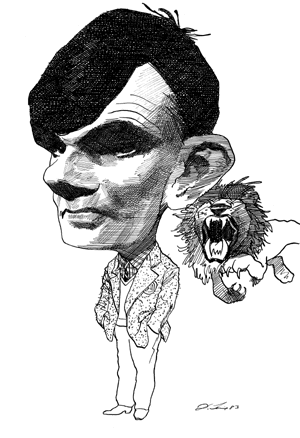
Cambridge University has always been hospitable to powerful but eccentric intellects. Again and again, solitary Cambridge thinkers have conceived, and given clear definitions to, the new ideas of later generations. One may think of young Isaac Newton, banished home to Lincolnshire in the 1660s to sit out the Great Plague; or of Charles Darwin in the 1840s and 1850s, back from the Beagle circumnavigation and wandering in the chalk hills around his house at Downe in Kent. Conversely, Cambridge tends to be a bit out of touch with worldly things. (“Oxford men think the world belongs to them,” the saying was, “Cambridge men don’t care who it belongs to.”) At best, the luminaries of Cambridge expected to deal with the world on their own idiosyncratic terms. So Newton became an autocratic Master of the Mint and lifelong president of the Royal Society; while, after a short spell as secretary of the Geological Society of London, Darwin retired to the country and enjoyed just that degree of ill health he needed in order to protect himself from intrusions that would interrupt his scientific writing.
Now, as Andrew Hodges’s remarkable biography makes clear, we may add another figure to this Cambridge pantheon: Alan Turing, newly elected a Fellow of King’s at the age of twenty-two, lying in a meadow near Grantchester in the summer of 1935, and dreaming up the arguments that would become essential points of departure for our own new world of information processing and “thinking machines.” Only, in Turing’s case, there is a mystery.
In relation to his own times, he had an intellect as radical, direct, and free of fog as any of his forerunners; and one would expect that now, at seventyone, he would be a pundit of British science, a public figure, even a life peer, celebrated not only for his ideas on artificial intelligence but for his secret work cracking the German “Enigma” codes during World War II. If all had gone well for him, he would be living a productive old age, as Baron Turing, former president of the Royal Society. But all did not go well for him. Instead, he has been dead for some thirty years, and his role in shaping our current modes of thought is half-forgotten. He died of cyanide poisoning in 1954, in his early forties, almost certainly a suicide, two years after being convicted under England’s antiquated laws against homo-sexual activity, and subjected, as the alternative to a prison term, to a year of androgynizing hormone treatment.
How did a life of such distinction end in a wreck? Until Andrew Hodges gave us the results of his inquiries, that question remained (as this book’s punning title suggests) an enigma. But, as happens rarely, an extraordinary thinker has found an ideal biographer. Andrew Hodges’s sympathetic and perceptive account traces both the professional and personal strands in Alan Turing’s life, death, and subsequent reputation; and he shows us how things went for him not as the story of an enigma, but as a Greek tragedy. The resulting account has much to teach us, not just about the intellectual life, but also about larger social issues for instance, about the disharmonies that exist between the world of truth and the world of power, and the risks that face those who carry into their personal lives the freedom of thought they rely on in dealing with ideas.
None of us who had intellectual dealings with Alan Turing in the late 1930s and 1940s had much doubt that he belonged in the honorable procession of Cambridge scientific geniuses. His final stature and contribution were not yet clear, but one thing was already apparent. Basic theoretical issues that stretched to the limit the mental powers of the best contemporary mathematicians, logicians, and scientists were for him straightforward, or even routine; and this remained so, whether they had to do with the foundations of mathematics and logic, cryptanalysis or digital computing machines, morphogenesis or the philosophy of mind. It is not that Turing found such issues easy: just that he had cleared his head of the standard inheritances of confusion and cant, and had defined for himself a standpoint from which some of the deepest and most obscure corners of the twentieth century scene could be sharply illuminated.
Alan Turing’s starting point lay in the foundations of logic and mathematics. As late as the 1930s, many mathematicians still shared an old philosophical dream, that all the formal procedures of mathematics, and with them all other truly logical procedures, constituted a self-contained “system” and so the workings of those procedures would turn out to be a matter of routine. In 1928, with this dream in mind, David Hilbert had posed three fundamental questions about the structure of that mathematical system: Is it complete? Is it consistent? and, Is it decidable? In each case, his own conviction was that the answer should be “Yes.”
Advertisement
Very soon, Kurt Gödel demonstrated that the system of mathematics could not, at one and the same time, be both complete and consistent. Yet Gödel’s theorem still left unanswered the final and most difficult question: Is there any definable method for deciding, at least in principle, whether any given mathematical assertion is true or not? Characteristically, that fundamental issue was the one that Alan Turing thought it worthwhile to address; and, in doing so, he reinterpreted it in an ingenious way. Any such method of “routinizing” mathematical proof (he reflected) can be thought of as a mechanical process; so what sort of a “machine” would be needed to carry it out?
In answering that question, he conceived a radically new notion: that of a “universal machine.” In theory, this machine could perform the functions of any other machine, provided only that it was first fed a suitable sequence of coded instructions, i.e., what we would now call a “program.” Of course, as Turing dreamed it up in the 1930s, he had no plan for actually building this machine. Instead, he used the conception simply to define the framework needed to attack Hilbert’s last question; and with its help he demonstrated, against Hilbert’s own convictions, that some mathematical questions must necessarily remain undecidable. For example, among the whole conceivable range of “real numbers,” we can generate some that cannot be computed by any mechanical or routine procedure. More important, having drawn attention to the existence of these “unsatisfactory” numbers, he showed that no definite method can be specified for telling which of the numbers are and which are not “computable.”
This was only the beginning of a more audacious train of thought. Turing’s immediate purpose was limited to mathematics, but his imagination at once carried him to other, far distant conclusions. As he understood very well, seventeenth-century (“modern”) philosophy and natural science, whose presuppositions remain alive and powerful in the twentieth century, embodied a mechanical vision of physical nature. This vision legitimated both the Cartesian dichotomy, which set the rational activities of human mentality outside the physical world of causal processes; and also the Newtonian account of material nature, as a self-contained and fully determined system of forces and particles, which Heisenberg’s indeterminacy principle had done little more than dent. And this same model of the world, as a self-maintaining system, had also been called on to explain, and to justify, the “social system” of the bourgeois order.
Thus, any basic reformulation of our ideas about machines and systems put more at risk than the systematic character of mathematics and symbolic logic. Having used his universal machine to undercut Hilbert’s mathematical agenda, Alan Turing at once went on to make other, more far-reaching, suggestions. For a start, he showed, his argument held out the possibility of building an actual machine to do all the work that can be done by any human computer; and he extended the same model to provide a new analytical account of states of mind and mental operations. At their intellectual or rational core (which was the central preoccupation of René Descartes’s arguments) all such states and operations rested on the kinds of procedures that his universal machine could in principle perform; and, from this insight, two very general conclusions followed. First, the idea of a “thinking machine,” which the seventeenth-century philosophers had regarded as a contradiction in terms, was now after all an admissible idea. And, second, the resulting world of mental procedures needs be no more exhaustive, self-contained, or systematic than Hilbert’s mathematical world had proved to be.
So, from the start, Alan Turing’s basic ideas were presented as a point of departure from which people might navigate into new, post-Cartesian waters. But Britain and the late 1930s were neither the place nor the time to pursue those more far-reaching issues; and from September 1939 on his ideas acquired a quite unforeseen practical application.
As it turned out, Turing’s general principle of operating a standard machine according to arbitrary initial instructions had already been embodied by German military technicians into the so-called Enigma machines, which all three German services were using to encrypt their most secret radio messages. Turing was recruited into the team of dons (including a sizable contingent from King’s College, Cambridge) who spent World War II at Bletchley Park, an old manor house halfway between Oxford and Cambridge, breaking those supposedly “uncrackable” codes. The success of their efforts was always temporary and at the mercy of unexpected changes in the construction or modes of operation of the Enigma machines; but thanks to the overconfidence of the German high command, such changes were less frequent than they might have been, and only rarely were the code breakers frustrated for more than a few days at a time.
Advertisement
The involvement of the most gifted of the Oxbridge senior common rooms in key Allied operations of the Second World War created an alliance which, from a post-Vietnam standpoint, may seem ironical or even paradoxical. The yield of knowledge from the resulting cryptanalyses gave Britain, and with it the Allies, the narrow margin of survival on which it depended through the painful years from 1940 to 1944, most particularly in the face of successive U-boat offensives against the lifeline of transatlantic shipping. One of Winston Churchill’s chief weapons in the defense of his imperial dreams was thus a team of freethinking dons: not least, dons from King’s College, the home of J.M. Keynes and E.M. Forster, with their heterodox views of patriotism, democracy, and traditional sexual morals. For once, “Intelligence” had fallen into the hands of the truly intelligent; and the residual strains within this alliance played their part in deciding Alan Turing’s fate.
All of this Andrew Hodges describes with admirable care, feeling, and documentation. As he shows us, all the things that went right in Alan Turing’s life were connected in complex ways with the things that went wrong. He was born into one of those families that happily served the rulers of empire without ever being accepted as their equals. Alan’s father, like George Orwell’s, worked in the Indian civil service; and, as so often, his father was not English by ancestry but Scots, while his mother was Anglo-Irish. He was conceived in India, but his mother returned to London for the confinement; and his early years were passed in England, sometimes with his mother but often without, in a series of foster homes, lodgings, and boarding schools. (His father was at this stage invisible: after he returned to Britain, on his retirement, he remained a source of weakness rather than strength to his family.)
With this background, Alan Turing was not socially equipped to attend one of the traditional upper-class “public schools,” such as Eton or Harrow; instead, he was sent to Sherborne School in Dorset, a boarding school which though ancient in foundation (dating from 1550) was then in the second rank. Its headmaster saw his task as being to mold boys from marginal families to fit into the “system” of English life and society.
Alan was out of things from the start, and he soon became a confirmed solitary. His built-in resistance to indoctrination made it hard for him to excel at school, even in the academic subjects for which he had a natural bent. Though he had a private fascination with scientific ideas, he began to translate this into scholastic successes only in his last two years at the school, after he had fallen in love with a boy in another house at Sherborne. Christopher Morcom was one year his senior, and also interested in natural science, but he had adapted better than Alan to the demands of boarding-school life. Unfortunately, after winning a scholarship at Trinity College, Cambridge, but before he could take it up, Christopher, Alan’s only close school friend, died of the effects of bovine tuberculosis, with which he had lived since childhood.
To say that this death was a source of grief to Alan Turing is to understate its effect. Before this experience, his emotional life had been confused, undeveloped, and ambiguous; from this time on, it was dominated by the idealized memory of Christopher Morcom. Disappointed in the hope that he might succeed Christopher as a Scholar of Trinity, Alan accepted an award at the college of his second choice, King’s, and there he found a social, cultural, and psychological atmosphere that—without active proselytizing—did little to discourage homosexual inclinations either among its students, or among the Fellows.
Yet Alan remained something of a solitary, even an outsider, and at King’s his academic talents were not matched by any growth in social or personal ease. While an undergraduate, he was not elected to any of the self-recruiting societies of the college and university elite; least of all, to the Cambridge Conversazione Society, or “Apostles,” which was then under the auspices of Anthony Blunt and Guy Burgess, and so going through a phase of left-wing politics. (That Turing never had such views was overlooked later when he was in trouble. In fact, he was always a skeptic about politics, and never let himself be drawn into any kind of oversimplified political theories.) Still, he found good friends and congenial company at Cambridge, at least among his mathematical colleagues, and his intellectual abilities finally had a chance of recognition. He was awarded a distinguished degree, the Prize Fellowship at King’s, and visiting fellowships for two years at Princeton.
After the Austro-German Anschluss of March 1938, Turing declined an offer to continue working in the United States with his American senior and counterpart, John von Neumann. This is the most tantalizing moment in his story. In many ways, John von Neumann would have been an ideal colleague. As a scientific virtuoso, he was one of Alan’s few equals; and he was also one of the few leading mathematicians who had read, and seen the full implications of, Turing’s original paper, “Computable Numbers.” In addition, he had the flair of a sophisticated émigré from the Hapsburg empire, and he continued after the war to play a major part in the politics of American science, notably in computer development.
Andrew Hodges underlines the relations between the two men, portraying von Neumann as the Wizard of Oz and Turing as a naive Dorothy. Having the severest standards of intellectual conduct, Turing had little use for what he saw as the self-promoting antics of Norbert Wiener; and he could dismiss as a “charlatan” even Warren McCulloch, who was aware of his debt to Turing’s work but was also in Turing’s eyes exaggeratedly self-important. Von Neumann’s quality, on the other hand, he recognized, and he declined the offered appointment with some regret. But, for an Englishman at this time, the war with Hitler was just around the corner; and by the summer of 1938 Turing was back at King’s, and being recruited into preparations for the work on the Enigma codes.
This was work to which he was naturally suited, and he remained a key member of the team throughout the first three or four years of the war, until all the main principles had been mastered and the work required only industry and organization, rather than radical originality. By that time, in any case, Turing’s own mind was running ahead, and he was hard at work on a new subject: thinking how his theoretical vision of a universal machine could be translated into practical terms, and embodied in physical hardware to become—as Andrew Hodges takes care to describe it—the first “automatic electronic digital computer with internal program storage”—a phrase we would today render by the single word “computer.” The war over, he took up a position at the National Physical Laboratory, where his enthusiasm for the new computer ran up against bureaucratic practices that he was not equipped to circumvent. He returned briefly to King’s, where he now found himself socially more at home; but his professional ambitions soon took him to the University of Manchester, where he saw better prospects for computer development.
In Manchester his personal life came to grief. Cruising along Oxford Street, which was then the focus of a homosexual demimonde, he befriended an intelligent and promising young man named Arnold who later became a talented guitarist; and after a few weeks, through Turing’s own naiveté, his house was burgled by an acquaintance of Arnold’s and he was entangled in blackmail. Not understanding just how vulnerable he was, he turned to the police for protection. When questioned, he told the police about his “affair,” and found them far more concerned about his sexual “crimes” than they were about any petty break-in. His reaction was to say that he thought a Royal Commission was going “to legalize it.” From then on, the machinery of law enforcement ground on, and his friends could only give the kind of testimony about his character that might help to mitigate his unquestioned “crime,” and keep him out of prison.
If Alan had still been in Cambridge, things would surely have gone otherwise. The deepest irony in this story is the spectacle of a Fellow of King’s being arrested in Manchester for sexual offenses of a kind that E.M. Forster, J.M. Keynes, and a dozen other prominent Cambridge and London figures knew better than to be caught out in. The trouble was that Turing had always been a loner, and did not appreciate the complexities of the situation into which he had grown up. He had never wished to be part of an elite; as Andrew Hodges puts it,
He had wanted the commonest in nature; he liked ordinary things. But he found himself to be an ordinary English homosexual atheist mathematician. It would not be easy.
So, when his crisis came, he was in the wrong place at the wrong time, and his friends and colleagues could not shield him.
In almost every respect, in my view, Dr. Hodges reads Alan Turing’s life, as well as his ideas, surely and accurately. Most important, he shows us how far Turing’s ideas and manner of life presented a threat to the established order. Near the end of the war, Niels Bohr (whose work on atomic spectra had played a key part in the early stages of twentieth-century physics) met with Winston Churchill and pleaded for the internationalization of work on atomic power and weapons. After their stormy discussion, Churchill asked, “How did that silly old man get in here?” Alan Turing was quite as much out of tune with the tone of public and political affairs. He had attacked the very notion of “system,” not only in his critique of Hilbert’s program, but in his mode of life at Sherborne School and afterward.
One of Turing’s colleagues at Manchester later described him as “a sort of scientific Shelley.” The comparison is apt. Like Shelley, Alan Turing was at once the product and the victim of his background. His social class was protected enough for him to be free to pursue his original ideas without apology; but having “got away with” his eccentricity and unadaptiveness at school, he did not recognize, how far the social stakes were raised when he went to Bletchley. In the last resort, it was not his homosexuality, or even his choice of a sexual partner from the working class, that caused his ruin; it was his own insistence on frankly telling the authorities about his homosexual life. This brought into the open an unacceptable conjunction between people from separate social orbits, who should have “known their places.” The police, Hodges writes, “were particularly struck by his absence of shame. ‘He was a real convert…. he really believed he was doing the right thing.’ ” In the world of English society and politics, as late as the 1950s, order and system were still deeply serious matters: and, once Alan had left Cambridge, he was playing for keeps.
Disoriented as a child, turned in on his own resources, Alan Turing was like a comet moving across the tidy cosmos of the English scene, indifferent to its prejudices and commitments. With his passion for truth, he did not see that he could find protection for his life and work only if he stayed within the institutions that could shield him from the agents of power and order, to whom both his mode of life and his ideas were affronts. Born twenty years later, he would have grown up into a time of greater sexual tolerance, and all might have gone well. Had he never left Cambridge, he would not have met his fate on Oxford Street, and all might have gone well. But in the years of the early 1950s, as matters turned out, a homosexual, atheist scientific don in possession of vital state secrets was cut out to be a sacrificial object, and Alan Turing blundered innocently into his own destruction.
This Issue
January 19, 1984
This Issue
January 19, 1984
