
“My goal is simple. It is complete understanding of the universe, why it is as it is and why it exists at all.”
—Stephen Hawking, 1981
Stephen Hawking opens his new book with a marvelous old anecdote. A famous astronomer, after a lecture, was told by an elderly lady, who was perhaps under the influence of Hinduism, that his cosmology was all wrong. The world, she said, rests on the back of a giant tortoise. When the astronomer asked what the tortoise stands on, she replied: “You’re very clever, young man, very clever. But it’s turtles all the way down.”
Most people, Hawking writes, would find this cosmology ridiculous, but if we take the turtles as symbols of more and more fundamental laws, the tower is not so absurd. There are two ways to view it. Either a single turtle is at the bottom, standing on nothing, or it’s turtles all the way down. Both views are held by leading physicists. David Bohm and Freeman Dyson, to mention two, favor the infinite regress—wheels within wheels, boxes inside boxes, but never a final box.1 Hawking is on the other side. He believes that physics is finally closing in on the ultimate turtle. But before discussing his stimulating book, which climaxes with this amazing prediction, I shall say something about the book’s even more extraordinary author.
Hawking, age forty-four, is the Lucasian Professor of Mathematics at Cambridge University, a chair held by Isaac Newton and Paul Dirac. Few living physicists could occupy this chair more deservedly, even though, as many by now know, Hawking has for two decades been confined to a wheelchair. He is already a legend, not just because of his brilliant contributions to theoretical physics, but also for his courage, optimism, and humor in the face of a crippling illness. Lou Gehrig’s disease may be gnawing away at his body, but it has left his mind intact. Hawking actually sees himself as fortunate. He has chosen a profession in which he can work entirely inside his head, and his disability has freed him from numerous academic chores.
A tracheostomy made necessary by a pneumonia attack in 1985 has silenced his voice. He speaks by way of a computer and speech synthesizer attached to his wheelchair. Because the synthesizer was made in California, he apologizes to strangers for his American accent. He has a devoted wife and three children. He has visited the United States some thirty times, Moscow seven times, and flown around the world. At a Chicago discotheque he once wheeled onto the floor and spun his chair in time to the music.
A Brief History of Time is Hawking’s first popularly written book. Warned that every equation would cut sales in half, he has left out all formulas except Einstein’s famous E = mc2, which he hopes will not frighten half his readers. Hawking’s prose is as informal and clear as his topics are profound. Work that he accomplished during what he calls his early “classical” phase—by “classical” he means work in relativity theory—is summed up in The Large Scale Structure of Spacetime, a book written with South African cosmologist George Ellis. Avoid it, Hawking advises; it is so technical as to be “quite unreadable.” His “quantum phase,” begun in 1974, supplies the subject matter for his thoroughly readable Brief History of Time.
The book’s first chapter is a quick survey of changing models of the universe, starting with Aristotle’s concentric spheres that rotated about a round earth. Its elaboration by Ptolemy held sway in the Western world until Copernicus moved the sun to the center in one of the greatest paradigm shifts in the history of science. Medieval thinkers continually debated two big questions: Did time begin with creation? Did God create matter out of nothing or out of pre-existing primal matter? Hawking does not mention Aquinas, who argued that God could easily have made a universe with an eternal past, but we know better because Genesis says so. Hawking does mention Augustine’s earlier argument that time had no meaning until God, who is outside of time, created the heavens and the earth. What was God doing before then? Here is how Augustine replies in his Confessions:
I answer not, as a certain person is reported to have done facetiously (avoiding the pressure of the question), “He was preparing hell,” saith he, “for those who pry into mysteries.” It is one thing to perceive, another to laugh,—these things I answer not. For more willingly would I have answered, “I know not what I know not,” than that I should make him a laughing-stock who asketh deep things, and gain praise as one who answereth false things. But I say that Thou, our God, art the Creator of every creature; and if by the term “heaven and earth” every creature is understood, I boldly say, “That before God made heaven and earth, He made not anything. For if He did, what did He make unless the creature?”
An even more familiar passage occurs a few paragraphs later:
Advertisement
At no time, therefore, hadst Thou not made anything, because Thou hadst made time itself. And no times are co-eternal with Thee, because Thou remainest for ever; but should these continue, they would not be times. For what is time? Who can easily and briefly explain it? Who even in thought can comprehend it, even to the pronouncing of a word concerning it? But what in speaking do we refer to more familiarly and knowingly than time? And certainly we understand when we speak of it; we understand also when we hear it spoken of by another. What, then, is time? If no one ask of me, I know; if I wish to explain to him who asks, I know not.
Einstein’s model of the universe, the first to be based on relativity theory, is best understood as a three-dimensional analogue of the surface of a sphere. The sphere’s surface is finite but unbounded. A plane flying in the straightest possible line across the earth’s surface never reaches an edge, but eventually returns to where it started. In Einstein’s model, space is the curved hypersurface of a four-dimensional sphere. The cosmos is finite in volume but unbounded. A spaceship traveling the straightest possible path would eventually circle the cosmos. To prevent gravity from collapsing his model, Einstein imagined a repulsive force that would keep the universe stable, but it was soon shown that stability would be impossible. His universe would have to be either expanding or contracting.
After overwhelming evidence was found that the universe is expanding, two influential models were proposed. The physicist George Gamow claimed that the universe started with what the astronomer Fred Hoyle derisively called the “big bang.” Hoyle and his friends countered with a “steady state” universe, infinite in both space and time, that has always looked the same as it does now, and is destined to look the same forever. To maintain the overall structure, it is necessary to assume that hydrogen atoms are continually forming in space to provide the matter that keeps coalescing into stars.
The steady-state model was shot down by the discovery of background radiation that could only be explained as a remnant of a primeval fireball. Gamow’s big bang became the standard model. For a while, cosmologists toyed with the notion of “oscillating” models in which the universe expands, reaches a limit, contracts to a small size, then starts over again with another explosion. Recent theoretical work, Hawking writes, makes such “bouncing” models extremely unlikely.
Before describing his new model of the universe, Hawking provides an artfully condensed overview of relativity theory and quantum mechanics. In Newton’s cosmology, motion is “absolute” in the sense that it can be measured relative to a fixed, motionless space that nineteenth-century physicists called the “stagnant ether.” Newton’s time is also absolute in the sense that one unvarying time pervades the universe. Einstein abandoned both notions. Space and time were fused into a single structure. Light became the only nonrelative motion, its velocity impossible to exceed, and never changing regardless of an observer’s motion. Gravity and inertia became a single phenomenon, not a “force” but merely the tendency of objects to take the simplest possible paths through a space-time distorted by the presence of large masses of matter such as stars and planets.
There is a curious mistake in Hawking’s discussion of Newton’s cosmology. We are told that Newton believed in absolute time but not in absolute space, and for this was sharply criticized by Bishop Berkeley. It was the other way around. Newton defended absolute space against the “relational” view of his archrival Leibniz, who argued that space is no more than the relative positions of objects. Inertial phenomena, such as the centrifugal force that turns the surface of water concave in a bucket rotating rapidly around its vertical axis, makes it necessary, Newton insisted, to view motion as relative to a fixed space. Berkeley argued that no body could move or rotate except in relation to other bodies—a striking anticipation of relativity theory.
Hawking also misleadingly attributes to Berkeley the belief that “all material objects…are an illusion.” The Irish bishop did not think objects were illusions in any ordinary sense of the word. No one argued more cogently than he that the outside world is not dependent on human observations. For Berkeley, the structure of a tree or stone is maintained by the mind of God. He would have been delighted by quantum mechanics in which “matter” dissolves into mathematics. All material objects are made of molecules, but molecules are made of atoms, and atoms in turn are made of electrons, protons, and neutrons. And what are subatomic particles made of? They are quantized aspects of fields that are pure mathematical structures, made of nothing else. Applied to a field or its particle, the word “matter” loses all meaning. Nevertheless, for both Berkeley and a particle physicist, rocks are as nonillusory as they were for Samuel Johnson, who naively supposed he refuted Berkeley by kicking a large stone.
Advertisement
Hawking’s chapter on the expanding universe centers on a famous paper he wrote with Roger Penrose, now at Oxford University. Penrose had been the first to show that if a massive star collapses into a black hole, a region of space-time from which light cannot escape, it must (if the laws of relativity hold “all the way down”) produce a space-time singularity—a geometrical point of zero extension. At that point gravity would produce an infinite density and an infinite spatial curvature. When the variables of a law acquire infinite values, the law becomes meaningless. In plain language, physicists have no idea what happens at black hole singularities, if indeed they exist.
Hawking devotes two chapters to black holes. Although there is yet no decisive evidence that black holes exist, most cosmologists now are convinced that they do. (The best candidate for a black hole is the invisible part of a binary star system in the constellation of Cygnus, the swan.) Hawking’s major contribution to black hole theory was showing that as a star’s matter falls into a black hole, quantum interactions must occur and particles escape in what is known as “Hawking radiation.” As the title of a chapter indicates, “black holes ain’t so black.” Mini–black holes are tiny structures that may have formed in great numbers after the big bang. Hawking showed that if they exist, radiation will cause them to evaporate and ultimately explode. When Hawking delivered his classic paper on this in 1974, the conference chairman, John Taylor, called the paper rubbish. 2 Dennis Sciama, a British cosmologist, had an opposite reaction. He called the paper one of “the most beautiful in the history of physics.”
A chapter called “The Origin and Fate of the Universe” is the book’s centerpiece. About 1981 Hawking and Penrose became more and more impressed by the possibility that relativity ceases to apply on the quantum level. Just before the universe exploded there would be no singularity because quantum mechanics completely dominated the scene. Nor would there be a singularity if the universe contracted to the big crunch. These thoughts led Hawking to an elegant new model of the universe that he constructed with Jim Hartle, at the University of California, Santa Barbara.
It is hopeless to explain the new model in any detail here because it makes use of a special kind of time called “imaginary time,” which plays a role in calculating the most probable paths of particles. It is called imaginary because it is measured by complex numbers—numbers of the form a + b√-1, where a and b are real numbers and √-1 is imaginary.3 Like Einstein’s model, the new model is finite in volume but not unbounded. Unlike Einstein’s model, time is treated in exactly the same way as a space coordinate. Einstein’s three space coordinates were closed in a circle, but his time was open at both ends. In Hawking’s model, “real time” is replaced by imaginary time.
Hawking makes no attempt to explain his model except by a vague analogy. The universe is likened to a tiny region at the earth’s North Pole. Think of the earth’s axis as an imaginary time axis. The universe explodes and expands until it reaches its maximum size at the equator, then contracts to a tiny region at the South Pole. The two end spots are “singular” in the ordinary sense of being unique, but not in the technical sense of unextended points where the laws of science break down. Because the time axis is imaginary, it is not necessary to assume that the universe had a beginning or will have an end. The two spots are regions where disorder is total, the arrow of real time vanishes, and quantum events fluctuate aimlessly and forever in imaginary time.
From the standpoint of real time, the universe looks as if time began with the initial explosion and will cease after the big squeeze, but in imaginary time there are no singularities where time starts and stops. The universe emerged from a chaos that always was, and will go back to a chaos that will never cease. As Hawking puts it, the universe is eternal, “completely self-contained and not affected by anything outside itself. It would neither be created nor destroyed. It would just BE.”
It is not clear whether Hawking is a determinist who thinks history has to be the way it is, or whether chance and free will intervene, although early in his book he raises a curious paradox. If determinism reigns it would impose the outcome of our search for universal laws, but “why should it determine that we come to the right conclusions from the evidence? Might it not equally well determine that we draw the wrong conclusions? Or no conclusion at all?” Because the search has so far proved increasingly successful, Hawking sees no reason to abandon Einstein’s faith that the Old One may be subtle, but not malicious.
Space coordinates are symmetrical in the sense that they are the same in both directions and you can travel along them either way. But time is like a one-way street, with an arrow that points in only one direction. Hawking considers three foundations for the arrow: psychological, cosmological, and thermodynamic. The psychological basis is memory of the past. The cosmological basis is the expansion of the universe. The thermodynamic basis is the second law of thermodynamics, which says that events move in the direction of increasing entropy or disorder. Our psychological arrow points the same way as the thermodynamic arrow, Hawking reasons, because our minds are parts of the physical world. We remember events in the order in which disorder increases. “This makes the second law of thermodynamics almost trivial. Disorder increases with time because we measure time in the direction in which disorder increases. You can’t have a safer bet than that!”
Will the cosmological arrow ever reverse? That depends on the amount of mass in the universe. If it is below a certain ratio to the volume of the cosmos, the universe will expand forever and eventually die of the cold. If it is above the critical ratio, gravity will slow down the expansion and eventually reverse it. Early in his career Hawking defended the bizarre view that in a contracting universe time’s other two arrows would turn around and human beings (if any still existed) would live backward like a motion picture run in reverse. It is impossible to reconcile this with consciousness and free will, but in any case Hawking now admits that this was a youthful blunder. His new model allows disorder to continue increasing throughout the contracting phase, although disorder would be too extreme to permit life. Of his earlier view he writes:
What should you do when you find you have made a mistake like that? Some people never admit that they are wrong and continue to find new, and often mutually inconsistent, arguments to support their case—as Eddington did in opposing black hole theory. Others claim to have never really supported the incorrect view in the first place or, if they did, it was only to show that it was inconsistent. It seems to me much better and less confusing if you admit in print that you were wrong. A good example of this was Einstein, who called the cosmological constant, which he introduced when he was trying to make a static model of the universe, the biggest mistake of his life.
Chapter ten sketches some of the grand unification theories (GUTs) now being proposed to explain all the known forces in nature in relation to one another, including the latest theory of superstrings. In superstring theory, pointlike particles (electrons, for example) are replaced by inconceivably tiny strings, closed like rubber bands. Their vibrations in different modes determine the properties of all the particles. The strings vibrate in a space-time of ten dimensions; one is time, three are the spatial ones we know, and the other six are curled into tiny little hyperspheres as much smaller than an atom as the atom is smaller than the universe.
Superstrings solve so many problems about why the different particles have the properties they have that some physicists are euphoric over the possibility that they are about to discover a TOE—a theory of everything. Hawking is aware of similar overconfidence in the past. He quotes a notorious 1928 prediction by the physicist Max Born: “Physics, as we know it, will be over in six months.” Only two particles were then known: the electron and the proton. In spite of such failed prophecies, Hawking actually believes that physicists are nearing the end of their quest for all the fundamental laws of the universe.
One of the big mysteries that remain is why after the big bang all but three space dimensions “compacted” into the tiny hyperspheres. On this question Hawking invokes familiar arguments that we could not exist in a universe with fewer or more than three dimensions. He includes a drawing of a two-dimensional dog showing how food digestion would be impossible because a tube from mouth to anus would split the flat dog in half. Evidently Hawking has not looked into A.K. Dewdney’s fantastic book The Planiverse (Poseidon, 1984), in which methods of digestion in flatland are carefully worked out. As for dimensions above three, Hawking is quite right in saying that solar systems and atoms would be impossible, but the catch is that they are impossible only if based on laws we know. In my opinion Dewdney’s book provides strong grounds for not ruling out the notion that universes could operate efficiently with laws we don’t know.
“Even if there is only one possible unified theory,” Hawking writes in his last chapter,
it is just a set of rules and equations. What is it that breathes fire into the equations and makes a universe for them to describe? The usual approach of science of constructing a mathematical model cannot answer the questions of why there should be a universe for the model to describe. Why does the universe go to all the bother of existing? Is the unified theory so compelling that it brings about its own existence? Or does it need a creator, and, if so, does he have any other effect on the universe? And who created him?
Hawking wisely does not try to answer these questions. He does, however, say that if the ultimate theory exists it should eventually be understandable by everybody. We will then be able to get on with the superultimate question of why we and the universe bother to exist. “If we find the answer to that,” writes Hawking in his book’s final sentence (except for three idiosyncratic appendixes that capsule the lives of Galileo, Newton, and Einstein), “it would be the ultimate triumph of human reason—for then we would know the mind of God.”
To me, a philosophical theist, there is not a chance of such a triumph. Even entertaining such a possibility strikes me as total folly. I firmly believe that it is not possible for science to discover any fact, or confirm any theory, that has the slightest bearing on why the universe bothers existing. As for time, I am among those who, like Augustine and Miguel de Unamuno, consider it the most terrible of mysteries. It is something given. You cannot even define it without smuggling time into your definition. The physicist John Wheeler is fond of saying that time is what keeps everything from happening at once. True, but this throws not a glimmer of light into the darkness. I have written elsewhere about why I believe time is bound up with other impenetrable mysteries such as free will and the foresight of God. I can imagine a possible world without time—just think of the universe as frozen to a halt—but I cannot conceive of you and me “existing” in such a world.
As Carl Sagan recognizes in his perceptive introduction, Hawking’s book is almost as much about God as it is about time and the universe,
…or perhaps about the absence of God. The word God fills these pages. Hawking embarks on a quest to answer Einstein’s famous question about whether God had any choice in creating the universe. Hawking is attempting, as he explicitly states, to understand the mind of God. And this makes all the more unexpected the conclusion of the effort, at least so far: a universe with no edge in space, no beginning or end in time, and nothing for a Creator to do.
This Issue
June 16, 1988
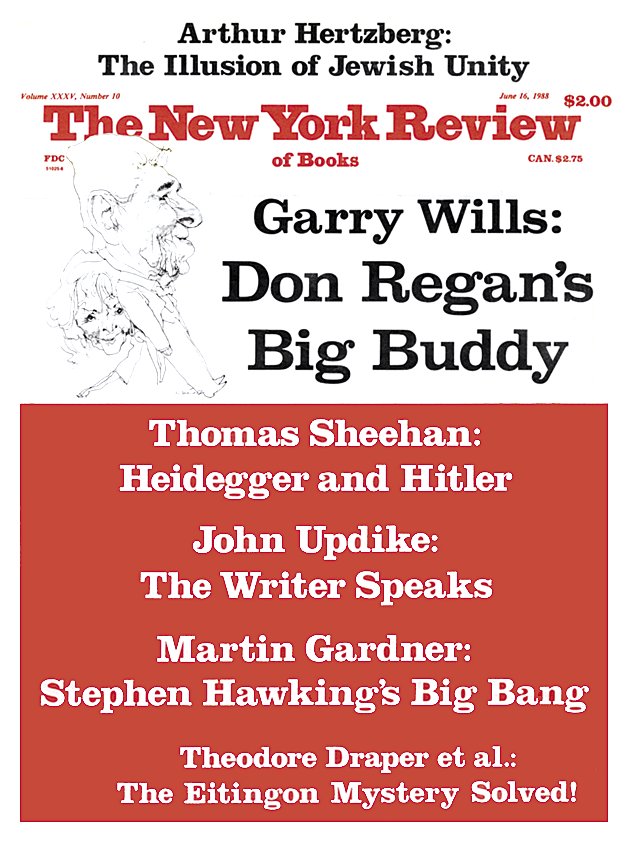
This Issue
June 16, 1988
-
1
Dyson’s new book, Infinite in All Directions (Harper and Row, 1988), is, as the title suggests, a hymn to the inexhaustible diversity of nature toward both the large and small. He writes: “I hope that the notion of a final statement of the laws of physics will prove as illusory as the notion of a formal decision process for all of mathematics. If it should turn out that the whole of physical reality can be described by a finite set of equations, I would be disappointed. I would feel that the Creator had been uncharacteristically lacking in imagination.” ↩
-
2
John Taylor, a British mathematical physicist, is noted for having written one of the most worthless of all books about black holes. It is exceeded in rubbishness only by his later book Superminds (since repudiated), which extols the spoonbending powers of psychic children. ↩
-
3
The clearest explanation of imaginary time I know of for nonspecialists is to be found in the late Richard Feynman’s book Q.E.D., which stands for quantum electrodynamics (Princeton University Press, 1985). ↩