
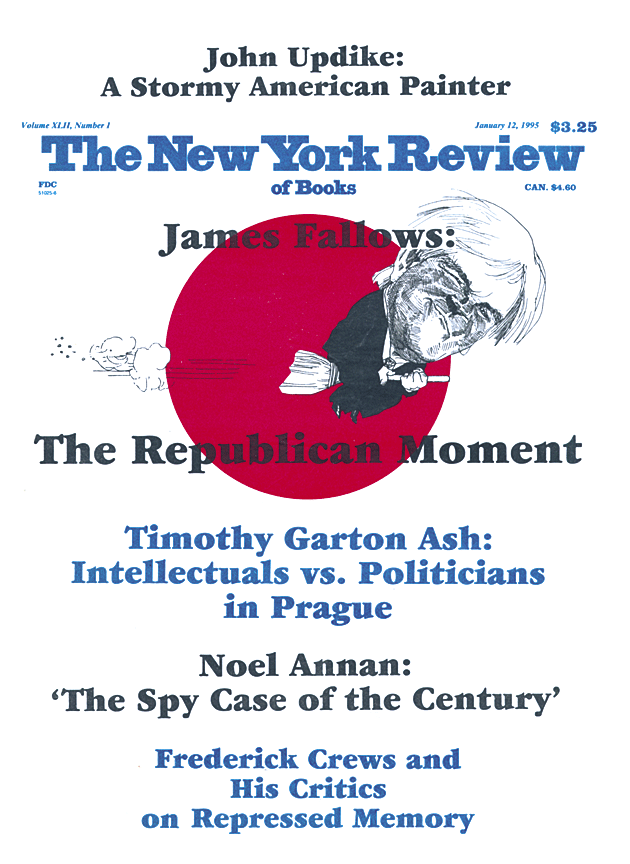
On September 27, the House Republican Conference—which has imposed on Republicans in Congress more ideological unity through their years as the minority party than the Democrats have had in ages—issued its tensection “Contract” as a joint campaign platform for Republican candidates across the country. For the next forty-one days this fall, the “Contract With America” was viewed by most commentators in official Washington as a strategic mistake.
The underlying idea of “nationalizing” the congressional elections was, however, seen to be shrewd. Even as Republicans have dominated presidential elections in the last twenty-five years and have always been in contention for control of the Senate, the local popularity and patronage power of Democratic representatives have made it hard for Republican challengers to dislodge them. By making each House race a referendum on Bill Clinton and on established government in general, the Republicans hoped to convert a nationwide conservative mood into the first Republican majority in the House since 1954.
The problem, or so it seemed, lay in the details of the Contract. Early in 1994 Newt Gingrich, the new speaker of the House who was then the House minority whip, had begun laying plans for a joint document that could help Republican candidates and, if all went well, serve as a legislative agenda for a new Republican-controlled House. He and Representative Dick Armey of Texas, the new House majority leader, went through an elaborate process of consulting Republican candidates, through focus groups and questionnaires, to see which issues would help them most in their campaigns. (The best account of the Contract’s history is an article by Dan Balz in The Washington Post, November 20, 1994.) The goal was to include issues that would attract the hard-core Republican voters without adding anything that might scare off moderates or create bitter fights among party members.
The resulting document was therefore hedged in many ways. It said nothing about two issues that matter intensely to some Republican activists—abortion and school prayer. Gingrich’s recommendation that children be taken from unfit parents and placed in orphanages made news after the election but was not part of the Contract. Proposals that would have a big impact on the budget, for instance through changes in the welfare system or America’s defense commitments, were accompanied by no details whatever to suggest how much they would cost. The centerpiece of the plan was a promise to bring a “balanced budget amendment” to the House floor for a vote. The Republicans knew that this would have no effect on federal spending in the short run, and would probably not matter in the long run, either, since chances are remote that the necessary thirty-eight state legislatures would ratify the amendment and put it into effect. (The states’ main fear is that if the federal government could not legally run a deficit, it would simply pass on safety, environmental, health, and other obligations to the states, without giving them the money to pay for new programs. Congress’s habit of enacting “unfunded mandates” has been the major strain on state budgets in the last decade. A federal balanced-budget amendment would likely make it worse.)
Such vagueness was in keeping with Gingrich’s career in Congress, during which he had often struck provocative or outrageous-seeming poses, without having serious plans to back them up. Five years ago I attended a small dinner in Washington at which he spoke. “The big media and the Democratic establishment don’t have a clue,” he said in his excited way. “What’s really going on in this country is Teenage Mutant Ninja Turtles!” As with many of his previous positions, on space exploration and the “Conservative Opportunity Society,” this made him seem more hip than most other politicians, and in fact Gingrich is one of the few elected officials who seems capable of fresh thought. But in the case of the Ninja Turtles, as with a number of his other positions, Gingrich never got around to explaining what (if anything) he had in mind. I’m just guessing now, but I would bet that references to Beavis and Butthead showed up in Gingrich’s speeches last year, and have been replaced by Mighty Morphin’ Power Rangers now.
Despite some of its lapses in specificity, the Contract was clear enough about its main points—more money for defense, and tax cuts directed mainly at corporations and upper-income Americans. Some Democrats, therefore, thought the Contract would actually work to their advantage. “We are absolutely grateful for it,” Clinton’s confidant George Stephanopoulos told Michael Kelly of The New Yorker two weeks before the election. Stephanopoulos said that the White House viewed the Contract as a godsend, which like Pat Buchanan’s fulminating speech at the Republican convention in 1992 would drive centrists toward the Democrats. “If people look at their ideas, they will realize they are bad.”
Advertisement
Perhaps Stephanopoulos did not believe this even as he said it—he has become notorious in Washington for issuing flat-earth public denials that anything could possibly be wrong with the administration or its policies—but many political operators initially felt that the Republicans might have hurt themselves by shifting attention from what the Democrats hadn’t done to what the Republicans might do. Then came November 8, the forty-second day after the release of the Contract, when the Republicans gained nine seats in the Senate, an astounding fifty-two seats in the House, and eleven governorships. The Contract seemed to have been part of a masterful strategy.
Now the 104th Congress convenes, and the Contract is, as Representative Armey has put it, “a seriously intended legislative agenda” for action in the next 100 days. What sort of agenda might it be?
Like the Bill of Rights and the original Commandments, the Contract With America has ten parts. (Gingrich was reportedly determined that it have exactly ten sections, and as a result several sections are grab bags of vaguely related measures.) The names of the sections are as significant as many of the provisions. To cynics they may seem Orwellian—the plan to cut capital gains taxes by 50 percent is called the “Job Creation and Wage Enhancement Act”—but they reflect the determination of Gingrich-era Republicans to position themselves as forward-thinkers, in contrast to stodgy old Democrats. Gingrich has taken the same approach in reorganizing congressional committees. For instance, what was once the Education and Labor Committee is now the Economic Opportunity Committee. The Republicans are also determined, Perot-like, to appeal to today’s wide-spread disillusionment with politics. The Contract’s preamble says, “In this era of official evasion and posturing, we offer instead a detailed agenda for national renewal, a written commitment with no fine print.” Under the Contract the Republicans have committed themselves to introduce the following legislation within 100 days:
1) “Fiscal Responsibility Act”: the balanced-budget amendment plus line-item veto power for the president.
2) “Taking Back Our Streets Act”: measures expanding prison construction, increasing sentences, and reducing the possibility of appeal for death-sentence cases.
3) “Personal Responsibility Act”: welfare reform.
4) “Family Reinforcement Act”: diverse measures including tax incentives for adoption.
5) “American Dream Restoration Act”: mainly a different form of tax-sheltered retirement account.
6) “National Security Restoration Act”: defense measures, mainly limiting US participation in United Nations ventures.
7) “Senior Citizens Equity Act”: expanded tax breaks for Social Security recipients.
8) “Job Creation and Wage Enhancement Act”: mainly a 50 percent reduction in capital gains taxes.
9) “Common Sense Legal Reforms Act”: assorted changes intended to reduce excess litigation.
10) “Citizen Legislature Act”: term limits for representatives and senators.
In addition to these legislative proposals the Contract promised sweeping changes in the way Congress itself was organized. Gingrich has already put some of these changes into effect, by eliminating, consolidating, and renaming House committees and cutting off funding for several dozen “caucuses,” the best-known of which is the Congressional Black Caucus.
The several dozen disparate proposals lumped together in the Contract and the changes in congressional operating rules can be examined by putting them in three broad categories with the names Gingrich might use in a private Republican strategy session:
1) The “It’s About Time” Package of Common Sense Reforms. Some elements of the Contract are popular because they deserve to be. These were measures which are widely seen as reasonable but which have seemed impossible to enact.
The best idea in this group, and the best thing Newt Gingrich has done since the election, is his promise to end Congress’s shameless practice of exempting itself from the laws, mandates, and regulations it imposes on the rest of the country. The US Navy has to abide by laws forbidding sexual harassment; the office of Senator Bob Packwood does not. The Denny’s restaurant chain could be prosecuted for violating laws against racial or religious discrimination; the office of Senator Jesse Helms could not.
The Contract also promises that Congress will stop imposing unfunded mandates on state and local governments—for example, to pay for toxic-site cleanups or make all buildings accessible to disabled people. In reality this will not stop the practice—it is too attractive a way for representatives to take brave stands without putting up any money—but it will make it easier for states (and the press) to complain the next time it occurs. The “Family Reinforcement Act” includes a clause that would make court orders for child-support payments enforceable across state lines and provide federal help in making deadbeat parents pay.
Somewhat more controversial but just as overdue are the Contract’s proposals for a “loser pays” rule in lawsuits and line-item veto power for the president. “Loser pays,” also known as “the English rule,” holds that the party that loses a lawsuit pays the legal fees of the winning side. The idea of this system, which has prevailed in England for decades, is to make filing a lawsuit riskier, so that fewer of them are filed. The main objection to “loser pays” is that it would discourage some otherwise deserving suits, since poor plaintiffs would be afraid of financial ruin if they lost. The Contract’s plan is surprisingly solicitous on this point: it says that the loser must pay the winner an amount no greater than the loser’s own legal costs. That is, if a poor plaintiff sued a rich corporation and lost, his maximum risk would be double his own legal expense, not whatever huge fee the corporation’s counsel might have run up. Also, this rule would apply only to a narrow category of cases filed in federal courts.
Advertisement
The line-item veto has long been anathema to Congress, since it reduces legislators’ bargaining power with the president. Under current law a president is, of course, forced to sign or veto a bill in toto. Legislators therefore get excited whenever a bill that really matters to a president is up for consideration, since they know they can lard it with their own projects without risking a veto of the entire package. With line-item veto power, a president could knock those projects out. Under the Republican provision, Congress could reinstate vetoed items with a two thirds vote. Most states (forty-three out of fifty) give their governors some form of line-item veto power. The Republicans justify this limitation on Congress’s power by saying that “Congress has neither the will nor the desire to cut wasteful government spending”; it cannot lead to worse budget practices than we have today.
2) The “Image Is Everything” Package of Symbolic Gestures. The balanced budget amendment is of course first on this list; if Newt Gingrich’s concern really were a balanced budget, he—like Ronald Reagan and George Bush before him—could have proposed one at some point during his career. The reason none of them has done so is the one that Peter Peterson and others have pointed out repeatedly in these pages: nearly three fourths of all federal spending goes either for defense, Social Security and other pensions, Medicare and other medical programs, or interest on the national debt. Neither party wants to touch those categories—the Republicans, as we will see, actually want to increase several of them—and there is not enough money elsewhere in the budget to make much of a difference.
The Contract’s provisions on “family values” are mainly modest tax cuts. It provides a $5,000 tax credit to people who adopt children (its way of sending an anti-abortion signal), a $500 per child tax credit instead of today’s per child tax deductions, and a $500 tax credit for those who care for elderly parents or grandparents at home. These tax breaks, of which the most important is the $500-per-child tax credit, are the Republicans’ version of a “middle-class tax cut.” They would be limited to families with taxable incomes under $200,000, or 99 percent of all American families. A month after the election Representative Richard Gephardt, who will be the Democrats’ minority leader in the new Congress, proposed similar tax breaks for families with taxable incomes under $75,000 (more than 90 percent of all families), and the Clinton administration promised its own scheme of middle-class tax relief.
The Contract requires parental consent before children participate in any federally funded survey of public opinion on sensitive subjects, including “family or individual sexual behavior or attitudes” or “any illegal or self-incriminating behavior.” It proposes to deal with crime through longer mandatory sentences for drug crimes and reductions of the legal loopholes that get prisoners out early. To accommodate the larger number of prisoners, it recommends an extra $10 billion to build new prisons over the next six years, although there is no clear proof that increasing the prison population reduces crime. It spends several pages outlining a plan to deport illegal immigrants convicted of crimes, including $14 million for construction of a “Criminal Alien Tracking Center.”
The foreign affairs and national security portions of the Contract are surprisingly vague on basic military questions—how much to spend, on what kinds of equipment, for what missions where. Instead the Contract recommends that a “blue ribbon panel of independent defense experts” look into all such issues. The closest it comes to tangible recommendations are an emphasis that “firewalls” should protect Defense Department money from being transferred to other agencies (not a significant practice in any case) and a “renewed commitment to a National Missile Defense.”
The latter is of course a revival of the Reagan-era plan for a Strategic Defense Initiative, or “Star Wars,” shield against incoming missiles. The contract does not even pretend to offer a rationale for reviving a missile-defense system, even though the arguments against it are even stronger now than they were when Ronald Reagan first proposed the Strategic Defense Initiative a decade ago. (As William Broad of The New York Times demonstrated in his book Teller’s War, tests indicating that the system might work were largely rigged. Despite breathless early reports that Patriot missiles had destroyed Iraqi SCUDs during Operation Desert Storm, later analysis showed that the Patriots had been largely ineffective against this relatively primitive threat.) The “renewed commitment,” to missile defense, moreover, is merely a gesture, for the Contract does not mention spending any money on the scheme. Nearly all of the other provisions of the “National Security Restoration Act” are clauses meant to keep US forces from being entangled in United Nations activities.
3) The “Let’s Pretend” Package of Specific Proposals. Where the contract is most specific it is likely to prove most troublesome for Republicans. It is full of promises the Republican majority cannot or will not fulfill.
The “Citizen Legislature Act,” with its endorsement of term limits on representatives and senators, may be the most hypocritical single chapter in the long saga of American political expedience and hypocrisy. The Contract calls for a vote soon after the new Congress convenes on two competing schemes for term limits. The more permissive of the two would limit representatives to six terms in office and senators to two, or a maximum of twelve years in either house.
Forget the merits of this issue for a moment. Forget even the fact that turnover in Congress is near its historic high. Nearly one fifth of all House members in the 104th Congress will be in their first term, suggesting that voters know how to impose term limits themselves. The chutzpah of the proposal is its most impressive feature. Virtually every member of the Republican leadership that initiated and publicized the Contract is a living violation of the idea of “Citizen Legislators.” Newt Gingrich will soon begin his seventeenth year of Congressional service, five more than his Contract allows. Bob Dole will soon begin his thirty-fifth year. Phil Gramm has been in Congress for sixteen years; Trent Lott, for twenty-two; Alan Simpson, for eighteen; Robert Packwood, for twenty-five. About the only prominent Republican who would still be able to serve if the Contract were now law is Dick Armey, who was elected to the House in 1984—and even he would be beginning his final two-year term.
Shortly after the election, Armey suggested that with Republicans in control of the House, “maybe the nation’s desire for term limits will be diminished.” Other Republican leaders have indicated that when the Citizen Legislature Act comes to the floor it will have a grandfather clause nowhere mentioned in the Contract, exempting today’s representatives and senators from replacement by citizen legislators. “If we break this contract, throw us out,” said flyers issued by the House Republican Conference. “We mean it.” No you don’t.
Nor does the contract mean anything serious about federal spending. A principled conservative fiscal program would start by pointing out that over the next six years, federal budget deficits will total about one trillion dollars. Some economists and “deficit doves” have argued that such deficits themselves are less harmful than the draconian belt-tightening measures necessary to eliminate them. Presumably the Republicans don’t agree—if they did, why would their Contract include the Balanced Budget Amendment? Yet their contract gives no indication of where even a small share of the trillion dollars necessary to close the gap might come from.
Most federal spending, as I have said, goes for medical care, pensions, defense, and interest on the debt. The Contract, amazingly, contains not a single word about controlling medical costs, by far the fastest-rising category in federal and state spending. Its welfare reform package includes a limit on spending for today’s main welfare programs. But these represent only about 1 percent of the entire federal budget, and the Contract’s welfare package as a whole would probably increase welfare costs. (This is because the Contract recommends replacing welfare with “workfare,” which limits benefits to two or three years and then requires recipients to take jobs. Most welfare analysts believe that “workfare” could possibly bring about changes in a culture of welfare dependency, but all experts say that it would be more expensive to administer than today’s plan, not least because it entails large expenditures to find, provide, and supervise jobs.)
What the Contract says about the military implies greater spending, and what it says about Social Security requires bigger budgets. Social Security is one of the two great middle-class entitlements (the other is the tax deduction for mortgage-interest payments). For nearly two decades, politicians from both parties have tried to preserve its universality while making it subtly more “means-tested,” so that fewer benefits go to the retired rich. The main device for doing so has been to include a portion of Social Security benefits in the taxable income of retirees. This approach approximates “means testing,” since the poorest recipients are in very low tax brackets. It is also fair, since today’s Social Security recipients receive much more from the program than they and their employers put in. The surplus is additional income, which should be taxed.
The Contract would undo this twenty-year effort with a variety of tax breaks for Social Security recipients. The breaks would be most valuable to retirees who are already the richest—exactly the opposite of what principled conservatives or supporters of a balanced budget amendment should be trying to do. What principle could lie behind this proposal? The Contract’s rationale for new tax breaks for the elderly reads, in its entirety:
Americans over the age of 65 number more than 30 million and constitute more than 12 per cent of the population. Two important areas of concern for them are Social Security and the cost of long term care.
Therefore, give them tax breaks. There is nothing Republican or Democratic about this position. It is the logic of the welfare state in undisguised form.
The Contract contains one other important budgetary proposal, its recommendation of cuts in the capital-gains tax. The cuts would come in two forms: a reduction by half in the tax rate itself, and an adjustment of any capital gains to offset the effects of inflation.
Unlike the Contract’s position on prison-building or term limits, the capital-gains proposal derives largely from the remnants of supply-side ideology. Republican theorists have argued since the early Reagan years that the best way to increase US rates of savings and investment would be to lower or even eliminate the burdensome tax on capital gains. In reality this tax is not very burdensome. Its maximum rate is lower than the maximum tax on ordinary income (28 percent for capital gains, versus 39 percent for income), and no Social Security or Medicare taxes are applied to capital gains, as they are against income. The result is that rich people with much of their income in capital gains pay a lower overall tax rate than even minimum-wage workers, all of whose income is subject to payroll taxes.
Democrats have long argued that decreasing the capital-gains rate would make the tax system more regressive without making the economy any more productive, since much of the activity it would stimulate would be a simple re-arrangement of assets in search of tax gains. (Michael Kinsley summarized the economic arguments against cutting the capital-gains tax in The New Republic, December 12, 1994.) But so far the debate about the Contract’s capital-gains clause has not addressed its blatant unfairness. Instead it concerns the way the tax cut will be “scored” for budgetary purposes.
For the last few years the Congress has operated under budget-control legislation. Under these rules, if Congress does something to reduce federal revenue, through a tax cut or other change, it has to find some offsetting way to raise more money or cut other expenditures. The Republicans say that these rules are no impediment to cutting the capital-gains tax, since the cut will stimulate so much new growth that the government will collect more revenue at lower tax rates. This is the old supply-side hypothesis of the Laffer Curve and the Reagan years, but Republicans now call it “dynamic scoring” of budget effects, in contrast to the stodgy, “static” thinking of Democrats.
Apart from the merits of supply-side thinking, by asking now for “dynamic scoring” the Republicans are asking for a convenient change of rules. Until now, proposals for tax cuts had to meet the budget standards under a “static” test. For instance, the GATT legislation that the Congress approved in early December reduces US tariff rates on many imports. Most economists believe that in the long run these reductions may actually increase tariff revenue. Lower tariff rates will mean more trade, and more trade will ultimately mean more revenue. But during the GATT debate the Congress could not fall back on this “dynamic” hope. It had to act on the “static” assumption that GATT would cut federal revenues and therefore increase the US budget deficit. In the end it “solved” this problem by passing a special waiver exempting GATT from the budget rules. The Republicans have not yet proposed a similar waiver for capital-gains tax cuts. Asking for a waiver might be hard to square with their balanced-budget promise, but it would be more honest than the talk of dynamic scoring.
2.
How did we come to this pass, with a president who has no immediate hope of enacting his program and a congressional leadership elected on a plainly unenforceable “contract?” In Washington there are two main hypotheses. One casts Bill Clinton as the villain, now being punished for his own excesses and inattention. The other presents him as the victim of the very forces that helped elect him in 1992.
Elizabeth Drew’s On the Edge is a distillation of the first view. Her first chapter describes the buoyancy with which Clinton assumed his duties on Inauguration Day. She ends the chapter by saying, “But the truth was that as the confident new President took the oath of office, he, his wife, and his staff had no idea how unready they were to govern. Nor did the public.”
The rest of the book is an extensive, chronologically organized elaboration on that theme. Drew is a longtime Washington correspondent, having reported on politics over the last thirty years for The Atlantic Monthly, The New Yorker, and PBS. Her book displays the virtues and defects of reporting from “inside” Washington.
Its analysis, which is often implied rather than stated, closely parallels the Washington talk-show consensus on what is wrong with Clinton. He is indecisive and too eager to please. He paradoxically worked too hard and was too undisciplined, carrying the grad student’s “pull an all-nighter” mentality into the White House. He lost touch with the centrist Democratic constituency that had helped elect him and tried to cram a leftist, big-government health plan down the public’s throat. He was thoughtlessly hostile to the Washington establishment that he would have to work with—yet thoughtlessly willing to accept shopworn liberal ideas. He was too easy on his Arkansas cronies and naive about world affairs—and yet on occasion he could rise to brilliance and win big legislative fights.
There was much that was appealing about him—his brain, his zest, his resilience, his charm—but he didn’t come across as a settled person, and the public seemed to sense that.
Drawing on her conversations with officials and politicians who often cannot be identified by name, Drew provides numerous and mainly plausible details about how and why things went wrong for Clinton. She describes genteel but deadly serious battles between Warren Christopher, the secretary of state, and Anthony Lake, the national security advisor, over who would take the blame for foreign-policy missteps. Each of them, Drew says, feared being set up by the other as the mastermind of Clinton’s vacillating policy toward Bosnia. She says that George Stephanopoulos felt that he had been publicly humiliated when David Gergen was brought in to “save” the administration’s communications effort five months into Bill Clinton’s term. Rival camps grew up around the two men. Drew’s description of their rivalry is artful, since it’s easy to tell that both men were important sources for the book. As with Bob Woodward’s The Agenda and most other insider accounts, the book’s portrayal of people like Gergen and Stephanopoulos—or Lani Guinier, or Les Aspin, all of whom clearly provided Drew with anecdotes—is much kinder and more understanding than its view of those who apparently were not helpful, like Ira Magaziner, the health-reform czar.
The bad side of this approach is that its judgments and analyses are almost entirely about the tactics of power—Bill Clinton made a mistake here, he offended important congressional committee chairmen there, he changed his policy in three different ways. Sections of the book end with the verdict that Clinton had had “another bad week”—a “good week” or “bad week” being the basic unit of measurement on Washington talk shows. On the Edge is more openly analytical than The Agenda, which it otherwise resembles in its behind-the-scenes reportage, and the specific points it makes about Clinton’s inconsistency and other failures of character and policy are usually sound. But Drew muffles most of her judgments in formulations stressing what “many people thought,” as in the following typical sentence:
In late June [1993], the Clinton administration engaged in some international muscle-flexing that left a number of people wondering whether the real purpose was to show that it could flex muscles.
The implication of the book is that Clinton has mostly himself to blame for his troubles, which will be politically fatal unless he can “redefine his presidency” yet again.
Kevin Phillip’s book is not so hopeful. The assumption behind most analyses of Clinton’s problems, including Drew’s, is that the administration must somehow have missed opportunities and forgotten what it used to know. Clinton and the people close to him had seemed so sure-footed when outmaneuvering George Bush. If they had concentrated as hard in office as they did in the campaign, then presumably they could have beaten Bob Dole and Rush Limbaugh as well.
Phillips is hardly interested in appraising the day-by-day strategies of Clinton and his crities. He suggests that Bill Clinton’s early successes and later failures were both symptoms of a deeper political and economic shift. That shift, to characterize it broadly, is the collapse of the capacity of the US economy to sustain growth in jobs and income for the middle class. The “arrogant capital” of Phillips’s title means both Washington, DC, with its lobbyists and warring interest groups, and the financial capital that flows through brokerages and investment banks without creating an adequate base for middle-class employment. As Phillips points out (and as many others, including Secretary of Labor Robert Reich, have argued over the last decade), the very steps that have made US corporations leaner and more “competitive” have reduced the connection between their profitability and the growth of middle-class jobs for American workers. Phillips calls this process the “financialization” of the economy:
Firms once committed to longterm thinking now faced money managers and speculators little concerned about existence beyond the life of a futures contract…. Corporations purged employees, especially older ones close to retirement, cut employee benefits, slashed real wages, and shut down plants in Terre Haute or Muncie…. For the first time in modern US history, stock prices decoupled from the real economy, enabling the Dow-Jones industrial average to keep setting records even as employees’ real wages kept declining. Financialization has only a vague definition, but all of these burdens—the erosion of wages, the agonies of families and communities—go into it.
At first there may seem a huge dose of hypocrisy in the very idea that Kevin Phillips would write a book criticizing the political and journalistic establishment in Washington for its blindness. He lives in Bethesda and has been part of that establishment since the Nixon years. The Washington characters he deplores in this book are people with whom he has had much to do himself. Arrogant Capital is more a jeremiad than a careful expository work, and its examples are mainly quotes and clippings from other people’s research.
With that said, Phillips’s book is still bracing and important, much more right than wrong—and much more useful as a guide to future politics than most Washington analyses. Even in this moment of Republican victory, Phillips argues that both parties have internal contradictions that will keep either of them from satisfying voters for very long:
The Republicans, collectively, are simply not free to admit that serious economic declines—for the middle class and the American dream, in accelerating national indebtedness, and the eroded competitiveness of key industries—occurred during the Reagan-Bush period. Party economic policies are too closely linked to the interests that profited from the recent era’s speculative bubble, tax cuts, bailouts, and trade liberalizations….
The Democrats face the same problems with the reverse set of interest groups. Criticizing the economic policies of the 1980s is easy because their party represents the constituencies that suffered most: minorities, the poor, urban interests, social welfare organizations, labor unions, education groups. But discussing the moral and cultural decline that many Americans feel has taken place since the 1960s is another story.
There is no longer much surprise in the idea that America is being polarized into a richer and better-educated elite, and a less-well-educated, harder-pressed proletariat. Phillips succeeds in making this now-familiar trend seem newly dramatic. For instance, everyone knows that the top 1 percent of Americans increased its share of US wealth and income during the 1980s. But Phillips points out that the bottom half of the top 1 percent—“the $300,000-a-year lawyers, $250,000-a-year suburban orthodontists”—did not significantly increase its share. “Virtually the entire gain went to the top one half of one percent, the families with $4-million to $5-million net worths on up. Their investment capacity exploded.”
The political result of this polarization is a statistic that may seem drearily familiar but has enormous consequences. The US economy as a whole has surged mightily in the last generation, roughly doubling in total output since the early 1970s. But because so much of the growth has gone to the richest Americans, in their roles as officials of or owners of corporations, the median US income has fallen (adjusted for inflation). In 1993 the US economy grew by 3 percent, but the median income of American families fell by 1 percent (as Jason DeParle reported in The New York Times on October 7, 1994). What has been good for America in an abstract statistical sense has been bad for most Americans.
In a paper prepared this fall for the Economic Policy Institute, the polling analyst Ruy Teixeira says that this economic polarization—rather than the genius of Bill Clinton’s campaign—was the main factor in George Bush’s defeat. The economy as a whole was growing throughout 1992, and Bush often wondered why an ungrateful public still demanded “change.” The reason, Teixeira says, is that most Americans were still losing ground. Clinton voters and Perot voters had on average seen their real hourly wages go down over the previous twenty years, and especially in the year before the election. Two years later, the economy as a whole continues to grow—but not the real incomes of most Americans. Now that Clinton is president it is his turn to wonder why an ungrateful population wants change.
Phillips argues that the two main sources of discontent—middle-class economic decline and the perception of cultural collapse—have opposite short-term impacts. Economic distress helps the Democrats; largely cultural issues, such as abortion, school prayer, and immigration, are made much of by the Republicans. But Phillips says that in the long run each trend reinforces the other. People who feel hardpressed economically often express their grievances in other ways. For example, the “angry white men” who voted so strongly against the Democrats in 1994 told pollsters that they were mainly angry about big government, overregulation, the alleged tyranny of political correctness, and other seemingly non-economic issues; but these same angry people had generally suffered economic declines. Indeed, as Ruy Teixeira points out in his paper, the voters who seem angriest, the Perot constituency, differ from other voters in having lost more ground economically in the half dozen years.
Because the fundamental force creating discontent—the erosion of middle-class incomes—has not changed, Phillips says that the Republicans are fooling themselves if they think they’ve created a new, permanent coalition. Today’s politics are volatile and unhappy, he says, more than they are liberal or conservative. Until the polarizing economic trends change, whoever is in charge will displease most of the voters. Phillips ends his book with a list of suggestions for dealing with the change. Most are shifts in the tax code and structure of government to encourage manufacturing investment in the United States, to reduce the rewards of purely speculative and “financialized” activity, to limit the power of lobbyists and interest groups in the capital, and generally to attempt to offset the polarization of incomes among Americans. This plan is not wholly original—Lester Thurow, for one, has made similar points over the last decade—nor is it perfect. It is far more serious than Gingrich’s, but a large question remains whether any of the political leaders we now have could adopt it and sell it to the public.
—December 15, 1994
This Issue
January 12, 1995
This Issue
January 12, 1995