
In response to:
Counsels on Foreign Relations from the August 13, 1998 issue
To the Editors:
I have read Tony Judt’s review, “Counsels on Foreign Relations” [NYR, August 13], with some sadness.
It is over twenty years since I left government. One would have thought that to be enough time to permit a calm discussion of the challenge America has faced since the Vietnam War destroyed the national consensus on foreign policy. The deeper meaning of the period is that it crystallized the inherent tension between America’s idealism—the perception we have of ourselves as a nation with a special mission—and our growing involvement in a world of power, hence of relative judgments.
How to strike the balance between these competing realities is not a simple matter, and practitioners of foreign policy have struggled with that problem for most of our history. The reconciliation of ambivalent pulls is a task never likely to be completed, but we will not manage any progress unless we grant the good faith of the principal participants in the debate and have sufficient confidence in ourselves to risk a truthful definition of the issues.
Both Bundy’s book and Judt’s review fail to meet this test:
—Judt, based on Bundy, asserts that I have reclassified public papers as “personal” in order to close them to “prying eyes.” This is flatly untrue. No public document has ever been reclassified by me. Well over 90 percent of the papers in my collection at the Library of Congress are copies of originals in the files of either the State Department or the Nixon and Ford libraries. They are available to researchers on the terms established by the originating departments.
The only unique papers in the collection are records of telephone conversations that a court of law—not I—held to be personal papers and that never were treated as public papers before that.
—Judt claims that I avoided “a clear and official record wherever possible.” This is the opposite of the truth. No administration recorded its deliberations, decisions, and negotiations more carefully or more fully than the ones in which I served. There is in the official files a nearly complete verbatim record of all my negotiations, backchannel or otherwise. (I insert the qualifier “nearly” only to protect against an inadvertent bureaucratic slip-up.) There is also a complete record of all my memoranda to the President prior to any negotiation (front- or backchannel) outlining the proposed talking points and afterward reporting the results. There are certainly no unrecorded agreements.
—To demonstrate the anachronism of my world view, Judt quotes me as writing: “One can hope that something akin to the Metternich system evolves.” He does not reveal that he is fiddling with the quote which is from a paragraph comparing Metternich’s greater emphasis on moral consensus with Bismarck’s balance-of-power politics. Specifically, Judt is cutting the sentence in half and omitting the next sentence: “…something akin to the Metternich system evolves in which a balance of power is reinforced by a shared sense of values. And in the modern age, these values would have to be democratic.”
Distortions of specific fact are exceeded by distortions of the underlying reality. Despite strained bows to fairness, Bundy cannot overcome his distaste for his successors. Even when he praises me for some action, as on Middle East diplomacy, he ascribes the success to some unappetizing character trait, as even Judt has pointed out.
Even when discussing bibliography, Bundy cannot keep himself from making snide comments. Thus, he describes Nixon’s and my memoirs as “perhaps the most determined effort ever to fix the image of their period.” And when describing the transition process by which the Nixon NSC process came about, Bundy writes, “Nixon approved Kissinger’s secretly produced blueprint.” The facts fully described in my memoirs and easily checkable were these: I was appointed Security Advisor on December 2. Nixon had designated General Goodpaster, Eisenhower’s former Chief of Staff, as principal consultant regarding NSC procedures. My original recommendation was to retain the existing machinery with slight modifications. This was rejected by Nixon and even more vehemently by President Eisenhower, whom we consulted. Goodpaster therefore produced a plan very close to the system later adopted by Nixon. This was discussed by Nixon at a meeting in Key Biscayne on December 28 with the new Cabinet appointees, Laird for Defense and Rogers for State. During January there were further discussions with Rogers and Elliot Richardson, Undersecretary of State-designate. On January 19, Nixon formally established the existing system. The trouble with my alleged secret blueprint is that it was not “secret” nor did it in the main come from me.
As Judt renders Bundy, the Vietnam peace accords of 1973 were a disingenuous deception because we held out the prospect of a free and autonomous South Vietnamese state. No allowance is made for the possibility that any senior member of the Nixon administration may have held sincere views. We knew the task of preserving the only ally ever asked to defend itself entirely with its own forces would be extremely difficult and said so on many occasions. But we did believe—as Bundy would have found out by interviewing those involved in the negotiations—that with adequate economic and military assistance, South Vietnam had a chance to preserve its independence. We did not consider it conceivable that the Congress would within two years at first drastically reduce and finally cut off aid to the country for whose freedom over 50,000 Americans had given their lives. Bundy obviously believes that South Vietnam was doomed no matter what we did. But it is possible that Bundy was as wrong about how to end the war as he was about whether to enter it. In any event, a difference of assessment does not warrant the charge of deliberate deception or disingenuousness.
Advertisement
Because Bundy has chosen the posture of prosecuting attorney, he is unable to do justice to the constraints reality imposes on policymakers’ preferences—a challenge for which he should have some compassion from his own experience. Judt notes approvingly Bundy’s criticism of Nixon and me for failing to brief Japan in advance about the opening to China in 1971, and the European allies about the military alert in 1973 in the Middle East crisis. As a former Assistant Secretary of State for East Asia, Bundy knows only too well that there was no way of briefing the Japanese government without a leak; it was a painful decision not to give advance warning, though all friends and allies—and especially Japan—were consulted to the utmost once the US-China dialogue began in earnest.
As for the alert, we faced what we considered a Soviet ultimatum; we thought that a Soviet move into the Middle East was imminent—perhaps a matter of hours away. To demonstrate our resolve to resist, we increased the readiness of our military forces and simultaneously called a meeting of the NATO Council in Brussels. In addition, we briefed our principal allies in detail in their capitals.
Bundy’s attitude of condescending righteousness leads to extraordinary hypocrisy. Throughout his review, Judt follows Bundy in treating the alleged penchant of Nixon and me for covert operations as the ultimate cause of Nixon’s downfall. Phrases like “morally repugnant” for a covert operation in Chile that was never carried out—and was in many ways an extrapolation of the activities of the administration in which Bundy served—drop lightly from Bundy’s pen and are duly repeated by Judt. One would have thought that having served in one of the key positions in two administrations truly profligate in the use of covert operations, Bundy would not open up the subject. Bundy served in high office in the administration which instigated a coup against the South Vietnamese leader with whom we were allied, one of the unintended consequences of which was the assassination of Ngo Dinh Diem and his brother; the administration that invented the Phoenix Program in Vietnam, conducted the Bay of Pigs and the war in Laos as CIA programs, started covert programs in Chile, and planned the only assassination plots of any American administration.
The Cold War was not a tea party, and I do not pass judgment on complex decisions from the vantage point of thirty years. But I do say that Bundy is in no position to give moral lectures on covert operations to his successors whose use of that instrument was much more limited both in scope and frequency.
Judt (and Bundy) decry covert operations of the administration in which I served, but they suppress the context. They claim “misleading promises to the Kurds,” as if that suffering people had been triggered into fighting Iraq by our representations to them. The fact is that when the US decision to support the Kurds was made in July 1972, the Kurds had already been fighting Saddam’s oppression for several years. They were supported by Britain, Iran, Israel, and neighboring countries. Nixon was asked to support them in 1972 when the Soviet Union, disappointed in Egypt, began to pour arms into Iraq beyond the capacity of the Kurds’ existing sponsors to match. Without our help, the Kurds would have been destroyed earlier—that was our real choice.
Judt next asserts that we “abandoned” the Kurds. The fact is that in 1975 when the issue of expanded support came up, it was for $300 million and two Iranian divisions at the precise moment that Congress was cutting off all aid to Vietnam and Cambodia. Does Judt believe such a request would have succeeded? The Shah did not and threw in his hand. It is possible to argue the practical issue; to elevate it to a moral assault is at a minimum inappropriate.
Advertisement
Cambodia by now evokes a reflexive response, and assertions about Cambodian bombings have achieved a near liturgical quality. If so, their advocates should be able to risk stating the facts bearing on the decision without invoking totally misleading forms of words. Instead, Judt cites Bundy approvingly when he describes the secret bombing of Cambodia “as the military violation of a neutral state.”
Given his previous position, Bundy knows the facts well enough. Four North Vietnamese divisions were based permanently in Cambodia, killing scores of Americans each month in South Vietnam and then withdrawing into the safety of a specious neutrality they were violating daily. The real question is why the Johnson administration, of which Bundy was then the principal staff member on East Asia, accepted this charade which cost so many American lives, not why the Nixon administration “violated” it. It is also relevant that the Cambodian chief of state, Prince Sihanouk, had all but invited US attacks on the sanctuaries, both publicly and in remarks to Chester Bowles (then an emissary of the Johnson administration). He implied that he would ignore such attacks because the Cambodian population had been expelled by the Communists.
The secret bombing started after the North Vietnamese launched an offensive (the mini-Tet) two weeks after Nixon assumed office, killing an average of four hundred Americans a week. After four weeks of this and suffering over 1,000 dead, Nixon retaliated by bombing a ten-kilometer-wide zone along the South Vietnamese border where the sanctuaries were located. We had originally planned to react to a Sihanouk protest by asking for a UN investigation of the sanctuaries, thereby admitting the bombings. But Sihanouk did not protest and even invited Nixon to Phnom Penh while the bombing was going on. Key members of Congress had been briefed, including the Chairmen of the Armed Services and Appropriations Committees, the Speaker, all of them Democrats, and other congressional leaders. I recall no objections nor any urging to widen the circle of those privy to the information.
After a year of secret bombing of the ten-kilometer zone, Nixon ordered American forces into the sanctuaries for two months. They destroyed some 20,000 tons of supplies, yet Judt speaks sneeringly of “undiscovered base areas.” From then on, for five years, American military operations were in the open and fully reported. American casualties were cut in half immediately and dropped significantly from then on.
Bundy, endorsed by Judt, objects to the entire military effort, because “the intensity of the bombing…drove the Khmer Rouge to greater military efforts. It also made them more self-reliant, more alienated from Sihanouk….” In other words, basically America was to blame for the murderous character of the Khmer Rouge. This makes as much sense as blaming the Holocaust on the British bombing of Hamburg.
Judt quotes with approval a Bundy argument that the bombing “made it more rather than less difficult to persuade the Khmer Rouge to accept a cease-fire and negotiate a political compromise.” Are Bundy and Judt arguing that the best way to achieve a cease-fire with genocidal murderers like the Khmer Rouge is to reduce military operations? Not even Bundy will go this far. Endorsed by Judt, he retreats to saying that “a much more limited program of bombing to keep the threat alive” would have done the trick. Shades of the “graduated escalation” which doomed the Johnson administration’s effort in Vietnam and of which Bundy was a principal architect.
The Nixon administration genuinely believed that, with adequate help, Cambodia could be saved. The Vietnamese invaders could not hide among the population; the Khmer Rouge forces were relatively small and difficult to supply. Our domestic opponents were determined to prevent a repetition of their version of the Vietnam experience and imposed crippling budgetary restrictions and severe operational limitations on the ground. This in turn left bombing as the sole recourse.
This is not the place to refight those arguments. The Vietnam experience was traumatic for all involved. We will never come to grips with it unless a serious effort is made to examine with some understanding the real choices and above all the fact that there were no good choices—something Bundy should have understood better than most, because he left us the dilemma of over 500,000 troops in Indochina but not a plan for either victory or extrication.
Both sides of the debate are convinced that the other is responsible for the debacle in Cambodia. Perhaps Cambodia’s fate was sealed whatever policy had prevailed. But surely our domestic stalemate guaranteed that Cambodia became a victim of our own internal civil war. We will never learn the right lessons until we are able to conduct a national discussion on the subject that begins with granting the good faith of all parties. This is what Bundy and Judt have refused to do.
Space does not permit dealing with the equally distorted descriptions of the energy crisis and the India/Pakistan war of 1971. I will confine myself to the grotesque treatment of the Nixon administration’s European policy. Judt, following Bundy, alleges that our initial coolness to Willy Brandt’s Ostpolitik alienated Germany and, for that matter, all of Europe. Records of conversations with other European leaders make it clear that the majority of them were very wary about Ostpolitik, seeing in it the beginning of a possible national German foreign policy. We shared that suspicion at first but, influenced by Helmut Schmidt and others, dealt with it by integrating Ostpolitik into an overall Atlantic approach.
Shortly after being sworn in as Chancellor, Brandt sent his closest aide on these matters, Egon Bahr, to Washington to work on coordinating our policies. Bahr and I worked closely together for the rest of the way, as his memoirs describe. Bahr and I conducted the backchannel negotiations with the Soviets that produced a guarantee for access to Berlin and for its status, without which Ostpolitik could never have succeeded and which remained in force until German unification.
And when Schmidt replaced Brandt and Hans-Dietrich Genscher became Foreign Minister, we succeeded (now in the Ford administration) in achieving in the Helsinki Final Act a provision allowing for the peaceful change of frontiers that became the basis for the unification of Germany. Genscher has credited our policy for this in his memoirs.
As for the charge that relations with Europe were so bad when I left office that they took a decade to repair, the surviving heads of government who have remained warm friends will, I am confident, be as astonished as I was to hear this.
Neither Bundy nor Judt seems to have read the memoirs of Hans-Dietrich Genscher who served as German Foreign Minister from 1974 to 1992. The last chapter describes how in 1993 he invited Gorbachev and me to accompany him to his hometown in Halle in the former Communist East Germany: “Now they were here, the two men with whom Icollaborated so closely and to whom I owed so much. Henry Kissinger who in the most difficult periods had always shown so much understanding for Germany and who at the beginning of my career was such an important counselor to me. Mikhail Gorbachev… whose courageous policy made possible the unification of Germany and of Europe…. Ithanked both men…for what they had done after all that Hitler’s fascism had caused to enable us Germans to have a new beginning as a united people.”
Bundy, scion of a distinguished family and with a record of devoted service to our country, was in a position to write knowledgeably about a period in which he served and from which much could be learned. Instead he chose to assault the Nixon administration, of which he was a remote and inherently unsympathetic observer, not in terms of serious men trying to do the best for their country in a difficult situation, much of which they inherited, but as a tale of deceit, dissimulation, and secrecy. And Judt endorses this collage of secondary sources and miscellaneous interviews—but not with me or my closest associates—as definitive and scrupulously fair.
When I was in office, there was a vigorous public debate in which I was an eager participant. As Secretary of State, I traveled to thirty-eight states, testified before scores of congressional committees, and delivered over a hundred speeches and interviews. I supervised the drafting of four major annual reports to the Congress. I gave a full accounting for my tenure in office in my memoirs, including a forthcoming volume on the Ford period. There are the voluminous verbatim accounts of all my negotiations and the memos to and from the presidents I served. I will stand on that record.
It is a pity that the wounds of Vietnam are never permitted to close. It is especially sad when they are being ripped open by someone who had himself been subjected, in and out of office, to the kind of personal assault he has now visited on his successors.
Henry A. Kissinger
New York City
Tony Judt replies:
Dr. Kissinger raises a number of interesting points of fact, addressed in the first instance to William Bundy, who may choose to take them up. But the main thrust of his letter concerns issues of interpretation and judgment, and the fairness of his critics. Readers must judge for themselves whether A Tangled Web is “condescendingly righteous” and unfair to Dr. Kissinger; but I don’t think I can be charged with a prejudice in Bundy’s favor. Like many in my generation I was critical of US involvement in Vietnam, and I noted in my review that Mr. Bundy played a major role in conceiving and executing US policy in that era. But it does not follow that his account of his successors’ choices is for that reason suspect, nor is it a sufficient riposte to exclaim, with Dr. Kissinger, “tu quoque”—you sinned too. It is not Dr. Kissinger’s “good faith” that is at issue here, but the cogency of his arguments.
As it is, his reasoning is curiously contradictory. The Helsinki Final Act and its unexpected consequences, for example, were not part of his grand design (or anyone else’s), and if the West German Ostpolitik indirectly contributed to German unification, this was not its initial objective. Here as elsewhere Dr. Kissinger is indulging in anachronism, claiming for himself and his colleagues credit for an outcome he neither sought nor anticipated at the time. With respect to the tragic fate of Cambodia and the Kurds, however, he reverses himself. I am not responsible for the consequences of my decisions, he seems to suggest; I ask to be judged by the choices I made in the circumstances of the time, and it is unreasonable to hold me to account for what followed.
But the circumstances of the time were not a force of nature. If it is true, as Dr. Kissinger claims, that Congress would have rejected any request for military aid to the beleaguered Kurds in 1975, that is in large measure—as Bundy demonstrates—thanks to the legacy of mistrust and suspicion fostered by the actions of governments in which Dr. Kissinger played a prominent role. Is Dr. Kissinger claiming that it was only the anticipated congressional impediment that prevented him from doing what he implies, in retrospect, would have been the right thing? The record suggests otherwise. As to the “undiscovered base areas” in Cambodia, adduced at the time to justify the violation of Cambodian neutrality: the administration in which Dr. Kissinger was then serving most certainly did insist upon their existence. Were they located and destroyed? If not, was the destruction of Cambodia not a mistake, even on Dr. Kissinger’s own account? I do not blame “America” (sic) for the murderous character of the Khmer Rouge, a misrepresentation of my position and that of many others; I suggest what many observers concluded, that Dr. Kissinger and his colleagues, by defective strategic and political reasoning, may have contributed to the rise to power of the Khmer Rouge.
The problem here is that Dr. Kissinger doesn’t seem to grasp the force of the criticisms directed toward him by Bundy, by me, and by numerous others, not all of whom can be writing in unstinting bad faith. It is not an accident that he appears, at least, to be oblivious to some of the human costs of his actions, and resentful of unfavorable analyses of his record that insist on taking these into account. High-altitude geopolitical calculations can obscure a clear perception of events on the ground; Kurds, Cambodians, East European dissidents, and many others get lost from view. For Dr. Kissinger, his critics’ apparent obsession with victims and human suffering must seem irritating and petty, born of a moralizing cast of mind that doesn’t understand the constraints of decision-making faced by men in power. But even from a rigorously realist perspective there is more to a decision than the decision itself. Undesirable (and unsought) outcomes suggest faulty processes and procedures (Bundy’s main point), and a flawed strategic vision (the gist of my own comments).
I have no doubt that Mr. Genscher and other retired luminaries of his generation speak well of Dr. Kissinger. Today as in Metternich’s time there is a natural community of feeling among diplomatic notables, even former adversaries.* But when writing of European alienation from the US in the aftermath of Dr. Kissinger’s years in power, I had in mind a swathe of opinion extending rather beyond a small group of statesmen. It is illustrative of Dr. Kissinger’s outlook that he should have inadvertently misread me in this way—his “Europe” is peopled by fellow men of power and influence, just as his Asia was calibrated according to dealings with a select coterie of would-be absolute rulers.
The late Raymond Aron—whom Henry Kissinger recently described as a “great French philosopher and political scientist”—insisted throughout his life as a writer on international affairs that it was deeply wrong of commentators on politics to offer criticisms of men in office unless they could answer the question: “What would you do if you were a Cabinet minister?” It is a wise admonition, and without abusing hindsight I cannot pretend to know better than Dr. Kissinger what decisions he should have taken at various crucial and truly difficult junctures. But the same Aron—a realist, but no friend of Realpolitik—wrote in 1931, apropos of those who would excuse German extremists in the light of the errors of Versailles: “It is no reparation of past faults to commit new ones in the opposite direction…. A good policy is measured by its effectiveness, not its virtue.” The misfortune of Dr. Kissinger’s illustrious career is not that his policies lacked virtue. The reality is more serious—a good many of his policies were ineffective. To judge from his letter, that is a charge to which he is, rightly, sensitive.
This Issue
September 24, 1998
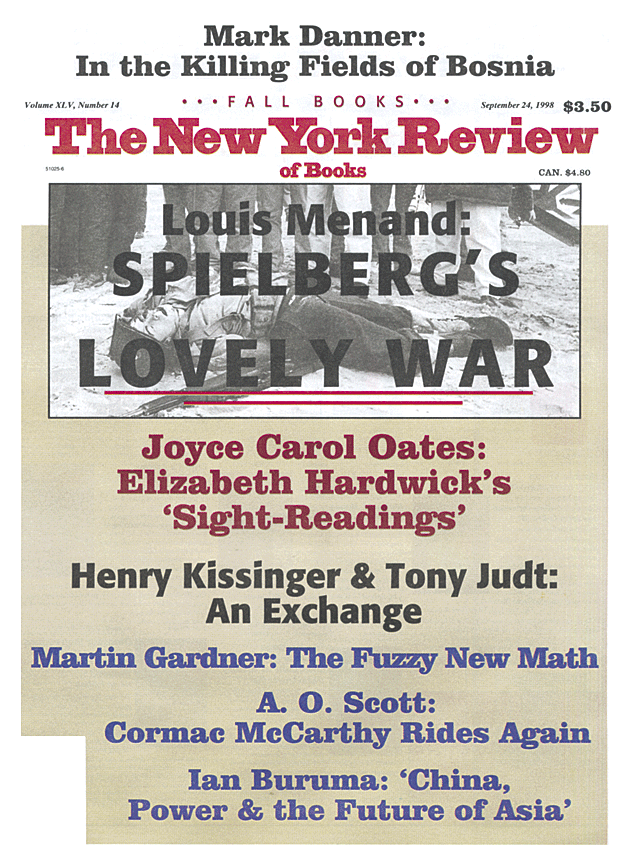
This Issue
September 24, 1998
-
*
I apologize to Dr. Kissinger for not quoting in its entirety the sentence in Diplomacy where he expresses his hope that a Metternichian international system will emerge today. But I don’t think I distorted or elided his meaning in what I said in my review. The paragraph in question was not a comparison between Metternich and Bismarck, but expresses a desire for a “balance of power” politics akin to that of the nineteenth century, with democratic values replacing those of a past age. I never meant to say that Dr. Kissinger disparaged democratic values; merely that he did not understand their implications for the conduct of modern diplomacy. ↩
