
1.
The first task of any intelligence organization is to establish where danger lies. In the Arab world it is traditionally considered to lie within, where revolutionaries, religious zealots, and ambitious military officers plotting to seize power are watched and periodically arrested by the local security service, the mukhabarat. In Egypt and Iraq, in Jordan and Saudi Arabia it is always the same: the real interest and expertise of the secret police are concentrated on the home-grown opposition. The United States may speculate obsessively on the military programs of Saddam Hussein or on Iranian ambitions in western Afghanistan, but the Arab countries worry less about neighbors, including Israel, than they do about the contacts and travels of their own radical university students, the commanders of armored divisions in urban centers, and impassioned mullahs preaching a return to fundamental Islam. Arab secret services hold tight to what they know, and are sphinxes about the things they don’t know—a source of deep frustration to American intelligence officers trying to sort out the background and contacts of the aircraft hijackers of September 11.
For a brief period last fall pained noises of discontent with the level of Saudi cooperation could be heard in Congress after the CIA and the FBI explained the difficulty of prying open Arab doors. Nothing came of it. The White House insisted all was well and American intelligence officers had nowhere else to turn. CIA officers and the FBI’s legal attachés assigned to American embassies could do very little on the ground in most Arab countries before September 11; there was no knocking on doors or flashing of badges, and even now they must ask the locals. The normal drill has been to send a liaison officer stationed in Cairo or Riyadh to pay a visit to the office of his counterpart, submit his questions, and then listen to the air conditioning while the counterpart goes through a folder on the desk in front of him, choosing what to share. In this way the CIA or the FBI may learn who went to high school with Mohamed Atta, or when the former Saudi intelligence chief, Prince Turki al-Faisal, last spoke with Osama bin Laden, or whether the Saudi Istakhbarat had found earlier reason to open files on the hijackers who arrived in the United States during the year 2001 to fly commercial airliners into the World Trade Center, the Pentagon, and a Pennsylvania mountainside.
In high-profile cases in the past, leading officials or even the director of the FBI or the CIA might fly in to ask for help, in which case large bustling groups might gather to process the request and its answer, but otherwise the drill was the same. Americans can’t order the locals to pony up; they must ask, and it is the temperature of relations with the United States that determines whether local intelligence chiefs will be forthcoming, or instead close the folder and say they are sorry, they can find nothing of interest. Following September 11, the locals have been more forthcoming in some places, like Yemen and Pakistan, where the FBI and CIA have been working closely with police to round up al-Qaeda activists. But cooperation given on one day may be taken away on another. In an intelligence war getting and keeping the help of the locals is half the battle, and for help in that half Americans are dependent on friends in the Middle East, if any. Without that help it is difficult to know who is on the other side.
Defining and describing “the threat” was easier during the forty years of cold war with the USSR, when estimators at the CIA hammered out the Annual Survey of Soviet Strategic Intentions and Capabilities—the hard-fought consensus reached (or in some cases not reached) by analysts from the CIA, the Defense Intelligence Agency (DIA), and other American intelligence organizations about what Soviet Russia could do and what it planned to do. No “Soviet Estimate,” as it was generally called, ever predicted imminent war, and every estimate reported a vigorous and continuing Soviet military buildup. Between those two poles debate ranged widely and was sometimes bitter and prolonged. Why, for example, were the Soviets spending so much money to improve missile accuracy? Was it pure technological momentum, or were they patiently assembling the capacity for a first strike? Why did they appear to be trying to hide the results of their tests? Was it simply the historic Russian obsession with secrecy, or were they hoping to hide a growing ability to disarm America at a stroke?
Throughout the cold war it was usually Soviet “capabilities,” not Soviet intentions, that drove the estimates. Plans come and go; capabilities persist from one day, one year, one decade to the next. “The threat” was not posed by Soviet plans to influence European labor unions, curry favor with India, buy enough Cuban sugar to keep Fidel Castro afloat, encourage West German Ostpolitik, or sell tanks to Egypt and Syria. These were all trivial irritants compared to the real threat of huge Soviet conventional armies at the door of Western Europe, far greater than anything the NATO allies ever placed in their path, and of the Soviet Strategic Rocket Forces with a capacity to obliterate every city in North America, and finally of multiwarhead, superaccurate Soviet missiles with an ability to destroy American hardened land-based missiles and bombers on the ground, while preserving a still-vast second-strike capability threatening catastrophe if the United States chose to retaliate. What Moscow intended was neither here nor there; the threat of war might have been small on any given day but Soviet capabilities—the power of the weapons themselves—were threat enough to keep the United States and its allies on edge for decades.
Advertisement
In the first few years of the cold war the Americans had a tough time keeping track of Soviet military developments and deployments, but by the early 1960s, with the development of overhead reconnaissance by ever-improving satellites, the CIA and the DIA could pretty much find, count, and describe any piece of large-scale military hardware on or near the surface of the earth. But “national technical means,” as American officials called the array of expensive collecting devices and systems, of which satellites were only the best known, could not answer some questions—especially those, always lurid, about what new superweapon horrors might be on the drawing boards or in the pipeline.
The “bomber gap” of the 1950s and the “missile gap” of the 1960s, powerful drivers of American military budgets in their time, both proved illusory. The Soviets chose to save money, ignore bombers, and proceed directly to missiles; and the huge numbers of missiles feared by the CIA and the Pentagon turned out, when the first overhead photos came in, to be a relative handful of cumbersome, vulnerable brutes sitting up on their launchpads in Siberia where an American nuke might have destroyed the lot. But more information did not put an end to “threat inflation”—the tendency of interested parties in the American national security establishment to argue that some alarming new Soviet development required a corresponding jump in their own budgets.
The Air Force was a perennial offender when it came to the question of “enough.” American missiles, the generals argued, were never numerous enough, or safe enough in hardened launch silos; US warheads were never certain enough to hit the Politburo men’s room in the Kremlin, and were not connected enough by Command, Control, Communications, and Intelligence (“C3I”). But in truth everybody in Washington played the game—even the CIA, with its need for total technical coverage of the Soviet Union, and the FBI. J. Edgar Hoover had long argued that the United States could not safely permit additional Soviet consulates unless the bureau’s budget was bumped up to accommodate all those extra field agents needed to follow the Russian cooks, secretaries, and chauffeurs who were really highly trained intelligence professionals working for the KGB.
How great was “the threat” in retrospect? It’s hard to say. The wheezing, alcoholic, geriatric gang who ran the Soviet Union in its last decades seemed incapable of forming and executing a coherent scheme for global struggle, but their decrepitude, in fact, might have only made the danger more acute. The arms race had created a highly combustible situation—the new missiles really were accurate, warning systems left almost no time to gauge the reality of an attack, war-fighting plans on both sides made no provision for backing down or giving up. But it is equally true that the end of the cold war was so sudden and complete that it revealed a “threat” based on smoke and mirrors—a barely functioning Soviet economy, a cynical and despairing populace with a falling lifespan, technology primitive in all but a few areas of military hardware, a worthless currency, a degraded environment, allies eager to break free.
The imaginary Russia, the bear that endangered Europe and the world, according to the British intelligence historian Rhodri Jeffreys-Jones, was dreamed up by the threat-artists of the CIA and the Pentagon, a product of “the inflationary disease in American intelligence.” The problem, Jeffreys-Jones says, is an “overheated imagination,” but the title of his most recent book—Cloak and Dollar: A History of American Secret Intelligence—suggests another, simpler, older explanation: money. Cold war threat inflation was certainly about money—big budgets for the military services, big contracts for military suppliers, big contributions for campaign funds, and a never-ending Mississippi of consultant money for experts in think tanks.
Priming the military-industrial-intelligence pump with “smooth talk, hyperbole, deception,” in Jeffreys-Jones’s view, is that familiar American figure, “the confidence man.” Jeffreys-Jones has in mind the salesman and boomer—the professional spinner of dreams of opportunity, the coming thing, constant progress, eternal youth—a cross between the Duke and the Dauphin in The Adventures of Huckleberry Finn and Willy Loman in Death of a Salesman, “way out there in the blue with a smile and a shoeshine.” Frances FitzGerald has argued persuasively that America’s greatest pitchman for superweapon snake oil was President Ronald Reagan, whose dream of a world made safe from missiles became a kind of national bedtime story. But the dream is still only that; no other American military program has spent more money for less result than Reagan’s Strategic Defense Initiative (SDI), and the billions continue to pour out. The credit for the mad national persistence in this endeavor, FitzGerald concludes in her history of SDI, Way Out There in the Blue,1 must be given to the smooth talk of the Great Communicator.
Advertisement
So there is definitely something to Jeffreys-Jones’s notion of the intelligence con game. But having made a plausible argument that the history of American intelligence can be written as a history of succeeding scare stories, he largely abandons theory to retell a dozen episodes from American intelligence history—spying by Alan Pinkerton’s detective agency during the Civil War, the surprise attack at Pearl Harbor, the career of the father of American code-cracking, Herbert O. Yardley, the Kennedy administration’s obsession with Cuba, indirectly leading, as news of anti-Castro plots leaked out, to Senator Frank Church’s investigation of CIA intelligence activities in the mid-1970s and a subsequent basket of “reforms.”
Jeffreys-Jones argues that these reforms, although obviously intended to quiet public alarm, were more than mere window dressing. The two biggest were a requirement for on-the-record, albeit secret, presidential approval of covert operations and the creation of permanent intelligence oversight committees in Congress with a right to “timely” briefing on important developments—intelligence sharing with allies, for example, or the discovery of major spies. Together these reforms signaled an end to the era of anything goes.
2.
The structure of American intelligence history can be organized in many ways—as a succession of White House manias, for example, with the CIA frantically trying to satisfy presidential demands for information on Soviet military programs, for the overthrow of unfriendly governments in Guatemala and Iraq, or for the defeat of guerrilla movements in the Congo and Vietnam. Or as a chain of public convulsions at the sudden disclosure of crimes and horrors—plots to murder Fidel Castro, spying on Americans, dangerous drug experiments with unsuspecting humans, aid for drug smugglers, training for Latin American death squads, illegal funding for guerrilla movements.
But just as important in any effort to understand the nature of the CIA is a history of its failures. The agency was founded in response to the failure at Pearl Harbor, and it has been repeatedly shaken by similar failures to spot coming trouble ever since—the North Korean invasion of South Korea in June 1950, for example, or the intervention of China into the Korean War in November 1950, the decisive Cuban response to the CIA-mounted invasion at the Bay of Pigs, the Russian invasion of Czechoslovakia in 1968, the combined Arab attacks on Israel in October 1973, the collapse of the Soviet Union between 1989 and 1991, the Iraqi invasion of Kuwait in 1990, and—to a degree still unknown—the terrorist attacks of September 11.
CIA analysts refer to these failures as examples of the either-or, yes-no kind of estimating effort they describe as “single outcome forecasting.” They have tried to replace it in recent years with a more fluid approach giving a sense of the range of possible outcomes with fuzzy numbers for the probability of the major ones. This is roughly how the US Weather Bureau goes about it; 40 percent chance of rain, total precipitation two to three inches, partly cloudy, Hurricane Betsy will approach the Florida Keys in the early morning hours, etc. Rough guesses help, but some things you still want to know for sure. On December 6, 1941, American military commanders would have liked to know that there was a 100 percent chance of a Japanese attack on Pearl Harbor the following morning, and appeals to the inherent difficulty of predicting things that have never happened before offer zero solace to those caught unprepared.
Calls for an inquiry into the lack of warning on September 11, tentatively made in the first week or so, were vigorously resisted by the White House on the understandable grounds that it was “too soon.” But as time goes by it appears the White House believes it will always be too soon to make a major and serious effort to investigate the failure, especially one conducted by anything as prone to twenty-twenty hindsight, Monday morning quarterbacking, finger-pointing, witch-hunting, and playing the blame game as a public commission.
Why the White House should be so troubled by the prospect of an inquiry is growing easier to understand, as the public learns by fits and starts that President Bush was briefed by the CIA on the danger of al-Qaeda hijackings on August 6 last year, five weeks before the attacks; that the CIA had followed two of the hijackers to a terrorist meeting in Malaysia but was slow to pass on what they knew to the FBI; that the FBI for obscure institutional reasons had resisted repeated requests by agents in Minneapolis for a Federal Intelligence Security Act (FISA) warrant to search the computer hard drive on a laptop belonging to Zacarias Moussaoui, now facing the death penalty for his alleged role in the September 11 conspiracy. The same FBI official who resisted the FISA warrant request also ignored important information on Moussaoui contributed by the French, and failed to connect the episode to the July 10 warning memo from another FBI agent in Phoenix, Arizona, claiming that terrorists might be attending flight schools in preparation for an attack. These troubling facts have been reported extensively in the press and we may expect to learn of others in a steady stream as the current, preliminary investigations in the House and Senate continue. There will be much detail that is hard to absorb, but certain warnings may light up in retrospect like neon signs.
What, exactly, was the President told in that August briefing? According to Karl Rove, a White House adviser who was with President Bush on Air Force One on September 11, security officials resisted the President’s demand to return immediately to Washington. In an interview with Tim Russert broadcast on CNBC on July 13, Rove said the officials warned Bush on September 11 that other hijacked aircraft might still be in the air and they could not “guarantee the security of the airspace over Washington.” When the President finally returned to Washington late in the day he pointed to the smoking Pentagon and said, “Take a close look. You’re looking… at the face of war in the twenty-first century.” “He needed no briefing,” Rove said. “He needed no explanation…. When there was a second plane [which flew into the World Trade Center] he knew exactly what it was…that a war had been declared on the United States.” It seems likely that what the President knew came at least in part from the August briefing.
It is my guess that the CIA and the FBI, the two American intelligence organizations principally involved, had a startling depth of knowledge about the terrorists, their allies, and their plans and movements before September 11. When elements of the story began to reach the public in recent months a series of officials—and most prominently Robert Mueller, director of the FBI—insisted that what they knew or could or should or might have known still wasn’t enough to have saved the World Trade Center. No doubt this is narrowly true. We may trust that no one was sitting on a piece of paper with hard, specific, unambiguous information on date, time, and target. That officials probably could have acted on. But two things are increasingly clear: first, the principal intelligence failure before September 11 was a failure by counter-terror specialists deep within the FBI and CIA to sense the shape of the plot that was unfolding—the often-cited inability to “connect the dots.” But the CIA well knew something was in the works and frequently said so in the months leading up to September 11. The second great failure was the decision of the Bush administration on taking office to restudy the problem of terrorism from top to bottom, rather than pursue programs already begun under President Clinton. This lost year was the subject of a Time magazine cover story in the issue of August 12 describing the efforts of Richard Clarke, a Clinton holdover, to win agreement from the new national security team for an aggressive effort targeted on al-Qaeda and its refuge in Afghanistan. The principals like Vice President Richard Cheney, National Security Adviser Condoleezza Rice, Defense Secretary Donald Rumsfeld, and Attorney General John Ashcroft all knew that terrorism posed a real danger, Time reported; the problem was that all had come into office with pet programs of their own and terrorism was somewhere down the list. Before a counter-terror program could be placed on the President’s desk, the principals had to agree, and before they could meet their deputies had to agree. That alone took the better part of a year, with the result that before the World Trade Center had been destroyed, President Bush had no chance to say yes, no, or let’s look at it again. It is the fear of more stories like this one that perhaps best explains the White House resistance to an inquiry.
3.
But sorting all that out is left for the future. What’s right in front of us is troubling evidence that American intelligence organizations, and especially the FBI, have lost the ability to grasp what is failing or going systemically wrong, and the fact that they lack the will to do something about it. Problems in big government bureaus are ordinarily hidden from the general public, but in the case of the CIA and the FBI the recent discovery of spies in their midst illuminates at a stroke the extent of the trouble within.
The case of Aldrich Ames, the CIA counterintelligence analyst arrested in 1994 for spying for the Russians and now serving a life sentence, has been the subject of half a dozen books, all of which stressed the astounding lethargy of the agency’s attempt to figure out what had gone wrong in 1985, when just about every Soviet spying for the Americans was suddenly yanked from the street and executed or imprisoned. Counterintelligence can be a wonderfully subtle and nuanced exercise, but Ames’s “big dump”—a briefcase full of names and operations simply handed to a KGB intelligence officer in a Georgetown restaurant—is not an example of it. Standard procedure would have called for a sophisticated KGB game of playing back these exposed agents against us, until they could be slipped out of view one by one in ambiguous circumstances. Instead, the Russians panicked, arrested the lot, and sent as clear a message to the CIA as any analyst could have asked for—we got ’em all, and one of your people gave them to us. It is possible to dream up other explanations for this unprecedented roll-up, and mole sleuths tried to do it, but in their guts the sleuths knew at the time that the bad news was true, and the obvious answer was the right one: somebody had sold the agency down the river.
In one of many investigations of why Ames got away with it for so long, the inspector general of the Department of Justice, Michael R. Bromwich, cited in his report the FBI’s contribution to this failure—a strange combination of missed opportunities, high-level inattention, and lack of curiosity. From the beginning the FBI knew that the problem could not be laid entirely at the CIA’s doorstep; most of the lost Soviet agents had been run by the agency but during the same period—1985 and 1986—the FBI had also suffered compromised operations and lost agents of its own. Nevertheless, according to an unclassified summary of Bromwich’s report released by the Justice Department in April 1997,2 the bureau’s first investigating task force, code-named ANLACE, gradually ran out of steam and then gave up in the fall of 1987 despite having “reached no firm conclusions concerning the cause of its intelligence losses.” Worse, ANLACE said nothing about their possible relation to the CIA’s losses. In short, the bureau shrugged off the question of how this could have happened.
So it went for the next six or seven years. The bureau’s investigation was not resumed until mid-1991 when a joint FBI–CIA team—two members from each organization—again tackled the problem of finding a mole; they gradually accumulated evidence pointing a finger at Ames, whose conspicuous outlays of cash were hard to explain. But despite “compelling circum-stantial evidence,” Bromwich writes, the FBI members of the task force made no recommendation to open an investigation of Ames, and FBI managers, although aware Ames was “a top mole suspect,” failed to ask for details or to press for action. The group’s report, issued in March 1993, simply concluded that “there was a penetration of the CIA” and dropped the matter there.
Bromwich describes but does not explain this odd lack of urgency in face of “a catastrophic and unprecedented loss” of the bureau’s own hard-won Soviet sources, who were there one day and gone the next in a classic roll-up. He notes simply that the bureau was slow to take note and quick to lose interest in the problem. “Senior management” never understood, or tried to understand, the magnitude of the betrayal and “never showed any sustained interest” even in the losses at the CIA, despite the FBI’s statutory responsibility for protecting the nation against spies. The result was “inadequate management attention as well as insufficient resources” for the effort to explain the roll-up. “Senior management” is as close as Bromwich comes to naming the culpable. But he does quietly offer one tacit explanation for the bureau’s tepid response—its obligation under the law to notify congressional oversight committees of “any significant intelligence failure.” The only way “senior management” could escape blame for its failure to do so, it is clear, was to tell Bromwich that they were never told of “the scope and significance of these losses.” Bromwich offers no opinion whether these denials were true.
But there’s a deeper irony to Bromwich’s story of missing the obvious. While he was investigating the bureau’s failure to catch one spy, another was contemplating further treacheries at FBI headquarters. Did Bromwich understand what is implicit in his report—that the arrest of Aldrich Ames did not quite solve the mystery? Still unexplained were the operations that failed and the agents who were lost by the bureau’s New York City field office between 1985 and 1990. The bureau continued to gnaw at the problem but its investigation rivaled in its slowness the groping of the CIA’s search for Ames, and in the end in both cases the light bulb refused to go on until the answer was more or less handed to the investigators.
How this unfolded is still largely hidden, but recent books on the FBI, taken together, offer a rough account of what happened. It was a fine example of the old maxim of mole hunters that “spies catch spies.” According to Ronald Kessler, a former Washington Post reporter whose recent history of the FBI, The Bureau, is the latest of many useful books he has written on intelligence subjects, it was not the analysts and sleuths assigned to solve the problem who caught Ames. Instead, one of the CIA’s Russian agents-in-place—that is, a mole working for the US—provided enough operational details to narrow the investigators’ focus to Ames. Code-named AVENGER, this spy later defected to the West and in November 2000, Kessler writes, he helped to recruit a second source, then still inside a Russian intelligence organization, who actually obtained and hand-delivered the bulky file of another spy in the United States run by the KGB and its successor.
The best account of this extraordinary coup—and of much else—is to be found in David Wise’s account of the case, Spy: The Inside Story of How the FBI’s Robert Hanssen Betrayed America. Wise—not to be confused with David Vise, who has also written about the case—has been writing about American intelligence for nearly forty years, and it appears that he has never forgotten the name or lost the phone number of a source. The nuances of Hanssen’s character do not long detain him; what interests Wise is the spy stuff—the names, dates, personal histories, old cases, and twists of tradecraft that give intelligence files their flavor. From the day of Hanssen’s arrest it was known that the FBI had somehow obtained the KGB file. The challenge for everybody writing about the case has been to explain how. The short answer, Wise tells us, is that the FBI winnowed its list of Russian intelligence officers who might have known the mole’s identity, picked one who had retired from intelligence work to open a business in Moscow, and then lured him to America with the hope of a contract. How the FBI managed to go after exactly the right man Wise admits he does not know, but they did; the Russian either had or obtained the file, and the FBI bought it for $7 million and help in finding a new home. The file included everything but Hanssen’s name.
In an extraordinary break with orthodox intelligence procedure the KGB had agreed to run this second agent for two decades without knowing who he was, and communicating solely by dead drops—the exchange of materials left at prearranged locations. The KGB knew the agent only as “B” or “Ramon Garcia,” but it didn’t take long for FBI investigators, reading the many letters of the spy to his handlers, and listening to a taped telephone conversation, to recognize the cocksure, opinionated voice of the guy who poked his nose into everything at headquarters, Robert Phillip Hanssen.
Born in 1944, the son of a Chicago policeman, and an FBI agent since 1976, Hanssen had been a queer duck all his life—socially awkward, smarter than a lot of people but not as smart as he thought, good with computers, a daily churchgoer with a toe-the-line, by-the-book rigidity on questions of morals and behavior. In the bureau fellow agents thought him smart but weird, and in fact he was weirder than they suspected. He had few friends, a house full of guns, a passionate fidelity to the Catholic Church and especially to the half-secret Opus Dei (“Work of God”) organization, and a kinky sexual obsession which led him to e-mail nude photos of his wife Bonnie to an old high school buddy, and to post lurid but probably fictional sexual narratives about her on the Internet. (One of these is quoted in full in both David Vise’s The Bureau and the Mole and Norman Mailer and Lawrence Schiller’s Into the Mirror: The Life of Master Spy Robert P. Hanssen.3 ) Hanssen first gave secrets to the Russians in 1979 but quit when Bonnie caught him at it. In 1985 he contacted the Russians again by writing a letter to a well-known KGB spy handler at the Soviet embassy in Washington, Viktor Cherkashin, who had also handled Aldrich Ames.
In addition to identifying some of the same Soviet spies betrayed by Ames, Hanssen left garbage bags full of secret paper at dead drops in a park near his home—more than 6,000 pages in all, including items like the National Intelligence Program for 1987, the text of a “stealth orientation” briefing for a director of the CIA, a CIA staff study of KGB “recruitment operations” against the agency, and even the US government “continuity of government” plan. The last detailed exactly how the United States would maintain the government’s ability to make decisions during an all-out nuclear war, knowledge of which the Soviets might have made devastating use.
Deciding who was the more damaging to American security—Ames or Hanssen—is an academic exercise; both turned over pretty much everything they could lay their hands on, and both were in a position to scoop up plenty. But there the similarity between the two men ends. Ames was an alcoholic, careless about covering his tracks, who thought he could hold on to his demanding wife with money. Hanssen was meticulous. He routinely checked FBI files for any sign he was under suspicion. He also broke some of the oldest rules of agent-running tradecraft, by sticking to a single dead drop, for example; he accepted money but didn’t press for more, and seems to have been drawn on by an obscure psychological need to risk exposure. This waxed and waned; he cautiously quit spying in 1990 when it was clear the accelerating collapse of the Soviet Union threatened the KGB’s ability to protect its agents. But around 1999, apparently missing the excitement of the game as retirement approached, Hanssen got in touch with the Russians again. “Dear friend: welcome!” the Russians replied. “We express our sincere joy on the occasion of resumption of contact with you.”
But something had changed in Hanssen’s personality. The old take-it-or-leave-it superiority had been replaced by a hunger for recognition, acceptance, approval—a neediness well described by two Time magazine veteran reporters, whose account of the Hanssen case, The Spy Next Door, is solidly informed and lucidly written. In mid-March 2000, Elaine Shannon and Ann Blackman tell us, Hanssen wrote his handlers a rambling, disjointed letter: “One might propose that I am either insanely brave or quite insane. I’d answer neither, I’d say insanely loyal…. I have, however, come as close to the edge as I can without being truly insane…. I hate uncertainty. So far I have judged the edge correctly. Give me credit for that…. It’s been a long time my dear friends, a long and lonely time.” Hanssen later carefully checked the FBI’s Automated Case Support system for telltale keywords, including his own name and address, trusting they would pop up if he were being investigated.
By mid-November 2000 the FBI had obtained the Russian file on “B” and within weeks the bureau had Hanssen under surveillance. If the Russians knew the Hanssen file had been lifted they failed to let Hanssen know, but he still sensed a change in the weather. In his last letter to his Russian handlers, scheduled for delivery in February 2001, he wrote that “it is time to seclude myself from active service…. Something has aroused the sleeping tiger.” Minutes after depositing a bag containing the letter and seven FBI documents classified secret at the dead drop code-named ELLIS—a bridge over a creek in Foxstone Park near his home—Hanssen was arrested by FBI agents. Facing a possible death penalty, he later pleaded guilty in return for a sentence of life without parole.
All the superlatives mustered to describe the Ames case were summoned again to give a sense of the magnitude of Hanssen’s betrayal. Ames eluded discovery for nine years, Hanssen for twenty-one. Ames crippled CIA efforts to spy on the Russians; Hanssen did the same to the bureau and delivered an even wider range of equally damaging secrets. But more troubling than the immediate injury was the fact that the CIA and the FBI alike, some-how paralyzed despite unmistakable evidence that both organizations had been penetrated, dawdled for many years until a spy handed them the answer.
Catching the spies should have been the beginning of a process of self-examination and renewal, but nothing of the kind has occurred. The in-house damage reports, full of detail about missed opportunities and overlooked clues, fail to explain the extraordinary inability of the CIA and the FBI to face the plain facts of failure and do something about it. This paral-ysis when confronted by internal problems is no minor matter, because the ready excuse of secrecy makes it difficult even for authorized outsiders—congressional committees, oversight boards of distinguished public citizens, presidential advisers—to address any problem which an intelligence organization chooses to conceal. The nature of this self-protectiveness, and its implications for the success of President Bush’s war on terror, will be the subject of a second article.
—August 28, 2002;this is the first of two articles.
This Issue
September 26, 2002
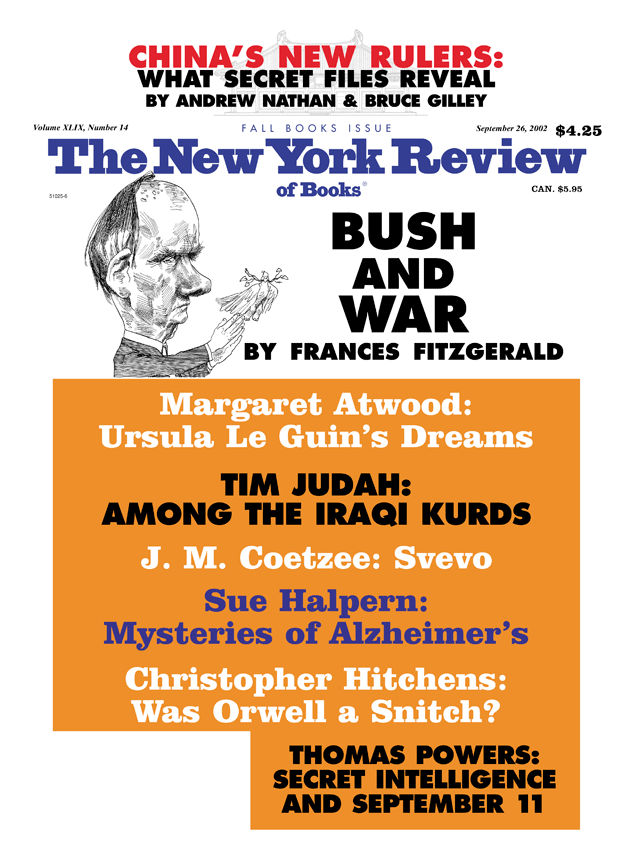
This Issue
September 26, 2002
-
1
Simon and Schuster, 2000. ↩
-
2
Available at the Federation of American Scientists Web page, www.fas.org. ↩
-
3
HarperCollins, 2002. ↩