1.
On June 11, 1829, Alexander Pushkin was traveling through the Caucasus, on his way to join his brother on the Russo-Turkish front, when he came across a disturbing sight:
Two oxen harnessed to a cart were descending the steep road. Some Georgians were accompanying the cart. “Where do you come from?” I asked them. “From Tehran.” “What do you have on your cart?” “Griboyed.”
Alexander Griboyedov had been murdered in Tehran by an angry mob during the storming of the Russian embassy. It happened at the end of the Russo-Persian war, when Griboyedov had been sent as the Tsar’s envoy to impose a humiliating peace treaty on the Persians. Griboyedov was a diplomat who played a modest but important role in the Russian Empire’s conquest of the Caucasus between 1818 and 1829. But Pushkin had known him since 1817, when Griboyedov had been a rising star in literary St. Petersburg. Today Griboyedov is best known for his sparkling and subversive drama Woe from Wit (Gore ot uma, 1823), which still remains, as Pushkin had predicted, the most quoted work of Russian literature in its native land. Relatively unknown in the West, Griboyedov’s extraordinary life is the subject of Laurence Kelly’s well-researched and finely written book Diplomacy and Murder in Tehran. It is a fascinating tale of imperial conflict and political intrigue with much contemporary relevance.
Alexander Griboyedov was born in 1795 to a noble family with grand connections but very little cash. At the age of eleven, he enrolled as a student in the Literature Faculty of Moscow University, where he fell into a circle of romantic liberals that included the philosopher Petr Chaadaev (later to fall afoul of the authorities for his Western views) and the future revolutionary conspirators, the Decembrists Ivan Turgenev, Sergei Trubetskoi, and Artamon Muravev. The War of 1812 crystallized their political convictions, and, having served in it as young guards officers, they returned from it in the expectation that Russia would embark on the Western path of constitutional reform. Having been in the cavalry reserves, Griboyedov went back to St. Petersburg and became a civil servant in the Foreign Ministry, joining on the same day as Pushkin (then just eighteen). The Russian Foreign Service was extravagantly overmanned (Griboyedov said that “all he did was to attend the Ministry once a month, and sleep in its padded armchairs to talk about the Trojan war”). It left him time to learn Persian, to write poetry, and to compose operas (Kelly thinks that he had studied with the Irish composer John Field, who lived in Russia at that time). He also pursued pretty ballerinas, which led to his involvement in a tragic duel, for which he was banished from the capital.
Griboyedov took a post as attaché to the first Russian mission in Tehran. His main concern was the Caucasus. Since the eighteenth century, the Russians had been seeking to extend their influence in the Caucasus at the expense of the Ottoman and Persian Empires. The pretext they used was the protection of the Georgians and Armenians, fellow Orthodox civilizations, from the Muslim infidels. In 1801, after the Persians had sacked Tiflis, Russia annexed Georgia, with the consent of the Georgian ruling house, and three years later became engaged in a victorious war with Persia, ending in the Treaty of Gulistan (1813).
By this treaty, Russia extended her sovereignty over most of the Caucasus. Sovereignty but not control—as the Muslim mountain tribes of Chechnya and Daghestan began a war of resistance that was opposed with brutal force, but little real effect, by the Russian troops. As a diplomat, Griboyedov advanced the empire’s interests, enforcing Russia’s will against the weakened Persians and counteracting the influence of Britain, which sought to build up Persia as a bulwark against Russia’s perceived threat to India. But as Kelly demonstrates, Griboyedov was ambivalent about Russia’s “civilizing” role in the Caucasus. He had moments of nationalistic pride, when he tried to justify the “pacifications” of the Chechens. “We shall hang them, and forgive them, and spit on the verdict of history,” he once prophesied. Yet, like Lermontov, the subject of Kelly’s previous book, Griboyedov wrote a number of poems expressing sympathy with the Chechen resistance against Russia. There was a romantic cult of the Chechen warriors in nineteenth-century Russian literature, and Griboyedov’s verse should be understood in this context. But in ways that might have been explored, his literary sympathies were informed by his politics.
In 1823 Griboyedov returned on leave to Moscow and completed his brilliant social satire Woe from Wit. The comedy was censored by the authorities, but thousands of copies were passed around by hand, and in the liberal circles of the Decembrists, where Griboyedov had his friends, its circulation became a “rallying point.” The play’s greatest appeal was the liveliness and precision of its language, which is exceptionally difficult to translate (perhaps one reason why the play has seldom been performed outside Russia). Contemporaries marveled at its easy rhyming verse, its clever wit and natural dialogue, which was sprinkled with winning lines that soon acquired the status of popular sayings (Pushkin predicted, on his first reading of the play, that more than half its lines would become proverbs). The hero of the play is an angry young man called Alexander Chatsky, who returns to Moscow, as Griboyedov did, after a long period abroad. Chatsky is repulsed by the boorishness and conservatism of the society he finds on his return, and he departs again:
Advertisement
Out, out from Moscow! Now no more I’ll ride this way; I’m off, I’m running, I’m not looking back,
I’ve gone to search the world,
To find some niche, where outraged sense can shelter!
My carriage! Get my carriage!1
Chatsky was a prototype of the “superfluous men” (like Pushkin’s Eugene Onegin or Lermontov’s Pechorin, the Hero of Our Time) who inhabit nineteenth- century Russian literature. Immersed in European culture, Griboyedov’s hero, like many of his friends, felt estranged from Russian society, which appeared backward by comparison. In this sense, as Kelly emphasizes, Woe from Wit was perceived, almost from the start, as a “manifesto of the doomed generation of liberal aristocr ats” to which Griboyedov and the Decembrists belonged.
Kelly does not think that Griboyedov was an active member of the Decembrist conspiracy. He had some contact with the so-called Vasilkov cell, which was plotting to assassinate Tsar Alexander I during his forthcoming visit to inspect the troops in Kiev, and then march to the capital to seize power and impose a constitution on Russia. But Griboyedov took no part, it seems, in the abortive mutiny of December 1825, which ended in the execution of five ringleaders and penal exile in Siberia for over a hundred Decembrists. Griboyedov was arrested and interrogated about his links to the conspirators, but he denied all knowledge of their plot and escaped punishment, although not feelings of remorse for having survived where his friends had not.
News of the Decembrist rising led the Persians to believe that Russia would be torn apart by civil war. Urged on by his Shiite clerics, Crown Prince Abbas Mirza led an attack on Russian-controlled Karabakh. The Russians sent in their heavy guns, swept through Azerbaijan toward Tabriz, forced the Persians out of Erivan, and imposed the Treaty of Turkmenchai, whereby the khanates of Nakhichevan and Erivan were ceded by the Persians to Russia. As Kelly emphasizes, by securing Russia’s control of the Caucasus and giving Russian ships the exclusive right to trade and navigate on the Caspian Sea, the 1829 treaty made clear Russia’s domination of Persia, forcing Britain “to seek new buffer zones for India in Afghanistan and the Punjab.” The “Great Game” had begun.
Griboyedov was dispatched as an envoy to the Persian court with orders to enforce the treaty’s humiliating terms. His mission was made up of a motley group of Georgians, Cossacks, Muslims, and Armenians, who saw the whole adventure as a drinking binge and an opportunity to extract money from the Persians. In Tehran Griboyedov gave offense by failing to deliver the customary presents to the Shah. The Russians rode roughshod over Persian protocol. But the event that really inflamed Persian passions was the defection of the Shah’s eunuch. The treaty with Russia made provision for the repatriation of prisoners-of-war and Christians held against their will in Persia. One of these was the Shah’s favorite eunuch, Mirza Yakub, an Armenian who had been captured by the Persians in the siege of Erivan in 1804, and who then converted to Islam. Mirza Yakub fled from the Shah’s harem and sought protection in the Russian embassy, demanding to be taken back to Erivan. The Russians made a principle of defending the legal rights of Mirza Yakub, who stood to be condemned as an apostate by the Muslim courts, a crime for which he would be stoned to death if he ever was returned to the Shah.
The Persians were outraged by what they saw as an insult to Muslim dignity. The Shah had been humiliated by the defection of a personal slave who could (and did) divulge the most intimate secrets of his domestic life. In the mosques the mullahs told the people to proceed to the Russian embassy and seize Mirza Yakub. Kelly thinks that the mob’s attack on the embassy had been encouraged by the Shah, because this seemed the only way he had to recapture Mirza Yakub without breaking the treaty. But it seems just as likely that a show of force got out of hand. On the evening of January 29, five hundred men and teenage boys, waving clubs and swords, amassed outside the embassy. They threw stones and then broke into the courtyard and seized Mirza Yakub. Cossacks fired from the roof, killing one of the stone-throwers, whose body was carried to a mosque, where the mullahs called for a jihad. The mob swelled in size and burst into the embassy, where forty-four members of the Russian mission, including Griboyedov, were hacked to death. According to one account, Griboyedov’s body was so badly mutilated that it could only be identified by a scar on his finger. One wonders just what Pushkin saw when he came across the cart that carried his friend’s body down that mountain pass.
Advertisement
2.
Intrigue and murder had a special place in Russian imperial history. Court plots and assassinations had of course an ancient pedigree (the Emperor Paul I was the last to be murdered, in a palace coup of 1801), but the Decembrists were the first in a long line of conspirators to try to effect democratic change by the assassination of the Tsar. From the middle of the nineteenth century the revolutionaries were engaged in a war of terror against the tsarist police, culminating in the last twenty years of the imperial dynasty, when over 15,000 officials were killed by fighters for the “people’s cause.”
As Richard Pipes points out, quoting the historian and one-time member of the People’s Will Vladimir Burtsev, in Russian liberal society there was a
general sympathy for political terror and, specifically, for attempts on the life of the tsar. The terrorists expressed social protest. More than that—they embodied society’s hope.
Within the intelligentsia’s circles it was deemed a matter of “good taste” to sympathize with the terrorists and many wealthy citizens donated large sums of money to them. Vera Figner, one of the main leaders of the People’s Will, which was responsible for the assassination of Tsar Alexander II in 1881, later wrote about “a cult of the bomb and the gun” in which “murder and the scaffold took on a magnetic charm”:
Outsiders became reconciled to terrorism because of the distinterestedness of its motives; it redeemed itself through renunciation of material benefits, through the fact that the revolutionist was not satisfied with well-being…it redeemed itself by prison, exile, penal servitude and death.2
How should we explain this murderous impulse? That is the question at the heart of The Degaev Affair, Professor Pipes’s short book about the extraordinary life of the terrorist Sergei Degaev (1857–1921).
Pipes dismisses the common explanation, that terrorists are born out of frustration with “political oppression and/or poverty.” Referring to the 1960s and 1970s, he points to the Baader-Meinhof gang in Germany and to the United States (where “a similar movement…resorted to terrorism”) as illustrations of this violent impulse in countries as “rich and as free and law-abiding as any society in history.” For Pipes the explanation is rather to be found in a moral sickness (an “overpowering destructive urge which, at the same time, exhibits self-destructive symptoms”) that seizes hold of “a sizable body of the young” in modern societies “from time to time.”
When this happens, the ostensible objective—an ideal political and social order—serves but as a pretext for resort to violence: violence, ostensibly the means to an end, becomes an end in itself.
Pipes appears to be suggesting that we should see the violent revolutionary as a pathological type of the sort Dostoevsky wrote about in The Possessed. It is a view he has advanced on a grander scale in The Russian Revolution (1990), where the Bolsheviks were basically depicted as a band of fanatics, driven, like Petr Verkhovensky and Nikolai Stavrogin in The Possessed, to their murderous deeds by their hatred of society and deluded vision of its future. This may not be convincing as an explanation of a mass movement like the Bolsheviks. But there is a certain type of revolutionary that Pipes has found and brought to life in his fascinating tale of Sergei Degaev.
Degaev was born to a middle-class family in Moscow. It was, Pipes tells us, a “romantic” family with “exalted if unfocused ambitions” and close connections to the revolutionaries. Degaev had a high opinion of himself, and he strived to make his mark. As a student in St. Petersburg, he joined the People’s Will. But he lacked the temperament to carry out its dictates to murder in cold blood. In 1881, Degaev was one of many radicals arrested following the assassination of Alexander II. In the House of Preliminary Detention he was interrogated by the head of Russia’s security police, Lieutenant Colonel Georgi Sudeikin, who persuaded him to become an informant and to infiltrate the People’s Will. Released from jail, Degaev betrayed his comrades in the revolutionary movement, providing information that led to the arrest of Vera Figner, whom Degaev despised. He played along with Sudeikin’s plan to “run the revolution” by having Figner replaced by himself, Degaev, at the head of a police-sponsored People’s Will.
Sudeikin was a mirror image of the revolutionaries. He fought them without principles, and as he once confessed, he could have just as readily been one of them. Born to a poor gentry family, Sudeikin sought adventure and personal advancement in the Gendarmes Corps. After the assassination of the Tsar, in 1881, he was transferred from Kiev to the capital, where he was the first to develop the technique of using informants to infiltrate the revolutionaries. Sudeikin was dissatisfied with his success. Not promoted to a general, he thought the new tsar, Alexander III, had failed to recognize the value of his work. Sudeikin dreamed up a fantastic plan. By controlling Degaev, he would use the revolutionaries in a campaign of assassinations against leading members of the court, so that he would be awarded extra powers by the frightened Tsar. According to Pipes, Sudeikin was plotting a coup d’état to become “de facto ruler of the empire.”
Sudeikin’s plan was soon undone. Degaev was exposed as an informant and he was forced by the revolutionaries to expiate his sin by killing Sudeikin. On December 16, 1883, Degaev lured Sudeikin to his apartment, where two accomplices lay in hiding. As Sudeikin entered the study, Degaev shot him in the back and then, as the victim staggered to the door, watched as one of his accomplices battered him to death with a crowbar.
Degaev fled to France. Three years later he arrived with his wife in North America. He worked for a while in St. Louis, studied mathematics at Washington University, and in 1891 became a naturalized American, registered as Alexander Pell. With a Ph.D. from Johns Hopkins, Pell later became a professor of mathematics at the University of South Dakota, where he was remembered, after his death in 1921, as a popular teacher and colleague, much loved for his friendship and warm human qualities. Thus Pipes ends his fascinating tale, leaving readers to ponder on the reasons for such contradictory behavior:
Did Degaev-Pell suffer from a split personality? Was his dissimilar behavior on the two continents the natural result of maturation of a man who was in his early twenties when living in Russia, and in his forties when in South Dakota? Or was he perhaps trying in middle age, with good deeds, to atone for the evils he had committed in his youth? Were the conditions of freedom which he encountered in America so different from the ones he had known in Russia as to transform him into a different human being? Or perhaps was Joseph Conrad right in saying that the Russian personality is so enigmatic that a Westerner cannot hope to penetrate it?
3.
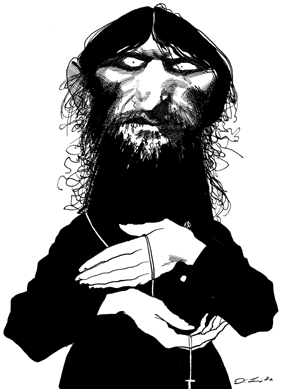
The murder of Rasputin must surely be the best-known political assassination in Russian history. The main assassin, Prince Felix Yusupov, was no wannabe, like Degaev, but the son of the richest woman in Russia and, through his marriage to the Grand Duchess Irina Alexandrova, the Tsar’s niece, a close relative of Nicholas II. Yusupov’s winning yet mendacious memoirs, Lost Splendor, have now been reissued, fifty years after their first publication in 1953.
The Yusupovs had vast estates scattered over Russia, some “so far away,” the prince recalls in a style of fable-telling that veils the whole memoir,
that we never went there at all. One of our estates in the Caucasus stretched for one hundred and twenty-five miles along the Caspian Sea; crude petroleum was so abundant that the soil seemed soaked with it, and the peasants used it to grease their cart wheels.
In St. Petersburg they owned a magnificent neoclassical palace on the embankment of the Moika Canal presented as a gift by Catherine the Great. As if to suggest a rationale for his murder of Rasputin, Yusupov recounts an incident in 1906, when he first laid eyes on the wretched poor at a night shelter in St. Petersburg. Walking back to the Moika Palace, he asked himself:
What would happen if a war or a revolution deprived me of my fortune? I recalled the miserable wretches I had seen…. Could I ever, by a turn of Fortune’s wheel, sink to their level? The very thought was horrible.
Born in 1887, Felix was a frail and effeminate youth. Throughout his memoirs there are obvious hints about his alleged homosexuality, especially his relationship with the Grand Duke Dmitry Pavlovich, a favorite nephew of the Tsar, who was “aware of the scandalous rumours about my mode of living [and] disapproved of our friendship.” Although Yusupov does not admit as much, there may have been a sexual aspect to his friendship with Rasputin, who befriended other homosexuals in the Romanov court and even claimed to “lie with” them. Of the many temptations Rasputin offered members of the aristocracy, Yusupov prefers to dwell on his peculiar brand of spiritualism, in which, as he tells us, as a young man he had taken a “great interest.” Here he claims he found his savior in the Grand Duchess Elisabeth Feodorovna, “whom, since childhood, I had loved and revered as a second mother.” The Grand Duchess was the widow of Tsar Alexander II’s fourth son, the Grand Duke Sergei Aleksandrovich, a former governor of Moscow who was blown up by a terrorist bomb in 1905. After her husband’s death the Grand Duchess gave herself entirely to charitable works and to the life of the convent which she built in 1912.
Like many Orthodox leaders, the Grand Duchess was bitterly opposed to the influence of Rasputin, whose mysterious healing capacities had brought him into the inner circle of the Tsar and Tsarina, who were so desperate for a cure for their hemophiliac son, the Tsarevich Aleksei, that they discounted all the tales about Rasputin’s scandalous behavior with gypsies, prostitutes, and the ladies of the court whom he seduced. The Grand Duchess saw Rasputin as an impostor, and did not conceal her opinions from the imperial family. Yusupov compares her influence to a revelation. From her, he claims, he learned to turn away from sin and dedicate himself to the welfare of the poor. He resolved to “change my way of living” and to open up his palaces to the public: “in times when revolutionary passions were so rife, it was no longer possible to live as one did during the time of Catherine the Great.” In fact, for the next three years, Yusupov would live the charmed existence of an Oxford undergraduate (looked after by a Russian chef, a French chauffeur, “an excellent English valet,” a housekeeper, and an equerry).
Returning from England in 1912, Yusupov became convinced that Rasputin was working for “the enemies of Russia and of the throne.” Such convictions became common with the outbreak of World War I, when it was widely rumored that Rasputin and the Tsarina (“the German woman”) were leaking Russia’s military secrets to the Kaiser. There is no proof of these rumors. But their significance is not in whether they were true or not, but in whether people believed them (in a revolutionary situation, it is popular belief, not truth, that counts). Yusupov believed the worst: that through his influence on the Tsarina, “Rasputin governed Russia”; that he drugged the Tsar with herbal teas to keep him weak; that he plotted to “remove [him] from the throne,…proclaim the Czarina regent, and sign a separate peace with Germany”:
Each of my visits to Rasputin convinced me more and more that he was the cause of Russia’s disasters, and that if he disappeared the diabolical spell cast over our Czar and Czarina would vanish with him.
The Grand Duke Dmitry and the right-wing Duma politician V.M. Purishkevich joined Yusupov’s murder plan. On December 16, 1916, Yusupov invited Rasputin to the Moika Palace on the pretext of meeting his wife, the beautiful Grand Duchess Irina. He plied him with poisoned Madeira and when that had no effect, shot him “in the region of the heart.” Purishkevich and Dmitry began to dispose of the body, but suddenly Rasputin “leapt to his feet”:
This devil who was dying of poison, who had a bullet in his heart, must have been raised from the dead by the powers of evil…. I realized now who Rasputin really was. It was the reincarnation of Satan.
Rasputin staggered into the courtyard. Purishkevitch fired four more shots.
The news of Rasputin’s murder was greeted with joy among aristocratic circles. The Grand Duke Dmitry was given a standing ovation when he appeared in the Mikhailovsky Theatre on the evening of December 17. The Grand Duchess Elisabeth wrote to Yusupov’s mother: “God bless your dear son for his patriotic act.” She and fifteen other members of the imperial family pleaded with the Tsar not to punish the conspirators. But Nicholas rejected their appeal, arguing that no one had the right to engage in murder. Dmitry was exiled to Persia; Yusupov to one of his estates.
Thirty-seven years later, having left behind his vast estates and become an exile in Paris, Yusupov reflected on his murderous act:
I cannot imagine how I could have planned and committed a deed so contrary to my nature and principles. I was like a man in a dream…. I never had the slightest qualms of conscience; the thought of Rasputin never troubled my sleep. I had the feeling that it was someone else and not I who had done the deed, and I always spoke about it as if I had no part in it. The Grand Duchess Elisabeth had said that I was guided by a Force beyond my control. But was it a Force for Good or a Force for Evil?
This Issue
April 8, 2004

This Issue
April 8, 2004