
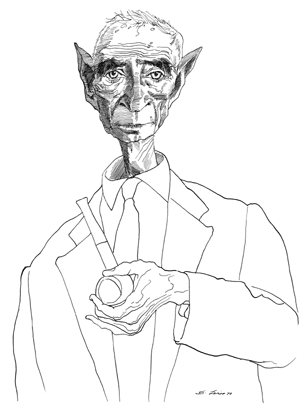
1.
One of the many complexities of the character of J. Robert Oppenheimer is apparent in his response to the discovery of nuclear fission in January 1939. “The U business is unbelievable,” he wrote to a colleague once he had satisfied himself that uranium atoms really did split when bombarded with neutrons. “It is I think exciting, not in the rare way of positrons and mesotrons, but in a good honest practical way.” He meant that fission didn’t turn physics upside down and inside out like so many other discoveries of the first decades of the twentieth century. Fission was as practical as a hammer. The clincher for Oppenheimer was watching the dramatic green spikes on the oscilloscope of the Berkeley physicist Luis Alvarez when an atom split. “In less than fifteen minutes,” Alvarez wrote later,
he not only agreed that the reaction was authentic but also speculated that in the process extra neutrons would boil off that could be used to split more uranium atoms and thereby generate power or make bombs. It was amazing to see how rapidly his mind worked….
The speed of Oppenheimer’s mind would not have surprised those who knew him. At thirty-four Oppenheimer was famously brilliant. The surprise was his enthusiasm for the “good honest practical way” fission might be put to work. His whole life had been moving in an entirely different direction since his discovery of physics, and especially theoretical physics, at Harvard in the early 1920s, then at the Cavendish lab in Cambridge, England, and finally in the German university town of Göttingen, where he studied with Max Born, argued with his fellow students, and developed “some taste in physics.”
For a decade theory dominated his life and later his teaching in California until the mid-1930s when Oppenheimer suddenly discovered politics—specifically, the “popular front” politics of the American Communist Party as it tried to rally resistance to fascism. Oppenheimer’s politics were, however—like his physics—mainly theoretical. He always insisted he never joined the Party himself, and the FBI, despite a dozen years of relentless surveillance and phone-tapping, never managed to prove he did.
Oppenheimer early in the war readily agreed with a US Army security officer, charged with weighing his loyalty, and said it seemed he had “belonged to nearly every fellow-traveling organization on the West Coast.” He went to rallies, helped raise funds for refugees of the Spanish civil war, made substantial donations of his own to a representative of the Party, fell in love with one Communist, and was close to many others, including his brother Frank, who joined the Party in 1936 and remained until about 1942. For Oppenheimer in his Red period communism was a noble ideal, a way of conceiving a just world, and very likely—much in the way of his physics, his ambitious reading, his tailoring, his interest in art, food, wine, and martinis made exactly so—another means of distinguishing himself from the ordinary run of mankind.
But Oppenheimer the theorist grasped immediately that fission could be used to build a bomb, and his interest went beyond the subatomic physics that would allow it to happen. Almost immediately some of Oppenheimer’s students—Philip Morrison, Sydney Dancoff, the newly arrived Joseph Weinberg—went to work designing a bomb. The first version was drawn on a napkin in a student union restaurant. Within a week Morrison was startled on entering Oppenheimer’s office to see on the blackboard a drawing of the bomb surrounded by equations. To his friend George Uhlenbeck, Oppenheimer wrote, “So I think it really not too improbable that a ten cm cube of uranium deuteride…might very well blow itself to hell.” This remark can be interpreted as one of the very first attempts to estimate “critical mass”—the all-important quantity of fissionable material required for the runaway chain reaction of splitting atoms that gives the atomic bomb its power.
Oppenheimer not only directed his genius toward understanding how a bomb could be made to work, but then stuck with it for six years through the ordeals of dispelling official doubts that the former Red could be trusted; building and running a laboratory; getting the best people to drop what they were doing to join a secret project in New Mexico; designing, manufacturing, and testing an actual weapon; and finally coaching military officers on delivery of the bomb itself—instructing them on how high to detonate it, what sort of weather to seek or avoid, and what kind of target would make the most powerful impact on the collective mind of the rulers of Japan and hasten the end of the war.
That the bomb happened at all is remarkable. More astonishing still is the pace that was maintained. The starting bell was a conference on bomb physics held at Los Alamos in March 1943, and written up by Oppenheimer’s former student Robert Serber in a tome referred to thereafter as “the primer.” Twenty-eight months later, in July 1945, a test bomb was detonated in the desert at Alamogordo. No other bomb-making nation has matched this speed record, and some aspirants, like Iran, have been picking their slow way forward over a span of decades and haven’t reached the testing stage yet.
Advertisement
The magnitude of Oppenheimer’s role in this vast endeavor is fully recorded in Richard Rhodes’s history, The Making of the Atomic Bomb, published twenty years ago. American wealth partly explains the success of the project but more important was American resolution—the driving determination to make it happen. The Manhattan Project, as it soon came to be called, was created in June 1942 and taken over in mid-September by Colonel Leslie Groves, who was given a general’s star for shouldering the task. Groves was a true monster of resolution. The scientists resented and often made fun of him, and Richard Rhodes was no fan of the general, either, yet he looms over The Making of the Atomic Bomb like a force of nature.
Money, industrial infrastructure, technical knowhow, and General Groves were all important parts of the mix, but none of these contributed more to the pace of the success than Oppenheimer. He was always on stage—guiding, pushing, placating, reassuring, asking questions, making suggestions, stretching Army security regs to ensure that the scientists could all talk to each other. He even found an hour a week to listen to the torrent of complaint and bright ideas from the brilliant but touchy Edward Teller, who was already obsessed with the fusion weapon he called the “super.”
The sheer effort of will of keeping the bomb on track through all hours and emotional weathers wasted Oppenheimer, always thin, down to a stalk at 115 pounds. Once or twice he was ready to snap and give up. His friend I.I. Rabi, the only physicist who answered with a principled “no” to Oppenheimer’s call to work on the project, came out to New Mexico from time to time to buck him up. Rabi did not want to help build a bomb as “the culmination of three centuries of physics,” but when the time approached to see if the gadget worked, and Oppenheimer was under greater strain than ever, Rabi was on hand to listen to the countdown and watch the dawn in an instant turn brighter than the full glare of day while many, staring awestruck through thick filters, wondered if the spreading ball of fire would stop before swallowing the world. As striking to Rabi was the sight of Oppenheimer himself after people were up and about again: “I’ll never forget his walk; I’ll never forget the way he stepped out of the car…. This kind of strut. He had done it.”
But it is not what Oppenheimer did in the high desert of New Mexico between April 1943 and August 1945 that explains our enduring interest in Oppenheimer as a man, and the appearance now, sixty years later, of four new books in which he is the central figure. In Oppenheimer’s extraordinary life the building of the atomic bomb is the middle chapter. The test that made Oppenheimer strut comes just past the midpoint in the nearly six-hundred-page biography jointly written by Kai Bird and Martin Sherwin, American Prometheus: The Triumph and Tragedy of J. Robert Oppenheimer. What followed the building of the bomb is what makes Oppenheimer one of the handful of genuinely tragic figures in American history.
When the dust of Hiroshima and Nagasaki had settled, the American military concluded that it had acquired the solution to practically everything—a club to cow the Russians and a cheap substitute for a big peacetime army. Oppenheimer’s thinking took a different turn. Over the next decade his deepening sense of the dangers posed by the hothouse growth in the number of nuclear weapons so angered Air Force generals and some civilian officials that they conspired to destroy him. More than once Rabi warned Oppenheimer that powerful enemies were sharpening their knives. Oppenheimer’s vulnerable spot would be his Red period. Rabi urged him to write something for a popular magazine like The Saturday Evening Post, confess all, and put it behind him. Perhaps Oppenheimer was overconfident; perhaps he feared exposing old friends to trouble from Red hunters like Senator Joseph McCarthy. In any event he ignored Rabi’s warnings and in 1954 Oppenheimer’s enemies, with the consent and assistance of the White House, brought him down.
How this was done, by whom, and why is the subject of Priscilla McMillan’s account of the Atomic Energy Commission hearing in the spring of 1954 which probed, and eventually publicized, the recesses of Oppenheimer’s political and emotional life and then stripped him of his security clearance for “substantial defects of character.” McMillan’s short, lucid, and intense book, The Ruin of J. Robert Oppenheimer, is a stunning complement to American Prometheus, placing the scarifying final episode in Oppenheimer’s life on a dissecting table in order to separate and identify, as if it were the nervous system of a rat, the filaments of ambition, rancor, and collusion of the three brooding men who cut Oppenheimer down. The man with the power to break him was Lewis Strauss, a vain and thin-skinned industrialist who became Oppenheimer’s boss when President Eisenhower named him chairman of the AEC in 1953. The man who provided the argument and the occasion was William Liscum Borden, a single-minded young zealot who thought he knew why Oppenheimer resisted Air Force demands for hydrogen bombs—“more probably than not,” Borden wrote the head of the FBI in November 1953, “J. Robert Oppenheimer is an agent of the Soviet Union.”
Advertisement
But neither could have managed Oppenheimer’s destruction without the help of the obsessed H-bomb promoter Edward Teller, who had never forgiven Oppenheimer for choosing another man to run the theoretical division at Los Alamos, who dreamed of replacing Oppenheimer as the protean man of the hour, and who nursed matters forward as he methodically planted seeds of suspicion in the minds of Borden, Strauss, and Air Force generals that Oppenheimer’s “faulty judgment” could be traced to hidden loyalties from his Red period.
For those ready to devote a whole season to absorbing Oppenheimer entire, an excellent introduction can be found in another of the new books now appearing; Jeremy Bernstein’s short profile, Oppenheimer: Portrait of an Enigma, will prepare the reader for the story in its long form. Bernstein was a student at the Institute for Advanced Study (IAS) in Princeton in the late 1950s when Oppenheimer was its director and took away a vivid impression of the man. A lively writer as well as a physicist, Bernstein has written many articles for The New Yorker and a number of books about scientists, and he not only understands but is actually interested in the physics that brought the bomb into the world. Indeed, his short book has the clearest feel for Oppenheimer’s way of doing science; it goes beyond the names of problems and papers to explain in brisk fashion the questions he was thinking about, and how he made such a profound impression on the leading physicists of the period before the war.
Best are several telling anecdotes of Bernstein’s encounters with Oppenheimer in the years closely following his public humiliation by the AEC. He notes, for example, that Oppenheimer always sat in the front row at Institute for Advanced Study physics seminars and often made sharp or biting comments about things said or questions asked. “If he made what he thought was a witty comment,” Bernstein writes, “he would look around to make sure that we had all taken it in.” Reading that we better understand the impulse behind Oppenheimer’s question to Joseph Volpe, the AEC’s lawyer, after a hearing in which Oppenheimer made cruel fun of Strauss for opposing export of American radioactive isotopes, a position Oppenheimer dismissed as silly: “My own rating of the importance of isotopes in this broad sense,” he said, “is that they are far less important than electronic devices, but far more important than, let us say, vitamins, somewhere in between.” “Well, Joe, how did I do?” Oppenheimer asked, expecting praise for the way he had skewered Strauss. “Too well, Robert,” Volpe answered, “much too well.” He had seen the look on Strauss’s face, and so had two other AEC members, Gordon Dean and the chairman of the AEC, David Lilienthal. “I remember clearly the terrible look on Lewis’ face,” said Dean. Lilienthal called it “a look of hatred …that you don’t see very often in a man’s face.”
This gratuitous offense was given in June 1949, when Oppenheimer was still a national hero and probably had more influence on American atomic policy than any other single person. He was chairman of the AEC’s General Advisory Committee (GAC) but his power was of the moral, not the bureaucratic, variety. Military officers, and especially the “big bomb” men of the Air Force, egged on by Edward Teller, found him a formidable adversary. As early as March 1950, McMillan writes, Teller sought out Borden, then a staffer on Congress’s Joint Committee on Atomic Energy (JCAE), to suggest that slow going on the hydrogen bomb was Oppenheimer’s fault for discouraging younger men from working on the problem. A few months later Teller planted another seed with Borden. Oppenheimer, he said, had been quite a leftist in his day; his brother Frank never would have joined the Communist Party without Robert’s approval; it was Robert who brought Frank to Los Alamos to work on the atomic bomb; and as chairman of the GAC, with a Q clearance that allowed him to know everything, Oppenheimer was well placed to be the most damaging spy in American history—that is, if he were a spy.
This speculation came only a few months after the confession of the Soviet spy Klaus Fuchs, prominent at Los Alamos and the man who kept the notes during an early conference on “the super”—the hydrogen bomb—in 1946. In the realm of malevolent insinuation Teller’s sly suggestion ranks as a grandmaster chess opening, and it was more than Borden could handle. By November he was telling the chairman of the JCAE, “I conclude that we may well have another Fuchs still in the project today….”
But personal animosity alone does not explain the destruction of Oppenheimer. Just as important was the argument over building a hydrogen bomb. The decision rested with the president but the man with the most powerful public voice in arguing whether it was to be yes or no was Oppenheimer. On this question he was of two minds between the end of the war and the moment in October 1949 when the GAC, prompted by the discovery that Russia had successfully tested its own atomic bomb, had to take a stand. Central to Oppenheimer’s thinking was the bomb itself—not just the practical difficulties of making it “better,” but also the troubling implications of the huge increase in destructive power promised by fusion weapons, a thousand times greater than the fission bombs which had destroyed Hiroshima and Nagasaki.
The practical difficulties, always safer to stress than moral hesitations, were formidable. The inventive Teller had many ideas for using fission bombs to create the high temperatures required to ignite fusion but none of the ideas worked—a fact Teller blamed on three people: on Oppenheimer for discouraging the project; on Norris Bradbury, the new director of Los Alamos, for not giving the program a crash priority; and above all on the Polish mathematician Stanislaw Ulam, for demonstrating time and time again that Teller’s math was wrong since the hydrogen would cool down too quickly for a working bomb. Never once, then or in the decades before his death in 2003, did Teller concede that while he was the one insisting the problem had to be solved, he did not know how to do it.
The years of intellectual combat that preceded a solution for the ignition problem are brilliantly told by McMillan, who explains the science, evokes the contrasting styles and gifts of Ulam and Teller, and brings fully to life the strangely distant time when men were learning how to unleash the energy of stars, but still had to do their calculations with slide rules and the primitive early computers that John von Neumann was building at the IAS in Princeton. One of Ulam’s inspired discoveries was a kind of shorthand method for calculating the progress of an exploding bomb, a gimmick that saved months of laborious number-crunching by hand. From Teller’s point of view the news from Ulam was always bad—rapid cooling, no ignition or no propagation of fusion throughout the hydrogen fuel, ever larger estimates of the amount of tritium needed to help trigger ignition. Tritium was expensive in the usual way of money, but in another way as well—every gram of it tied up production capacity that could have been used to make about eighty grams of plutonium, the fissionable material principally used in fission bombs.
Teller’s wartime design for the so-called “classical super” called for about four hundred grams of tritium; by 1947 he conceded that the requirement had doubled to eight hundred grams at a “cost” of sixty-four kilograms of plutonium, enough for perhaps between four and six fission bombs. The bad news did not halt there. In the fall of 1950 a new tritium estimate suggested a need for between three and five kilograms. Now the “cost” was four hundred kilograms of plutonium, getting on toward enough for fifty bombs. Teller’s bright ideas never caught up with the ignition problem, but despite these repeated failures Oppenheimer and the GAC supported and funded research on fusion weapons, albeit without enthusiasm, arguing what seemed self-evident—a larger number of smaller bombs would provide a lot more military clout than a smaller number of larger bombs, which in any event were too big for any targets except the largest cities.
When the GAC with Oppenheimer as chairman met at the end of October 1949 to consider whether an all-out “crash” program for the H-bomb was a sensible response to the Russian success, Teller’s difficulties offered a ready excuse for delay. But after two days of discussion, as McMillan describes in detail, the GAC raised a very different objection to H-bombs—they were immoral. Eight of the nine members of the GAC—Glen Seaborg was absent and could not participate—opposed a crash program, saying, “We all hope that by one means or another the development of these weapons can be avoided.” More remarkably, all agreed that the power of hydrogen bombs made them essentially weapons of genocide. Two of the members, Enrico Fermi and I.I. Rabi, went still further in a separate opinion, putting into words conclusions their colleagues probably shared, at least in part, but were unwilling to state baldly. “It is clear that the use of such a weapon cannot be justified on any ethical ground,” they wrote.
The fact that no limit exists to the destructiveness of this weapon makes its very existence and the knowledge of its construction a danger to humanity as a whole. It is necessarily an evil thing considered in any light.
Oppenheimer did not write this strong version of the case against the H-bomb, but Teller, Strauss, and the Air Force “big bomb” generals all assumed that it was his doing. They were not far from right. Since Hiroshima and Nagasaki Oppenheimer had changed. He soon developed second thoughts about the use of the bomb on Japan when it was already “essentially defeated,” and he was disturbed and probably a little shocked by the cavalier way in which an early effort to halt the spread of the bomb—the “Acheson-Lilienthal plan,” actually written by Oppenheimer with the help of the faithful Rabi—was handed over to a self-important financier, Bernard Baruch, by President Truman. Baruch reshaped the plan as a poisoned apple and the Russians predictably turned it down.
But Oppenheimer did not simply disagree with the drift of official policy; his moral qualms cut closer to the bone. There was no hiding from the horror of the destruction at Hiroshima and Nagasaki. Philip Morrison and Robert Serber had both been part of a survey team which had walked the ground, seen the victims, and returned to describe the devastation.
It should not seem odd that a weapon which killed a hundred thousand people in a day, most of them women and children, would raise troubling thoughts in the minds of the people who had worked flat out for two years to build it. When I first started to talk to Los Alamos scientists about the invention of nuclear weapons twenty years ago I assumed that they had long since confronted and sorted out the rights and wrongs of the case, but I soon found that it wasn’t so. At an early date their thinking had frozen around a handful of simple ideas—building the bomb was justified because the Germans were trying to do it; using the bomb was justified because it ended the war and demonstrated to the world their terrible destructive power; building more and better bombs was justified because they served as a deterrent and made it more difficult to use them again. Perhaps this self-reassurance should not surprise us; it is hard to condemn something that you have irretrievably done.
But at the outset of the invention process the power of the new weapon was harder to ignore. Some scientists were appalled by the intention to destroy cities at a single blow, and a few, for varying reasons, felt compelled to break lockstep. At Los Alamos, the Harvard physicist Theodore Alvin Hall, the youngest person (at eighteen) admitted to the Tech Area where the real work was mainly done, and the German Klaus Fuchs, a member of the British contingent, both decided they had an obligation to pass on atomic secrets to the Russians—information which in fact allowed the Russians in 1949 to test a carbon copy of the American plutonium bomb. In both the United States and Britain intelligence authorities received information on several occasions during the war from sources in Germany claiming that a German bomb program existed but was opposed by scientists assigned to carry out the work. Sending these messages east and west was illegal—treason, in fact—but it was also clearly moral in its primal impulse.
Motives similar to those of the Germans drove a few of the American bomb-makers—Robert Wilson at Los Alamos; Leo Szilard, James Franck, and others at the Metallurgical Laboratory in Chicago—to step out of channels to argue that it was immoral to use the bomb on Japan without first staging a demonstration and giving Japan a chance to surrender. Their attempts to reach high officials infuriated General Groves and failed to halt progress toward Hiroshima. Other restive souls included Rabi, who had declined to work on the bomb in the first place; the Polish émigré Joseph Rotblat, trapped in London by the outbreak of the war, who joined the British bomb program for fear of the Germans but quit in late 1944 when he was told that the Germans had no program; and Oppenheimer himself, who did more than anyone else to ensure that the bomb was ready “in time,” briefly exulted, and then gradually internalized the idea that the dead had been murdered by him.
Our evidence for Oppenheimer’s feelings is thin—a handful of remarks mainly recorded by others. But from them we can conclude that something very like a wave of remorse seems to have hit Oppenheimer shortly after Nagasaki was destroyed by the second atomic bomb, a blow criticized by many of the bomb builders as gratuitous and unnecessary. Within weeks his strut was gone. Abruptly, he resigned his position, packed up, and departed Los Alamos. In a somber farewell speech in October he said that pride in building the bomb
must be tempered with a profound concern. If atomic bombs are to be added as new weapons to the arsenals of a warring world …then the time will come when mankind will curse the names of Los Alamos and Hiroshima.
Nine days later he was brought to see President Truman by Secretary of War Robert Patterson. “Mr. President,” he said, “I feel I have blood on my hands.” Truman was disgusted, described Oppenheimer later as a “cry-baby scientist,” and told Dean Acheson, “I don’t want to see that son-of-a-bitch in this office ever again.” That was the last time Oppenheimer spoke so baldly of guilt, but he did not shed it. Three years later, in February 1948, Time magazine quoted him as saying, “In some sort of crude sense which no vulgarity, no humor, no overstatement can quite extinguish, the physicists have known sin; and this is a knowledge which they cannot lose.” Oppenheimer often cloaked his point in a thicket of words, as he did here, but there is no mistaking the meaning of the word “sin,” and there is no hiding which physicist he had in mind.
It was this personal history of guilt and remorse that convinced Teller, Strauss, and the Air Force generals that the GAC’s objections to the H-bomb as a weapon of genocide must have been ultimately Oppenheimer’s doing. McMillan cites the many policy differences that separated Oppenheimer from Air Force generals, who wanted a free hand in building and planning to use atomic weapons. But still worse from the generals’ point of view was any hint that destruction of cities from the air was immoral. That was how they had defeated Japan without an invasion. The GAC report threatened to raise questions that presidents and generals wanted to ignore. It is probable that no other official American document, on a subject of such consequence, was ever argued so lucidly and seriously on moral grounds; it is certain there has been none since. One reason is that the GAC report had no impact; at the end of January 1950, pressed by the Pentagon, his personal advisers, and the knowledge that the Russians had the bomb, President Truman announced that “I have directed the Atomic Energy Commission to continue its work on all forms of atomic weapons, including the so-called hydrogen or super bomb.” But there is a second explanation for the absence of moral argument in official deliberations of weapons policy over the last half-century—the brutal example of the public destruction of the haunted scientist-statesman who had seemed to embody both the triumph and the guilt for Hiroshima.
2.
The life of Oppenheimer has long awaited its biographer. Writing the history of the invention of nuclear weapons began immediately after Hiroshima and in recent decades has culminated with a series of major books on the leading figures of the early atomic era. Among these works, each the result of years of exhaustive research and writing, are Rhodes’s definitive history, already cited; William Lanouette’s life of Leo Szilard, Genius in the Shadows (1992); James Hershberg’s life of one of Oppenheimer’s civilian bosses during the war, James B. Conant: Harvard to Hiroshima and the Making of the Nuclear Age (1993); Gregg Herken’s Brotherhood of the Bomb: The Tangled Lives and Loyalties of Robert Oppenheimer, Ernest Lawrence, and Edward Teller (2002), a work containing much original research often cited by the books under review here; and Robert S. Norris’s Racing for the Bomb: General Leslie R. Groves, the Manhattan Project’s Indispensable Man (2003).
But Oppenheimer, the truly central figure, seemed to resist the attempt to write his life on the grand scale. An early effort, Peter Goodchild’s J. Robert Oppenheimer: Shatterer of Worlds (1980), included many valuable personal details, and now David Cassidy brings us the best account of Oppenheimer’s life in science with J. Robert Oppenheimer and the American Century. Cassidy is the author of a substantial biography of Werner Heisenberg, the German physicist who was at the heart of German nuclear research efforts during World War II. Having written the life of a scientist who did not build a bomb for his government, Cassidy has now written the life of a scientist who did.
The book’s chief strength is the way it tracks Oppenheimer through the later years of the quantum revolution, explaining, among other things, how Oppenheimer managed to miss the big idea or discovery so many people believed was in him, by concentrating instead during his years in California on the loose ends left by other theorists. Cassidy also argues that Oppenheimer’s destruction should be seen as a deliberate official effort to reassert a wartime degree of control over nuclear issues. But Cassidy’s grasp of Oppenheimer’s character seems once removed, probably because few who knew him remain to be interviewed.
Martin Sherwin, author of one of the important early histories of the bomb, A World Destroyed: Hiroshima and Its Legacies (1975), got an earlier start, when most of the major figures were still around with memory intact. He began researching an Oppenheimer biography in 1979 and seemed an ideal candidate for the job. In an author’s note Sherwin says he expected to deliver a manuscript to his publisher in four or five years. But twenty years after he began, no manuscript was in sight. Not everyone was surprised; historians of the subject, a small gossiping group, suggested that Sherwin was the latest victim of the curse of Oppenheimer, whose genius was tainted by a mean-spirited streak. Aspiring biographers, it was said, came to loathe the company of the man and dropped their projects. A history of Sherwin’s progress can be found in the list of interviews, more than a hundred in all, included in the bibliography of American Prometheus —he maintained a vigorous pace for the first couple of years, but then fell off in the early 1980s. In 1985 Sherwin stopped completely.
What agonies filled the intervening years go unmentioned in Sherwin’s author’s note, but about five years ago he was joined in the project by Kai Bird, distinguished author of lives of important cold war figures—John McCloy, intimately involved in the early history of atomic bombs as an assistant to Secretary of War Henry Stimson; and the Bundy brothers, William and McGeorge. The latter had helped Stimson write his own explanation of why a bomb was dropped on Hiroshima. So Bird arrived with a feel for the war years and well steeped in the early history of the bomb.
But even so the challenge was great—too long a time with a difficult subject can sap a writer of interest and enthusiasm; writing from another man’s notes can be dry and perfunctory; collaboration can be an awkward literary arrangement, bridging disagreements with bland language. But somehow in this case all difficulties have been overcome; American Prometheus is clear in its purpose, deeply felt, persuasively argued, disciplined in form, and written with a sustained literary power. It is still recognizably Sherwin’s book, giving new emphasis to arguments first made in A World Destroyed, but at the same time Bird has brought freshness and clarity along with some interpretive ideas of his own.
But it is Oppenheimer the man, not general ideas about the nuclear age, that dominates these pages. Oppenheimer emerges in all his complexity—a brainy theorist but also an “underdogger,” quick in his sympathy for those at the bottom of the social ladder; a sometime revolutionary who irritated former students like Philip Morrison with his talk after the war about “Dean” and “George”—Dean Acheson and George Marshall; devoted defender of his alcoholic wife Kitty but blind to her ego-crushing treatment of their son, Peter; lifelong friend of students like Serber, and betrayer of students like Rossi Lomanitz, Joseph Weinberg, and Bernard Peters, whom he simply threw to the Red-hunting wolves.
In this list, which might be long extended, no contradictions are more important than those involving the bomb itself, not just the first bombs built at Los Alamos but all the bombs that followed in the next eight years. No bomb builder expressed remorse in stronger words—“sin,” “blood on my hands”—but at the same time Oppenheimer stopped short of regretting what he had done. “It isn’t that I don’t feel bad,” he told reporters in Tokyo in 1960. “It is that I don’t feel worse tonight than I did last night.” This is like barbed wire stretched to the snapping point.
Oppenheimer’s feelings about the hydrogen bomb were central to the security charges brought against him by the Atomic Energy Commission in 1954. The AEC indictment was for the most part a repetition of “derogatory information” originally considered during the war, and then restudied in 1947 before Oppenheimer’s security clearance was confirmed—with one exception. The AEC now charged “that you were instrumental in persuading other outstanding scientists not to work on the hydrogen bomb project.” Unwilling to call him a spy, the commission nevertheless insisted that there was something untrustworthy in his reluctance to add the H-bomb to the American arsenal. During the hearing the AEC’s chief inquisitor, Roger Robb, picked at the core of Oppenheimer’s opposition as if it were a scab:
Robb: You mean you had a moral revulsion against the production of such a dreadful weapon?
Oppenheimer: This is too strong…
Robb: Which is too strong, the weapon or my expression?
Oppenheimer: Your expression. I had a grave concern and anxiety.
Robb: You had moral qualms about it, is that accurate?
Oppenheimer: Let us leave the word “moral” out of it.
Robb: You had qualms about it.
Oppenheimer: How could one not have qualms about it? I know no one who doesn’t have qualms about it.
It was Rabi who felt most keenly that the destruction of Oppenheimer was a gratuitous act resulting in a tragic loss—not just personally for Oppenheimer, but for the country. “I never hid my opinion from Mr. Strauss that I thought this whole proceeding…should not have been done,” Rabi testified during the hearing.
There he was…a consultant, and if you don’t want to consult the guy, you don’t consult him, period…. It didn’t seem to me the sort of thing that called for this kind of proceeding at all against a man who had accomplished what Dr. Oppenheimer has accomplished. There is a real positive record, the way I expressed it to a friend of mine. We have an A-bomb and a whole series of it….
In the published transcript asterisks follow representing material deleted for security reasons—a list of the many kinds of improved atomic weapons, including the hydrogen bomb, which were developed under Oppenheimer’s leadership as chairman of the GAC. Rabi concluded, “What more do you want, mermaids?”
The point is a sound one. Why did Lewis Strauss use his position as chairman of the AEC to destroy Oppenheimer, why did Edward Teller encourage him to do it, why did the Air Force insist it had to be done, and why did President Eisenhower not only permit Strauss to do it but help him? The answers to these questions—the detailed answers, providing not just plausible surmise, but chapter and verse—form the body of Priscilla McMillan’s extraordinary book, The Ruin of J. Robert Oppenheimer.
The reader will get the drift immediately if the word “ruin” is understood to be an active verb—in the sense meant when someone says “I will ruin you.” What destroyed Oppenheimer was the month-long AEC hearing, the stripping of his security clearance only one day before it would have lapsed, and the publication of the 993-page hearing transcript with its merciless exposure of so many details of Oppenheimer’s life—adulteries, lies to government officials, connections to Communists, betrayals of friends. But as Ward Evans argued in his dissent to the board’s ruling, every one of these charges had been weighed and dismissed during the war and again in 1947. When the AEC confirmed the cancellation of Oppenheimer’s clearance in June 1954, they took an entirely new tack, ignored the board’s previous findings, and dropped all mention of his “opposition” to the H-bomb, which in any event had not stopped him from overseeing its development and successful first test. Instead they cited “substantial defects of character.”
The AEC’s conclusion invites us to read the fate of Oppenheimer as a tragedy of the classic, Aristotelian sort—the fall of a great man caused by flaws in his character. But as McMillan shows in her vivid and relentless account of his “ruin,” it was not Oppenheimer’s flaws, or even the anti-Red hysteria of the time, that destroyed him—it was the power and the determination of his enemies. This is not the prevailing view of what happened, and Americans are famously unwilling to think ill of their national leaders. But McMillan makes a detailed and convincing case that Oppenheimer’s destruction was the result of Teller’s insinuations, the string-pulling of Strauss, and Borden’s willingness to attack at another’s bidding.
McMillan is a gifted researcher and interviewer, shrewd and patient. Her best-known previous book, published nearly thirty years ago, was Marina and Lee, which in my opinion remains the strongest single account of the tortured life that drove Lee Harvey Oswald to murder President Kennedy. In Ruin she illuminates all the old half-hidden corners of the final act in Oppenheimer’s life—how Strauss recruited journalists and fed them distorted stories about the H-bomb program to build public feeling against Oppenheimer; how Stanislaw Ulam actually found the way to ignite fusion in the H-bomb; how Strauss falsified accounts of his role in prompting the administration to erect a “blank wall” between Oppenheimer and the nation’s secrets while Borden’s sensational charges were investigated; how the Eisenhower administration authorized FBI eavesdropping on Oppenheimer’s conversations with his lawyers so that AEC inquisitors would always know what he feared or planned; how the AEC’s chief lawyer in the hearing, Roger Robb, lied about his access to hundreds of FBI wiretap transcripts, claiming falsely that he had never asked for or seen them.
But most relentless of all is McMillan’s account of Edward Teller, who may be said to have spent the last half of his life concealing, reinterpreting, and making slyly irrelevant apologies for what he did to Oppenheimer. Teller’s performance, something like Nixon’s in what remained of his life after Watergate, was just good enough to let him appear in distinguished company without fear of turned backs and refused handshakes. But no longer; the true Teller is stripped by McMillan for those who care to see.
The biggest lie in a life with many was Teller’s posturing as “the father of the H-bomb,” supported by the never quite explicit claim that he was the one who had solved the fusion ignition problem that allowed the H-bomb to work. What he did instead was to conceal the role of the man who really did it—Stanislaw Ulam, who began to think in December 1950 of a “bomb in a box.” The compression of thermonuclear material would help it to burn, he reasoned. The following month Ulam told his wife, who had been hoping that thermonuclear weapons could never be made to work. Next he told the physicist Carson Mark, busy at the time with pending nuclear tests in the Pacific, and then Norris Bradbury, who saw the point right away.
Finally Ulam described his idea to Teller, who told his colleagues in the Theoretical Division, “Ulam has had an idea, but he hasn’t got it quite right.” It was not shock waves from an exploding fission bomb that would best create the necessary compression, but the radiation itself, getting there first before the shock waves began to blow the assembly apart. “Radiation implosion” was Teller’s part of the new idea. But Ulam’s contribution went a step further by introducing the notion of “staging” the explosion—using a fission “primary” to compress both fusion fuel and a fission “secondary.” All three ideas were central to the first working thermonuclear device; two were Ulam’s, but Teller systematically squeezed him out of the history of the new idea, which was formally written up by a Teller protégé, Frederic de Hoffman.
Usually such inventions were patented; in this case Teller refused to sign the application because Ulam would have to sign, too. As a result, no patent was issued at all. In the mid-1950s Teller published a brief account of the invention of the H-bomb, The Work of Many Men, in which Ulam was identified only as one of the early pessimists. In his 1962 book, Legacy of Hiroshima, Teller claimed the big idea was his doing with the help of de Hoffman. “Ulam invented nothing!” he often insisted, but of course the bomb designers all knew the truth, and many considered Teller the lowest, most contemptible kind of offender in the world of science, a stealer of credit. What only a few knew then is visible to all now, and there is something bracing in watching a slippery character brought to account.
At that point, in mid-1951, Oppenheimer dropped his arguments against the H-bomb—the Ulam-Teller ideas were too “technically sweet” to ignore, he said, but that did not still the animosities encouraged by Teller in Strauss and the Air Force. At every stage of this story McMillan enriches our understanding of Teller’s character and his role in promoting the creation of a second laboratory in Livermore, California; in tempting the United States to ever greater reliance on nuclear weapons for “defense”; and in placing a dark construction on whatever Oppenheimer said and did. Teller’s plotting brought a moment of climax during the AEC hearing intended to end Oppenheimer’s public influence once and for all. Of the forty witnesses called to testify only eight could be described as “prosecution” witnesses. Of the eight only one was a leading scientist, only one had been intimately involved in the programs directly overseen by Oppenheimer as chairman of the GAC, and only one was prepared to testify on the record that Oppenheimer could not be trusted—Edward Teller.
In later years Teller tried to explain his betrayal as a last-minute thing, triggered by Robb’s account the day before his appearance of an elaborate story fabricated by Oppenheimer about an espionage attempt—the so-called “Haakon Chevalier affair,” in which Oppenheimer took the initiative in giving security officials the name of George Eltenton, a chemist who wanted to put him in touch with Soviet officials; but for several months he withheld the name of the friend, Haakon Chevalier, whom Eltenton had approached in hopes of getting Oppenheimer’s cooperation. Like all the other “derogatory information” in security files, the record of his evasions had been known to the AEC when it confirmed Oppenheimer’s clearance in 1947; nothing new had been learned in the five years since. Teller claimed that he was so shocked by Oppenheimer’s lie he determined to go farther than he had planned in his testimony the next day. That night old friends tried to dissuade him but he would not be moved.
The next day Robb put the big question to Teller in unmistakable form: “Do you or do you not believe that Dr. Oppenheimer is a security risk?” Teller answered:
In a great number of cases I have seen Dr. Oppenheimer act in a way which for me was exceedingly hard to understand. I thoroughly disagreed with him in numerous issues and his actions frankly appeared to me confused and complicated. To this extent I feel that I would like to see the vital interests of the country in hands which I understand better and therefore trust more.
That was enough. Nothing else ever said about Oppenheimer did him greater injury.
Teller tried to claim all of the credit for the H-bomb, when only a third belonged to him of right, and he spent the rest of his life trying to undermine the idea that he deserved any of the credit for stripping Oppenheimer of his security clearance. McMillan does not choose to give a number to the percentage of his just share. In this instance the credit must necessarily be shared widely, since so many people across the whole spectrum of official Washington, along with numerous disgruntled bomb builders, did what they could to bring Oppenheimer down. But at its heart the principle behind the strategy was simple—poisoning trust—and for that Teller must take a deep and sweeping bow.
McMillan writes for the most part with quiet lucidity, letting each act or utterance speak for itself, but from time to time there shoots up from her prose something like a tongue of flame. Teller’s success in promoting competing laboratories of bomb designers brings one such judgment. “Together,” she writes, “Livermore and Los Alamos created the vast arsenal of superfluous nuclear weaponry that curses us today.” Who does not sense that curse? She is tempted again when describing what Teller did to the men who aroused his ire—Oppenheimer, who wouldn’t put him in charge of theoretical work at Los Alamos; Norris Bradbury, the Los Alamos director who balked at Teller’s bullying behavior early in the H-bomb program; and Ulam, who came up with the brilliant insight that had eluded Teller. “The Freudian observer,” McMillan writes, “might say that…Teller symbolically destroyed each of the three men who had dealt him a severe narcissistic blow. The layperson might conclude, more simply, that he sought to destroy the three men who had stood in his way.” Judgments don’t come any plainer than that.
It is rare that two important books on the same subject are published in the same year, rarer still that together they tell us so much about American politics, history, science, truth, life, and fate. Together American Prometheus and The Ruin of J. Robert Oppenheimer bring to a close a half-century’s effort in writing the history of the atomic bomb. On this subject there will of course always be more to say, but the basic story is complete; if you want to know what happened it is there to read in these two books. One is a life of Oppenheimer on the grand scale for the first time. The other reveals at last how he was betrayed and destroyed. The present reviewer is tempted to say, I will not choose between these two books; honor them both.
Oppenheimer’s friend Rabi said the stripping of his clearance killed him, but in fact he survived his humiliation by a dozen years and rarely complained. Some observers wearied of that attitude. After hearing Oppenheimer lecture at Harvard in 1957 the writer Edmund Wilson noted in his diary, “His humility now seemed to me hangdog.” That doesn’t sound right, and I suspect it was a different undercurrent of emotion that Wilson picked up—not apology, but a reluctance to blame others for what he had done.
What Oppenheimer left us at the end of the day was not the bomb—somebody would have built it—but his life. I mean the whole of it—the brilliance, the rich and complex personality, the example of his greatest achievement, pushed through in the furious, triumphant American way; and then the long harrowing aftermath so apparent in his late photographs—a man distressed by what the world insisted on doing with what he had built, and convinced there would be a price to pay. Foreboding of this kind was banished at a very early date from the Pentagon, the White House, and the bomb laboratories. There the ruling faith is that professionals can manage the dangers, and for a decade after the collapse of the Soviet Union and the end of the cold war, it was possible to think they were right. But now things have changed again, and we find we are living once more with the old suspense, threatened by the weapons we were the first to build and use, and waiting for nothing to happen forever.
This Issue
September 22, 2005
This Issue
September 22, 2005