
1.
Not since Foreign Affairs magazine published Samuel Huntington’s “The Clash of Civilizations?” in 1993 has an academic essay detonated with such force as “The Israel Lobby and US Foreign Policy,” by professors John J. Mearsheimer of the University of Chicago and Stephen M. Walt of Harvard University’s Kennedy School of Government. Published in the March 23, 2006, issue of the London Review of Books and posted as a “working paper” on the Kennedy School’s Web site, the report has been debated in the coffeehouses of Cairo and in the editorial offices of Haaretz. It’s been called “smelly” (Christopher Hitchens), “nutty” (Max Boot), “conspiratorial” (the Anti-Defamation League), “oddly amateurish” (the Forward), and “brave” (Philip Weiss in The Nation). It’s prompted intense speculation over why The New York Times has given it so little attention and why The Atlantic Monthly, which originally commissioned the essay, rejected it.
The objects of all this controversy are two eminent members of the academic establishment. Mearsheimer is a graduate of West Point, a veteran of five years in the Air Force, and the author of three books, including The Tragedy of Great Power Politics. In 1989, Mearsheimer persuaded Walt to leave Princeton and to join the faculty at Chicago, and they worked closely together until 1999, when Walt left for Harvard’s Kennedy School; he’s been its academic dean for the last three years. Last year, he published Taming American Power: The Global Response to US Primacy. As their book titles suggest, both professors belong to the “realist” school of international relations, viewing national interest as the only effective ground for making foreign policy.
In their paper (the Web version runs eighty-two pages, forty of them footnotes), Mearsheimer and Walt argue that the centerpiece of US policy in the Middle East has been its unwavering support for Israel, and that this has not been in America’s best interest. In their view, the “extraordinary generosity” the US showers on Israel— the nearly $3 billion in direct foreign assistance it provides every year, the access it gives Israel to “top-drawer” weapons like F-16 jets, the thirty-two UN Security Council resolutions critical of Israel that it has vetoed since 1982, the “wide latitude” it has given Israel in dealing with the occupied territories—all this “might be understandable if Israel were a vital strategic asset or if there were a compelling moral case for sustained US backing.” In fact, they write, “neither rationale is convincing.” Israel may have had strategic value for the US during the cold war when the Soviet Union had heavy influence in Egypt and Syria, but that has long since faded. Since September 11, Israel has been cast as a crucial ally in the war on terror, but actually, according to Mearsheimer and Walt, it has been more of a liability; its close ties to America have served as a rallying point for Osama bin Laden and other anti-American extremists. Morally, Israel qualifies as a democracy, the authors write, but it’s a deeply flawed one, discriminating against its Arab citizens and oppressing the Palestinians who have lived under its occupation.
If neither strategic nor moral considerations can account for America’s support for Israel, Mearsheimer and Walt ask, what does? Their answer: the “unmatched power of the Israel Lobby.” At its core is the American Israel Public Affairs Committee (AIPAC), which is ranked second after the National Rifle Association (along with the AARP) in the National Journal’s 2005 listing of Washington’s most powerful lobbies. AIPAC, they write, serves as “a de facto agent for a foreign government.” The lobby, they say, is also associated with Christian evangelicals such as Tom DeLay, Jerry Falwell, and Pat Robertson; neoconservatives both Jewish (Paul Wolfowitz, Bernard Lewis, and William Kristol) and gentile (John Bolton, William Bennett, and George Will); think tanks (the Washington Institute for Near East Policy, the American Enterprise Institute, the Hudson Institute); and critics of the press such as the Committee for Accuracy in Middle East Reporting in America.
While other special-interest groups influence US foreign policy, Mearsheimer and Walt say, no lobby has managed to divert it “as far from what the American national interest would otherwise suggest, while simultaneously convincing Americans that US and Israeli interests are essentially identical.” The result has turned the US into an “enabler” of Israeli expansion in the occupied territories, “making it complicit in the crimes perpetrated against the Palestinians.” Pressure from AIPAC and Israel was also a “critical element” in the US decision to invade Iraq, they write, arguing that the war “was motivated in good part by a desire to make Israel more secure.”
Finally, the professors maintain, the lobby has created a climate in which anyone who calls attention to its power is deemed anti-Semitic, a device designed to stifle discussion “by intimidation.” They end with a call for a “more open debate” about the lobby’s influence and the consequences it has had for America’s place in the world.
Advertisement
Such points have been made before, but rarely by such hardheaded members of the academic establishment. And the response has been furious. Leading the way has been The New York Sun, whose lead story of March 20 was headed “David Duke Claims to Be Vindicated by a Harvard Dean.” Duke, the white supremacist, was quoted as calling the paper “excellent” and a “great step forward.” “It is quite satisfying,” Duke said, “to see a body in the premier American University essentially come out and validate every major point I have been making since even before the [Iraq] war even started.” “Harvard’s Paper on Israel Called ‘Trash’ by Solon,” went another headline two days later, the Solon in this case being New York congressman Eliot Engel, who said, “Given what happened in the Holocaust, it’s shameful that people would write reports like this.” Congressman Jerrold Nadler called the paper “a meretricious, dishonest piece of crap,” while Marvin Kalb, who teaches at the Kennedy School, expressed disappointment “that a paper of this quality appeared under the Kennedy School label.”
In The Washington Post, Eliot A. Cohen, a professor at John Hopkins University’s School of Advanced International Studies, wrote that he was “a public intellectual and a proud Jew” who was about to celebrate Passover with his oldest son, who was
on leave from the bomb-strewn streets of Baghdad…. Other supposed members of “The Lobby” also have children in military service. Impugning their patriotism or mine is not scholarship or policy advocacy. It is merely, and unforgivably, bigotry.
David Gergen of US News & World Report expressed shock at the professors’ charges, writing that they were “wildly at variance with what I have personally witnessed in the Oval Office” while serving four presidents. “I never once saw a decision in the Oval Office to tilt US foreign policy in favor of Israel at the expense of America’s interest.” “As a Christian,” he wrote,
let me add that it is also wrong and unfair to call into question the loyalty of millions of American Jews who have faithfully supported Israel while also working tirelessly and generously to advance America’s cause, both at home and abroad. They are among our finest citizens and should be praised, not pilloried.
No one, however, was more vociferous than Alan Dershowitz. A professor of law at Harvard and the author of The Case for Israel, Dershowitz was quoted in the Sun as claiming he had proof that the authors had gotten some of their information from neo-Nazi Web sites. Dershowitz (whom the professors call an “American apologist” for Israel) hurriedly drafted a forty-three-page rebuttal and arranged for it to be posted on the same “working papers” site at the Kennedy School. “As an advocate of free speech and an opponent of censorship based on political correctness,” he wrote, “I welcome serious, balanced, objective study of the influence of lobbies—including Israeli lobbies—on American foreign policy.” But, he added,
this study is so filled with distortions, so empty of originality or new evidence, so tendentious in its tone, so lacking in nuance and balance, so unscholarly in its approach, so riddled with obvious factual errors that could easily have been checked (but obviously were not), and so dependent on biased, extremist and anti-American sources, as to raise the question of motive: what would motivate two well-recognized academics to depart so grossly from their usual standards of academic writing and research in order to produce a “study paper” that contributes so little to the existing scholarship while being so susceptible to misuse?
Dershowitz went on to note that the implication of the paper—that American Jews put the interests of Israel before those of America—“raises the ugly specter of ‘dual loyalty,’ a canard that has haunted Diaspora Jews from time immemorial.” He ended by challenging Mearsheimer and Walt to a debate.
The study also drew criticism from the left, notably from Noam Chomsky. While Mearsheimer and Walt “deserve credit” for taking a position “that is sure to elicit tantrums and fanatical lies,” he wrote, their thesis was “not very” convincing, for it ignored the influence that oil companies have had on US policy in the Persian Gulf, and it overlooked the extent to which the US-Israeli alliance performed “a huge service” for “US-Saudis-Energy corporations” by “smashing secular Arab nationalism, which threatened to divert resources to domestic needs.” US policy in the Middle East, Chomsky argued, is no different from that in other parts of the world, and the Israeli government had helped implement it, by, for instance, enabling the Reagan administration to “evade congressional barriers to carrying out massive terror in Central America.” Many would find the Mearsheimer-Walt thesis appealing, he wrote, because it leaves the US government “untouched on its high pinnacle of nobility,” its Wilsonian impulses distorted by “an all-powerful force [i.e., the lobby] that it cannot escape.”
Advertisement
Here and there, some voices were raised in support of the professors. The Washington Post’s Richard Cohen called the citing of David Duke’s support for the paper a McCarthyite tactic and said the linking of Mearsheimer and Walt to hate groups was a form of “rank guilt by association” that “does not in any way rebut the argument made in their paper.” Cohen said that he found the essay itself “unremarkable, a bit sloppy and one-sided (nothing here about the Arab oil lobby), but nothing that even a casual newspaper reader does not know. Its basic point—that Israel’s American supporters have immense influence over US foreign policy—is unarguable.”
In an Op-Ed piece in The New York Times, Tony Judt lamented the “somewhat hysterical response” to the paper in the United States and the “virtual silence in the mainstream media.” He attributed this to a fear of feeding anti-Semitism. The result was a regrettable “failure to consider a major issue in public policy,” a form of “self-censorship” that is bad for the Jews, bad for Israel, and above all bad for the United States. With East Asia growing daily and “our clumsy failure to recast the Middle East” coming “into sharp focus,” Judt acidly wrote, the strategic debate is fast changing, and “it will not be self-evident to future generations of Americans why the imperial might and international reputation of the United States are so closely aligned with one small, controversial Mediterranean client state.”
Some of the most interesting responses came from Israel. Haaretz, the liberal daily, reflected in an editorial that whatever the article’s weaknesses, it would be “irresponsible” to ignore its “serious and disturbing message.” Instead of seeking to strengthen the Israeli lobby so that it can push US policymakers to back Israel “unreservedly,” the paper said, “the Israeli government must understand that the world will not wait forever for Israel to withdraw from the territories, and that the opinions expressed in the article could take root in American politics if Israel does not change the political reality quickly.” The essay, concluded the newspaper, “does not deserve condemnation; rather, it should serve as a warning sign.”
2.
Hysterical does seem an apt word for the reaction to “The Israel Lobby.” The paper seems to have brought out the worst in its critics, as when Eliot Cohen, rather than seriously discuss the issues at hand, makes a point of his son’s military service. In The New Republic, Michael Oren, a senior fellow at the Shalem Center in Jerusalem, pinned the blame for the essay on the late Edward Said, accusing him of creating a climate on college campuses in which such anti-Israel views could flourish. The coverage in the Sun has been particularly scurrilous in its attempt to blacken the authors’ reputation while diverting attention from their ideas.
It must be said, however, that “The Israel Lobby” has some serious shortcomings, and that these have contributed to the vehemence of the response. First, Mearsheimer and Walt have made some factual errors. The most glaring, as others have pointed out, is their assertion that Israeli citizenship is based on the principle of “blood kinship.” It’s not—Israel has about 1.3 million Arab citizens. Mearsheimer and Walt have obviously confused Israel’s citizenship laws with its law of return, which grants every Jew in the world the right to settle in the country. It’s an embarrassing mistake, though hardly a fatal one—the law of return itself obviously favors Jews; Arabs outside Israel have no such privilege of obtaining Israeli citizenship. But the critics have reacted sharply, with Alan Dershowitz declaring that “this mendacious emphasis on Jewish ‘blood’ is a favorite of neo-Nazi propaganda.”
Mearsheimer and Walt have also used some quotes from David Ben-Gurion badly out of context. In a discussion of Zionist policies in Palestine prior to the creation of Israel, for example, the professors have Ben-Gurion saying that “after the formation of a large army in the wake of the establishment of the state, we shall abolish partition and expand to the whole of Palestine.” The clear implication, as Dershowitz notes in his rebuttal, is that this expansion will be accomplished by force. Yet, Dershowitz points out, Ben-Gurion was asked in a follow-up question whether he meant to achieve this “by force.” No, he replied, it would be achieved “through mutual understanding and Jewish-Arab agreement”—a qualifier Mearsheimer and Walt omit.
This distortion of Ben-Gurion’s statements comes in a section in which Mearsheimer and Walt lay out the “dwindling moral case” for supporting Israel. Their conclusions are very harsh. While the creation of Israel was “an appropriate response” to a long record of crimes against Jews, they write, that act “involved additional crimes against a largely innocent third party: the Palestinians.” Israeli officials long claimed that the 700,000 Arabs who fled during the 1947–1948 war did so “because their leaders told them to,” Mearsheimer and Walt write, but Israeli revisionists like Benny Morris, they say, have shown that most of them fled out of “fear of violent death at the hands of Zionist forces.” The war, they go on, “involved explicit acts of ethnic cleansing, including executions, massacres, and rapes by Jews.” Israel’s subsequent conduct toward the Arabs and Palestinians has been no less brutal, “belying any claim to morally superior conduct.” They cite the murdering of hundreds of Egyptian prisoners of war in 1956 and 1967, the beating of thousands of young people during the first intifada, and the conversion of the IDF into a “killing machine” during the second.
The Palestinians “have used terrorism against their Israeli occupiers,” Mearsheimer and Walt write, adding that “their willingness to attack innocent civilians is wrong.” But, they hasten to add, “this behavior is not surprising,” for “the Palestinians believe they have no other way to force Israeli concessions.” What’s more, Zionist organizations fighting to create the state of Israel also used terrorism. “If the Palestinians’ use of terrorism is morally reprehensible today,” they declare, “so was Israel’s reliance upon it in the past, and thus one cannot justify US support for Israel on the grounds that its past conduct was morally superior.”
This seems an unconvincing line of reasoning, one that makes current judgments depend excessively on the events of the 1940s and that can also be used to justify suicide bombers today. There is no doubt that Israeli forces have killed many innocent civilians during the second intifada and deserve to be condemned for it; but to minimize the violence against Israel is both dubious morally and vulnerable as an argument. The lack of a clearer and fuller account of Palestinian violence is a serious failing of the essay. Its tendency to emphasize Israel’s offenses while largely overlooking those of its adversaries has troubled even many doves. “If you follow their logic, they imply that the US should allow Israel to be defeated,” I was told by Lewis Roth, an assistant executive director of Americans for Peace Now, a leading critic of Israel’s occupation and its policy toward Palestinians.
Benny Morris, whom Mearsheimer and Walt frequently cite, dismissed their work in The New Republic as “a travesty of the history that I have studied and written for the past two decades.” He faulted them, among other things, for exaggerating Israel’s military superiority over the Arabs, falsely accusing Israel of adopting a policy of expelling Arabs in 1948, downplaying Palestinian attacks on civilians, and overlooking Israel’s general acceptance of a two-state solution from Rabin on. (Yet Morris’s account itself seems highly selective; he completely ignores Israel’s long history of West Bank settlements and other activities in the occupied territories, and he glosses over IDF killings of civilians during the second intifada.)
Another problem in Mearsheimer and Walt’s essay is its thin documentation. In seeking to demonstrate the lobby’s negative influence, they don’t provide decisive evidence for their accusations. They maintain, for instance, that AIPAC “has a stranglehold on the US Congress,” the result of “its ability to reward legislators and congressional candidates who support its agenda, and to punish those who challenge it.” Yet they cite only one example—AIPAC’s part in defeating Illinois Senator Charles Percy in 1984 for making criticisms of Israel. Not only is this example more than twenty years old, but it relies on a two-sentence boast from a former AIPAC official about how the organization managed to oust Percy. No details are offered about what Percy did to arouse AIPAC, what AIPAC did to defeat him, or what Percy himself has to say about the matter. As with practically all of their accusations, the authors rely on published reports and have failed to interview either the lobbyists, their supporters, or their critics.
Similarly, in advancing their claim that the Israel lobby pushed the US into the Iraq war, Mearsheimer and Walt offer several disparate bits of evidence: a quote from Philip Zelikow, a former member of the President’s Foreign Intelligence Advisory Board, about how the “real threat” from Iraq was not to the United States but to Israel; Op-Ed pieces by former prime ministers Ehud Barak and Benjamin Netanyahu calling on the Bush administration to act against Iraq; a report in Haaretz that the Israeli “military and political leadership yearns for war in Iraq”; an editorial in the Forward noting that America’s top Jewish organizations were supporting the war; and the backing that neoconservatives like Paul Wolfowitz and Richard Perle and experts like Bernard Lewis provided the administration when it was attempting to win public support for the war. From such material they conclude, “There is little doubt that Israel and the Lobby were key factors in shaping the decision for war.”
Maybe so, but there are many other contending explanations for the administration’s action—ousting a regime seen as threatening to US interests, of which protection of Israel was one; overthrowing a tyrant who had brutally oppressed his people; projecting US power in the region with an eye to securing oil supplies in Saudi Arabia as well as Iraq; and setting off a process of democratization that, at least in neocon fancy, would transform the Middle East. In light of these other explanations, it would take a much fuller and richly sourced discussion than the one presented by the authors to make their case seem convincing.1
Overall, the lack of firsthand research in “The Israel Lobby” gives it a secondhand feel. Mearsheimer and Walt provide little sense of how AIPAC and other lobbying groups work, how they seek to influence policy, and what people in government have to say about them. The authors seem to have concluded that in view of the sensitivity of the subject, few people would talk frankly about it. In fact, many people are fed up with the lobby and eager to explain why (though often not on the record). Federal campaign documents offer another important source of information that the authors have ignored. Through such sources, it’s possible to show that, on their central point—the power of the Israel lobby and the negative effect it has had on US policy—Mearsheimer and Walt are entirely correct.
3.
Any discussion of AIPAC’s activities must begin with the policy conference it sponsors each year in Washington, a combination of trade show, party convention, and Hollywood extravaganza that seems designed to show AIPAC’s national power. On Sunday, March 5, 2006, the start of this year’s gathering, five thousand pro-Israel activists from around the country crowded into the Washington Convention Center. During the next three days, they listened to speeches, sat in on panels, chatted at receptions, and attended a book signing by Natan Sharansky. The crowd included more than a thousand college and high school students, mobilized through AIPAC’s ambitious campus advocacy program. Speakers included a cross-section of Washington’s political establishment—John Bolton, Newt Gingrich, Senators Evan Bayh and Susan Collins, House Majority Whip Roy Blunt—as well as all three Israeli candidates for prime minister (speaking via satellite from Israel, where they were campaigning). On several giant screens around the hall there flashed alternating clips of Adolf Hitler denouncing the Jews and Iranian President Mahmoud Ahmadinejad vowing to destroy Israel. The show ended with a fade-out to the post-Holocaust vow “Never Again.”
The next day, members of the conference went to Capitol Hill to lobby for AIPAC’s top legislative priority—the Palestinian Anti-Terrorism Act of 2006. Drafted with AIPAC’s help following Hamas’s recent electoral victory, the bill placed so many restrictions on aid to, and contacts with, the Palestinian Authority that even the Israeli government, seeking more flexibility, had expressed some unease about it.2 Already, though, the bill had more than two hundred sponsors in the House; now, to press the point, supporters of AIPAC held meetings in more than 450 congressional offices. At dinner that night, AIPAC Executive Director Howard Kohr, as he does each year, read the “roll call” of dignitaries in attendance. It included a majority of the Senate, a quarter of the House, more than fifty ambassadors, and dozens of administration officials. Reciting the names took twenty-seven minutes in all, with each name greeted by a roar, the loudest going to Joe Lieberman.
The conference ended the next day with a speech by Dick Cheney. The Vice President used the occasion to deliver the administration’s sternest warning yet to the government of Iran, promising that it would face “meaningful consequences” if it continued to pursue nuclear technology. “We join other nations in sending that regime a clear message: We will not allow Iran to have a nuclear weapon,” Cheney declared to loud applause. For the AIPAC faithful, Cheney ranks as a true American hero.
For many American Jews, of course, Cheney is nothing of the sort. On most issues, Jews are quite liberal, and the issue of Israel is no exception. J.J. Goldberg, the editor of the Forward, observes that opinion surveys consistently show that “a majority of American Jews favor Palestinian statehood, and that a significant majority favor ceding a significant amount of territory on the West Bank and withdrawing from the settlements.”
AIPAC claims to represent most of the Jewish community. Its executive committee has a couple of hundred members representing a wide spectrum of American Jewish opinion, from the dovish Americans for Peace Now to the militantly right-wing Zionist Organization of America. Four times a year this group meets to decide AIPAC policy. According to several former AIPAC officials I have talked to, however, the executive committee has little real power. Rather, power rests with the fifty-odd-member board of directors, which is selected not according to how well they represent AIPAC’s members but according to how much money they give and raise.
Reflecting this, the board is thick with corporate lawyers, Wall Street investors, business executives, and heirs to family fortunes. Within the board itself, power is concentrated in an extremely rich subgroup, known as the “minyan club.” And, within that group, four members are dominant: Robert Asher, a retired lighting fixtures dealer in Chicago; Edward Levy, a building supplies executive in Detroit; Mayer “Bubba” Mitchell, a construction materials dealer in Mobile, Alabama; and Larry Weinberg, a real estate developer in Los Angeles (and a former owner of the Portland Trail Blazers). Asher, Levy, and Mitchell are loyal Republicans; Weinberg is a Scoop Jackson Democrat who has moved rightward over the years.
The “Gang of Four,” as these men are known, do not share the general interest of a large part of the Jewish community in promoting peace in the Middle East. Rather, they seek to keep Israel strong, the Palestinians weak, and the United States from exerting pressure on Israel. AIPAC’s director, Howard Kohr, is a conservative Republican long used to doing the Gang of Four’s bidding. For many years Steven Rosen, AIPAC’s director of foreign policy issues, was the main power on the staff, helping to shape the Gang of Four’s pro-Likud beliefs into practical measures that AIPAC could promote in Congress. (In 2005, Rosen and fellow AIPAC analyst Keith Weissman left the organization and were soon after indicted by federal authorities for receiving classified national security information and passing it on to foreign (Israeli) officials.)
AIPAC’s defenders like to argue that its success is explained by its ability to exploit the organizing opportunities available in democratic America. To some extent, this is true. AIPAC has a formidable network of supporters throughout the US. Its 100,000 members—up 60 percent from five years ago—are guided by AIPAC’s nine regional offices, its ten satellite offices, and its one-hundred-person-plus Washington staff, a highly professional group that includes lobbyists, researchers, analysts, organizers, and publicists, backed by an enormous $47 million annual budget. AIPAC’s staff is famous on Capitol Hill for its skill in gathering up-to-the-minute information about Middle Eastern affairs and working it up into neatly digestible and carefully slanted policy packages, on which many congressional staffers have come to rely.
Such an account, however, overlooks a key element in AIPAC’s success: money. AIPAC itself is not a political action committee. Rather, by assessing voting records and public statements, it provides information to such committees, which donate money to candidates; AIPAC helps them to decide who Israel’s friends are according to AIPAC’s criteria. The Center for Responsive Politics, a nonpartisan group that analyzes political contributions, lists a total of thirty-six pro-Israel PACs, which together contributed $3.14 million to candidates in the 2004 election cycle. Pro-Israel donors give many millions more. Over the last five years, for instance, Robert Asher, together with his various relatives (a common device used to maximize contributions), has donated $148,000, mostly in sums of $1,000 or $2,000 to individual candidates.
A former AIPAC staff member described for me how the system works. A candidate will contact AIPAC and express strong sympathies with Israel. AIPAC will point out that it doesn’t endorse candidates but will offer to introduce him to people who do. Someone affiliated with AIPAC will be assigned to the candidate to act as a contact person. Checks for $500 or $1,000 from pro-Israel donors will be bundled together and provided to the candidate with a clear indication of the donors’ political views. (All of this is perfectly legal.) In addition, meetings to raise funds will be organized in various cities. Often, the candidates are from states with negligible Jewish populations.
One congressional staff member told me of the case of a Democratic candidate from a mountain state who, eager to tap into pro-Israel money, got in touch with AIPAC, which assigned him to a Manhattan software executive eager to move up in AIPAC’s organization. The executive held a fund-raising reception in his apartment on the Upper West Side, and the candidate left with $15,000. In his state’s small market for press and televised ads, that sum proved an important factor in a race he narrowly won. The congressman thus became one of hundreds of members who could be relied upon to vote AIPAC’s way. (The staffer told me the name of the congressman but asked that I withhold it in order to spare him embarrassment.)
Conversely, candidates who challenge AIPAC can find their funds suddenly dry up. Two well-publicized cases are those of Representatives Cynthia McKinney of Georgia and Earl Hilliard of Alabama, both African-Americans. In 2002, McKinney and Hilliard were alleged to have made statements or taken positions critical of Israel, and their primary opponents received large amounts of pro-Israel money. Both candidates had limited public support and ended up losing. Cases such as these occur infrequently: a candidate’s position on Israel is rarely enough by itself to cause defeat. But it can have a very large effect on fund-raising. (McKinney was reelected to Congress in 2004.)
In 1981, after leaving the Senate, Adlai Stevenson III decided to run for governor of Illinois. In the late 1970s, Stevenson had introduced an amendment to an appropriations bill in the Senate that would have cut US aid to Israel by $200 million until such time as the president could certify that Israel’s settlements policy was consistent with US policy. The amendment failed, but, as Stevenson told me, “the Israeli lobby lowered the boom. The money dried up.” The campaign, he told me, became demoralized, and his poll ratings dropped. In the end the race was so close that it was finally decided by the Illinois Supreme Court in favor of his opponent, Jim Thompson. The drop in funds, Stevenson says, “was critical.”
Cases such as this “happen almost once a year,” I was told by a Democratic congressman (who asked not to be named). Emphasizing that Israel “is never the sole thing” that causes a defeat, he proceeded to give a list of several politicians who had suffered because they had offended AIPAC. They include Tony Beilenson in Los Angeles (because he had wanted to divert one percent of all US foreign aid—including aid to Israel—to help drought victims in sub-Saharan Africa); John Bryant of Texas (for seeking to withhold funds in order to protest Israel’s settlements policy); and James Moran of Virginia, who found that his anticipated election funds dropped several tens of thousands of dollars after he said at a town meeting in 2003 that the Iraq war would not have been fought had it not been for the strong support of the Jewish community. (Both Bryant and Moran won anyway.)
This year, pro-Israel forces are targeting Senator Lincoln Chafee of Rhode Island. A Republican, Chafee has taken a number of positions that run counter to AIPAC’s, including a vote against the Syria Accountability Act, which prepared the way for US sanctions against that country. His challenger in the Republican primary, Stephen Laffey, has taken a strong pro-Israel position, and already he has received $5,000 (the maximum allowed) from the pro-Israel Washington Political Action Committee. In a recent report, the Forward noted that a Providence lawyer and pro-Israel activist named Norman Orodenker was preparing to send out a letter to other pro-Israel PACs praising Laffey’s lifelong record of support for Israel.
Democrats, though, still get most of the pro-Israel dollars. Among AIPAC’s staunchest backers in Congress are such well-known liberals as Nancy Pelosi, Henry Waxman, Jerrold Nadler, and Howard Berman. Steny Hoyer, the House minority whip, is so reliable that “he might as well be on the AIPAC payroll,” a congressional staffer told me. Hillary Clinton is equally dependable. Still attempting to live down her 1998 declaration of support for a Palestinian state and the kiss she gave Suha Arafat in 1999, Clinton has sought to compensate by voting AIPAC’s way on almost every issue. In the current election cycle, she has received $80,000 in pro-Israel money—more than any other congressional candidate.
Partly as a result of such giving, says one Hill staffer, “We can count on well over half the House—250 to 300 members—to do reflexively whatever AIPAC wants.”
4.
What AIPAC wants can be summed up very succinctly: a powerful Israel free to occupy the territory it chooses; enfeebled Palestinians; and unquestioning support for Israel by the United States. AIPAC is skeptical of negotiations and peace accords, along with the efforts by Israeli doves, the Palestinians, and Americans to promote them. During the 1980s, when Israel was aggressively expanding its presence on the West Bank, AIPAC had a very close relationship with the Israeli government, especially the Likud leader Yitzhak Shamir. That quickly changed in 1992, with the election of Labor’s Yitzhak Rabin. On a visit to Washington soon after taking power, he admonished AIPAC for having cozy ties with the Likud. No longer, Rabin said, would the organization act as Jerusalem’s representative in Washington.
When Rabin and Arafat signed the Oslo accords in 1993, AIPAC officially endorsed them, but—in contrast to its outspoken support of Likud policies—it remained largely silent. Seeing the Palestinians as terrorists who could not be trusted, the lobby looked for a way to subtly undermine the accords. It found one in the issue of where the US embassy in Israel should be located. Unlike all but two countries in the world (Costa Rica and El Salvador), the United States had its embassy not in Jerusalem but in Tel Aviv, in recognition of Jerusalem’s contested status. Under the Oslo accords, the city’s final disposition was to be taken up in talks set to begin in May 1996 and to conclude three years later.
But pro-Israel activists in Congress were unwilling to wait. They got an unexpected boost in early 1995, when Republicans took control of the House. The new speaker, Newt Gingrich—casting about for ways to steer Jewish money and votes away from the Democrats—announced on a visit to Israel in January that he was going to support the transfer of the US embassy to Jerusalem. In the Senate, Bob Dole, who had never shown much regard for Israel but who was preparing to challenge Bill Clinton for the presidency, said at that year’s AIPAC policy conference that he would support legislation mandating the transfer. He got a standing ovation.
Both Rabin and Bill Clinton were opposed to moving the embassy. They knew that such a step, by inflaming the Arab world, could disrupt the peace process. But for AIPAC and its allies, that was precisely the point. In October 1995 the Jerusalem Embassy Act overwhelmingly passed both houses of Congress. The act mandated the transfer of the embassy to Jerusalem by 1999, unless the president invoked a national security waiver. Unwilling to challenge AIPAC, President Clinton let the bill become law without signing it. As anticipated, vehement protests came from every Arab capital. Clinton duly invoked the waiver, so no transfer occurred, but every six months his administration had to submit to Congress a report explaining how it was complying with the law. And members of Congress, eager to demonstrate their support for Israel, continued to produce a stream of resolutions and letters demanding the embassy’s transfer. The strain on the Oslo accords was intense.
It became even more so when Hillary Clinton decided to run for the Senate in New York. Wanting to court the all-important Jewish vote, she early on declared Jerusalem “the eternal and indivisible capital of Israel,” and throughout the remainder of the race she and her Republican opponent Rick Lazio argued in synagogues and speeches over who would be the quickest to move the embassy to Jerusalem.
By then, Bill Clinton was overseeing the Camp David peace talks. Every time the issue of the embassy transfer was mentioned in the news, the Palestinians objected, and America’s ability to serve as an honest broker was undermined. “I wasn’t thrilled with their emphasis on moving the embassy,” recalls Dennis Ross, Clinton’s chief negotiator. As he observes, the Israel lobby ultimately did not succeed—the embassy was never moved—but the semiannual need to invoke the waiver and report to Congress “put a burden on us. It took up a lot of our time.”
A Clinton Middle East adviser points to the embassy issue as an example of how the Israel lobby works. Like all lobbies, he says, it’s “very effective at creating background noise.” When an administration considers taking a position on some issue, it must weigh the potential gain against the “downside”—the “constant barrage” from the press, Congress, and domestic interest groups. If it’s going to require a constant, time-consuming effort, “then you ask, is it worth it?” By raising the embassy issue over and over, AIPAC was able to create a lot of background noise.
In late 2000, when the intifada began, the former Clinton adviser told me, there were cases in which Israel used what seemed to many to be excessive force, such as breaking the bones of young Palestinians, and exacerbated the conflict in doing so. But if administration officials had said anything “that smacked of ‘moral equivalency,'” he observed, “it would have gotten us attacks from Congress, the media, and interest groups.” After a while, he continued, officials begin to shy away from saying anything that might become controversial domestically, leading to
self-censorship in speech and action. There were many policy initiatives we were considering where we’d have to address how certain domestic constituencies would react. There was a sense of weighing what the costs would be of being viewed publicly as pressuring Israel.
As this official points out, while AIPAC focuses most of its efforts on Congress, the executive branch is more often lobbied by the Conference of Presidents of Major American Jewish Organizations. This group is far less known than AIPAC but nearly as powerful. Made up of the heads of more than fifty American Jewish organizations, the Conference of Presidents is supposed to represent the collective voice of the American Jewish community, which, as noted, tends to be dovish on Middle East matters.
In practice, though, the organization is run by its executive vice-chairman, Malcolm Hoenlein, who has long been close to the settlers’ movement; for several years in the mid-1990s, he served as an associate chair for the annual fund-raising dinners held in New York for Bet El, a militant settlement near Ramallah. In his twenty years with the conference, Hoenlein has used it to make sure Israel has the right to pursue whatever policies it chooses—including expanding its presence on the West Bank—without any interference from the United States. During the Clinton years, the Conference of Presidents was an enthusiastic party to the campaign to move the US embassy to Jerusalem.3
Sometimes, the former Clinton official noted, the pressures on US policy come from domestic groups, sometimes they come from Israel, and sometimes they come from Israel using its allies in the US to influence administration policy. When Bibi Netanyahu was premier between 1996 and 1999, the former official recalls, “he made the implicit threat that he could mobilize allies on the Hill or on the Christian right if President Clinton did not do what he wanted.” Later, at Camp David, “Barak made a whole lot of calls when he felt he came under too much pressure—calls to allies in the Jewish community, and to politicians.”
Since 2001, the need to use such pressures has diminished, for George Bush generally shares AIPAC’s reluctance to try to bring Israelis and Palestinians together. But on those few occasions when the President has tried to do so, the lobby has moved quickly to discourage him. A good example occurred in April 2003, when Bush introduced his “road map” for the Middle East. The map stipulated a series of parallel steps that Israel and the Palestinians were to undertake simultaneously, leading to the creation of an independent Palestinian state by the year 2005. The plan reflected the administration’s conviction that, as it prepared to invade Iraq, it needed to show the Arab world that it was actively working to resolve the Israeli–Palestinian impasse. But the requirement that Israel take steps toward a settlement in conjunction with the Palestinians seemed to both AIPAC and the Sharon government an objectionable use of political pressure, and the lobby worked with its friends in Congress to issue a letter saying as much. The road map ultimately failed. This was caused by several factors, not least the continuing violence in the region, but the pressures from AIPAC certainly contributed.
Throughout all this, AIPAC has continued to organize resolutions, bills, and letters on Capitol Hill expressing fierce support for Israel and hostility toward its adversaries. More than a hundred such initiatives emerge from Congress every year, part of a cynical, routinized process designed to show a member’s fealty to Israel and thus his eligibility to receive pro-Israel funds. And it can be “suicidal” to resist, says M.J. Rosenberg, who is the Washington director of the Israel Policy Forum, which seeks US support for a two-state solution, and who worked for AIPAC between 1982 and 1986. He adds:
I worked on Capitol Hill for almost twenty years and, basically, criticizing AIPAC or defying it on some resolution is a sure way to get a staffer in serious trouble. I don’t think they can defeat a member of Congress, not even in New York, but for staffers, reporters, people like me who work for Jewish organizations, they will try to get you fired or block your chances of advancement. They issue threats and they definitely believe they are more important than members of Congress.
(For an example of a congresswoman’s reaction to AIPAC’s tactics, see the letter in the box on page 73.)
All the measures pouring out of Congress convey a very clear message. As one congressman put it:
We’re so predictable, so supportive, so unquestioning, of Israel’s actions that in the long run we’ve alienated much of the Arab world. We’ve passed any number of resolutions making it clear that we didn’t want Clinton or Bush to put pressure on Israel with regard to settlements, or negotiations. If we passed a resolution that fully embraced the road map, it would make an enormous difference in the Arab world, and it would help undermine terrorists. But you would never get a measure like that through the international relations or appropriations committees. Congress would never pass a resolution that was in any way critical of anything Israel has done.
I asked the congressman if he was willing to be identified. He said no.
5.
The political landscape in Israel is rapidly changing, and along with it the challenges facing the Israel lobby. The rise of Kadema and the shift away from the Likud have reinvigorated the three main groups that represent America’s pro-Israel doves: Americans for Peace Now, Brit Tzedek, and the Israel Policy Forum (IPF). Politically, these groups more faithfully represent the views of American Jews than AIPAC does, but they have much less influence, in part because they don’t raise money. In the past, the IPF’s annual dinners have been sedate affairs compared to AIPAC’s, but at its last one, in June, Ehud Olmert appeared, and he joked about how odd it was for an old Likudnik like himself to be there. He talked of new “policies” that would bring “peace and security to ourselves and to the Palestinians,” who “will live alongside the State of Israel in an independent state of their own.”
In spite of such statements, some liberal commentators in Israel and the US believe that Israel has no intention of ceding to the Palestinians enough territory and authority for a workable state. But if Israel did manage to withdraw behind a security fence and allowed such a state to emerge, what would AIPAC have left to do? Plenty. While pursuing its traditional concerns about Israel, the lobby in recent years has been steadily expanding its mission, becoming a strong force in the extended network of national security groups and leaders who have used September 11, the war on terror, and Israel as a basis for seeking a more aggressive US stance in the world.
This is especially apparent in AIPAC’s work on Iran. Since the mid-1990s, AIPAC has been devoting much of its energy to warning against Iran’s development of nuclear weapons, to denouncing the mullahs in Tehran, and to seeking their overthrow. Mearsheimer and Walt place much emphasis on the lobby’s support for war in Iraq, but AIPAC’s work on Iran has had far more impact in Washington (assisted as it is by the aggressive rhetoric and actions of President Ahmadinejad). The network with which AIPAC is associated, it should be said, does not constitute any sort of conspiracy or cabal; its various parts and members work independently and often take positions at odds with one another. Still, it would be foolish to ignore the very real ways in which their activities tend to reinforce one another as they agitate for a more muscular US presence in the Middle East and beyond.
One key part of the network is the Washington Institute for Near East Policy. AIPAC helped to create this think tank in 1985, with Martin Indyk, AIPAC’s research director, becoming its first director. Today, the Washington Institute is fully independent of AIPAC, and there is some diversity among its fellows (Dennis Ross is one). Overall, though, its policies mirror AIPAC’s. Its executive director, Robert Satloff, is a neoconservative with very hawkish views on the Middle East. Its deputy director of research, Patrick Clawson, has been a leading proponent of regime change in Iran and of a US confrontation with Tehran over its nuclear program. (AIPAC features him as an expert on its Web site.) Raymond Tanter, an adjunct scholar at the institute, has been championing the MEK, or People’s Mujaheddin, a shadowy group of Iranian guerrillas who want to overthrow the government in Tehran (and whom the State Department regards as terrorists). Members of the Washington Institute’s board of advisers include Paul Wolfowitz, Richard Perle, James Woolsey, Jeane Kirkpatrick, Mort Zuckerman, and Max Kampelman; its single most important source of funding is Larry Weinberg, one of AIPAC’s Gang of Four, and his wife Barbi.
Kampelman, Kirkpatrick, Perle, and Woolsey also sit on the advisory board of the Jewish Institute for National Security Affairs (JINSA), which, as its Web site notes, seeks “to inform the American defense and foreign affairs community about the important role Israel can and does play in bolstering democratic interests in the Mediterranean and the Middle East.” To describe its program more bluntly, JINSA seeks to educate gentile members of the Pentagon in the strategic value of Israel to the United States. About half its fifty-six board members are US generals and admirals. Other members include Stephen Solarz, who while a New York congressman worked tirelessly on Israel’s behalf; Eric Cantor, the only Jewish Republican in the House, who in 2002 was named the chief deputy majority whip—part of the ongoing Republican program to lure pro-Israel dollars from the Democrats; and Stephen Bryen, a neoconservative who served under Richard Perle in Ronald Reagan’s Pentagon and who is now a defense contractor.
Richard Perle, in addition to sitting on the boards of both the Washington Institute and JINSA, is a resident fellow at the American Enterprise Institute. So are Joshua Muravchik, a neocon who’s also an adjunct scholar at the Washington Institute; Michael Rubin, an up-and-coming neocon who worked in the Pentagon’s Office of Special Plans before becoming a political adviser to the Coalition Provisional Authority in Iraq; and Michael Ledeen, who helped to set up JINSA and who has spent the last several years seeking official US backing for regime change in Iran. Together with Morris Amitay, a former executive director of AIPAC, Ledeen is an important force at the Coalition for Democracy in Iran, another advocate for overthrowing the Iranian government. Muravchik, Tanter, and Woolsey are all listed as supporters on that coalition’s Web site.
Michael Rubin, meanwhile, is also the editor of The Middle East Quarterly, which is published by the Middle East Forum, a think tank dedicated to fighting terrorism, countering Islamic extremism, and promoting pro-Israel views on college campuses. MEF was founded by Daniel Pipes, an energetic neoconservative whose views seem extreme even within that world. In 2002, Pipes created a Web site called Campus Watch, which “reviews and critiques” Middle East studies in North America “with an aim to improving them.” (Initially, Campus Watch also encouraged students to take notes on lectures by professors critical of Israel, with the goal of “exposing” them on the MEF Web site, but this feature was dropped after it was widely condemned as a form of McCarthyism.) MEF’s work on campuses parallels that of AIPAC’s own college advocacy program.
Pipes is also an adjunct scholar at the Washington Institute as well as a columnist for The Jerusalem Post, whose editorial page editor, Saul Singer, is a neoconservative and is married to Wendy Singer Senor, who runs AIPAC’s Jerusalem office. She is the sister of Dan Senor, who was Paul Bremer’s chief spokesman at the Coalition Provisional Authority in Iraq.
Pipes is also a regular contributor to The New York Sun, which is co-owned by Bruce Kovner, a hedge fund manager who ranked ninety-third on Forbes magazine’s list of the 400 richest Americans and who is the chairman of the American Enterprise Institute’s board of trustees, and by the money manager Roger Hertog, who is a trustee of both AEI and the Washington Institute for Near East Policy and who is a co-owner (along with former hedge fund manager Michael Steinhardt) of The New Republic. That magazine’s editor in chief, Martin Peretz, another co-owner, also sits on the Washington Institute’s board of advisers. One wonders if Kovner and Hertog approve of the ugliness of the Sun’s campaign against Mearsheimer and Walt.
Mearsheimer and Walt’s essay, meanwhile, has been the object of much study by AIPAC’s research unit, which intently follows the activities of critics of Israel and of the lobby. Its “Activities Update,” a compilation of dozens of press clips, speech transcripts, and minutes of meetings, is periodically e-mailed to a select list of AIPAC supporters. This research provides the raw material for AIPAC’s efforts to intimidate and silence opponents. The editor of “Activities Update” is Michael Lewis, the son of Bernard Lewis, the Princeton scholar and interpreter of the Arab world who gave advice to the Bush administration in the months preceding the war in Iraq.
The nasty campaign waged against John Mearsheimer and Stephen Walt has itself provided an excellent example of the bullying tactics used by the lobby and its supporters. The wide attention their argument has received shows that, in this case, those efforts have not entirely succeeded. Despite its many flaws, their essay has performed a very useful service in forcing into the open a subject that has for too long remained taboo.
—May 11, 2006
This Issue
June 8, 2006
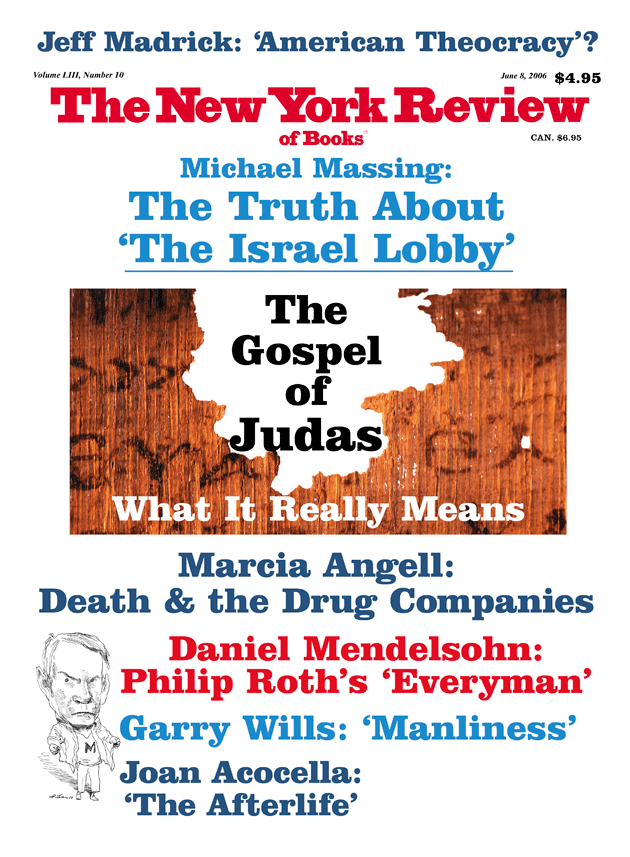
This Issue
June 8, 2006
-
1
See also the critical points made by Michelle Goldberg in “Is the ‘Israel Lobby’ Distorting America’s Mideast Policies?” Salon.com, April 18, 2006. ↩
-
2
Ori Nir, “Israelis Want AIPAC-Backed Bill Softened,” Forward, March 10, 2006. ↩
-
3
For more on the Conference of Presidents, see my article “Deal Breakers,” The American Prospect, March 11, 2002. ↩