
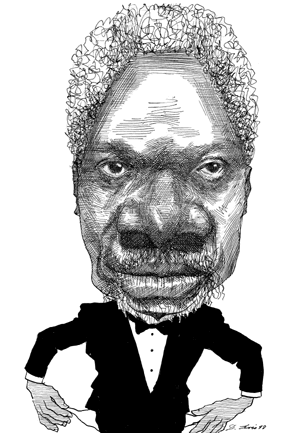
The United Nations is a curiously contentious topic. Mention it in the United States (especially in Washington) and you will likely be referred to “scandal,” “waste,” and “failure”; to the popular image of an expensive international excrescence, a breeding ground for inertia, sinecures, and time-servers, an impediment to the efficient pursuit and prosecution of American national interest. In these circles, the UN is at best a good idea gone badly “wrong.”
Elsewhere, however, you are just as likely to be reminded of the astonishing reach of the UN: through its various agencies in the fields of population, environment, agriculture, development, education, medicine, refugee care, and much else besides, the United Nations addresses humanitarian crises and challenges that most people in the West cannot begin to imagine. And then there is peacekeeping: between its blue-helmeted soldiers, its border observers, police trainers, election monitors, weapons inspectors, and the rest, the UN mounts an international peacemaking and peacekeeping force not much smaller than the entire US military complement in Iraq. Seen from this angle the world would be a decidedly nastier place if the United Nations didn’t exist.1
That the United Nations should be so controversial might have surprised its founders—especially the many Americans among them. Back in 1945 there was great enthusiasm for the project, whose justification and purposes appeared self-evident. The very scale of the catastrophe that the nation-states of the world had brought upon themselves suggested grounds for optimism: governments and peoples would surely know better than to let that happen again. The United Nations, its charter, and its agencies would be their chosen means of prevention. The inadequacies of the League of Nations would be addressed and powerful sovereign states would work through the United Nations rather than around or against it.
Six decades later, the UN certainly has problems. One of these was present from the start. In the aftermath of Nazism, whose surviving leaders were being tried at Nuremberg for, among other things, the crime of “planning, preparing, initiating and waging a war of aggression,” the UN’s founders emphasized the right of sovereign states to be secure from foreign interference—including, except in very unusual circumstances, interference from the UN itself. Article II, Part 7 reads, “Nothing contained in the present Charter shall authorize the United Nations to intervene in matters which are essentially within the domestic jurisdiction of any state.”
But the UN was also intended to be far more proactive than the League when it came to preventing rulers and governments from abusing citizens and others within their own borders. Over time it has established demanding expectations with respect to human rights and the treatment of minorities—whose abuse might legitimately trigger international intervention. This apparent contradiction between sovereignty and internationalism has been steadily exacerbated by the expansion in member states,2 many of whom abuse their subjects as a matter of course; but also by the rise in the number of failed states, where the nature of sovereignty itself becomes unclear.
In the 1990s in Haiti, Somalia, Bosnia, or Rwanda, and today in Iraq and Sudan, with whom should the UN in practice deal? The local criminal chieftain? The very regime responsible for the crisis in the first place? In the era of globalization, with the rise of multinational corporations and other economic agents that are not even states at all but far exceed many of them in wealth and influence, and when the worst abuses are often the work of nonstate actors, the core functions of the classic state have come quite unglued and it is unclear who should now undertake them, and how.3 What, in such times, is the role of the United Nations, an idea and an institution rooted, as its very name suggests, in the era of nation-states?
Compared with these urgent dilemmas, you might suppose that the problems that the UN (like any huge bureaucracy) faces and has always faced in operating efficiently and eliminating cronyism and graft would not dominate debate about the organization’s role in the world. But you would be wrong. Ever since Joe McCarthy condemned the United Nations as an agent of Communist influence there have been American commentators only too glad to smear the institution. The latest and nastiest in a long line of attacks comes from Eric Shawn, a self-styled “newsman.”4
Shawn, like many implacable critics of the UN, purports to wish the place well: “I join countless others in profound disillusionment that a noble ideal has morphed into a bastion of arrogance and, too often, inaction.” But this emollient humbug is soon displaced by a breathless “investigation” of the UN’s catalog of crimes. The UN is “rife with abject incompetence.” “UN ambassadors and staff enjoy luxurious and tax-free Manhattan lifestyles and other perks.” There is much prurient attention to reports of “peacekeepers…raping and having sex with twelve-year-old girls”—summarized on the dust jacket as “how UN workers have repeatedly turned children into their sexual prey”—and a tone of dripping contempt in every reference to Kofi Annan, the “ringleader of UN World.”
Advertisement
Behind this screed—whose tone and prejudices faithfully reproduce those of Fox News, Mr. Shawn’s employer—there is, however, a serious purpose. What Shawn and his fellows despise about the United Nations is the impediment it has presented to American goals, the invasion of Iraq above all. That any country or combination of countries should have had the temerity to dissent from America’s drive to war infuriates Mr. Shawn. That one Security Council member in particular—France—should have vetoed Washington’s efforts to railroad the international community renders him apoplectic: the refusal of France and others to send an additional 100,000 troops “to help Iraq achieve full stability” is a “continued double-cross of the Iraqi people,” the most “blatant example of the moral and political irrelevance of what the UN stands for.”
It isn’t just the French, of course. In Shawn’s account, the entire UN organization is geared to taking American money while supporting America’s enemies and hurting her interests. The senior staff are viscerally anti-American. Supporting evidence offered in the case of the Englishman Mark Malloch Brown, UN deputy secretary-general, nicely illustrates the author’s method. In 1983 Malloch Brown stood (unsuccessfully) as a parliamentary candidate for the Social Democratic Party (SDP). Twenty years later, in 2003, Britain’s Liberal Democratic Party—successor to the now-defunct SDP—voted against Tony Blair’s decision to send troops to Iraq. QED. And the place is full of Malloch Browns with comparably tainted pasts:
The UN should not be forgiven for its role in the war simply because democratic elections have finally been held in Iraq. Americans deserve answers from the occupants of that rectangular building overlooking New York City’s East River.
Shawn’s tract comes with a patina of respectability: it is published by a subsidiary of Penguin Books and has a blurb from Rudolph Giuliani.5 And the author is proud to cite his links to men like Charles Hill, a retired diplomat-in-residence at Yale and source of some of Shawn’s meaner-spirited one-liners. But The UN Exposed is in truth just an exercise in character assassination and chauvinist bile dressed up as journalism. Had Eric Shawn been serious about investigating the problems of the United Nations, he would have employed himself rather more usefully while visiting New Haven by speaking instead to Paul Kennedy.
The Parliament of Man, Professor Kennedy’s latest book, is a comprehensive and accessible introduction to the history, tasks, and dilemmas of the United Nations. It is an appealing and serious essay by a scholar who, for all his careful cataloging of the organization’s woes, never loses sight of the larger truth encapsulated in his closing sentences: “The UN,” he writes,
has brought great benefits to our generation and, with civic resolution and generosity by all of us who can contribute further to its work, will bring benefits to our children’s and grandchildren’s generations as well.
The first impression one gets from Kennedy, as too from James Traub’s excellent account of Kofi Annan’s last years in office, is that the UN is distinctly well served by its senior staff. In recent years the caliber of high-ranking civil service and diplomatic appointees in many Western countries has declined, as salaries and opportunities in the private sector seduce young men and women away from a career in public service. The United Nations, however, has continued to draw upon unusually talented and dedicated public servants. This was true in its early days, when it was run by statesmen like Dag Hammarskjöld and Ralph Bunche and attracted idealists like Brian Urquhart (the first British officer to enter Bergen-Belsen) and René Cassin (the French jurist who drafted the 1948 Universal Declaration of Human Rights).
It is still true today. The secretary-generals themselves are international political appointees of varying caliber (neither Kurt Waldheim nor Boutros Boutros-Ghali covered himself with glory6 ). But any government that could boast the services of Lakhdar Brahimi (head of the UN mission in Afghanistan from October 2001 to January 2005), Mohamed ElBaradei (director general of the International Atomic Energy Agency since 1997), Mary Robinson (UN high commissioner for human rights, 1997–2002), Louise Arbour (her successor and former chief prosecutor for the international criminal tribunals for the former Yugoslavia and for Rwanda), the late Sergio Vieira de Mello or Jean-Marie Guéhenno (head of UN Peacekeeping Operations since October 2000)—or indeed Kofi Annan himself, the most impressive secretary-general since Hammarskjöld—would consider itself quite extraordinarily fortunate.7
What has the UN achieved? In the first place, it has survived. The idea of an international conflict-resolving and problem-addressing agency is an old one, with its roots in eighteenth-century Kantian dreams of Perpetual Peace. Early and partial incarnations—the International Red Cross (founded in 1864), the Hague Peace Conferences of 1899 and 1907 and the Geneva Conventions to which they gave rise, the League of Nations itself—lacked legitimacy and above all enforcement power in a world of warring nation-states. The United Nations, by contrast, profited from the great power standoff of the cold war decades and the era of decolonization, both of which made it a natural agora and forum for debating international issues; and it was blessed, from the beginning until recently, with the backing of the United States.
Advertisement
The UN also benefited, if that is the word, from the steady accretion of international responsibilities that no one else wanted to take on, “foundlings dropped off at the UN’s door in the middle of the night,” in Kennedy’s words: from the Congo in 1960, through Somalia, Cambodia, Rwanda, and Bosnia in the Nineties to East Timor, Sierra Leone, Ethiopia-Eritrea, and the Congo (again) today. Many of these missions failed, and all cost lots of money. But they are a sobering reminder of why we need an international organization of some sort. And they represent just the most visible of UN undertakings.
For there are actually many UNs, of which the political and military branches (General Assembly, Security Council, Peacekeeping Operations) are only the best known. To name but a few: UNESCO (the Educational, Scientific, and Cultural Organization, founded in 1945); UNICEF (the International Children’s Emergency Fund, 1946); WHO (the World Health Organization, 1948), UNRWA (the Relief and Works Agency, 1949), UNHCR (the High Commissioner for Refugees, 1950), UNCTAD (the Conference on Trade and Development, 1963), and ICTY (the International Criminal Tribunal for the former Yugoslavia, 1993). Such transnational units don’t include intergovernmental programs administered under the UN’s aegis; nor do they cover the many field agencies established to address particular crises. These include UNGOMAP (the good offices mission to Afghanistan and Pakistan that successfully oversaw the Soviet withdrawal there), UNAMSIL (the Mission in Sierra Leone, 1999), UNMIK (the Mission in Kosovo, 1999) and many others before and since.
Much of the work done by these units is routine. And the “soft” tasks of the UN—addressing health and environmental problems, assisting women and children in crisis, educating farmers, training teachers, providing small loans, monitoring rights abuse—are sometimes performed just as well by national or nongovernmental agencies, though in most cases only at UN prompting or in the wake of a UN-sponsored initiative. But in a world where states are losing the initiative to such nonstate actors as the EU or multinational corporations, there are many things that would not happen at all if they were not undertaken by the United Nations or its representatives—the UNICEF-sponsored Convention on the Rights of the Child is a case in point.8 And while these organizations cost money, we should recall that UNICEF, for example, has a budget considerably smaller than that of many international businesses.
The United Nations works best when everyone acknowledges the legitimacy of its role. When monitoring or overseeing elections or truces, for example, the UN is often the only external interlocutor whose good intentions and rightful authority are acknowledged by all the contending parties. Where this is not the case—at Srebrenica in 1995, for example—disaster ensues, since the UN troops can neither use force to defend themselves nor intervene to protect others. The reputation of the UN for evenhandedness and good faith is thus its most important long-term asset. Without it the organization becomes just another tool of one or more powerful states and resented as such. The refusal in 2003 of the Security Council to authorize the disastrous US war on Iraq thus saved the UN from possibly terminal discredit in the eyes of much of the rest of the world.
The practical problems the UN faces in meeting expectations are easy to enumerate. Everything it does costs money; and the UN only has money if the member states provide it. The secretary-general and his staff are, it should be recalled, always and only executing the members’ wishes. The UN has no army or police force of its own. In the past the Netherlands, Scandinavia, and Canada (the “concerned North”), along with a handful of other states like Poland, Italy, Brazil, the Netherlands, and India, have furnished the UN with trained and equipped troops for its purposes. Today, a UN contingent is more likely to be provided by poorer countries from Africa or Asia, eager for UN cash but whose soldiers are inexperienced, undisciplined, and not always well regarded by those whose peace they have come to keep.9 And of course a fresh contingent has to be raised for each crisis.
Clearly, if the UN is to exercise its emerging “responsibility to protect”—which was not part of its original remit or design—it needs an army of its own (as Brian Urquhart, among others, has proposed).10 As things now stand, even when the Security Council does agree to authorize a military mission the secretary-general has to begin an interminable round of negotiations and cajoling for money, soldiers, policemen, nurses, arms, trucks, and supplies. Without such additional assistance the organization is helpless: in 1993, peacekeeping expenses alone exceeded the UN’s entire annual budget by over 200 percent. And therefore single-state interventions (the French in Côte d’Ivoire or Chad, the British in Sierra Leone), or a sub-UN coalition such as the NATO attack on Serbia in 1999, will continue to be faster and more effective solutions in a crisis than the UN.11
The Security Council, the UN’s executive committee, is itself one of the most intractable problems. Most of the members rotate, but the five permanent members have not changed since 1945. The special status of the US, China, and Russia (formerly the USSR) is resented but not really questioned. But many countries now express irritation at the continuing privileges of Great Britain and France. Why not Germany instead? Or just a single, rotating “European” slot? Shouldn’t there be at least one new member: Brazil, say, or India, or Nigeria, to reflect changes in the world since 1945? The French earned themselves a reprieve thanks to their internationally popular stand against the Iraq war, but these complaints will not go away.
Because agreement on Security Council reform is hard to reach—no one wants to give up their veto and adding more veto-wielding members would make things worse—certain problems are endemic. So long as China (and sometimes Russia) chooses to protect the “sovereign” rights of criminal regimes like Sudan with whom they do business, the UN will be unable to intervene to prevent genocide in Darfur. So long as the US exercises its veto over Security Council resolutions critical of Israel, the UN will be impotent in the Middle East. Even when the Security Council does vote unanimously—as it did last August in calling for a cease-fire in Lebanon—the refusal of just one powerful member (in this case the US) to oblige its client to acquiesce is sufficient to blunt the will of the entire international community.
Many critics would respond that this is because there is no international community. The machinery of both the Security Council and the General Assembly (the UN parliament) is, according to the generally sympathetic James Traub, “paralytic.” Representatives of the world’s states come to New York to pronounce and perform, but they hardly form a “community” with common interests and purposes; and even if they did, the UN would be unable to implement these. Hence the rising chorus of demands for “reform.” But what does this mean? The UN needs many things. It needs to acquire intelligence-gathering capacities of its own, certainly, the better to anticipate and analyze crises. It needs to become more efficient at making and implementing decisions; it could slim down its overlapping committees and programs, rationalize its regulations, legislation, conferences, and spending. And it needs to be far more aware than it has been hitherto of incompetence and corruption. As Kofi Annan himself has acknowledged, the UN management is “a problem…in need of reform.”
But reforming the practices of the UN would mean reforming the behavior of the member states. Everyone from the US to the tiniest sub-Saharan statelet has an agenda and a vested interest, and few will sacrifice their own advantage for the higher goals of the community at large. Thus the longstanding emphasis on “equitable geographical distribution” (rather than competence) when assigning committee memberships has its merits: it helps protect small, peripheral states from being railroaded by the rich powers and coalitions of powers. But it has also produced a Human Rights Commission with Sudan as a voting member and the infamous 1978 UNESCO declaration calling for restraints on press freedom. Kofi Annan himself warned recently that the new Human Rights Council (whose current members include Azerbaijan, Cuba, and Saudi Arabia) will rapidly discredit itself if it focuses overwhelmingly on Israeli rights violations while ignoring “grave violations committed by other states as well.” But the impediments remain.12
Sadly, the greatest impediment of all is the United Nations’ most powerful member state and major paymaster, the US. Much attention in the past year has been paid to the egregiously unsympathetic personality of the American ambassador to the UN, John Bolton. And Bolton is—or was (President Bush having reluctantly abandoned the attempt to extend his interim appointment)—a significant obstacle to the smooth functioning of the UN at many levels. As James Traub shows, genuine efforts at institutional and procedural reform over the course of the past two years were serially torpedoed by Bolton and his staff, who demanded “massive management reform” but blocked any compromises that might actually achieve it.
In effect, Bolton formed a de facto coalition with states like Zimbabwe, Belarus, and others who have their own reasons for keeping the UN ineffective and out of their domestic affairs. And because the US refused to concede an inch in recent negotiations on reform of the Human Rights Council, the establishment of Peace-building Commissions, or a new international disarmament regime, countries that might otherwise have been constrained to give ground (Iran and Pakistan in particular) felt no compunction in rejecting stricter rules on, for example, nonproliferation. The member states (mostly European) that sought ways to trade untrammeled national sovereignty for a more effective international legal regime or a workable set of rules for collective action found themselves in a permanent minority.
Bolton didn’t merely oppose effective reform at the UN but seized every opportunity to sneer at the institution itself, describing it variously as “incapable” and “irrelevant.”13 In so doing he placed his country in decidedly odd company. After the US vetoed a December 2006 Security Council motion to condemn Israel for the killing of nineteen Palestinian civilians at Beit Hanoun, the UN General Assembly (where there are no vetoes) passed a text merely expressing “regret” at the deaths. But the US opposed even this motion, joined by its usual allies—Israel, Palau, and the Marshall Islands—and, on this occasion, Australia. Earlier in the year, when proposals for a reformed Human Rights Council finally reached the floor of the General Assembly, 188 countries voted to implement them. Four votes were cast against: Israel, the Marshall Islands, the US—and Belarus.
Bolton’s personal style may have been distinctive, but his votes were cast on behalf of his bosses in Washington. For a while it was put about that Bolton’s extreme dislike of the UN did not in fact represent official American opinion; that Condoleezza Rice had “parked” Bolton on New York’s East River to keep him from wreaking havoc back in Washington. But even if true, this merely shows that the US secretary of state and her colleagues have still less respect for the UN than was previously supposed; assigning Bolton there was widely interpreted as a calculated expression of contempt.14
And indeed, Bolton was not the problem, merely the symptom. His “pre-emptive belligerence,” his description of the UN as a “twilight zone,” his habit of calling treaties “political obligations” rather than legal ones, for example, may seem nothing more than the rhetorical provocations of a hired thug; but in fact they reflect a seismic shift in America’s relations with the rest of the world. American presidents from Truman to Clinton generally appreciated that the US could get an awful lot from the United Nations—political support, international acquiescence, legal cover—for a modest outlay in cash and compromises. Now we oppose every little concession. This is new. Back in the cold war it was Mr. Khrushchev who banged his shoe on the table at the UN; it was Moscow that placed restrictions on every UN initiative and vehemently opposed any constraints upon its sovereign “rights.” Now Washington performs this role—a revealing indication not of strength but (as in the Soviet case) of weakness.15
A petulant US, expecting the UN to sweep up after it and generally perform international miracles but resolutely opposed to furnishing it with the means to do so and intent upon undermining its credibility at every turn, is an insuperable handicap and a leading source of the very shortcomings American commentators now deplore. The grubby scandals of the UN’s recent past—notably the “oil-for-food” scam—are inconsequential; certainly they caused less harm (and generated far fewer illicit gains) than any number of recent corporate scandals in the US, Australia, and elsewhere; not to mention the as-yet-uncalculated corruption and theft attendant upon the Iraq war and its aftermath. But the greater scandals—the UN’s inept handling of the Bosnian catastrophe, its incompetence in Rwanda, and its inaction over Darfur—are all directly attributable to the reticence (or worse) of the major powers, the US included.16
Is the UN doomed, then, to go the way of the unjustly maligned League of Nations? Probably not. But the fate of the League is a reminder of the continuing reluctance of the US to embrace the lessons of the past hundred years of history. After all, the twentieth century turned out well for the US and the habit of supposing that what worked in the past will continue to work in the future is deeply ingrained in American thinking. Conversely it is no accident that our European allies—for whom the twentieth century was a traumatic catastrophe—are predisposed to accept that cooperation, not combat, is the necessary condition of survival—even at the expense of some formal sovereign autonomy. British military casualties at the Battle of Passchendaele in 1917 alone exceed all US losses in World Wars I and II combined. The French army lost twice the total number of US Vietnam casualties in the course of just six weeks’ fighting in 1940. Italy, Poland, Germany, and Russia all lost more soldiers and civilians in World War I—and again in World War II—than the US has lost in all its foreign wars put together (in the Russian case by a factor of ten on both occasions). Such contrasts make quite a difference in how you see the world.
Thus today only an American diplomat would be caught saying, or even thinking, that, as Ms. Rice puts it, the “world is a messy place and someone has to clean it up.”17 The broader international consensus has it, rather, that precisely because the “world is a messy place”—and thanks to horrible experiences with self-assigned “cleaners”—the more safety nets and the fewer new brooms we deploy, the better our chances of survival. This was once also the view of an American diplomatic elite—the generation of George Kennan, Dean Acheson, and Charles Bohlen—far better informed about international realities and foreign perspectives than the men and women running US foreign policy today.
Kennan and his contemporaries understood something that their successors have missed. In a world where most states and peoples, most of the time, see a benefit to complying with international laws and conventions, those who scorn or break the rules may have a passing advantage—they can do things that others won’t. But they suffer long-term loss: they become pariahs or else—as in the US case—are intensely disliked and distrusted even if their presence is unavoidable. And thus their influence, whether inside the international institutions they affect to ignore or outside of them, can only diminish, leaving them with nothing but force with which to persuade their critics.
If the US is to be brought around—if, as Kofi Annan put it in a valedictory speech at the Truman Library in Independence, Missouri, the United States of America is to resume its lost leadership of the world community—then it will need to begin by recognizing, in Eisenhower’s words, that “with all the defects, with all the failures that we can chalk up against it, the UN still represents man’s best organized hope to substitute the conference table for the battlefield.” In Europe this realization only took root after Europeans had spent thirty years torturing and killing tens of millions of other Europeans; so long as they were merely torturing and killing colonial “natives,” attitudes changed little.
Here in the US, at the time of writing, the death of more than three thousand American soldiers in Iraq has registered with the public; but the killing of hundreds of thousands of Iraqis hardly at all. Indeed, the latest face-saving cliché in Washington is that the unfolding catastrophe in their country is the Iraqis’ own fault: we did our best but they let us down. And while the US continues (with full congressional approval) to “render” and torture suspects in the “war on terror,” we are unlikely to change our minds about the virtues of an International Court or the primacy of international law.
All in all, then, it seems unlikely that even the humiliating defeat of the Iraq war will change many Americans’ minds about the virtues of international cooperation. Something else, however, just may. For there is one common twenty-first-century international experience that American citizens and politicians cannot avoid sharing with the rest of the globe, however little they know of the outside world and however barnacled and prejudiced their views about it. Within the lifetime of many readers of this essay, the world is going to slip ever faster into an environmental catastrophe.
It is no coincidence that the two countries most responsible for this prospect—China and the United States of America—are also the two Security Council members least amenable to collective action in general; nor is it surprising that the man they have chosen to succeed Kofi Annan as UN secretary-general is Ban Ki-moon of South Korea, not someone hitherto known for pressing inconvenient agendas or speaking out of turn. His initial pronouncements, notably his equivocation over the propriety of Saddam Hussein’s execution, have not been reassuring. But in the coming decades we are going to face “natural” disasters, droughts, famines, floods, resource wars, population movements, economic crises, and regional pandemics on a wholly unfamiliar scale.
Individual states will have neither the means nor—thanks to globalization—the practical authority to limit the damage or make good the losses. Substate actors such as the Red Cross or Doctors Without Borders will at best be able to apply band-aids. “Acting with others”—the emerging post-Bush mantra—will be utterly insufficient: mere coalitions of the willing (or the subservient) will be powerless. We shall be forced to acknowledge the authority and guidance of those who know what has to be done. In short, we shall have to act through others: in collaboration, in cooperation, and with little reference to separate national interests or boundaries, which will in any case lose much of their meaning. Thanks to the United Nations and its various agencies, such as WHO, Paul Kennedy writes, we have already “established international early-warning, assessment, response, and coordination mechanisms for when states fray or collapse.” We shall have to learn to apply these to circumstances in which it is not states but whole societies that face collapse or failure, and where even Americans will not have the reassuring option of fighting “them” over “there” in order not to have to fight them “here.”
The United Nations, “unique and irreplaceable,” is all that we have achieved by way of a collective capacity to respond to such a crisis, when we finally awaken to it. If we didn’t already have such an organization we probably would not know how to invent it today. But we do have it and in years to come we shall consider ourselves fortunate to have inherited its founders’ decisions, if not their optimism. And so the good news is that in the long run the case for a UN will be made—indeed, it will make itself, if only when the UN headquarters (to the great relief of Eric Shawn and his friends) is constrained to leave Manhattan’s East River bank, as the waters around New York City inexorably rise. The bad news, of course, is that—as Keynes reminded us—in the long run we are all dead.
—January 17, 2007
This Issue
February 15, 2007

This Issue
February 15, 2007
-
1
See, generally, Michael W. Doyle and Nicholas Sambanis, Making War and Building Peace: United Nations Peace Operations (Princeton University Press, 2006). ↩
-
2
There were fifty founding members in 1945; there are now 191. ↩
-
3
For some implications of the modern state’s loss of control of its core functions, see Arjun Appadurai, Fear of Small Numbers: An Essay on the Geography of Anger (Duke University Press, 2006). ↩
-
4
Shawn’s self-promoting Web site can be found at www.ericshawnnewsman.com. ↩
-
5
Other blurbs are from Ann Coulter, Jesse Helms, and Christopher Hitchens (“The United Nations organization has become like one of the banana republics which dominate so many of its sessions and committees”). ↩
-
6
Kennedy, generous to a fault, is altogether too kind to Boutros-Ghali, who conspicuously failed to take seriously the crisis in Bosnia, and whose representative there—Yasushi Akashi—was utterly inadequate to his task. ↩
-
7
On Annan, and in addition to the book by James Traub reviewed here, see the new biography by Stanley Meisler, Kofi Annan: A Man of Peace in a World of War (Wiley, 2007). In an address to the UN Security Council on December 12, Annan pressed the case for an urgent settlement of the Israel–Palestine crisis. The dispassionate cogency of his reasoning quite puts to shame the clichés (or, worse, silence) of the rest of today’s world “leaders.” An excerpt from his address appears on page 48 of this issue. ↩
-
8
Only two UN member states have refused to ratify this convention: Somalia…and the United States. ↩
-
9
The failure of the African Union troops to make any difference in Darfur is a case in point—though here it was the local Sudanese government that insisted upon a non-Western contingent in the full knowledge (and desire) that it would prove ineffective in stopping the massacres. ↩
-
10
Between 1945 and 1988 the UN initiated just thirteen peacekeeping operations. Between 1988 and 1995 it initiated a further nineteen, mostly in the Balkans, Africa, and the Middle East, with many more to come. On the emergence and implications of this unanticipated UN function, see James Dobbins et al., The UN’s Role in Nation-Building: From the Congo to Iraq(Rand, 2005). ↩
-
11
The peacekeeping budget issue should be kept in proportion, however. In 2006 all of the UN’s worldwide peacekeeping operations together cost $5 billion. The American adventure in Iraq is estimated by the Congressional Budget Office to cost vastly more than this—$6 billion each month. ↩
-
12
See “Annan Calls for Anti-Terror Strategy Built on Human Rights,” Financial Times, December 9/10, 2006. ↩
-
13
Back in 2001, as US under-secretary of state for arms control and international security [sic], Bolton successfully derailed a UN Conference on the Illicit Trade in Small Arms and Light Weapons, and was even accompanied to the meeting by members of the National Rifle Association. ↩
-
14
It remains to be seen whether the nomination of Ambassador Zalmay Khalilzad to replace Bolton denotes a change of heart or merely of tone. ↩
-
15
In its early days the Security Council’s business was impeded mostly by Soviet vetoes. In recent years, however, it is the US that has been the chief villain. Since 1972 it has vetoed more than thirty Security Council resolutions critical of Israel, and dozens more on other issues from South Africa to international law. ↩
-
16
For a decidedly unsympathetic account of the UN Secretariat’s failure to stand up to its paymasters when it really mattered, see Adam LeBor, “Complicity with Evil”: The United Nations in the Age of Modern Genocide (Yale University Press, 2006). ↩
-
17
Condoleezza Rice, then national security adviser, in the fall of 2002. See Jeffrey Goldberg, “Breaking Ranks: What Turned Brent Scowcroft Against the Bush Administration?,” The New Yorker, November 2, 2005. ↩
