
In response to:
F. Kafka, Everyman from the July 17, 2008 issue
To the Editors:
Zadie Smith says in her fine essay on Franz Kafka [NYR, July 17] that although his work has seen some “revisionism” in recent years, this doesn’t pertain to the “quality of his work.” Except for Edmund Wilson’s well-known dissent, she notes, there are no serious doubts about Kafka as a writer. This is a less winning state of affairs than it may seem, because as a writer’s “quality” goes unquestioned, and theories about his or her work pile up around it, and those theories, more importantly, are woven together with our ever more intimate relationship with the author’s biography, we can find ourselves less simply reading Kafka (or Proust or whomever) than assuming we will be bathed in the larger-than-mere-writing event we have been programmed to experience.
As it happens, Anatole Broyard, in a review of Kafka’s stories that appeared in The New York Times in the early 1970s (and is available in his Aroused by Books), reported with some surprise how “heavy going” most of the stories were on his recent rereading. Broyard talked, for example, about the “too-muchness” of “The Burrow,” which “goes on too long: it is like a fugue without much melodic interest,” and about Kafka’s “arbitrary” and “bathetic” effects elsewhere. Broyard hardly intended a complete overhaul of the subject, but his sense that Kafka the writer could be as much under the thumb of his “obsessional or paranoid style” as in control of it can bring Kafka’s achievement more sharply into focus than the now quite numerous accounts of his life, temperament, and cultural moment.
Sanford Schwartz
New York City
This Issue
August 14, 2008
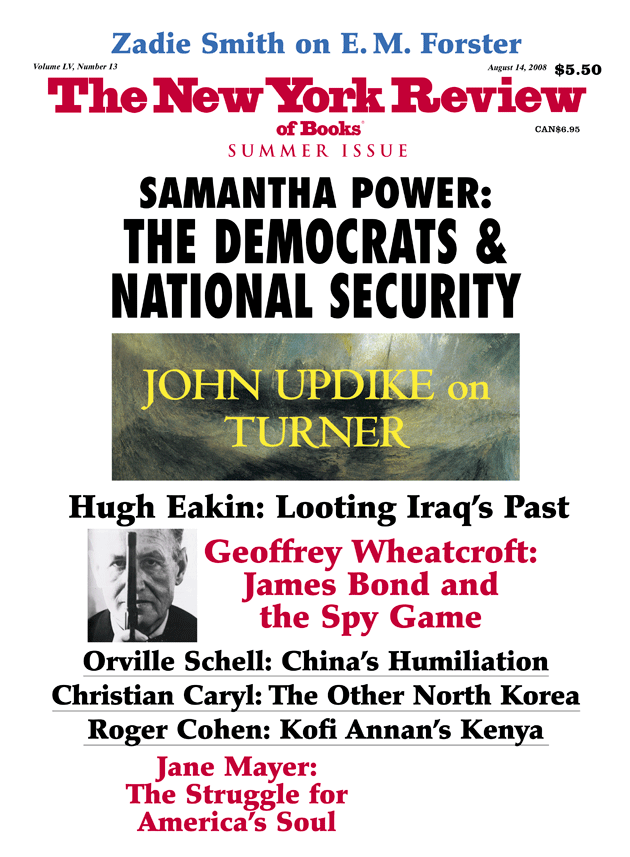
The Devastation of Iraq’s Past
Burdock
E.M. Forster, Middle Manager
This Issue
August 14, 2008
The Devastation of Iraq’s Past
Burdock
E.M. Forster, Middle Manager
