Prisoner of the State is the secretly recorded memoir of Zhao Ziyang, once holder of China’s two highest Party and state positions and the architect of the economic reforms that have brought the country to the edge of great-power status. The book has had much attention in the West. Inside China, despite official attempts to denigrate and block any news of it on the Internet, it is already having a powerful effect. This effect will increase as Chinese tourists from the mainland buy the Chinese edition of the book in Hong Kong.
Twenty years ago, just before the Tiananmen killings on June 3 and 4, 1989, Zhao was thrown out of office for sympathizing with the students; until his death in 2005 he spent almost sixteen years under house arrest. Born in 1919 and a member of the Communist Party since 1938, once he achieved great power he was a political loner, with only—a big only—Deng Xiaoping to back him. But when Deng decided to smash the Tiananmen demonstrations, he also smashed Zhao. When Zhao died in 2005, he was nearly forgotten; but the state was still put on high security alert.
When asked about Zhao’s memoir just after it was released, the official government spokesman, according to a press report, brushed the question aside, saying only that all matters involving 1989 have been dealt with. The semiofficial Hong Kong press later carried an attack on Zhao’s disclosures:
If overturning the verdict on the 1989 political turbulence is the interim objective of the “memoirs” editors and those foreign media promoting the book, then advocating the change of China’s current political system into Western parliamentary democracy is their ultimate goal.
But a subsequent report shows that the subject of Tiananmen keeps reappearing:
A group of Chinese intellectuals has disclosed it recently met…to urge an end to official silence about the bloodshed 20 years ago. Their speeches are now circulating on some Chinese-language internet sites and through email. “As time has passed, this massive secret has become a massive vacuum. Everyone avoids it, skirts around it,” [said] Cui Weiping, a Beijing-based academic…. “This secret is in fact a toxin poisoning the air around us and affecting our whole lives and spirit.”1
Up to now, even using the word “Tiananmen” on the Internet in China can bring a knock on the door. But foreign news of the book on the Internet has already slipped past the official censors, and may make tens of millions in China who have never or barely heard of Zhao realize what was lost when he died and what might have been.
What indeed? Zhao’s hopes for China’s political future were expressed during the internal exile in which he ended his days. Nothing can be more perilous in China today than saying this, which appears in the memoir:
In fact, it is the Western parliamentary democratic system that has demonstrated the most vitality. This system is currently the best one available. It is able to manifest the spirit of democracy and meet the demands of a modern society…. Why is there not even one developed nation practicing any other system?
If Zhao had uttered these words in public, he might have ended in prison, not under house arrest. In December 2008 over 8,500 Chinese, including some officials, signed “Charter 08,” which included these words:
Freedom to Form Groups. The right of citizens to form groups must be guaranteed. The current system for registering nongovernment groups, which requires a group to be “approved,” should be replaced by a system in which a group simply registers itself. The formation of political parties should be governed by the constitution and the laws, which means that we must abolish the special privilege of one party to monopolize power and must guarantee principles of free and fair competition among political parties.
Freedom to Assemble. The constitution provides that peaceful assembly, demonstration, protest, and freedom of expression are fundamental rights of a citizen. The ruling party and the government must not be permitted to subject these to illegal interference or unconstitutional obstruction.2
Some of the main signers were detained briefly for questioning, and one, the poet Liu Xiaobo, was arrested and then disappeared for months; he is still being held by the police. Among other signers, one professor was forced to resign his position as a researcher, and another was transferred from Beijing to a small college in China’s far west.
Zhao, in his taped remarks, just published in book form in Prisoner of the State, cautiously observed that true democracy would require many years of transition, but he could not resist noting the “positive experiences” of Taiwan and South Korea, which have successfully made the transition to democracy and prosperity. As Roderick MacFarquhar writes in his perceptive foreword:
If a patriotic official only came to the conclusion that democracy was needed for China after years of nothing to do but think, what chance is there for a busy official today to have the leisure or the security to think such thoughts while on the job?
And even Zhao remained extremely cautious, refraining from stating the views he taped. In 2000, after reading an account by Zong Fengming, a close friend of Zhao’s, who made over one hundred visits to his home, the Columbia scholar Andrew Nathan observed:
Advertisement
Zhao still believed in what we might call “glasnost authoritarianism”… a system of one-party rule with enough openness to allow citizens to criticize officials but not enough to allow a rival political force to overthrow the ruling party.
Is the book that is now revising this view and calling for parliamentary democracy genuine? Its editors claim that the tapes were secretly recorded, beginning about the year 2000, and smuggled by various means to Hong Kong. The tapes have been listened to by those who knew Zhao’s voice, including Bao Tong, his former secretary and the father of Bao Pu, one of the book’s editors. Bao Tong served seven years in prison after Zhao was purged. Bao Pu says that he helped smuggle the tapes out of China. “The Chinese Communist party is just like the Mafia,” says Bao Tong.
If the Mafia boss thinks you might betray him, he will just kill you or throw you into prison for as long as he likes. This is not how a political party or a government should behave.
Bao Tong says as well:
You have to say it clearly: It’s not a good system, it’s a bad system. It has to be stated that the people who were killed [on June 4] were good people and they shouldn’t have been killed…. We must announce that Tiananmen was a criminal action.
Bao Tong was sent into exile in his home province, forbidden to return until after the June 4 anniversary.
Apart from Zhao’s poignant late advocacy of democracy, much else will enrage his former comrades in the Politburo, particularly his revelations of how chaotic, unruly, uncomradely, and backstabbing the senior leaders were (and at least since the late 1950s always have been). Since dynastic times rulers have feared factions, and Deng is said here to have ordered his immediate underlings not to “squabble.” From Zhao’s account we learn how rumors spread and nasty little notes were passed about; people agreed with others to their faces and then undermined them immediately afterward. Slights against a colleague were never forgotten or forgiven, and could be deadly if that colleague secured the favor of the top man.
The top man in Zhao’s career from the late 1970s was always Deng Xiaoping, Zhao’s only reliable mentor and sponsor. When that sponsorship ended, it was curtains for Zhao, who, even after a lifetime of inner Party work, was outraged at how quickly he was cast out. This was the kind of infighting, whether one was in or out, of which Party members were forbidden to speak, much less quote from. In a recent review of Zhao’s book in The Washington Post, Perry Link notes that he
flouts the unspoken rule against public blame of others in the [ruling] group. He skewers Li Peng, Li Xiannian, Yao Yilin, Deng Liqun, Hu Qiaomu and Wang Zhen repeatedly and by name. He complains that the meeting at which martial law was decided was in violation of the Party Charter because he, the general secretary, should have chaired such a meeting but was not even notified of it.
The careers of some of these grandees reached far back into the Mao era and like members of a quarreling family they could not endure being pushed aside by one of its younger members. When Zhao died in 2005, as Perry Link wrote, they were alarmed:
China’s top leaders formed an “Emergency Response Leadership Small Group,” declared “a period of extreme sensitivity,” put the People’s Armed Police on special alert and ordered the Ministry of Railways to screen travelers headed for Beijing. If this is how the men who rule China reacted to Zhao’s death at home, how will they respond to…a book in which Zhao repeatedly attacks the stonewalling and subterfuge (and sycophancy, mendacity, buck-passing, and back-stabbing) of people whose allies and heirs remain in power today?
The first parts of this book will be of special importance to anyone interested in what happened during the spring of 1989, culminating in the Tiananmen killings of June 3 and 4. The demonstrations had begun immediately after the death on April 15 of the former Party General Secretary Hu Yaobang, whom the students liked for his straightforward, slightly country-bumpkin ways and his honesty, in contrast with the vast official corruption that became one of their principal concerns once the demonstrations got going. Deng had appointed Hu as general secretary, but got rid of him when he seemed opposed to Deng’s attacks on intellectuals and in favor of discussion rather than persecution. Cravenly, in true Party style, Zhao didn’t defend Hu when he was under attack, and chided him for being too reckless. Premier at the time, Zhao reluctantly succeeded Hu as general secretary in 1987.
Advertisement
Zhao’s account of how the protests began confirms much that we already knew or suspected. Hu Yaobang, he acknowledges, had always had “a very good public image.” Many people were enraged by his demotion, which they felt was a stab in the back to reform. Zhao recalls that in the spring of 1989, at a meeting of the Politburo Standing Committee, China’s tiny ruling group, he said that
we should not forbid the activities of the students who were merely holding their own commemorations while the Central Committee was holding memorial services.
Reporting on these events from Beijing, I saw the police cars cruising through the square even then, and observed the constant questioning of students about their identities. Zhao urged that the students should be encouraged to return to their campuses, and said that “bloodshed must be avoided, no matter what.” Everyone agreed to this, he emphasizes. But on April 19, as Zhao was preparing for a visit to North Korea, a fatal time to leave Beijing as it turned out, the hard-line Politburo Standing Committee member Li Peng asked him why he wasn’t taking “counteractions” to stop students from gathering just outside the leadership compound. Zhao replied, he says, that this was not his job, and adds that most of the students had already left the square.
But on April 23, after Zhao left for North Korea, at a meeting of the Politburo’s Standing Committee, Li Peng and his clique, Zhao says,
vigorously presented the student demonstrations as a grave situation. They disregarded the fact that the student demonstrations had already calmed down.
The minutes of the meeting, Zhao recalls, referred to the student demonstrations as “organized and carefully plotted political struggle.”
This must have panicked Deng for two reasons. He spoke of his fear of a resumption of the Cultural Revolution between 1966 and 1976, when he was detained and his son was permanently crippled. Deng probably also recalled that, in the 1920s, it was young students like himself who be- gan agitating against the Guomin- dang government that collapsed with the Maoist victory in 1949. In Deng’s words on April 25, the demonstrations had become “anti-Party, anti-socialist turmoil,” a situation to be stopped at once, “in the manner of ‘using a sharp knife to cut through knotted hemp.'” More fatally yet, on the next day, April 26, the demonstrators were accused of being “anti-Party” and “anti-socialist” in a People’s Daily editorial.
The number of demonstrators soared. On April 27 I joined thousands of angry students marching toward Tiananmen from their campuses, miles from the square, cheered on by enthusiastic crowds along the way. Not far from their goal they were blocked by ranks of the Armed Police, backed by armed soldiers in trucks. I feared that there would be bloodshed, but the police ranks suddenly parted and the cheering students poured through into the square. Zhao says that while in North Korea he telegraphed his complete approval of the Politburo’s actions:
I was not in any position to express disagreement because I was abroad and had no direct knowledge of the situation at home.
Since imperial times, and especially since Mao, Chinese officials have learned to go along. But when Zhao returned to Beijing and discussed matters with university officials, he realized that the harsh April 26 editorial in People’s Daily had made matters much worse and that the numbers of demonstrators had escalated. He says that some senior officials now feared bloodshed and were urging restraint.
As for the students, Zhao says, they now felt “that the symbol of the paramount leader had lost its effectiveness.” What Zhao appears not to have known is that, as they told me at the time, members of the research institute that had helped formulate his economic policies, and that had regular contact with Bao Tong, were writing some of the leaflets circulating in the square about what was happening inside the highest levels of government.
Before long, students were shouting “Li Peng resign” and “Down with Deng Xiaoping.” Such shouts had not been heard in Beijing since the public meetings of the Red Guards during the Cultural Revolution, and we now know, although the regime seemed paralyzed to those of us walking about in the streets, that Deng and his allies were preparing to take action against the demonstrations that were spreading to dozens of other cities.
Zhao seems unaware of this and notes that Deng’s children were worried about his bad health and hoped that Zhao would not alarm him further, especially with the impending visit to Beijing of Mikhail Gorbachev. In a speech, drafted for Zhao by Bao Tong, to the Asian Development Bank on May 4, and later held against him, Zhao observed that all the students were doing was “asking us to correct some of our flaws.” And in the following days, he says, most of the students returned to their classes, “waiting to see…how the promises in the May Fourth speech would be realized.”
Quite futilely, he suggested to his colleagues that
on the topics of most concern to people and raised by the students—such as corruption, government transparency, democracy, rule of law, and public scrutiny of government—we needed to take active measures.
His enemies on the Standing Committee, he says, particularly Li Peng, made “fierce attempts” to block his proposals. On May 13 a small group of students began a hunger strike that rapidly spread—highly dramatic in a country where not eating regularly is regarded with particular dismay—and Zhao worried that “some students might die. We would have a hard time answering to our people.”
During these tense days, his opponents, led by Li Peng, were spreading rumors that Zhao’s own family was corrupt; these were picked up by the foreign press, including myself, and reported as probably true. Zhao insists that they were totally false. He asked to see Deng Xiaoping on May 17 and on arriving at the senior leader’s house discovered that his enemies on the Standing Committee were already there. “I realized that things had already taken a bad turn,” he comments.
Zhao made what was an impossible but brave suggestion: that the severe judgments of the April 26 editorial must be “revised,” that the students should no longer be labeled anti-Party and anti-socialist. Li Peng blamed Zhao’s speech to the Asian Development Bank on May 4 for the size of the demonstration.
Deng now made a deadly decision that foreclosed the possibility of compromise and sealed Zhao’s fate. “Since there is no way to back down now without the situation spiraling out of control,” he said, “the decision is to move troops into Beijing to impose martial law.” To oversee this, Deng appointed Zhao’s three greatest enemies, including Li Peng, who also accused Bao Tong of leaking reports of Standing Committee meetings. This meant that Zhao himself was responsible. Zhao denied this. To his last days a stickler for correct procedures, Zhao says that there was no formal vote to impose martial law, as if this were shocking. On May 18 he made a final plea to Deng, which he knew to be fruitless, pressing for a reversal of the April 26 denunciation of the demonstrators and advising that “key leaders personally go out among the masses and admit this.”
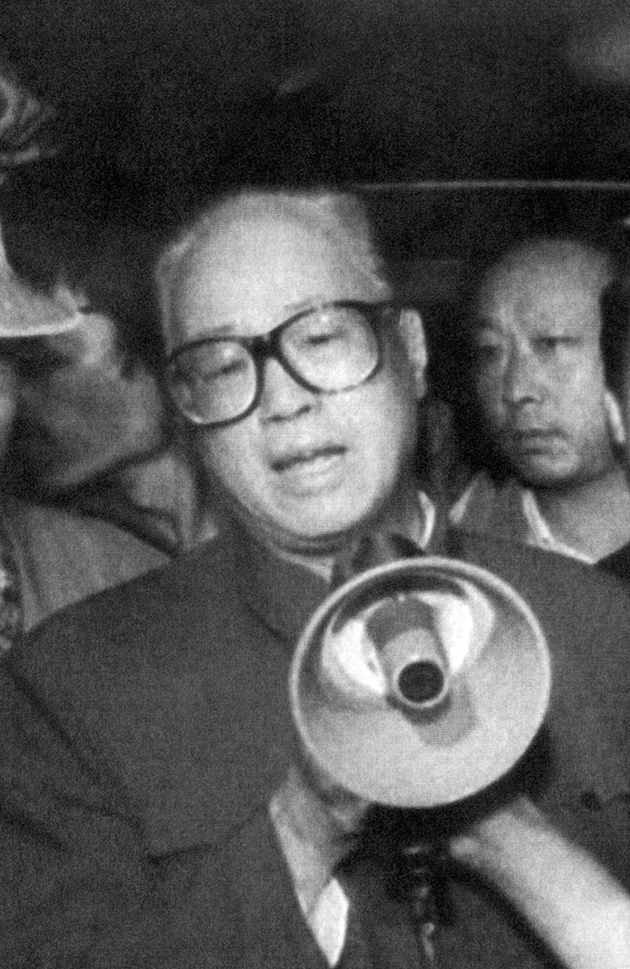
Now came perhaps the most dramatic moment in the Tiananmen crisis thus far, one that those who witnessed it, including myself, failed to understand. Early in the morning of May 19, Zhao took his own advice and in the darkness entered the square, followed closely by Li Peng, who fled, “terrified,” leaving behind the director of the Party’s Central Office, Wen Jiabao, now China’s premier. Looking drained and defeated, Zhao apologized:
Students, we came too late. Sorry, students. Whatever you say and criticize about us is deserved. My purpose here now is not to ask for your forgiveness. I want to say that now, your bodies are very weak. You have been on a hunger strike for six days, and it’s now the seventh day…. Now what is most important is to end this hunger strike. I know, you are doing this in the hope that the Party and the government will give a most satisfactory answer for what you are asking for. I feel, our channel for dialogue is open, and some problems need to be resolved through a process. You cannot continue to…insist on stopping only when you have a satisfactory answer.
As he admits, the students (and listening reporters) had no idea what he was implying. “Even less,” he says, “could they imagine the treatment in store for them.” At that eleventh hour Zhao still could not break Party discipline and warn that martial law would be imposed the next day.
He now fully grasped that great decisions were being made without his knowledge, and on the night of June 3, he says, “while sitting…with my family, I heard intense gunfire.” Zhao’s brief appearance in the square was held against him later because he had “revealed that there were differences among the Party’s highest level of leadership and that he might be stepping down.” Astonishingly, he never refers to the actual killings or gives a clear impression that he knew what had actually happened in Tiananmen apart from the terrible noise. He says that “of the activists involved in this incident,…most were arrested, sentenced, and repeatedly interrogated.” But he gives no idea of the vast nationwide purge that followed. In another example of his ignorance he states flatly that no one in the square had “aimed at overthrowing the People’s Republic and the Communist Party.” In fact, thousands had been shouting “Down with the Communist Party,” “Down with Deng Xiaoping,” and “Li Peng resign!”
On May 16, Zhao had a conversation with Mikhail Gorbachev, who reportedly was smuggled to a meeting with him through secret tunnels under the square because of the tumult in central Beijing. During that conversation Zhao told the Soviet leader that “we still needed Deng to be at the helm.” Although Deng was no longer on the Politburo, he was, as everyone knew, making the most important decisions. Zhao says he later learned that Deng was “extremely angered” when he learned of his remarks, because they pushed him to the forefront during the student turmoil. This, Zhao puzzlingly insists, was unbearable for Deng.
But that was only one of many charges against Zhao. Not only Deng but other influential retired “elders” who were formally outside the power structure, and in theory not eligible to make official decisions, were beside themselves with rage at the students. From TheTiananmen Papers, published in 2001, we learn that at a meeting just before the crackdown, Vice President Wang Zhen burst out:
Those goddamn bastards! Who do they think they are, trampling on sacred ground like Tiananmen so long?! They’re really asking for it. We should send the troops right now to grab those counter- revolutionaries, Comrade Xiaoping! What’s the People’s Liberation army for, anyway?
Deng replied,
We’ve got to do it or we’ll never forgive ourselves! We’ve got to do it or the common people will rebel! Anybody who tries to overthrow the Communist Party deserves death and no burial! The so-called democrats or opposition in China—people who in fact are the scum of the Chinese nation…. Imagine for a moment what could happen if China falls into turmoil. If it happens now, it’d be far worse than the Cultural Revolution.
This is what Zhao was up against, and for me, at least, the most curious aspect of his book is that he doesn’t seem to comprehend the power and the malice of the forces opposing him. Once he was dismissed as Party general secretary—an act of which he was not immediately informed—the post was soon given to Shanghai’s Party secretary, Jiang Zemin, who would eventually become president. Zhao was promptly sent home and for more than three years failed to grasp that he was not simply out of power but had been condemned to house arrest, which would last almost sixteen years.
From then on he wrote letters to the leaders, complaining that he had not been treated according to the rules and the law, words he never misses a chance to use. When Bao Tong was put in prison, for instance, Zhao complained that this violated “the Party Charter and the law.” How could the Standing Committee function, Zhao demanded, “when two of the five members…had been pushed aside?” The other member was Hu Qili, who had been sympathetic to Zhao’s views on reform.
At a meeting of the Central Committee, Zhao was accused of “splitting the Party” and “supporting turmoil”; then and in the years that followed he complained that the Party was
reversing black and white, exaggerating personal offences, taking quotes out of context, issuing slanders and lies—all in Cultural Revolution language.
What was absent from these complaints was any mention of the killings or their horrible aftermath. Zhao must have known what happened after he was purged from the many visits he had from members of his family and from his old comrade Zong Fengming, who tricked his way into Zhao’s house.
Zhao was a child of the very Party that was now persecuting him. He had joined at the age of nineteen and over the decades—including his incarceration and forced labor during the Cultural Revolution—he had witnessed and, I dare say, participated in acts that were outside the rules and against the law. Indeed, in the campaigns against intellectuals from 1983 to 1987, in which Deng, not for the first time, attacked his adversaries, Zhao had objected but not too much. He was also ill informed. He mildly chides China’s leading scientist, Fang Lizhi, who while “abroad, attacked Deng Xiaoping personally, by name.” In fact Fang was in Beijing, where he gave interviews to me and other reporters. (His essay calling for democracy, “China’s Despair and China’s Hope,” was published in the February 2, 1989, issue of The New York Review and then circulated in China.) Eventually, after taking refuge in the American embassy, Fang was allowed to leave for the US.
Among Zhao’s other constant complaints were the refusals to let him play tennis and golf and to spend the winters in the warm south, which was allowed but not in places he had requested. (At one point he was advised to play golf; he suspected that this was because Jiang Zemin would soon be in the US, where he could say that all was well with Zhao because he “had recently even gone out to play golf.”) Although he was permitted to travel south almost every winter to escape Beijing’s bleak climate, staying near Hong Kong was ruled out because Governor Chris Patten “was attempting to extend democratic elections in Hong Kong, so the situation was very delicate.”
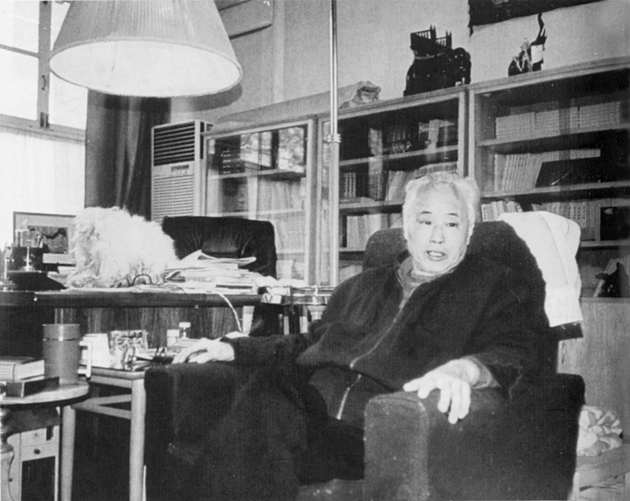
For an active, if elderly, man once at the top of the political scene, to be confined at home was painful, “cold” as Zhao put it. But he was, after all, at home, able to see old friends, and not in prison like Bao Tong and many thousands of ordinary people. A photograph in the book shows him in his cosy study. He was visited by family, who unlike the relatives of lesser prisoners had not been persecuted; indeed, his daughter remained in her senior position in a fashionable Beijing hotel. But he was gradually forgotten, in China and abroad. Nonetheless, as Perry Link has observed, Zhao’s death four years ago aroused intense anxiety within the leadership.
What will never be forgiven by the present leaders and, I fear, by their successors—in a country where Mao’s giant portrait still hangs over Tiananmen Square—is Zhao’s advocacy of true democracy for China—even if he thought it could be achieved only slowly. Maybe worse is his damning judgment of Deng:
[He] always stood out among the Party elders as the one who emphasized the means of dictatorship…. He found extremely annoying the use of street demonstrations, petitions and protests as a way for people to express their views.
It is also important to recall, as MacFarquhar underlines, that it was Zhao “rather than Deng who was the actual architect of [economic] reform…. Without Deng’s support it would never have been possible to proceed.”
What will be the effect of Zhao’s book when news of it gets loose in China? Bao Pu writes in his eloquent epilogue,
Without political reform, without checks and balances, the market is distorted, manipulated by corrupt officials and dirty dealing. The nation is still ruled by men, not law.
As the late Lucian Pye of MIT wisely observed:
In the annals of history there is only a small chapter devoted to those who advanced economic progress. The big chapters are reserved for those leaders who brought political freedom and security to their people.
—June 4, 2009
This Issue
July 2, 2009
This Issue
July 2, 2009
-
1
Chris Buckley and Benjamin Kang Lim, “China’s Ex-censor Claims Key Tiananmen Memoirs Role,” Reuters, May 21, 2009. ↩
-
2
The full text of “Charter 08” was published in these pages, January 15, 2009, translated by Perry Link. ↩