In the West we conceive of tragedy as involving catastrophic downfall. That is one reason why Al Gore has had such astonishing success in drawing our attention to global warming, a development that, if some of his scenarios come true, will provoke a cataclysmic series of events that our civilization may or may not survive. (Another reason is that Gore is a famous politician, and a tragic one at that, hence his crusade captures our attention in ways that a mere scientist’s could not hope to rival.) Equally serious environmental threats, such as resource depletion, deforestation, land erosion, species extinction, groundwater contamination, and loss of biodiversity, do not have nearly the same claim on the public imagination, no doubt because the prospect of the worst consequences of global warming induces terror, while the reality of environmental degradation induces demoralization.
Global warming is a worldwide natural phenomenon, yet it is largely a first-world cultural obsession. The anxiety about it that is felt in the West these days has something to do with the bad conscience of the first-world citizen, who consumes a much greater share of the planet’s resources, especially its fossil fuels, than his or her counterpart in the third world.* Acknowledging the reality of global warming amounts to a confession of responsibility, and all good tragedies revolve around the hero’s hamartia (or “tragic flaw,” as it used to be translated). In its consumerist frenzy, the first world today lives with an uneasy and often inarticulate environmental guilt (“guilt” is in fact a more adequate translation of hamartia). The daily massacres that provide the meat, fish, and poultry on which we gorge week in and week out, for the most part thanklessly, may take place in slaughterhouses far removed from the worlds we inhabit, yet few of us are oblivious enough not to recognize, at some subconscious level, that our relation to the natural world is one of outstanding debt. This aggravated debt is our guilt, and our best stories, from time immemorial, tell us that it must be punished by the gods or the laws of nature or the hounds of our own conscience.
What human civilization must do to survive materially is a question that is bound to engage us in the decades to come, yet alongside it there are other questions, easily brushed aside, that are no less paramount in import. Will a greener technology transform our relation to nature? Will a more sustainable economy merely provide a more sustainable basis for our consumerist sloth? Does nature make any spiritual demands on us, or is it purely the supplier in a supply–demand relationship? In short, if the setting is what the story was all about, what moral truths, if any, does it contain?
These are questions one pursues fruitfully in Donald Worster’s excellent new biography of John Muir (1838–1914), who lived at a time when the public’s awakening disquietude about the fate of America’s natural heritage brought about far-reaching institutional changes of which we are still the beneficiaries today. As one of our leading environmental historians, Worster is well aware how different Muir’s age was from our own. Yet it is his sensitivity to some of their remarkable similarities that makes his biography more than a comprehensive account of the life and thought of America’s best-known naturalist and conservationist. It fills his book with many relevant lessons for the citizen, government official, environmental militant, scientist, historian, and journalist of our own era.
Worster’s book builds on previous, partial biographies like Michael Cohen’s The Pathless Way: John Muir and American Wilderness (1984) and Steven Holmes’s The Young John Muir: An Environmental Biography (1999), but astoundingly, it is the first to assess Muir’s private and public life in full. It relies not only on the published literary evidence, but also on a variety of archival sources, including Muir’s entire correspondence and the jumbled mess of journals and memoiristic writing he left behind.
Given the itinerant character of Muir’s life, there is a predictably picaresque quality to Worster’s story, as it begins with Muir’s boyhood in Scotland in the 1840s and follows him to frontier Wisconsin, where his father Daniel bought a piece of farming land in 1849, uprooting the family when John was eleven not for economic reasons but in search of greater religious freedom. From there Muir went to Canada toward the end of the Civil War, before wandering through the Reconstruction South, then to the Yosemite Valley, where he did most of the amateur naturalist work for which he is famous, and finally making numerous expeditions to Alaska, Russia, and even Brazil and Africa in 1912. As Worster himself suggests, his biography runs the metaphorical course of a mountain trail, moving through the shifting natural, social, and economic landscapes of America from 1848 to the onset of World War I.
Advertisement
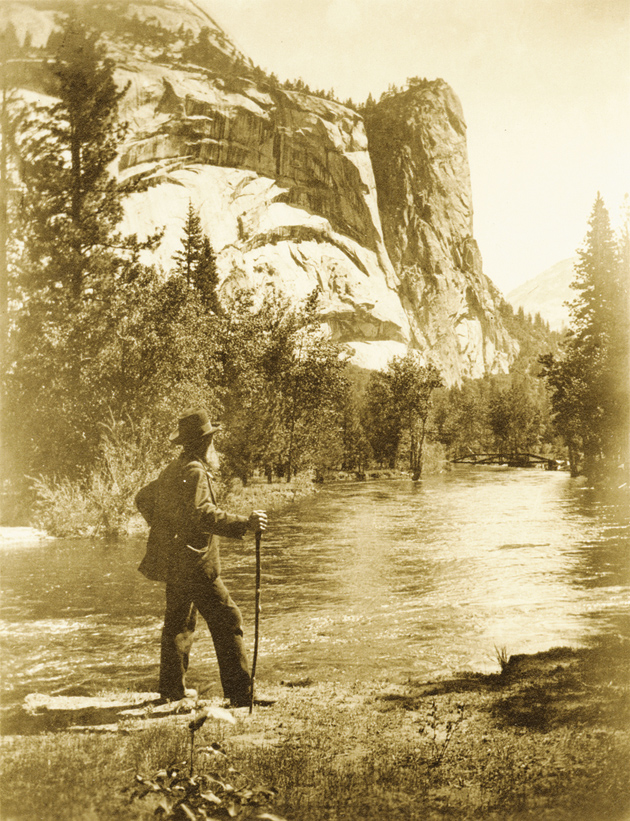
Along the way there are long stretches of sedentary living in Yosemite Valley and San Francisco in the 1870s, and on the profitable fruit farm that Muir ran with the family of his wife, Louie Strentzel, in Martinez, California, through the 1880s, and that he called home until his death. Certainly Muir’s single-minded, religious devotion to the protection of what Emerson called his “mountain tabernacle” at Yosemite Valley seems to align with a long tradition of American naturalism that is intensely focused on the cultivation of places, from Thoreau’s Walden Pond to the Sand County Almanac of Aldo Leopold. Yet in the end Muir lived the life of a peripatetic nature tourist, even during the prolonged residence on his farm or in Yosemite Valley.
Muir was often surrounded by loyal, humble friends but often also by the luminaries of his day, many of whom sought him out on their visits to California from the East Coast. He was indifferent to personal comfort as he ventured for days into the wilderness with a loaf of bread in his coat pocket. He was just as at home in the private car of an express train owned by his supercapitalist friend E.H. Harriman as he was rambling across glaciers in Yosemite or Alaska and camping in the wild with Teddy Roosevelt.
The unifying thread of Muir’s life story was indeed, as Worster puts it, the “passion for nature” he developed early in life. Muir came to believe that from the time of his boyhood in Scotland he had an “inherited wildness” in his veins that set him apart from adults. The nature poems of Wordsworth and Robert Burns moved him deeply, and he instinctively shared one of Romanticism’s “core convictions,” as Worster expresses it, that “nature—the wildness that lies beyond human technology and culture—is essential to the psychological and spiritual well-being of people.”
In this respect Muir shared something in common with his contemporary Frederick Law Olmsted, who had constructed Central Park in Manhattan, and who served as “First Commissioner” of Yosemite Valley soon after it became a California state park in 1864. Olmsted was less enamored than Muir with “wildness,” yet he and Muir both believed that nature and open spaces were crucial to the psychic health of people in an urbanized, overindustrialized society. One could say that in their original conceptions, Central Park is to New York City what Yosemite National Park is to California and the western United States generally—sanctuaries of natural beauty for the restoration of the soul.
As a youth Muir was especially drawn to botany. After venturing north to Canada to escape military service, he moved to Indianapolis in 1866 and worked as a factory manager, drawing graphs aimed at improving labor efficiency. Meanwhile his spiritual muse and mentor, Jeanne Carr, wife of his natural history professor at the University of Wisconsin, Ezra Carr, continued to stimulate his passion for nature by sending him Romantic literature and reminding him of nature’s wonders. Fascinated by Alexander von Humboldt, Muir entertained visions of distant botanical paradises. After he nearly lost sight in one eye in a factory accident, he determined to make his “walk with Nature,” setting off on a perilous southward journey from Indiana to Florida, described in his posthumously published A Thousand-Mile Walk to the Gulf.
Muir hoped to continue from Florida to the Orinoco River in Venezuela, which Humboldt had explored in 1800, yet his first foray into the tropics was thwarted when he contracted malaria in Florida, where he spent several weeks recovering, and he did not make it further than Cuba. Meanwhile his thousand-mile botanical walk from Indianapolis to Cedar Keys, which took him through the Reconstruction South just after the war, had yielded rich botanical and spiritual insights. His daily observations confirmed his enthusiastic notions of the diversity and beauty of plants, and of the miraculous interconnectedness of ecosystems, both local and global. Reflecting on God, man, and nature during his weeks of convalescence in Florida, he came to the conclusion that if God was anywhere, He was here on earth, in all of creation.
In short, Muir became a pantheist. Rejecting once and for all his father’s fundamentalist Presbyterianism, he found in its stead the “gospel of natural theology,” which held that all things, as Muir put it, “are our earth-born companions and fellow mortals.” Worster summarizes it somewhat differently: “Nature had come to supplant written revelation as a source of truth and as the only heaven he needed.” Believing that man was irreverently antagonistic toward deific nature, Muir confessed in his journal that “if a war of races should occur between the wild beasts and Lord Man, I would be tempted to sympathize with the bears.”
Advertisement
It is noteworthy that Muir became convinced that paradise exists here on earth just before he stumbled into one in California that same year. After a brief sojourn in Cuba, Muir quickly lit out by boat, first to New York City and then back south, via Panama, and arrived in California through the Golden Gate in 1868. He immediately beat a path toward the Sierra, which offered him the spectacle of an untrammeled Eden flowing “with more of milk and more of honey than ever did old Canaan in its happiest prime,” as he wrote ecstatically in his first letter to his brother from California. The summer he spent in Yosemite Valley in 1869 was one of undiminished rapture and exaltation. Here in Yosemite he found a “New Jerusalem” and overwhelming evidence for his pantheistic creed that a divine sacrality pervaded creation and that nature was indeed a full-fledged paradise when left to itself and viewed on its own terms. The Sierra high that Muir experienced in the summer of 1869 stayed with him the rest of his life.
There were plenty of snakes in the California grass, to be sure. Some took the form of sheep, which Muir, while employed as a shepherd, called “hoofed locusts” because of their destructive effects on native vegetation. He was no pastoralist. There were also the rapacious loggers, developers, and exploiters of the land—stock characters in the sorry story of America’s frontier expansion. Yet Muir found most of California pristine and glorious, a place where nature shone forth in its prelapsarian splendor—“where every prospect pleases and only man is vile,” to recall the early-nineteenth-century hymn “From Greenland’s Icy Mountains” by Reginald Heber.
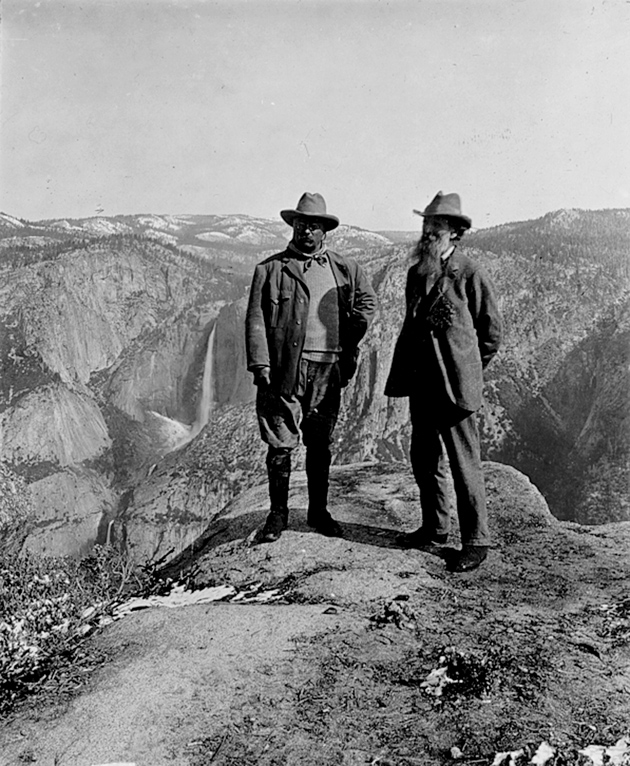
Muir became a fixture of the steady tourist traffic to Yosemite in the early 1870s, an eccentric guide and congenial raconteur who impressed Emerson and P.T. Barnum, just as he would Theodore Roosevelt many years later. Part of the fascination of Worster’s account is to see how Muir’s concerted conservation work emerged only in 1889 when he was already in his fifties, as part of the sudden wave of progressivism that swept America toward the end of the Gilded Age, and how this conservationism oddly sought corporate allies during its first flush of grassroots organization, accommodating itself to pragmatic, utilitarian, and commercial pressures of many kinds.
It was precisely Muir’s irrepressible “passion for nature” that turned him into one of the “prophetic voices” of the Gilded Age. Worster writes:
He was always a reluctant leader, diffident and inclined to head for the hills when he heard the call to arms. What he gave the [conservation] movement was, nonetheless, indispensable: the compelling image and words of a prophet standing before unsullied nature in a posture of unabashed love. That love of nature was both rhapsodical and worldly, a love that knew no bounds but knew how to compromise. He inspired Americans to believe that nature deserved higher consideration.
One wishes Worster had spent more time discussing how Muir’s writing made him such an inspirational figure for American conservationism. His biography deals far too briefly with the literary legacy of Muir, who broke onto the national scene as a journalistic nature writer while living on Valencia Street in San Francisco’s Mission District in the mid-1870s. His most important journalistic work (from an activist point of view) took place in the 1890s, by which time he was addressing an East Coast readership hungry for naturalistic writing. It was above all Muir’s power to communicate his passion for nature in journalistic prose that transformed him from a voluntary local tour guide into a figure of national importance.
There are a great many heroes in the American conservation movements of the late nineteenth century, which achieved such lasting legislative successes, and certainly one of the most important and underacknowledged is Robert Underwood Johnson, editor of the widely read New York–based publication The Century. Johnson was as committed to preserving the West’s spectacular natural heritage from the laissez-faire grab for resources by selfish, unregulated entrepreneurs as Muir was. He recognized in his friend a singular genius for inspiring a wide reading public through the medium of the written word. Johnson pressed Muir tirelessly for descriptive articles about the western landscape and opinion pieces about the need to designate places for protection from exploitation by big business. Thanks to his contributions to The Century, Muir quickly became a leading voice in the conservation movement and found himself thrust into a national leadership role.
Muir’s detailed proposals for a “Yosemite National Park” in The Century were quickly adopted by Congress and signed into law in 1890 by Benjamin Harrison in a swell of federal legislation aimed at safeguarding America’s natural beauty from private interests. In the same year, Worster writes:
Congress would establish not one but three national parks in California, setting in motion a broad, comprehensive policy of wild land conservation unprecedented in American or world history. Building on that precedent the country would create a whole new system of national parks— making Yellowstone no longer the national park but the first of many parks —and also a system of national forests.
Muir had written with passionate insistence about the vital need for forest protection. From that beginning would grow one of the most ambitious and influential government conservation efforts on the planet. “It would rank as one of American democracy’s finest hours.” Worster does not neglect to add that “Robert Underwood Johnson deserved much of the credit for setting the nation on a new course.”
America loves a happy ending. In many respects there could hardly be a happier ending to Muir’s efforts to awaken his nation to the beauty of its western treasures and the need to preserve them for the enjoyment and edification of future generations. Muir’s contagious ecstasy before the spectacle of nature’s grandeur, combined with his scientific knowledge of the delicate interdependence of the ecosystem, indeed, of the biosphere as a whole, had a broad and powerful influence on large segments of the public and many members of Congress at a critical time in American history. It comes as no surprise that, among his peers, he was the most natural choice for president of the newly formed Sierra Club. The citizens of America today are the fortunate heirs of several wise decisions made on our behalf back then—many of them inspired by John Muir and his natural allies. One of the lessons we all may learn from Muir’s career is that inspiration is a powerful agent of change, and that when the “fierce urgency of now” is upon us, it is essential to make room for, and to ride, the wave of enthusiasm while it lasts. The wave does not last long, but while it does an extraordinary number of good things may be achieved in practically no time at all.
Of course anyone familiar with the great novelistic tradition of America knows that, when all is said and done, the terminal emotion of the American hero as she or he exits the stage is, more often than not, disappointment, if not bitterness. This has to do no doubt with our tendency to set our expectations too high. Muir did not end his life embittered, to be sure, but the failure of his frantic lobbying efforts to block the massive dam project that would flood the Hetch Hetchy Valley, which he thought even more beautiful than Yosemite, dealt him a crushing emotional blow the year before he died. More to the point, in the last years of his life Muir was seriously disappointed that he was unable to bring about a “transvaluation” of American values. For all his inspirational genius, Muir could not persuade most of his fellow citizens to open themselves to the transformative spiritual and aesthetic power of nature. He complained, for example, that Californians had only a “moderate” love of nature, and that many people seemed not to see what lay before their very eyes.
One of Worster’s main arguments is that Muir’s passion for nature was in the best tradition of American democratic liberalism, and that it was related to the egalitarian ideals born in the revolutions of the eighteenth century. He cites a seldom-noted chapter in Tocqueville’s Democracy in America where the Frenchman argues, in Worster’s paraphrase, that “democracy was in love with nature, and nature was the natural and logical religion of democracy.” Perhaps the chapter is seldom noted because its thesis is untenable. Unfortunately not all passionate democrats are passionate lovers of nature, by any means. If pantheism is the spiritual correlate of democracy, as Tocqueville himself suggested, then we do not live in a real democracy, for, as Muir came to discover, there are few pantheists among us. Muir indeed saw nature as the deific site of God’s presence, a place where “divine love spreads through all of nature equally and indiscriminately.” This meant that materialism, especially in its crass capitalist forms, was sacrilegious. There was plenty of sacrilege to go around in Muir’s democratic America, and things were getting worse, not better.
Part of Muir’s disappointment toward the end of his life was also political. Muir felt betrayed when his friend Theodore Roosevelt, in 1908, redefined the conservation project—understood by Muir as the preservation of natural spaces for their spiritual and aesthetic benefits—as a matter of resource management. “We have become great in a material sense,” said Roosevelt to a gathering of governors,
because of the lavish use of our resources, and we have just reason to be proud of our growth. But the time has come to inquire seriously what will happen when our forests are gone, when the coal, the iron, the oil, and the gas are exhausted, when the soils shall have been still further impoverished and washed into the streams, polluting the rivers, denuding the fields, and obstructing navigation.
We today may rue the enlightened view of resource management espoused by Roosevelt in such a speech, yet his paean to national greatness based on a wise use of natural resources is far from what Muir had in mind when he imagined the nation awakening to the presence of paradise on earth. He did not live in a false Eden of consumerism that induces pathologies and species-loneliness but the manifest paradise of the visible world to be inhabited rapturously, full of wonder and reverence, alongside our other earth-born companions and fellow mortals.
Despite his success in inspiring Americans, what Muir came to dis-cover is that it is very difficult to get some people to see what lies before them, or at least to get them to see it the way you do. The greater part of the visible world withdraws from the picture. Once while traveling with a party of scientists in 1877, he overlooked an alpine vista and began dancing and shouting, “Look at the glory! Look at the glory!” His companions remained coldly reserved and apart. There is no more quintessential image of Muir than that.
John Muir died in 1914, a few months after the outbreak of World War I. Fortunately his work was mostly done before the reckless twentieth century got underway in earnest. The century was not particularly eager to “look at the glory.” Yet for all its calamities, it was not able to undo what Muir and other conservationists set into motion before those calamities unfolded. Let’s hope the same will hold true for the twenty-first century. Meanwhile the debt we owe to visionaries like Muir, Olmsted, Johnson, and many unsung activists who raised their voices and took action over a century ago is immeasurable. Thanks to them, there is still enough paradise left around us that its downfall would be the tragedy to end all tragedies.
This Issue
March 12, 2009

This Issue
March 12, 2009
-
*
Paul Kennedy, in his book Preparing for the Twenty-first Century (Random House, 1993), states that “according to one calculation, the average American baby represents twice the environmental damage of a Swedish child, three times that of an Italian, thirteen times that of a Brazilian, thirty-five times that of an Indian, and 280(!) times that of a Chadian or Haitian because its level of consumption throughout its life will be so much greater.” Indeed, the global ecological crisis boils down in essence to overconsumption. Walt Reid, coordinator of the Millennium Ecosystem Assessment, said in 2005: “The bottom line of this assessment is that we are spending earth’s natural capital [at such a rate], putting such strain on the natural functions of earth that the ability of the planet’s ecosystems to sustain future generations can no longer be taken for granted.” On just how much worse the situation has become since that assessment was made, see for example Paul and Anne Ehrlich’s recent study One with Nineveh: Politics, Consumption, and the Human Future (Island Press, 2004). ↩