
I’ve peered at the congregation of the nightly stars—bright powerful creatures blazing in air,
the ones that bring summer, the ones that bring winter,
the ones that die out, the ones that rise up….
Many scholars, from Ulrich von Wilamowitz-Moellendorff to Eduard Fraenkel, have considered that last line spurious, on linguistic and metrical grounds. It also betrays the sense. The watchman sees the stars as a “night council” (nykterōn homēgyrin), a meeting of “rulers” (dynastas)—the language is political. What Carson translates as “die out” is phthinōsin, “wither.” It makes no sense to say rulers wither (or to call them “creatures”) when you are stressing their power. The watchman crouches under the heavenly rulers as under his earthly mistress. Browning gets it right:
I know of nightly star-groups the assemblage,
And those that bring to men winter and summer,
Bright dynasts, as they pride them in the aether.
Carson rightly says that Aiskhylos favors great compound words—which is what Aristophanes caricatured him for doing. Some of these she manages well—though she overdoes it when she takes one adjective, “purple-strewn,” and gives us
Make his path crimsoncovered! purplepaved! redsaturated!
Other times she blunts the force of a compound. When the night watchman describes his mistress Klytaimestra, he refers to her “manplanning” and “hopeful” heart. Since the guard is waiting for news from Agamemnon, that might seem what she is hoping for. But in conjunction with “manplanning” we realize that she is hoping to do something sinister when her husband comes. Carson omits the “hoping” and weakens the “manplanning”:
Those are the orders I got from a certain manminded woman.
Again we need Browning:
The man’s-way-planning hoping heart of woman.
In the play’s first great choral ode, there are famous religious passages. One of them Carson renders thus:
Zeus! whoever Zeus is—
if he likes this name I’ll use it—
measuring everything that exists
I can
compare with Zeus nothing
except Zeus.
May he take this weight from my
heart.
The god who was great before
Zeus
is not worth mentioning now.
The one who came after that is
past and gone.
Zeus is the victor! Proclaim it:
bull’s eye!
Carson omits the lines describing the god who came before (Ouranos) as “bursting with the audacity of an all-conqueror,” and the god who came after (Kronos) as “having met his three-throws wrestler-down.” These are not mere filler phrases, since one point of the play is the overthrow of pride—indeed the first description may foreshadow the fate of Agamemnon and the second that of Klytaimestra. But the main problem here is one of tone.
At the New York performance of this play in March, the informal shrug of “if he likes this name, I’ll use it” was greeted with laughter. So was the last reference to “bull’s eye.” (The text says that one professing Zeus will hit his own mind’s mark). The chorus should not be full of wiseacres. Its groping for religious meaning is best conveyed, again, by Browning: note the play of “veritably” (etētymōs) against “vague” (matan) care. The chorus is trying to find something solid in the mystery of what the gods are doing:
Zeus, whosoe’er he be,—if that express
Aught dear to him on whom I call—
So do I him address.
I cannot liken out, by all
Admeasurement of powers,
Any but Zeus for refuge at such hours,
If veritably needs I must
From off my soul its vague care-burthen thrust.Not—whosoe’er was the great of yore,
Bursting to bloom with bravery all round—
Is in our mouths: he was, but is no more.
And who it was that after came to be
Met the thrice-throwing wrestler,—he
Is also gone to ground.
But “Zeus”—if any, heart and soul, that name—
Shouting the triumph-praise—proclaim,
Complete in judgment shall that man be found.
I will not pursue the comparison with Browning further, but one can learn much from it—Carson sometimes showing what the problem with a passage is, and Browning sometimes showing how to solve it.
Advertisement
Slippages of tone recur all through the Carson translation, and most lapses were underlined by the laughter of the New York audience. The chorus risks criticism of its king, but it should not do so as smartalecks. Carson has them say:
Now I have to admit when you sent an army after Helen
I wrote you off as a loose cannon.
It is hard to keep a tragedy going, especially an Aiskhylean tragedy, when the characters are zinging people with one-liners. The jauntiness of the “loose cannon” line is not in the cautious and hedged words of the original, which say, “When you led off the army for Helen’s sake, I will not hide this, you were pictured in very unsightly ways, not managing the helm of judgment.”
When Klytaimestra begs Agamemnon to tread the purpled cloth into the palace, he resists at first, but then says, peevishly, “Oh all right.” (More laughter.) Shortly after, Agamemnon says, “Enough of those things,” which Carson drew more laughs with by her version, “Well, so it goes.” When the chorus begs Kassandra to be clearer in her prophetic frenzy, she answers, “Okay.” The eagle-bark of Aeschylus is, over and over, reduced to the eagle whine of Aeschylus.
Carson was commissioned to translate Agamemnon by Brian Kulick, the artistic director of the Classic Stage Company in New York, who wanted to do an Oresteia (Orestes saga), as opposed to theOresteia of Aiskhylos, the only complete tragic trilogy to survive. The original Oresteia told the story of Agamemnon’s murder by Klytaimestra as revenged by their son, Orestes. The story was told and retold by other poets and dramatists. Kulick conceived the idea of letting Sophokles and Euripides continue the story after playing the first part from Aiskhylos.
Sophokles and Euripides both composed an Elektra, about the sister of Orestes. But Euripides came back to the story again with his later Orestes. Carson had already translated Sophokles’ Elektra and Euripides’ Orestes, so all she had to do was add Agamemnon and Kulick had his Oresteia. The director wanted to show a span of dramatic performance, moving from the early Athenian empire through a prime period to the empire’s decline—he calls this dawn, midday, and twilight in fifth-century-BCE Athens, going from Aiskhylos’ eagle-bark through Sophokles’ refinement to Euripides’ decadence.
One trouble with this scheme is that the date of Sophokles’ Elektra is uncertain. It is usually thought to come shortly before or shortly after Euripides’ Elektra (413 BCE), which would make the Athenian empire’s “mid-day” far off from dawn (Agamemnon in 458) and very close to twilight (Orestes in 408). Sophokles and Euripides were contemporaries who died in the same year (406) at the peak of their powers—each left a play that won a posthumous first prize, Oidipous at Kolōnos by Sophokles and Bakkhai by Euripides. They hardly represent two different periods in Athens.
Still, the performance of three plays on the same myth by the three greatest Greek tragedians seemed like an experiment worth trying. The Classic Stage Company offered the three plays in two formats—played two on one weeknight and one on another, and all three together in “marathon performances” on Saturday and Sunday. I saw the first marathon, which was supposed to take four hours. With breaks between the plays it took five hours.
The first play, directed by the man who conceived the whole exercise, Brian Kulick, and Gisela Cardenas, was the most successful. It got off to a fine start. What to do with the chorus of ancient Greek plays is always a problem in modern performance, where singing and dancing ensembles are rarely understandable. Kulick and Cardenas divided the choral passages between three old male household workers and three young laundresses. Carson’s lines proved eminently performable in the famous long opening odes. Aiskhylos loaded the songs with ancient history, ominous foreshadowings, and high religious pondering.
In the first ode, the laundresses mimed the sacrifice of Iphigeneia at Aulis, the crime Klytaimestra would claim she was avenging. In the second, they mimed the abduction of Helen. In the first case, a little girl’s white dress served as Iphigeneia, in the second a woman’s white dress stood in for Helen.
Advertisement
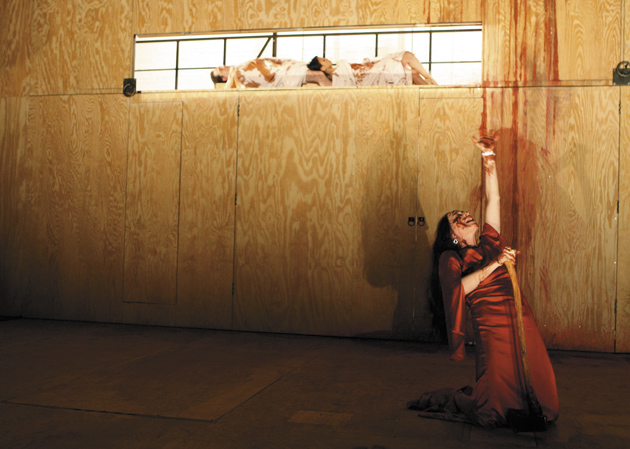
The two odes were separated by Klytaimestra’s long speech describing the torch relay that brought news of Troy’s fall to Mycenae. On the stage’s upper level, pierced by two windows, she strung a red ribbon from hook to hook as she named the relay stations—a nice anticipation of the red carpet she would use to entangle Agamemnon at his murder.
The role that must carry the play is that of Klytaimestra, and unfortunately Stephanie Roth Haberle went a thousand miles over the top. Sneering, screaming, pacing, she looked like she was doing a Gloria Swanson imitation. Steve Mellor as Agamemnon arrived wearing a Douglas MacArthur uniform and sunglasses, and acted as a New York liberal’s idea of a dumb general. Aigisthos was a maniacal man who threatened the chorus with a pistol and lasciviously humped the sack supposed to be holding the corpse of Agamemnon. This was horrible in the unintended sense.
Carson says she gave special attention to the language of the riddling prophetess Kassandra. But little of it could be heard as Doan Ly, in the part, screamed high and low, shrill and guttural, over and over. The chorus cruelly treated her as a madwoman, to be given anachronistic shock treatment from water hoses. After she had been hosed down, a pail of water was brought to force her head into, and her hair was chopped at. There was less sympathy for the character than for the shivering and battered actress.
The evening got worse. The chorus for Elektra was made up of three aristocrats at the palace (two women, one man), first seen in bathing suits for sunbathing, then in formal dress for ballroom dancing. There is no reason for these Noël Coward hedonists to show any great concern for Elektra, which is the main task Sophokles gave them. Annika Boras, who had been in the chorus for Agamemnon, played Elektra as a kind of surly rebel in combat boots. The directors of this segment, Kulick and Cardenas, may have had the character from Euripides’ Elektra in mind—in that play she rusticates as a farmer’s wife.
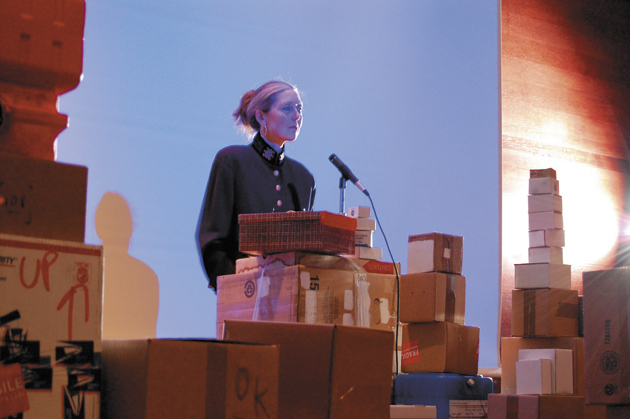
Of course, the high boots (kothornoi) and masks of the ancient actors made it impossible for them to roll around on the floor this way. But the main point is that Elektra should show a kind of awe at the numinous urn. She and Orestes should circle it as if it were radioactive. The use of such signs in recognition scenes was a way of showing how difficult it is to resume familiarities long suspended. The use of the bed as a recognition device in the Odyssey is the parent of all these recognition scenes. They strike modern people as slow and artificial, but that is the point—one does not just stroll in and resume life as if nothing had happened. After Orestes kills Klytaimestra, her body is thrown down in a sack just as Agamemnon’s was. Aigisthos enters as he had before—but this time he thinks the sack contains the body of Orestes. Luckily, he does not try to hump it this time. He just spits on it.
The last play, Orestes, poses many problems for the reader, or translator, or director—in this case, director Paul Lazar. Often things go crazily wrong in Euripides. This time things go crazily right. After attempted stonings, suicides, and murders, people are paired up in marriages as at the end of a Shakespeare comedy, Pylades given to Elektra, Hermione to Orestes, a replacement for Helen to Menelaos. One thinks of Melina Mercouri at the end of Never on Sunday urging everybody to just go to the beach.
It is hard to see how this happy play fits into Kulick’s scheme of the twilight of empire. Some try to make the play express a kind of black-comedy nihilism. Carson seems to lean toward this interpretation in her introduction, calling the drama “a wild, heartless, unconstruable statement.” But her translation opens the way to slapstick treatment, which is what it got in New York. How else do you play the god Apollo telling Orestes:
Hermione, you’ll marry.
I know she’s supposed to marry somebody else (Neoptolemos I think)
but I’ll see to it he dies.
The costumes for this play are nineteenth-century Greek garbs (skirts for men and women); the chorus is a Greek folksong duo (one transvestite man, one woman). There is much comic dancing. Even Steve Mellor, again doing his dumb general act, this time as Menelaos, enters with a dance. He has come to see Orestes, crazed by the Furies for killing his mother, so he takes up a chair at the head of the hero’s couch and turns into a psychiatrist. Elektra, played again by Annika Boras, here has a kind of sappy Giulietta Masina hairdo and look. She is paired with a boyish Pylades almost half her height, so she gets to do comic takes when told that she will have the little twerp for a husband.
One of the special problems in this problem play is the Phrygian slave who delivers the messenger speech on how Helen of Troy was rapt up to heaven when Orestes was about to kill her. The aria is mainly in the excited and excitable dochmiac meter. The performer, a eunuch from Helen’s court, is the only anonymous slave who sings an aria in Greek drama. Since Orestes is the first actor (protagonist) in this play, and Elektra is the only other character who sings an aria, it is clear that the second actor (deuteragonist) performed the roles of both Elektra and the Phrygian. The ancient literary critic Dionysius of Halikarnassos said that Elektra’s song was delivered in a high register—which would have been appropriate to the eunuch’s voice.1 Since the evanescence of Helen is the most outlandish plot turn, having an exotic foreigner deliver the account of it is fitting. “Barbarians” often reported the supernatural or surreal.2 The slave is telling an eerie tale in an eerie way.
The temptation is to make the figure just ridiculous, as William Arrowsmith did when he translated the song into pidgin English: “[Helen] fly through roof/as though some magic mebbe mebbe.”3 Carson translates in a “swishy” way, “my own dear little slippers…my own dear little soul…my dear little song,” with stilted rhymes:
they come toward Helen from different angles.
Meanwhile her bodyguards are busy rearranging their bangles….
When the slave uses the mourning cry ailinon, which is of non-Greek origin, he thinks the chorus may not understand it. He says, “Foreigners say ailinon ailinon at the approach of death, aiai in the Asian tongue.” The cry is meant to be strange. Carson makes it slangily familiar:
Where I come from people say bad shit happening
when they mean death.
Another quaint barbarian idiom is real bad shit happening….
The slave’s speech was delivered as a nightclub routine by the dancer who played him, David Neumann. In the original, the slave’s excited speech confuses the chorus, which interrupts his dochmiacs with single lines of the regular-dialogue meter, trying to get at the mystery he has seen. In the Paul Lazar version, the folk-duo chorus joined the slave’s act, singing and dancing with him while he camped it up. At one point, having referred to Helen, he interpolated, “I saw her in a circle-jerk at the Europa”—which cracked up the New York audience but made a mess of Euripides. The whole play was simply played for yuks.
Carson cannot be blamed for all the directorial liberties taken, though she seems to be asking for such treatment with things like “bad shit happening.” That is too bad, since elsewhere she has proved a wonderful translator of Euripides—especially in the escapist odes of Hippolytos.4 In fact, the comparison with Browning, by which she suffered where Aiskhylos was concerned, leads to a reverse judgment when her Herakles and Alkestis are compared with his. Browning made a good match with the knotty language of Aiskhylos, but he is congested and self-entangling when it comes to the simpler verses of Euripides. Here is Herakles in Browning:
To the gods, the gods, are crimes a care,
And they watch our virtue, well aware
That gold and that prosperity drive man
Out of his mind—those charioteers who hale
Might-without-right behind them: face who can
Fortune’s reverse which time prepares, nor quail?
—He who evades law and in lawlessness
Delights him,—he has broken down his trust—
The chariot, riches haled—now blackening in the dust!5
That seems like the shunting of railroad cars around in the station, going nowhere. Contrast it with the light, swift moves of Carson, leading to the final pounce:
Gods, gods are giving heed
to what is unjust, to what is holy.
Gold and the good life
drag men out of their right
minds—
the lure of power!
None dares to think how time
may flip him over—
racing past the law
he smashes
the black car of his luck.6
This Issue
May 14, 2009

This Issue
May 14, 2009
-
1
Dionysius of Halikarnassus, “On Literary Composition,” Critical Essays, Vol. 2, translated by Stephen Usher (Harvard University Press, 1985). ↩
-
2
For the eunuch of Orestes in this capacity, see Edith Hall, Inventing the Barbarian: Greek Self-Definition Through Tragedy (Oxford University Press, 1989), pp. 119, 157–158. ↩
-
3
Orestes, in The Complete Greek Tragedies, edited by David Grene and Richmond Lattimore (University of Chicago Press, 1958), Vol. 4, p. 194. ↩
-
4
For a review of Carson’s Grief Lessons: Four Plays of Euripides (New York Review Books, 2006), see G. W. Bowersock, “The Art of Risk,” The New York Review, June 14, 2007. ↩
-
5
Robert Browning, “Aristophanes’ Apology,” in Robert Browning: The Poems, edited by John Pettigrew (Yale University Press, 1981), Vol. 2, p. 296. Browning’s translation of Alkestis is part of “Balaustion’s Adventure,” The Poems, Vol. 1, pp. 867 ff. ↩
-
6
Carson, Grief Lessons, p. 51. ↩