
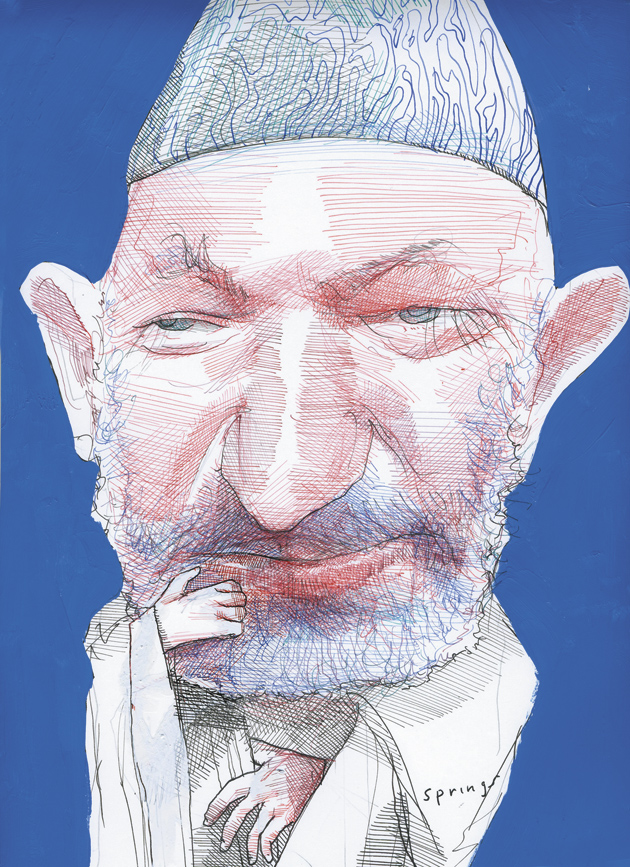
On August 5, Baitullah Mehsud, the all-powerful and utterly ruthless commander of the Pakistani Taliban, was killed in a US missile strike in South Waziristan. At the time of the strike, he was undergoing intravenous treatment for a kidney ailment, and was lying on the roof of his father-in-law’s house with his young second wife. At about one o’clock that morning, a missile fired by an unmanned CIA drone tore through the house, splitting his body in two and killing his wife, her parents, and seven bodyguards.
His death marked the first major breakthrough in the war against extremist leaders in Pakistan since 2003, when several top al-Qaeda members based in the country were arrested or killed. Over the last few years, Mehsud’s estimated 20,000 fighters gained almost total control over the seven tribal agencies that make up the Federal Administered Tribal Areas (FATA) bordering Afghanistan.
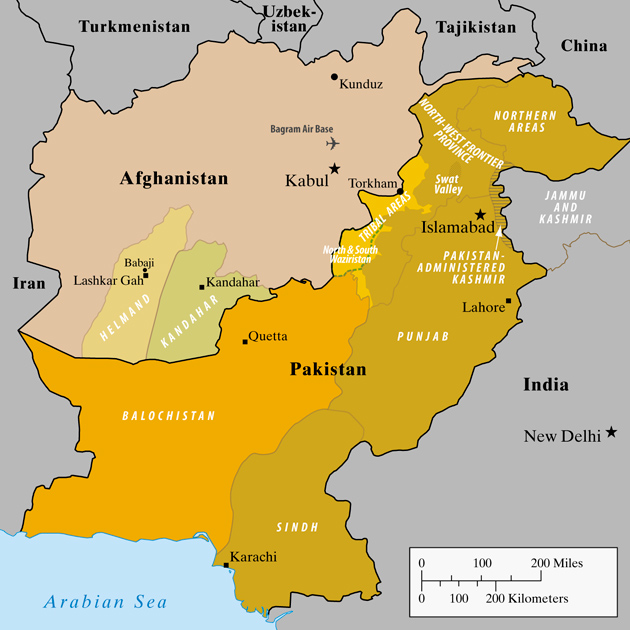
Mehsud’s death plunged the Pakistani Taliban, composed of some two dozen Pashtun tribal groups, into an intense struggle over leadership, creating an opportunity for the CIA and Pakistan’s Interservices Intelligence (ISI) to take action against the extremists. After ousting in April and May the militants who had seized the Swat valley—which is not in the tribal areas but north of the capital city of Islamabad—the Pakistani army is now pursuing the Pakistani Taliban with more determination: in mid-August, two of Mehsud’s senior aides were arrested, one in FATA and the other in Islamabad while seeking medical treatment. The US is anxious for Pakistan to continue its pressure by launching an offensive in Waziristan, the region in the southern part of FATA—first in South Waziristan to eliminate the Pakistani Taliban there and then in North Waziristan, where al-Qaeda and Afghan Taliban leaders are based.
In North Waziristan two key Afghan Taliban networks—one led by the Pash- tun warlord Jalaluddin Haqqani and his son Sirajuddin Haqqani, and the other by the Muslim extremist Gulbuddin Hekmatyar—have been on the payroll of Pakistan’s ISI since the 1970s and the ISI still allows them to operate freely. Al-Qaeda militants also live in North Waziristan, as do militant groups of Pakistani Punjabis, who launch terrorist attacks in India and Afghanistan.
The key question is whether the Pakistani army and the ISI, which have intermittently supported the Afghan and Pakistani Taliban since 2001, can now make a strategic shift—turning decisively to eliminate not only the Pakistani Taliban but also the Afghan Taliban and al-Qaeda. Until now the Pakistani army has considered the Afghan Taliban a strategic asset in its battle against India and other regional rivals for influence in Afghanistan.
Success in eliminating these terrorist networks is vital for the US and the world—even more so now that the rigged presidential elections in Afghanistan in late August have created a deep political and security crisis for Afghans and Western forces there. Every day the evidence of electoral fraud has mounted, with videos posted on the Internet showing, for example, a local election chief stuffing ballot boxes.
Fighting Over the Spoils in the Tribal Areas
Baitullah Mehsud became Pakistan’s most-wanted leader after Taliban forces allied with him took control of the Swat valley in April. They were pushed out of the valley by the army in June after fierce fighting that left 312 soldiers, 2,000 militants, and an unknown number of civilians dead. Mehsud also became a target for CIA-launched drones, after the US decided last year to target Pakistani Taliban leaders along with those from the Afghan Taliban and al-Qaeda.
Mehsud was close to and trusted by Osama bin Laden; by Mullah Omar, the leader of the Afghan Taliban; and by Jalaluddin Haqqani. He gave them support, troops, and facilities for their various operations. By fighting off the Pakistani army and expanding his power across Pakistan’s tribal areas, he gave al-Qaeda and the Afghan Taliban a hugely expanded sanctuary from which to operate and gather recruits for their war in Afghanistan.
Among Mehsud’s innovations were the extremely efficient new systems he set up to train suicide bombers, some as young as eleven, and to produce vast quantities of land mines and improvised explosive devices (IEDs), which are being used in both Afghanistan and Pakistan. He also oversaw a criminal network of kidnapping for ransom, which netted him a war chest estimated in the tens of millions of dollars. Seventy prominent Pakistanis have been kidnapped this year throughout Pakistan, with ransoms—as high as one million dollars—handed over in FATA.
With the control of money, men, and territory at stake, there was a fierce struggle among various Pashtun tribal contenders to succeed Mehsud as leader of the Pakistani Taliban. The succession was also heavily influenced by al-Qaeda and the Afghan Taliban. Mullah Omar and Sirajuddin Haqqani sent several delegations to South Waziristan to influence Pakistani Taliban leaders.
Advertisement
Finally on August 26 a new power-sharing agreement was worked out between the two main contenders: Hakimullah Mehsud, twenty-eight, a ruthless Mehsud protégé who took responsibility for a series of suicide bombings in Pakistan earlier this year, became the new chief of the Pakistani Taliban; while his main rival, Waliur Rehman, who had acted as Mehsud’s deputy, will head the Taliban in South Waziristan, where most of the fighters are based. Both men promised a new bombing campaign in Pakistan and increased support to the Afghan Taliban. One day later, on August 27, they fulfilled their promise when a suicide bomber at Torkham—a town that straddles a major crossing on the Afghanistan–Pakistan border—attacked a police checkpoint on the road used by NATO convoys to enter Afghanistan, killing twenty-two people. Three days after that, on August 30, a suicide bomber killed fifteen policemen in Swat.
The Reconquest of Swat
Regrouped under its new leadership, the Pakistani Taliban will continue to pose a major threat to the civilian government of President Asif Ali Zardari and to the country’s military leaders, who are the real decision-makers in Pakistan. The army’s recent counterinsurgency campaign in the Swat valley was its first success since 2001, allowing the more than two million people who had fled the region to return home. Mingora, the main town in Swat, is once again open for business and the hundreds of schools destroyed by the Taliban have restarted under tents.
However, the Swat campaign has left gnawing doubts. None of the twenty militant commanders operating there has been killed or captured. The local Taliban chief Maulana Fazlullah is also at large, although suspected of being badly wounded. Taliban attacks against schools and police stations resumed in late August, proving that many Taliban are still hiding out in the mountains.
Still, the army has clearly adopted a new and much tougher strategy for eliminating the Pakistani Taliban and establishing greater cooperation between the CIA and the ISI in the tribal areas. This progress has been much appreciated by US officials. On a visit to Islamabad in mid-August Richard Holbrooke, the US special envoy for Afghanistan and Pakistan, told me that Pakistan’s cooperation in fighting the Pakistani Taliban was very welcome, but that the army now has to go into South Waziristan and clear out the militants just as it did in Swat. In the meantime the US military is providing limited fresh equipment and funds to the army for just such an operation.
During August, other Western officials came to Islamabad to deliver the same message. In addition to Holbrooke, they included British Foreign Secretary David Miliband and two senior US commanders, General David Petraeus, head of US Central Command, and General Stanley McChrystal, the new head of US and NATO forces in Afghanistan. They all urged the government and army to use this moment to turn decisively against the terrorist holdouts in the tribal areas and in Waziristan.
However, Pakistan’s generals made it abundantly clear that they will not invade South Waziristan for the moment. “It’s going to take months” to launch a ground offensive, the senior commander in the area, Lieutenant General Nadeem Ahmad, told reporters after meeting with Holbrooke on August 18. General Ahmad said that all the army can do now is choke off supplies to South Waziristan by shutting down the roads, while planes and artillery bombard terrorist hideouts—but from outside South Waziristan.
The army would prefer to wait and see what happens in Waziristan and also in Afghanistan. It is hesitant to move into the tribal areas, where since 2004 it has been defeated by the guerrilla tactics of the Taliban and their advantage in the area’s harsh mountainous terrain. Pakistan continues to pursue a policy of containing the Taliban fighters on the Afghan border rather than eliminating them. That clearly will not satisfy Western governments and military leaders since it leaves NATO forces in Afghanistan vulnerable to the inflow of men, supplies, and suicide bombers from the tribal areas of Pakistan.
Senior Pakistani officials say they will only be able to adopt a new strategy against the Taliban when India changes its current policy toward Pakistan and Kashmir. In Swat the army succeeded because it made use of Pakistani troops transferred from the Indian border, where 80 percent of the army is based. The key to launching a Pakistani offensive in the tribal areas is for the Americans to help improve Pakistan’s relations with New Delhi, so that the army can move more of its troops to the Afghan border.
India is not helping. Prime Minister Manmohan Singh said on August 17 that Pakistan-based terrorist groups were plotting more attacks against India. Last November the Pakistan-based Lashkar-e-Taiba (Army of the Pure) carried out attacks in Mumbai that killed 166 people. Lashkar is a group that is distinct from the Taliban and has been particularly active against targets in India and Kashmir. Indian officials now say that Hafiz Saeed, the Lashkar leader who lives undisturbed in Lahore, was “the brain” behind the Mumbai attack. They demand that he be put on trial.
Advertisement
Pakistan is refusing to clamp down on Lashkar or put Saeed behind bars. Lashkar is the best disciplined, organized, and loyal of the jihadi groups that the ISI has trained and sponsored since the 1980s, and it has always targeted India rather than the Pakistani army. The army will do everything to preserve Lashkar, as long as it believes there is a threat from India. Similarly, Pakistan’s continued support for the Afghan Taliban is based on countering India’s influence in Afghanistan and on having an alternative force that Pakistan can count on, in case the Americans leave Afghanistan.
In short, the strategy of the Pakistani military to selectively use Islamic extremists both as a tool in its foreign policy arsenal against India and to gain influence in Afghanistan is not going to change in a hurry. The Obama administration’s main strategy for the moment is hand-holding—it wants to keep engaging with the Pakistani leaders to try to get them to change course. At least one senior US official arrives in Islamabad every other week to argue the American case.
The Afghan Elections
Pakistan’s safe havens for the Afghan Taliban have been to a large extent responsible for their revival and growing dominance across Afghanistan and for the rising death toll among NATO forces. But the Taliban were not the major cause of the political crisis that enveloped Afghanistan after the August 20 presidential elections.
US officials told me in April 2008 that President Bush had been warned by his military commanders that Afghanistan was going from bad to worse. More troops and money were needed; reconstruction was at a standstill; pressure had to be put on Pakistan; the elections in April 2009 should be indefinitely postponed. Bush ignored all the advice except for asking the Afghans to postpone the elections until August.
He left everything else to his successor to sort out. When Obama took over in January, the crisis was much worse and Pakistan and Afghanistan immediately became his highest foreign policy priorities. Obama added 21,000 more troops, committed billions of dollars to rebuild Afghan security forces and speed up economic development, and sent hundreds of American civilian experts to help rebuild the country. He has attempted to make the anti-narcotics policy more effective and to involve neighboring countries in a regional settlement. It’s an assertive and possibly productive new strategy, but the Obama administration has had neither the time nor the resources to implement it.
The depth of the opium problem, for example, has recently been exposed by Gretchen Peters, who in her book Seeds of Terror describes how opium sales have ballooned since 2001, because of either a lack of a coherent strategy by the US or the constant bickering over a strategy between the US and its NATO partners, particularly Britain. Bush refused to use the US military—the only capable force on the ground—to interdict drug convoys in Afghanistan and arrest or kill drug lords, many of whom were easily identifiable. Only last year did the Department of Defense agree to use the military for these purposes. During the last six months there have been a series of raids by US Special Forces and Afghan commandos that have netted large amounts of opium, chemicals that turn it into heroin, and many of the drug traffickers. Afghanistan today provides 93 percent of the world’s heroin. As Peters shows, from the poppy growers, to the Taliban and other local powers, to the drug lords and their allies in government, the influence of opium money pervades Afghan life.
In fact, most of this year has been taken up with preparing for the Afghan elections and trying to ensure sufficient security for them. Everything else has had to be put on hold. In private moments Holbrooke has regretted how the elections have distracted attention from putting into effect Obama’s new strategy. At home Obama has not had the time to show that his policy is the right one to follow, and now the elections themselves are being exposed as riddled with fraud.
Another complicating issue for Obama has been the troubled US relationship with President Hamid Karzai, who in the spring was convinced that Obama and Holbrooke wanted to replace him and hold the elections under a caretaker president. That was never the case, but Karzai’s paranoia, which is fostered by some of his aides and brothers, who drum up astounding conspiracy theories about US or British intentions, got the better of him.
That the elections were subject to extensive rigging by Karzai’s supporters was partly the result of his belief that the Americans were backing one of the two strongest opposition figures, either Abdullah Abdullah or Ashraf Ghani Ahmadzai, which was again not the case. In fact, with so much now invested in Afghanistan, Obama and Holbrooke had every incentive to ensure that the election results were credible. What is now clear, however, is that the flagrantly dishonest elections have undermined the government and its Western backers, jeopardized future Afghan trust in democracy, and given the Taliban more reason to claim they are winning.
For much of this year the Taliban have been on the offensive in Afghanistan. Their control of just thirty out of 364 districts in 2003 expanded to 164 districts at the end of 2008, according to the military expert Anthony Cordesman, who is advising General McChrystal. Taliban attacks increased by 60 percent between October 2008 and April 2009. Forty-seven American soldiers died in August, making it the deadliest month in the war for the US Army. Forty-four were killed in July.
In August, moreover—as part of their well-planned anti-election campaign—the Taliban opened new fronts in the north and west of the country where they had little presence before. On election day in Kunduz in the far northeast of the country, considered to be one of the safest cities in Afghanistan, the Taliban fired fifty-seven rockets. The US military has acknowledged the gravity of the situation. “It is serious and it is deteriorating…. The Taliban insurgency has gotten better, more sophisticated” in their tactics, Admiral Mike Mullen, chairman of the Joint Chiefs of Staff, told CNN on August 23.
Both before and after the elections there were highly visible Taliban attacks in cities including Kabul and Kandahar, along with well-laid ambushes, attacks against security forces, and extensive use of IEDs. A month before the elections thousands of US, British, and Afghan forces launched an offensive in Helmand province in southern Afghanistan in order to regain territory, block supply routes from Pakistan, and release villagers from the clutches of the Taliban so that they could vote.
Instead, voter turnout was estimated by Western officials who had done their own investigation at between 1 and 5 percent in most parts of Helmand and Kandahar—before high-intensity ballot stuffing for Karzai began in the late hours of August 20. According to Western diplomats, Karzai loyalists also created hundreds of fake polling sites, from which many thousands of votes were recorded in favor of the incumbent. In one southern district, the polling sites were shut down and the entire vote of 23,900 ballots was forged for Karzai. In Babaji, a town in Helmand that was reclaimed by British forces with the loss of four soldiers this month, only 150 people voted, out of 80,000 who were eligible. The British suffered thirty-seven dead and 150 wounded in the six-week Helmand campaign— ostensibly to provide security for the vote. It will be difficult to maintain the morale of Western troops for long under such circumstances.
The Taliban had threatened to derail the elections and, to a considerable degree, they did, because much of the terrified population did not vote. The turnout is expected to be between 30 to 40 percent, much less than the 70 percent who voted in 2004. There were four hundred Taliban attacks on election day and many polling stations never opened.
How Could the Rigging Have Happened?
Forty candidates ran against Karzai. His main opponent, Dr. Abdullah Abdullah, and other candidates produced overwhelming evidence of cheating. By the end of August the Electoral Complaints Commission had received over 2,500 complaints, of which more than 570 could directly affect the results. It will take weeks to go through all these claims.
Still, within hours of the polls closing, the US, NATO, the European Union, and the UN congratulated everyone on a successful election. Their words were aimed at the Taliban, who had failed to stop it; but they sounded hollow and deceitful to Afghans who were more interested in the credibility of the election.
The rigging defied expectations. There were hundreds of foreign observers from the US and other embassies. Both UN officials and a European Union delegation were assigned months ago to make sure this would be a credible election. Afghans and other experts were warning the embassies about possible rigging. Abdullah Abdullah painted a bleak future for the country if the West did not recognize the fraud. “The fact is that the foundations of this country have been damaged by this fraud, throwing it open to all kinds of consequences, including instability. It is true that the Taliban are the first threat but an illegitimate government would be the second,” said Abdullah to reporters in Kabul on August 29. Yet the entire Western community in Afghanistan was caught napping by the widespread fraud. In fact, as I recently wrote elsewhere, the fraud was assured months ago when Karzai began to align himself with regional warlords, drug traffickers, and top officials in the provinces who were terrified of losing their lucrative sinecures.
The biggest mistake may have been made by the UN in not running the elections as it did in 2004 but instead handing them over to the Afghan-run “Independent Election Commission,” which was beholden to Karzai, who appointed the members. On September 8, a UN-backed commission announced that it had found “clear and convincing evidence of fraud” and ordered a partial recount of returns that claimed Karzai had received 54 percent of the vote. If Karzai does not receive over 50 percent of the vote in the final count then there will be a runoff election in October. If Karzai wins over 50 percent his legitimacy will be doubted by many Afghans while the credibility of the US and the other nations involved in the elections will be even more damaged.
An October runoff between Karzai and Abdullah may win back the credibility of the democratic process if that election is more tightly run, but it will leave the country paralyzed for most of the next two months. During that time there could be severe ethnic tensions. Karzai is a Pashtun while Abdullah’s mother is a Tajik. We can expect local conflicts, assassinations, and a breakdown in law and order—while the Taliban will further justify their condemnation of democracy as an infidel conspiracy. The best option would be for the US to pressure Karzai to accept a national government that would include Abdullah and other opposition candidates.
In Washington President Obama is under fire from the left of the Democratic Party for becoming another war president and from right-wing Republicans for being overly ambitious in his plans for Afghanistan. Increasingly Americans are getting fed up with a war that has gone on longer than the US involvement in the two world wars combined. For the first time, polling shows that a majority of Americans do not approve of Obama’s handling of Afghanistan. Yet if it is to have any chance of success, the Obama plan for Afghanistan needs a serious long-term commitment—at least for the next three years. Democratic politicians are demanding results before next year’s congressional elections, which is neither realistic nor possible. Moreover, the Taliban are quite aware of the Democrats’ timetable. With Obama’s plan the US will be taking Afghanistan seriously for the first time since 2001; if it is to be successful it will need not only time but international and US support—both open to question.
After Obama’s injection of 21,000 troops and trainers, total Western forces in Afghanistan now number 100,000, including 68,000 US troops. It is likely that General McChrystal will soon ask for more. Obama’s overall plan has been to achieve security by doubling the Afghan army’s strength to 240,000 men and the police to 160,000; but these are tasks that would take at least until 2014 to complete, if indeed they can be carried out. Meanwhile the military operation in Afghanistan is now costing cash-strapped US taxpayers $4 billion a month.
Across the region many people fear that the US and NATO may start to pull out of Afghanistan during the next twelve months despite their uncompleted mission. That would almost certainly result in the Taliban walking into Kabul. Al-Qaeda would be in a stronger position to launch global terrorist attacks. The Pakistani Taliban would be able to “liberate” large parts of Pakistan. The Taliban’s game plan of waiting out the Americans now looks more plausible than ever.
For all these reasons it is important to recognize that if Western forces are to regain the initiative in Afghanistan, they must deal with the situation in Pakistan, which needs to eliminate sanctuaries of both the Pakistani and Afghan Taliban forces within the country. The Pakistani military will bide its time until the Americans are really desperate, and then the army will demand its price from the US—a price to be measured in financial and military support.
Balochistan
Much has been made of Pakistan as a potential failed state on the verge of breakup, yet if there is even a remote chance of that happening it will not be because of the Taliban, but because of an underlying crisis that has been studiously ignored by the West—the separatist movement in Balochistan. The issue is well described in the best chapter of a new book on Pakistan by Nicholas Schmidle, To Live or to Perish Forever: Two Tumultuous Years in Pakistan.
Balochistan is Pakistan’s largest province, comprising 48 percent of its territory and sharing a long border with southern Afghanistan; but it is a land of rugged mountains and deserts, with a population of only 12 million people. Ever since Pakistan’s creation in 1947, the Baloch tribes have been in revolt against what they see as the chauvinism and denial of their rights by the Pakistani army in favor of Punjab, the country’s most populous province, with 86 million people.
In five major insurgencies against the army, the Baloch have demanded greater autonomy, royalties for the province’s gas, development funds, and genuine political representation. The fifth insurgency began in 2005 and has intensified because of the brutal repression and hundreds of “disappearances” of Baloch nationalists, for which the army under former President Pervez Musharraf was responsible.
Many young Baloch are now demanding their own state. In August, with the start of the new school year, Baloch students refused to hoist the Pakistani flag or sing the national anthem. Ten non-Baloch college principals were assassinated by guerrillas the same month, creating panic among the Punjabi settler population. The Khan of Kalat, Mir Suleman Dawood, the titular chief of chiefs of all the Baloch tribes—whose ancestors once ruled Balochistan—announced on August 11 the formation of a council for “an independent Balochistan”; he rejected any reconciliation with the government unless there was international mediation from the UN. According to human rights activists, hundreds of Baloch nationalists have disappeared—they are believed to have been secretly arrested and tortured by the military but their whereabouts remain unknown.
Schmidle meets the Khan and other Baloch chiefs and, with no small courage, follows them as they are trailed by the ISI. “By the end of 2006, nearly every nationalist leader in Balochistan had been killed, arrested, or placed under house arrest,” he writes. The Khan of Kalat describes Balochistan’s mineral wealth to Schmidle: “We are sitting on gold and anytime we speak up and ask for due compensation, we get a bloody spanking.”
The civilian government under President Zardari arranged a cease-fire with the guerrillas last year but failed to follow it up with serious talks, and guerrilla attacks have resumed. Pakistan’s past military rulers have ignored the fact that their country is a multiethnic, multireligious state and the policies of an overtly centralized military do not work. The army’s refusal to acknowledge this led to the loss of East Pakistan—now Bangladesh—in 1971. Tomorrow it could be Balochistan.
Schmidle has written a picaresque book about what Pakistan looks like today. Like a good film director he presents extraordinary pictures of political mayhem and violence interspersed with dialogue, solid character actors, and tightly focused close-ups of bad guys such as Maulana Fazlullah, the leader of the Swati Taliban—“a short man with large gaps between his teeth,…wavy hair,…a bulky, black turban and a goofy smile.”
However, like many movies, Schmidle’s book lacks a coherent plot. Each chapter serves up a separate scene or subject, but no common thread or larger themes and ideas link the chapters together. In fact there is little that sets the book apart from the best recent Western newspaper reporting on Pakistan. Schmidle’s prose can be brilliant but fails to describe the undercurrents of life in Balochistan or provide the analysis that is needed.
As early as page 8 he heralds his arrival in Pakistan with an analysis that could have been culled from any US magazine over the past three years—Pakistan as the most dangerous place on earth:
From what I gathered, there were a few essential things to know about Pakistan: the army was perpetually in charge, the intelligence agencies were a brooding and ubiquituous force, the Islamists threatened to take over, ethnic problems portended more Balkanization, corruption plagued human interaction and a modest arsenal of nuclear weapons all combined to make Pakistan the most dysfunctional—and most dangerous—country in the world.
After reading such a statement of the obvious we expect some further insights. Instead, at the end of the book, Schmidle is still asking the same questions, having found no answers:
The political, social, economic, and religious dynamics embedded in Pakistan seemed to become more and more complicated—and volatile—with time, and less and less solvable.
Foreign correspondents should not make too much of their own intrepid adventures, but this is not the case with Schmidle. He opens the book with a graphic account of his deportation from Pakistan, warning us that the book is going to be as much about him as about Pakistan. We are often told about his looks and his physique—he is six feet two with blond hair—and about the personal dilemmas that obsess him: What clothes should he wear? What color should he dye his hair? Would it be better to pretend to be Canadian rather than American? Such worries only trivialize his story.
The son of a Marine general, Schmidle, in his mid-twenties and married, arrives in Pakistan in February 2006 under a two-year grant from a Washington think tank. To his credit, he learns Urdu and travels extensively. His time in Islamabad coincides with the most tumultuous events in the country’s history during the dictatorship of General Musharraf. The heart of his story is his meetings with Islamic extremists. He befriends the bespectacled, soft-spoken yet lethal religious leader Abdul Rashid Ghazi, who ran the radical Red Mosque in the center of Islamabad. Ghazi opens doors for Schmidle that lead him straight into the heart of the Islamic militancy that was beginning to grip the country in 2006. Ghazi himself is a complex character:
While Ghazi relished his al-Qaeda connections and the confidence such friends might have lent, I still found him to be surprisingly sensible and pragmatic. His eyes didn’t burn with fervor. Nor did his rhetoric emanate hatred. He calmly explained the rise of anti-Americanism around the world as a product of the United States’ “missed opportunity” to act as a benevolent, global leader.
Ghazi’s story ends with his martyrdom once the army, after procrastinating for six months, storms the Red Mosque. One hundred militants die but hundreds of Ghazi’s young followers escape the siege to become the suicide bombers that have since torn through the heart of Pakistan’s cities.
Ultimately the book’s strength lies in its cinematic descriptions, for example its account of the quarter in Karachi run by the political leader Altaf Hussain and his party, the Muttahida Quami Movement (MQM), which advocates preserving the ethnic identity of the Urdu-speaking minority that emigrated from India:
Whitewashed apartment blocks lined the surrounding streets. Billboards modeled Altaf’s face more than they advertised products, and the MQM’s white, green, and red-striped flag fluttered from lampposts, traffic lights and car antennas. Sputtering Suzuki hatchbacks circled around a dried-up fountain, the color of rain clouds. A sculpture of a clenched fist rose from the top of the fountain.
Unfortunately, strong description is not enough. Whether Pakistan’s army and political leaders can deal with the threat from the Taliban and other violent forces they have themselves sustained over the years is a question that needs to be addressed more urgently than ever as the situation in Pakistan and Afghanistan deteriorates further.
—September 10, 2009
This Issue
October 8, 2009

This Issue
October 8, 2009
