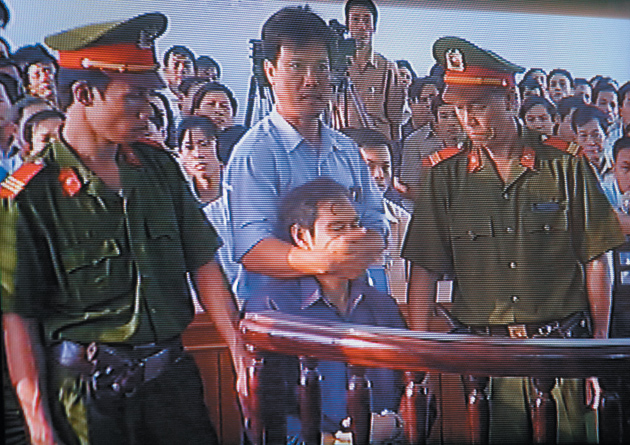
A television image of a security man clapping his hand over the mouth of the Catholic priest Nguyen Van Ly, one of the drafters of the 2006 ‘Manifesto for Freedom and Democracy,’ during his trial for spreading propaganda against the state, Hue, Vietnam, M
Reading Bill Hayton’s enlightening and persuasive narrative about postwar Vietnam I wondered, as I have before in these pages, how the Vietnamese won their long wars against the French and the United States. After Dean Rusk retired as secretary of state during much of the war, his son, Richard, asked him, “Short of blowing them off the face of the earth how could we have defeated such a people? Why did they keep coming? Who were these people? Why did they try so hard?” Rusk replied, “I really don’t have much to answer on that, Rich.”1
Or take Bao Ninh, one of North Vietnam’s brilliant novelists about the war, and a veteran, who in his The Sorrow of War writes:
Victory after victory, withdrawal after withdrawal. The path of war seemed endless, desperate and leading nowhere. The soldiers waited in fear, hoping they would not be ordered in as support forces, to hurl themselves into the arena to almost certain death.2
But they did, again and again.
According to Bill Hayton, who in 2006 and 2007 reported for the BBC from Vietnam until his visa was withdrawn for reporting on dissidents, nowadays in Hanoi
many Vietnamese who fought the war find themselves trapped in voiceless rage. They know why they fought, they know what they and their fellows suffered, they know how unjust it felt—but they’re banned from expressing any of it in public because the Party has decided that the country needs the support and resources of the United States.
Mai Elliott, the author of RAND in Southeast Asia: A History of the Vietnam War Era, has written to me that “the war veterans feel that they have made horrendous sacrifices only to see themselves marginalized and to see the Party and military elite enrich themselves.”
Here is one of Hayton’s most telling points. The Vietnamese are forbidden to mention the “sheer monstrosity of the war: the industrial-scale killing….” But it remains alive for Americans. “No other country name has the same resonance: ‘the lesson of Vietnam,’ ‘the ghost of Vietnam,’ ‘another Vietnam’—we know instantly all that these phrases imply.” The “lessons of Vietnam” in Iraq or Afghanistan are regularly argued. Hayton emphasizes that things are different in Vietnam itself, where the war is a taboo subject, although, as he recalls near the end of his book, the Americans did vast and brutal damage to the country and its people.
Living in Vietnam, he claims (puzzlingly as one reads his book), “moved and inspired me…until I was told to leave.” He observes that foreigners find there is something secretive about Vietnam “until Vietnamese friends patiently explain what, to them, is blindingly obvious—and things slowly fall into place.” Notwithstanding the regime’s supression of free inquiry, it doesn’t seem very secretive to the reader because Hayton describes the key issues and problems with considerable clarity. At the core, he makes plain, is the Communist Party’s conviction that come what may it must stay in sole power. In his penetrating new book, The Party: The Secret World of China’s Communist Rulers,3 Richard McGregor writes, “For all the reforms of the past three decades, the Party has made sure it keeps a lock-hold on the state.” And this is exactly the situation in Vietnam.
Vietnam experienced a cruel awakening after the war, discovering that defeating the American capitalists and their war machine did not mean that state socialism could then build a peacetime economy. By 1979, Hayton explains, it was apparent that heavy industry was eating up state funds, and light industry was failing; as southern peasants resisted collectivization, agriculture stagnated. But the regime was adaptable. “In 1979, before China and the Soviet Union opened the door to industrial capitalism, Vietnam’s communists had already started experimenting with it.” Reformers inside the Party demanded an end to central planning and an opening to the market, “and a vast land reform programme gave farmers control over their fields.”
After succinctly tracing Hanoi’s political history after 1979, Hayton settles down to a revealing description of Vietnam today. This includes “rocketing economic growth” that distorts the economy toward “the wants of the few rather than the needs of the many”; the need to create one million jobs every year; the emergence of a well-off urban class; the erosion of traditional rural values; the disdain for minority peoples; vast official corruption; an overwhelming security system; and above all the Party’s determination to stay in power by any means, including the carefully supervised revival of religion and folk beliefs. Much of this could be said of China, but it would be a mistake to describe Vietnam as merely post-Mao China writ small. Despite some political and economic echoes of China in its smaller neighbor, the two countries are fundamentally different, as the Chinese found out in 1979 when they unsuccessfully fought the Vietnamese.
Advertisement
One similarity with China is that many foreigners either believe or want to believe that economic reform will lead to more liberal, even democratic, reforms. The World Bank, Hayton notes, has hailed Vietnam as a “poster boy” for “economic liberalisation.” There is something in this claim for the advantages of the market, Hayton writes. But he adds that “Vietnam’s transition was marked by rising state involvement in the economy…. The state remained in control, and foreign investment was directed into joint ventures with state firms.” Hayton—forgetting China—claims that this coordination has produced “economic growth, poverty reduction and political stability unmatched by any other developing country.” And, he adds, an avalanche of endemic corruption and wildly erratic lending by state banks, with some firms becoming “mini-empires.” Some of these state-controlled cor-porations “became outright criminals.”
Hayton tells us how it works at the very top, the fifteen-member Politburo. No one ascends to that height, he writes, “without building up a network of supporters”—in China this web of relationships is called guanxi—“and delivering them benefits in return.” He shows how President Nguyen Minh Triet built his fiefdom in Binh Duong province, near Saigon (now Ho Chi Minh City), by securing foreign money that helped create hundreds of thousands of jobs. This involved pharao, fence bending, “to get things done.” Now his nephew runs Binh Duong, and under what Vietnamese call his “umbrella” his family and retainers are “protected” from the law. Such arrangements, the norm with national leaders, extend down through provincial and yet-lower-tier officials who have turned capitalism into family businesses, what the Vietnamese call “son of father, grandson of grandfather,” meaning “the young offer loyalty, the old offer protection.”
These relationships are financially valuable, and investors—this, too, is true in China—will pay handsomely for introductions into such families. On a day-to-day basis every official transaction is likely to require some form of hidden payment. Corruption is built into every public activity:
Kindergarten teachers will have to bribe the boss to get hired, the children’s parents will have to bribe the teacher to ensure their children get well-treated, high school pupils will bribe their teachers to get good marks in exams, and Ph.D. students pay to get their theses written for them by their examiners’ colleagues…. Extra payments are required to get good treatment in hospitals, to get electricity connections fixed and to get business.
The environment is a deepening disaster. The rivers surrounding Ho Chi Minh City are “biologically dead,” and the air in Hanoi is poisonous, two more parallels with the waterways and cities of China. Sewage and other waste in both cities are dumped raw into the rivers and landfills and eventually poison the local water supplies. As in China local people unsuccessfully complained about such pollution for years, but now that the urban middle classes are up in arms about smells and tastes, action is slowly beginning to be taken. Hayton says that a World Bank report has warned that pollution will frighten away tourists and harm economic growth. In the north of the country, Ha Long Bay, Vietnam’s premier tourist attraction with its low mountains rising straight from the water, is now a biological disaster zone, its waters polluted by the effluent from northern Vietnam’s coal industry, its fish killed by coal dust that turns the sea black or “by explosives, electric shocks and poison.”
Environmental laws are flouted in favor of big business. “Ha Long Bay survives, but as a natural environment, it is dying.” The press and television have been warned not to discuss this tourist-alarming subject. Forests are suffering, too; Hayton notes that between 1976 and 1990 loggers “destroyed nearly as much of the country’s forest cover as the United States did with Agent Orange in the 1960s…. The combination of war and logging has left a quarter of the country classified as ‘bare’ or ‘denuded.'” But the major operators continue to log illegally, either in Vietnam or over the border in Laos and Cambodia—military areas where the army may be involved, Hayton alleges, in this ecological crime. He describes the slaughter of Vietnam’s rich animal life, which includes some of our rarest creatures such as elephants, rhinos, tigers, and many plants. As in China, restaurants cater to the rich public’s taste for endangered animals like pangolins, porcupines, and civet cats, with the “greatest kudos” going “to those who can buy the most expensive, most endangered, most sought-after meat available. The trade is vast.”
Advertisement
Hayton briefly mentions the use of Agent Orange in defoliating Vietnam’s forests and other vegetation. It was a tactic borrowed from the British in Malaya, to deny natural cover to enemy forces. The US estimated that it sprayed 2.6 million hectares, sometimes repeatedly, and that “between two and five million people were sprayed directly.” Agent Orange and some of the other American defoliants contain dioxin, “one of the most toxic chemicals ever made,” although I recall being assured by US officials in Vietnam that it was not used deliberately on human beings and in any event was not that dangerous.
As Hayton observes, the dangers of dioxin were well known in the West, where they were frequently mentioned during antiwar protests. Hayton reports that tens of thousands of children, the offspring of parents who had been sprayed, were born blind, limbless, with huge heads, extra arms and legs, and mental handicaps. Such children are often hidden from sight—and medical help—because their parents are ashamed. Dow and other chemical companies deny responsibility for these horrible results, but, as Hayton writes, they have also paid millions of dollars in compensation to American veterans injured by Agent Orange:
While assistance with finding US soldiers Missing In Action was a priority for Washington, Hanoi wasn’t allowed to discuss the mass poisoning of civilians. The contrast was obscene but Vietnam had little choice. The leadership wanted to end the country’s diplomatic isolation so the whole dioxin issue was dropped.
Eventually Agent Orange again became a subject during Vietnam’s negotiations with the Americans on economic and security questions. The presidents of both countries discussed Agent Orange in 2006, and in 2007 the Americans agreed to help clean up the traces of dioxin at Danang: “Once again, difficult memories have been suppressed in the interests of a strategic rapprochement with the US.”
Richard Vogel/AP Images
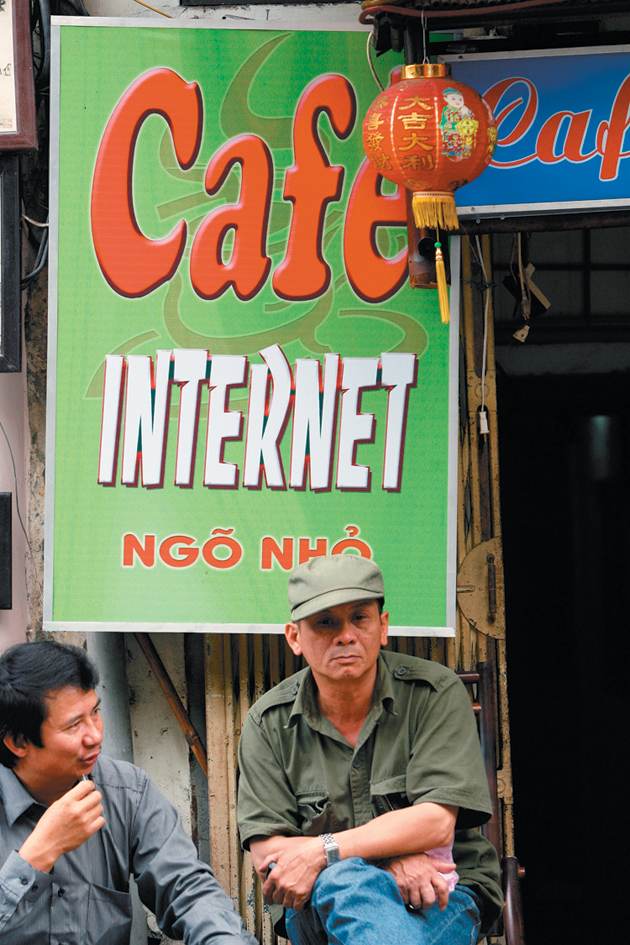
A shopkeeper outside his Internet café, Hanoi, April 2006
As is true in some other Communist or ex-Communist countries, Vietnam’s fifty-three minorities, which make up 15 percent of the national population, are described in terms with which any Chinese would be familiar and most would approve: “backward,” “uncivilized,” and “aboriginal.” And as in China, minorities have been mobilized into theme park entertainment, dressing up in their traditional costumes and performing “tribal dances.” They have become, as Hayton puts it, “a backdrop onto which the Kinh [the ethnic name for the Vietnamese majority] can project their own imaginings.” In 2004 the World Bank estimated that 15 percent of the Kinh lived in poverty, while the rate for minorities was 75 percent. Hayton recalls how the French and Americans mobilized some of the ethnic minorities in the south to fight against the Communists by exploiting their sense of grievance against the Vietnamese majority.
For me, the most startling statistic in Hayton’s book comes in his passages on prostitution, “now so integral to male life in Vietnamese cities that it seems ridiculous even to try to eradicate it.” In 2001, an official report estimated that there were at least half a million prostitutes, more than 1 percent of the female population—a number that, Hayton supposes, is larger today. “Deals will often be lubricated and celebrated with the assistance of a cohort of sex workers.”
Hanoi commands a huge security apparatus, 6.7 million members in a working population of 43 million, meaning that one person in six has a security job. Hayton points out that at least one reason to be grateful for this was the power of the Vietnamese state when it stopped a possible global epidemic of SARS in 2003. Security officers surrounded the homes of all infected people, and hospital wards were closed off. “It worked…. The WHO declared the disease ‘contained’ in Vietnam.”
The Vietnamese Internet is closed to discussion of political and religious matters from any source, especially overseas Vietnamese. The regime claims that it blocks “unhealthy sites.” This does not include pornography, so “the Vietnamese firewall allows youngsters to consume plenty of porn but not Amnesty International reports.” Hayton describes a “pervasive sense of fear that has been instilled into most Vietnamese having contact with anything which might seem subversive.” Even international NGOs fear to speak publicly on sensitive issues without first making inquiries in official circles:
As a result there is no public criticism of governmental policies or priorities from those who know most about it. All comment has to be channelled through Party-controlled structures.
As one would expect, therefore, outspoken dissidents can expect to be repressed. In January 2006, four Catholic priests issued a plea for freedom of speech: “We Are Not Afraid. We Ought to Know the Truth.” With remarkable boldness for any Communist country, they called for an end to the Party’s monopoly rule, for Party members and soldiers to desert, and for non-Communist parties to speak out. In April 2006, the principal mover, a heroic priest called Father Nguyen Van Ly, who had already spent three terms in jail totaling sixteen years for anti-Communist agitation, issued a “Manifesto for Freedom and Democracy”; one of his codrafters was a retired army colonel. The document was signed by 118 people. Some were well known, such as the ex-dean of the Marx-Leninist Institute of Philosophy. The regime delayed its reaction; it was then involved in negotiations to enter the World Trade Organization and President Bush was heading for Hanoi to discuss MIAs and other sensitive issues.
The diplomatic community, as craven as usual in Communist countries, hedged its remarks, fearful that the dissidents could be harming “Vietnam’s gradual path towards stable democracy.” What these diplomats wanted was exactly what Hanoi wanted: “stability.” As soon as the WTO issue was settled and Bush had gone home, there occurred what Human Rights Watch termed “one of the worst crackdowns on peaceful dissidents in 20 years.” Students taking part in a meeting on human rights “were persuaded to denounce their teachers as traitors.” At his trial Father Ly shouted that the process was “a lewd comedy for years, Jurors a bunch of baboons….” A security officer clapped his hand over the priest’s mouth. “The colloquial Vietnamese word for censorship is bit mieng—literally, to cover the mouth.” Hayton doesn’t tell us that in 2007 Father Ly was sentenced to eight years in prison and released earlier this year after suffering two strokes. The movement he led has been crushed.
Hayton points out that while Burma, which is also brutally hard on dissidents, is subjected to great international pressure, Vietnam receives billions of dollars’ worth of foreign aid and investment. The country “is being wooed by a succession of American admirals in their best whites,” and no American administration
is likely to jeopardise the multimillion-dollar interests of Intel, Nike, Ford, GE and all the other US corporations who’ve invested in Vietnam, by pushing for change and instability. International capitalism is doing very nicely out of Communist Party rule in Vietnam and stability is a lot more important than the release of a very few troublesome dissidents.
Hayton has written a very good book about a country about which we know little. He pulls no punches on matters that arouse his justifiable concern. He may sound vague when he concludes that “Vietnam still has the capacity to surprise.” But he is right. He describes the twists and turns of an authoritarian regime always struggling to keep control and—like China—always ready to abandon what seemed like ideals to maintain itself.
In 1968, during Tet, the New Year celebrations, Hanoi suffered an unexpected setback after 70,000 of its best troops, North Vietnamese and Vietcong, launched attacks on American installations throughout South Vietnam, hoping to ignite a general uprising against the Americans and their South Vietnamese clients. These attacks culminated in an attack on the American embassy in the heart of Saigon. Some of the soldiers blasted through the building’s protective wall and Americans heard Saigon correspondents reporting that Vietcong were inside the embassy. Two thousand American soldiers died during Tet and so did four thousand South Vietnamese.
Before long the American command stated that 50,000 Communist soldiers had been killed and General William Westmoreland declared that Tet had been an American victory. After a detailed postmortem, the Communist side conceded that it had been a disaster for them. But American journalists had seen the dead bodies in the embassy. Walter Cronkite, the country’s most trusted television anchor, who until then had supported the war, now broadcast that it “was more certain than ever that the bloody experience of Vietnam is to end in a stalemate.” This broadcast famously shocked President Johnson and after some of his closest advisers changed their minds about the value of further struggle in Vietnam, on March 31, 1968, he announced that he would not seek a second term. By then the North Vietnamese had invited Cronkite to Hanoi—he declined—and in April they announced that they were ready for talks with the Americans. These crept on for five years while many more Americans and Vietnamese died in battle.
After the war, one of Hanoi’s most celebrated generals, Tran Do, admitted to Stanley Karnow:
In all honesty, we didn’t achieve our main objective, which was to spur uprisings throughout the south…. As for making an impact in the United States, it had not been our intention—but it turned out to be a fortunate result.4
Although Bao Ninh and other novelists showed that North Vietnam’s soldiers were terrified as they fought, in the end Hanoi was more stoical or bloodthirsty or willing to sacrifice lives than the Americans were. It was one of those Vietnamese surprises. For Americans Vietnam still lurks in national memory. In Vietnam itself the war cannot be mentioned. Another surprise.
This Issue
June 24, 2010
Subscribe to our Newsletters
Best of The New York Review, plus books, events, and other items of interest
Jonathan Mirsky is a historian of China. He was formerly the East Asia Editor of The Times of London and China Correspondent for The Observer. (December 2016)
This Issue
June 24, 2010
1
See my article “[The War That Will Not End](/articles/archives/1990/aug/16/the-war-that-will-not-end/),” The New York Review, August 16, 1990. ↩
2
See my article “[No Trumpets, No Drums](/articles/archives/1995/sep/21/no-trumpets-no-drums/),” The New York Review, September 21, 1995. ↩