
Poetry has always been half in love with easeful death. There must have been a time, as Thomas Hardy in his great poem “Before Life and After” assures us there was, when death constituted nothing more than the end of life, a time when “if something ceased, no tongue bewailed”; a far-off time, that is, before the poets discovered their calling as elegists. It was a discovery they made early on. The Epic of Gilgamesh, one of the oldest surviving works of literature, is obsessed with the mystery of mortality, Homer too lingers often among the shades, and Shakespeare and Milton are ever mindful that the very notion of cadence implies a lapsing, a falling away. Death, Wittgenstein assures us, is not an experience in life, but the poet knows otherwise, and seeks to catch us in the web of words as we fall.
The mourning bell tolls throughout Human Chain, Seamus Heaney’s new collection of poems, his twelfth, but the sound it makes is a sonorous call to life and continuity: “The dead here are borne/Towards the future.” In these marvelous poems Heaney displays all that sweetness and ease of gesture, that colloquial accommodation, that are the unmissable traits of his art; but the thinking in these lines evinces new “torsions”—a word Heaney used tellingly in his Nobel acceptance speech—that Donne and Dowland would have recognized and approved:
Too late, alas, now for the apt quotation
About a love that’s proved by steady gazing
Not at each other but in the same direction.
Yet if this is metaphysical poetry, it is without the yawning tomb, the death’s-head rictus, the bracelet of bright hair about the bone. Heaney’s dead are vibrantly alive, fleshed out by the force of memory and through the power of poetry, even if the flesh here often has the “webby weight” of his dying father’s underarm in the poem “Album.” Human Chain marks many deaths but all the markings are a celebration of what was lived:
As between clear blue and cloud,
Between haystack and sunset sky,
Between oak tree and slated roof,I had my existence. I was there.
Me in place and the place in me.
Baudelaire somewhere remarks that literary genius—the word “genius” used here in the Latin sense of begetting or making—consists in an ability to summon up childhood at will. Seamus Heaney’s power of recall, especially of his earliest years, is a phenomenon that has awed critics from the time of his first collection, Death of a Naturalist, in 1966—the title poem of which remembers in exact and gloriously turbid detail the flax-dam near his childhood home where “bubbles gargled delicately, bluebottles/Wove a strong gauze of sound around the smell,” and frogspawn “grew like clotted water.” One of this poet’s great gifts is to have found a way of making a music that sounds like the rough music of the past itself, a music that is guttural, consonantal, as he has said himself, yet wonderfully delicate, too, as in “Song,” a poem from Field Work (1979), that opens with the ash tree called a rowan, which has red berries:
A rowan like a lipsticked girl.
Between the by-road and the main road
Alder trees at a wet and dripping distance
Stand off among the rushes.There are the mud-flowers of dialect
And the immortelles of perfect pitch
And that moment when the bird sings very close
To the music of what happens.
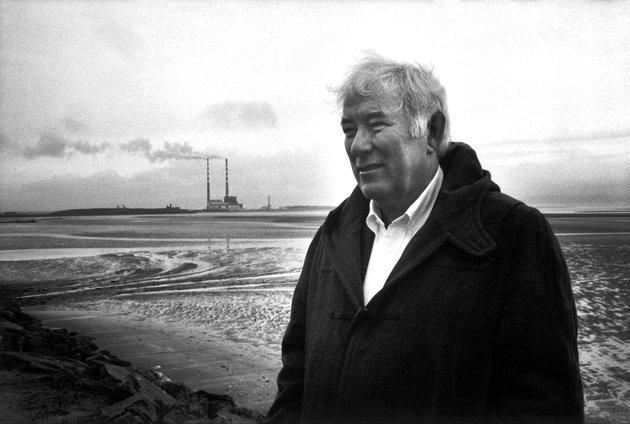
As many of his readers will know by now, Seamus Heaney was born in 1939 on a small farm, Mossbawn—a wonderfully Heaneyesque name, soft and allusive—near the village of Castledawson, County Derry, in Northern Ireland, the first of nine children. In Stepping Stones (2008), a book of interviews with Seamus Heaney by Dennis O’Driscoll, the poet describes the “one-storey, longish, lowish, thatched and whitewashed house” consisting of three rooms attached to a stable. Here, as he said in his Nobel acceptance address, the family
lived a kind of den-life which was more or less emotionally and intellectually proofed against the outside world…. We took in everything that was going on, of course—rain in the trees, mice on the ceiling, a steam train rumbling along the railway line one field back from the house—but we took it in as if we were in the doze of hibernation. Ahistorical, pre-sexual, in suspension between the archaic and the modern….
The family later moved to a larger farm a few miles away, called The Wood, and built a new, modern, featureless house. By then Heaney was fifteen, and although he speaks of summer days there that “were among the most idyllic of my life,” and despite the fact that a number of later poems are set in The Wood, it is probably fair to say that Mossbawn is Heaney’s true treasure-house of memory. The poem “Mossbawn,” consisting of two parts and dedicated to the poet’s mother, conjures and celebrates a childhood world:
Advertisement
And here is love
like a tinsmith’s scoop
sunk past its gleam
in the meal-bin.
“Mossbawn” appeared in North, Heaney’s most politically engagé and most politically troubled collection, published in 1975, when the Northern Ireland conflict was in one of its most savage phases; yet even here, amid these tensed and often tormented poems, it is plain that the prelapsarian world of childhood is the poet’s abiding inspiration. And if childhood is for Heaney, as it is for all of us, a recent antiquity, he found in the more ancient past of northern Denmark as depicted in the archaeologist P.V. Glob’s book The Bog People a landscape that was to him politically and poetically familiar.
When North was published Heaney came in for criticism, especially in southern Ireland, for what seemed to some a too easy and even dangerous comparison between the ritual Iron Age slayings that Glob described and the sectarian slaughter being carried out almost daily among Catholics and Protestants in the North. Already, however, in “The Tollund Man,” an early “bog poem” from his 1972 collection Wintering Out, he had declared that “some day I will go to Aarhus” to see the body of this sacrificial victim preserved by peat-acids:
Out there in Jutland
In the old man-killing parishes
I will feel lost,
Unhappy and at home.
And in District and Circle, published in 2006, the collection that preceded Human Chain, he imagined “The Tollund Man in Springtime”:
…neither god nor ghost,
Not at odds or at one, but simply lost
To you and yours, out under seeding grass
And trickles of kesh water, sphagnum moss,
Dead bracken on the spreadfield, red as rust.
In Human Chain the deaths are more prosaic and more recent, and the poet’s relation to them is more intimate, more pained, and more urgent, for now he is feeling the pinch of his own mortality and confronting the dismaying and immediate fact that one day perhaps not very far off he will be numbered among these shades that he is invoking. In the very beautiful title poem he combines the appalling present of foreign wars and catastrophes with a characteristic memory from his own past and an intimation of an inevitable future. Here is the poem in full:
Seeing the bags of meal passed hand to hand
In close-up by the aid workers, and soldiers
Firing over the mob, I was braced againWith a grip on two sack corners,
Two packed wads of grain I’d worked to lugs
To give me purchase, ready for the heave—The eye-to-eye, one-two, one-two upswing
On to the trailer, then the stoop and drag and drain
Of the next lift. Nothing surpassedThat quick unburdening, backbreak’s truest payback,
A letting go which will not come again.
Or it will, once. And for all.
It is always difficult to know whether to take a poetry collection as an intended whole and read it through from first poem to last, or pick one’s way about in it as one might in a summer meadow, fixing on this blossom and then on that, haphazardly, happily. Human Chain, however, is unmistakably of a piece, for as its title suggests it is a series of links stretching in a great arc from an opening moment of airy epiphany to a final loosening and lightening as a kite breaks free of its string and “takes off, itself alone, a windfall.” “‘Had I Not Been Awake,'” the initial poem—and it does stand at the head of the collection like the compact but elaborate first letter of a medieval codex—crackles with the force of a presentiment that seems as dangerous as it is exciting, as the poet awakes to hear
A wind that rose and whirled until the roof
Pattered with quick leaves off the sycamore
And got me up, the whole of me a-patter,
Alive and ticking like an electric fence….
After this opening gust we are at once transported to the land of the dead, although the second poem, “Album,” also starts off with a whoosh and a whop as “the oil-fired heating boiler comes to life/Abruptly, drowsily, like the timed collapse/Of a sawn-down tree….” The image of the felled tree sets the poet to imagining his parents in a time before he knew them even though he was somehow present with them:
It’s winter at the seaside where they’ve gone
For the wedding meal. And I am at the table,
Uninvited, ineluctable.
The poem centers on the poet’s father, and a thrice-enacted embrace between him and the son, the first one that might have taken place but did not “on the riverbank/That summer before college,” the second when the father was drunk and needed help, and the third when he is dying and the son is helping him to the bathroom, “my right arm/Taking the webby weight of his underarm,” an Aeneas, as it might be, about to sling Anchises up onto his back. Heaney has always been a Virgilian, and this poem finds an echo much later in the collection, in “The Riverbank Field,” a lovely reimagining of passages from Aeneid VI in which the poet declares that he will
Advertisement
confound the Lethe in Moyola
By coming through Back Park down from Grove Hill
Across Long Rigs on to the riverbank—
That poem is followed by a masterly twelve-part sequence, “Route 110,” which opens with the poet as a young man buying a second-hand copy of Aeneid VI, and where again we find ourselves on the banks of the Lethe watching the dead being transported to their final destination, as the poet “hurried on, shortcutting to the buses,/Parrying the crush with my bagged Virgil” and in a market passes by
racks of suits and overcoats that swayed
When one was tugged from its overcrowded frame
Like their owners’ shades close-packed on Charon’s barge.
The true beauty of “Route 110,” however, is revealed only at the end, when we find that we are not in the land of the dead at all, or at least not all of us are, but in the place of the living, in a lying-in room where there is not death, but the birth of a grandchild:

So now, as a thank-offering for one
Whose long wait on the shaded bank has ended,
I arrive with my bunch of stalks and silvered heads
Like tapers that won’t dim
As her earthlight breaks and we gather round
Talking baby talk.
A few years ago Seamus Heaney suffered a serious stroke, from which he recovered fully, though it is plain that he still can feel the place where death laid its chill hand on his brow. Deaths crowd upon these pages, the past deaths of others and the poet’s own death that is to come, but, Heaney being Heaney, both the remembrance and the expectation are spurs to a meditation upon what it is to be alive, both as an individual in one’s own life and as a survivor standing in the shadow of those who have, in that gentle old phrase, gone before. Ghosts abound in this volume, not only the ghosts of family and friends, but of previous work, too. Heaney’s early and, in all senses of the word, signature poem, “Digging,” from his first collection, Death of a Naturalist, opens with a recollection of his father plying a spade and ends with the poet’s famous declaration of intent:
Between my finger and my thumb
The squat pen rests.I’ll dig with it.
In Human Chain he picks up that pen again, and this time it is a specific model, a Conway Stewart with a fourteen-carat nib, three gold bands in the screw-top, and a pump-action lever that the shopkeeper demonstrates, treating the pen “to its first deep snorkel/In a newly opened ink-bottle,” and allowing the poet and his parents
time
To look together and away
From our parting, due that evening,To my longhand
“Dear”
to them, next day.
Another revenant is the final, thrilling poem in this collection, “A Kite for Aibhín,” naming Heaney’s granddaughter in a version of Giovanni Pascoli’s “L’Aquilone,” which ends with that splendidly consoling image of death already quoted, as the kite breaks free of its earthly tether and “takes off, itself alone, a windfall.” The poem brings us back to another kite poem, from the 1984 collection Station Island, “A Kite for Michael and Christopher,” in which the poet urges his two sons to take the kite-string “in your two hands, boys, and feel/the strumming, rooted, long-tailed pull of grief.”
In Human Chain grief is not debilitating, does not stop the poet in his tracks or blind his sight with tears; rather, it is a token of sensibility, of fellow feeling and loving-kindness, a proof of being alive and capable of treasuring others, and the memory of others, the lost ones. This kind of grieving is touched with a Virgilian nobility, and although it is a strong link between the poems in Human Chain it pervades all of Heaney’s work. Reading of the dying father being helped to the lavatory in “Album” we recall a similar ministration in the poem “Home Help” in District and Circle, where the poet tells of himself and another carrying a dying aunt upstairs every night in her wooden chair—“carefully manhandled”—and thinking “of her warm brow we might have once/Bent to and kissed before we kissed it cold.”
That last is an example of the kind of heart-stopping ending that Heaney is such a master of, and in Human Chain such instances of sudden lift and illumination carry us again and again to that riverbank where the shades are crowded together, twittering as they wait for Charon to come and bear them away. In two of the poems, “Chanson d’Aventure” and “Miracle,” it is the poet himself who is being transported, “strapped on, wheeled out, forklifted, locked/In position for the drive,” not to the land of Pluto but to a more mundane but no less frightening destination, the hospital where this stroke victim’s life will be saved. The third section of “Chanson d’Aventure” is a resplendent evocation of the ancient statue of the charioteer in the museum at Delphi, who
holds his own,
His six horses and chariot gone,
His left hand loppedFrom a wrist protruding like an open spout,
Bronze reins astream in his right, his gaze ahead
Empty as the space where the team should be,His eyes-front, straight-backed posture like my own
Doing physio in the corridor, holding up
As if once more I’d found myself in stepBetween two shafts, another’s hand on mine,
Each slither of the share, each stone it hit
Registered like a pulse in the timbered grips.
In “Miracle” the place of the bronze charioteer is taken by the paralyzed man saved by Christ in the New Testament, a passing glimpse of whom we are given in the phrase “the one who takes up his bed and walks,” and just as the paralytic, summoned back to health and vigor, finds himself at first dazed and bewildered, so the poet stretches out an infirm hand to steady himself, as in the ambulance he and his wife “careered at speed through Dungloe,/Glendoan, our gaze ecstatic and bisected/By a hooked-up drip-feed to the cannula.” Here, now, the old certainties are gone—“Where can it be found again,/An elsewhere world, beyond/Maps and atlases…?“—but out of the new uncertainty a marvelous poetry springs.
And what poetry it is. Heaney writes with such easy assurance that one tends not to remark the technical mastery with which he achieves his effects. In this volume he has found a new fluidity of line, and his rhythms have a lightly skipping quality that belies the sombre themes he addresses. At times this lightness produces the quality of a Japanese print, or of William Carlos Williams at his most limpid—
The full of a white
Enamel bucket
Of little pears:Still life
On the red tiles
Of that floor
—or, describing the look of a coal fire banked up with slack and burning itself out from within, the wit of one of the Elizabethans:
The cindery skull
Formed when its tarry
Coral cooled.
Perhaps one might ask for a harsher note now and then, a drop of acid to bring a bit of bitterness to all this lush and celebratory remembering—something of Lowell’s lordly rancor, say, or even of Eliot’s calculated reprehensions—but surely it would be nothing less than churlish to spurn anything of the rich late gift that is so generously offered to us in these poems. In his Nobel address, acknowledging the awe we rightly feel before the “torsions in the poetry of Paul Celan” and the “suspiring voice in Samuel Beckett,” he quoted lines from Yeats’s great poem “Meditations in Time of Civil War” in which the poet invokes images of blood and terror and yet tenderly invites the honeybees to come and build in an empty bird’s nest at his window—lines that, Heaney insists, satisfy
the contradictory needs which consciousness experiences at times of extreme crisis, the need on the one hand for a truth telling that will be hard and retributive, and on the other hand, the need not to harden the mind to a point where it denies its own yearnings for sweetness and trust.
In Human Chain the poet faces death squarely, and faces it down. Who else in our time but Seamus Heaney could have taken up his bed and walked with such fortitude, such insouciance, and such tenderness? What he has found is nothing less than
A way for all to see a way to heaven,
The same as when a pinholed cameraObscura unblinds the sun eclipsed.
This Issue
November 11, 2010
This Issue
November 11, 2010