
1.
The Supreme Court has now heard oral arguments in a case—Fisher v. University of Texas—in which it is likely to overrule or eviscerate its own 2003 decision in Grutter v. Bollinger allowing limited “affirmative action” plans in public institutions of higher education. These are admissions policies through which universities seek to increase the number of qualified minority students in their classes by counting their race as an advantage in choosing among the large number of well-qualified candidates, all of whom they cannot admit. I believe that affirmative action is of great value to American society generally, but the five ultraconservative Supreme Court justices are widely expected to seize this opportunity to outlaw it. Chief Justice John Roberts, in his opinion in an earlier case, made his position clear. “The way to stop discrimination on the basis of race,” he said, “is to stop discriminating on the basis of race.”
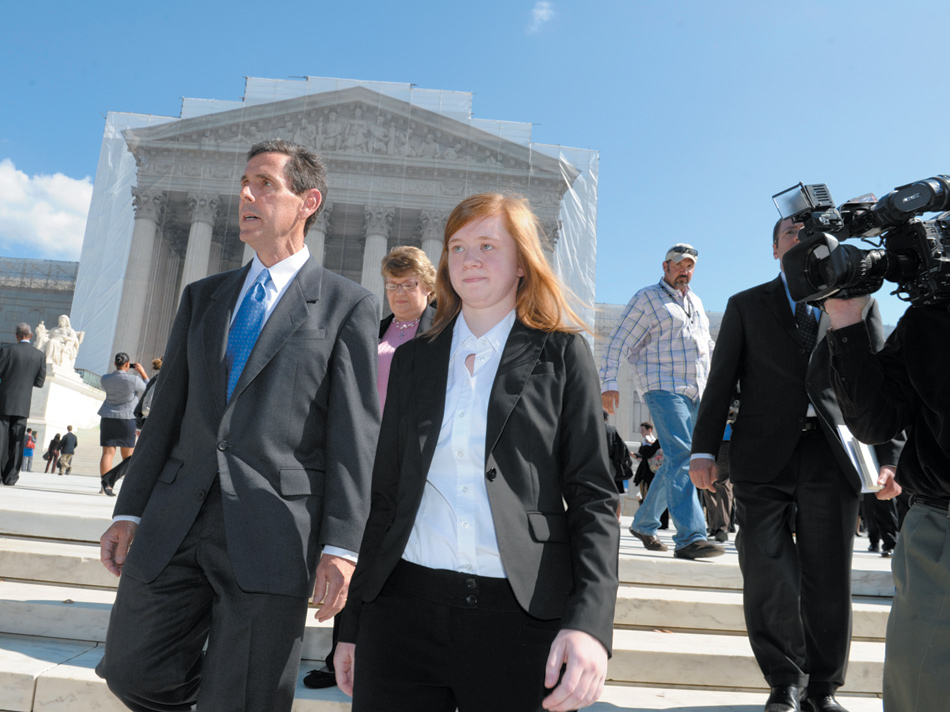
Abigail Fisher, a white applicant who was denied admission to the Austin campus of the University of Texas, claims that the university infringed her constitutional rights because it has a policy, based on the principles approved in Grutter, of taking race into account as one factor. She does not claim that her SAT scores or her academic record were good enough to admit her under a standard that was neutral with respect to race. She insists only that her constitutional rights were denied just because the standard was not race-neutral.
Judging from the oral arguments, the five conservative justices are likely to agree: they are likely to declare that the Constitution, in principle, demands color-blind criteria for admissions and that Texas has not shown that its racially sensitive standards for admission serve any goal that is sufficiently urgent to override that constitutional right. In order to test this legal claim, we need a brief review of the Court’s recent jurisprudence of race. In a series of historic decisions in the 1950s and 1960s, including its 1950 Sweatt v. Painter decision requiring the University of Texas School of Law to accept black candidates, its 1954 Brown v. Board of Education decision outlawing racial segregation of public schools, and its 1967 decision in Loving v. Virginia prohibiting laws banning interracial marriage, the Supreme Court ruled that public institutions that discriminate against blacks deny them the equal protection of the law.
We can justify these early decisions on either of two different theories, and the difference between them is of the utmost importance. We might say that they rest on a constitutional right not to suffer from official prejudice or stereotype. Or we might say that they rest on a very different right: that public institutions must always be color-blind in their decisions. Both these supposed rights would justify the early decisions. But the first justification—that people have a right against prejudice—would permit affirmative action plans whose history and structure rebut any suspicion that they express any kind of prejudice. The second justification would not. It would permit only racially sensitive admissions policies that can be demonstrated as necessary to serve a public interest sufficiently “compelling” to override a constitutional right.
In 1978 the Court was required to choose between these two very different interpretations of its past decisions. The University of California Medical School at Davis had set aside a specific number of places for minority applicants to be filled by a separate admissions committee whose members included only minorities. Alan Bakke, a white applicant who was denied admission, claimed that this admissions policy violated his right to equal protection. Justice Lewis Powell, speaking for a fragmented court in the Bakke case, chose the second of the two different interpretations of the past decisions. He said that Bakke had a constitutional right to a color-blind standard and that the Davis Medical School’s quota system was not designed carefully to serve any urgent state goal. But he offered a compromise: a state university does have a compelling interest, he said, in racial diversity in its student body that it might pursue in some less mechanical way. He quoted with approval Harvard’s description of its own admissions policy:
When the Committee on Admissions reviews the large middle group of applicants who are “admissible” and deemed capable of doing good work in their courses, the race of an applicant may tip the balance in his favor just as geographic origin or a life spent on a farm may tip the balance in other candidates’ cases…. In Harvard College admissions the Committee has not set target-quotas for the number of blacks, or of musicians, football players, physicists or Californians to be admitted in a given year….
The Harvard model was then widely adopted by state universities. But conservatives were not satisfied and they continued to press for total abolition of affirmative action programs. In 2003, in its Grutter decision, the Court reaffirmed the Harvard model: it said that a university may use race as a factor if its goal is to seek student-body diversity, provided that it avoids quotas and makes applicant-by-applicant judgments in which race counts only as one pertinent factor. Justice Sandra Day O’Connor sought to clarify what counted as “diversity.” She said that a university might use affirmative action to seek a “critical mass” of minority students sufficiently large that none of them felt isolated. She attached a sunset clause to her ruling: she said that she did not expect that affirmative action would be needed to achieve that goal after 2028.
Advertisement
But she retired in 2006, and was replaced by the ultraconservative Justice Samuel Alito. Since the Court’s political composition had dramatically changed, opponents of affirmative action challenged it again. The transcript of the arguments in Fisher v. University of Texas makes sad reading. The arguments centered on whether the five conservative justices would need openly to overrule Grutter to find in Fisher’s favor, and so add to their fast-growing reputation for mowing down even recent past decisions with no respect for the value of precedent. Or could they find some unimportant difference in the facts of the two cases that would allow them to eviscerate Grutter without formally overruling it?
They asked a variety of questions meant to embarrass O’Connor’s reasoning. How can a university decide what is an appropriate level of diversity? What constitutes a “critical mass” of minority students? How do you measure racial isolation? Would a university need to hire psychologists to roam dining halls? Who actually counts as a minority applicant for purposes of diversity? Would a student of 25 percent Hispanic background who identified herself as of mixed race on her application count? If so, would one of 12.5 percent Hispanic background count?
Justice Alito was particularly outraged at the prospect that a minority applicant from a privileged background—the daughter of a black law firm partner, for instance—might be admitted over a more disadvantaged working-class white applicant with better test scores. Wouldn’t it be fairer, in any case, at least to give preference to poor black students over privileged ones? A Texas statute requires its universities to admit the top 10 percent of graduates from each high school. Because high schools in poor districts are dominantly black or Hispanic, this policy insures that some seriously disadvantaged minority applicants will be admitted to each campus. Why, Justice Alito asked, isn’t that enough and the right kind of diversity?
These apparently embarrassing questions are made pertinent by Powell’s choice of the second rather than the first interpretation I described of the earlier race case. If applicants really do have a constitutional right to color-blind standards, then it is hard to find a state interest sufficiently compelling to override that constitutional right. Certainly it would not do to claim that affirmative action will help make the country more egalitarian in some way. Equality cannot trump a genuine constitutional right. We could not justify abolishing or censoring right-wing nationalist political parties on the ground that they threaten equality. So defenders of affirmative action have been forced to fall back on the shorter-term goal of classroom diversity that Powell offered and O’Connor confirmed. This is a fragile defense because it offers only vague standards.
2.
We need to reexamine Powell’s initial choice. It will help, I think, to begin not with a legal but a moral question. Do university applicants have a moral right to admissions policies that are strictly neutral with respect to race? Most people, I think, would answer yes. That widespread conviction undoubtedly fueled Powell’s choice. But though it is popular, I believe that answer to the moral question is wrong. The question must be answered: no.
We start with what is obvious. People do have a moral right that institutions not reject or discount them just because their race is despised or culturally stereotyped as inferior or unsuited. For many decades blacks—and until relatively recently Jews and women as well—were denied a fair chance at admission to white, Christian, and male-dominated universities and professional schools for exactly that morally unsupported reason. People like them were just not wanted. The Court’s early decisions on race rightly ruled that kind of discrimination unconstitutional.
But it seems equally plain that people do not have a moral right that universities avoid any admissions standard that puts some people at a disadvantage. That supposed right could be satisfied only by an admissions lottery. So we must insist on a distinction: some criteria that disadvantage some applicants are permissible and some are not. Those that reflect prejudice cannot be permitted. But a very wide variety of other standards are widely accepted as permissible, because they obviously express no prejudice, even though they do put some applicants at a marked disadvantage. Giving preference to applicants who score well on aptitude tests or who have good prior academic records obviously puts many applicants at a disadvantage. But it does not stereotype any social group as less clever, and those applicants who are judged less clever by these tests and records are not thought inherently unworthy or undesirable for that reason. They have a lower chance of admission because universities have adopted a particular—though by no means automatic or exclusive—sense of their mission.
Advertisement
It is important to recall that academic ability is not the only criterion universities use to select students: some people have less chance of admission for very different reasons. In the case of admissions policies and student aid programs that emphasize athletic ability, short people have a lower chance at the universities that pride themselves—and depend financially—on the success of their basketball team. People from conventional backgrounds with conventional tastes have a lower chance of admission at other universities that prize eccentricity. Applicants at some law schools have a lower chance of admission if their ambition is wealth rather than public service. Foreign applicants have a higher chance of admission than domestic ones at universities that think it desirable that their students encounter people with foreign backgrounds or perspectives, and also desirable that some of their graduates return to their own countries with an education reflecting American values and culture.
These admissions policies violate no one’s moral rights. Short applicants do not have a right that universities not aim at athletic success; domestic applicants have no right that universities not aim at a more cosmopolitan student body. Why is race different? Why are universities not morally free to use racially sensitive criteria to serve a different kind of goal: helping to make our community more socially and economically integrated, as well as legally? They may think that it serves that goal when more black university graduates secure prominent places in the professions and government: when more law firms have black partners, for example, and more black professors teach white students. That might help to erode stereotypes and encourage minority children to aim higher than they do. Affirmative action programs do not guarantee these desirable results of course, but they may well contribute to them.1
A great many Americans do think that race is different. A great many white applicants who are rejected even though they have better test scores than some successful black applicants do feel that they are victims of unfair discrimination. But their resentment seems unjustified. When we consider the matter from a moral point of view, we find we have no more reason to condemn all racially sensitive admissions than we have to condemn all standards sensitive to athletic promise or geographical distribution.
Of course racially sensitive criteria may raise suspicion that some hidden prejudice, stereotype, or plain favoritism has actually driven the policy. Perhaps a medical school’s decision to set aside a quota of places to be filled by an entirely minority selection committee was not the result of a general faculty judgment but of demands by its minority members, for example. But there is no room for any such suspicion about the familiar affirmative action programs in large universities. No one could rationally suspect that the University of Texas is prejudiced against the white students who still form almost all of its student body.
3.
So Fisher has no moral right to match the constitutional right she asks. If the Constitution’s text or the Supreme Court’s past decisions, properly interpreted, really do mean that she has that right—that she has a right to color-blind admissions standards—then the gap between constitutional law and moral sense is very wide on a question of great political importance. Is that gap really there?
The text of the Fourteenth Amendment’s equal protection clause does not mention race: it says only that no one shall be denied equal protection of the laws. The Supreme Court’s rulings over many decades have clarified the effect of that prohibition in cases not involving race. The Constitution does not prevent regulative legislation that gives advantage to some over others—to optometrists over oculists, for example—when the legislation serves a “rational” purpose that reflects no prejudice or favoritism. The Court’s later decisions about “suspect” distinctions, other than race—distinctions based on gender, physical disability, and sexual orientation, for example—reflect the same understanding that such distinctions are permissible so long as they do not reflect prejudice or stereotype.
In Craig v. Boren, for example, in 1976, the Court ruled unconstitutional an Oklahoma statute prohibiting the sale of “nonintoxicating” 3.2 percent beer to males under the age of twenty-one and to females under the age of eighteen. It did not say that political decisions must all be gender-neutral. Instead it said that the statute denied equal protection because it was based on a stereotypical assumption that men are more often drunk and dangerous than women, an assumption that the evidence did not support. In Cleburne Living Center, Inc., in 1985, the Court voided an interpretation of the city’s housing ordinance denying a permit to a proposed home for “feebly minded” people. Justice Byron White, for the majority, said he was not assuming that distinctions based on mental competence are always unconstitutional, but rather that the facts of the case revealed prejudice against the mentally ill.2
When we look closely at the Court’s recent affirmative action decisions, moreover, we find the same discriminating principle, rather than a flat right to color-blind statutes, at work. In a series of increasingly sophisticated opinions by Justice Sandra Day O’Connor, culminating in her Grutter opinion, the Court moved the law away from that flat right to the morally more respectable position that the equal protection clause bans prejudice, favoritism, and stereotype. She defended the Court’s strict scrutiny of racial distinctions on evidentiary grounds: it is necessary to test all racial classifications by asking whether they are carefully designed to serve a compelling interest, she said, in order to “smoke out” illegitimate motives for racial distinctions disguised as benign ones. “Absent searching judicial inquiry into the justification for such race-based measures,” she said in the 1989 Croson case, “there is simply no way of determining what classifications are ‘benign’ or ‘remedial’ and what classifications are in fact motivated by illegitimate notions of racial inferiority or simple racial politics.”
So Powell’s fateful declaration of˙ a universal constitutional right to a color-blind test in all circumstances now stands exposed by such decisions as a doctrinal misfit. It was not required by a fair reading of the Court’s earlier decisions striking down racial segregation. It does not fit with the Court’s later decisions about what equal protection requires in other areas in which prejudice or stereotype has been historically evident. It does not even fit the Court’s later decisions about racial standards in Grutter and other recent cases.
The Court would do best to recognize that Powell’s interpretation of the law was a mistake that does not fit logic, political morality, or its own precedents. It should take the opportunity of the Fisher case finally to deny that there is any constitutional right to color-blind standards in all circumstances. It could then adopt the more sensitive constitutional test I have urged. That test creates a presumption that certain kinds of standards are illegitimate but allows that presumption to be overcome when suspicion of an impermissible motive is refuted.
This will not happen. On the contrary—unless some of them reconsider their positions—the five conservative justices will expand the alleged right to color-blind tests on all occasions and try to cement it more firmly into constitutional jurisprudence. They will overrule their own precedents, in effect if not formally, in the wrong direction and for the wrong reason.
4.
It certainly does not follow from my argument that publicly financed universities should be free to adopt any admissions scheme or goal they wish. It rather means that academic and political debate should concentrate on the real issue: Which schemes and goals are sensible? It should be an academic decision, subject to political supervision, how far a state university should seek athletic success, for example, or special excellence in some particular field of research, or a racially diverse student body. Universities should also be free to adopt the assumption I described earlier: that it is good for the community as a whole when more minorities are visible in professions and other admired positions.
In the oral argument only Solicitor General Donald Verrilli cited that goal; he did so on behalf of his own client, the United States as a nation. He conceded that much of the technical jargon of the precedents should be ignored. Though O’Connor had said that universities could seek a “critical mass” of minority students, he agreed with the five conservative justices “that critical mass—the idea of critical mass has taken on a life of its own in a way that’s not helpful because it doesn’t focus the inquiry where it should be.” Then he said what the real issue was:
I think it is important, Your Honors, not just to the government, but to the country, that our universities have the flexibility to shape their environments and their educational experience to make a reality of the principle…that our strength comes from people of different races, different creeds, different cultures, uniting in a commitment to freedom, and to a more perfect union.
His clear statement shows why so many of the taunting questions the five conservative justices asked in the oral argument miss the point. Throughout the argument, for example, they referred to the Texas state law I mentioned that requires its universities to admit the top 10 percent of the graduates of each public high school. That automatically supplies some small level of diversity because some schools, in poor school districts, have almost exclusively black students. Why, they asked, isn’t that diversity enough?
The question treats minority students as a fungible commodity, as if it matters only how many black or Hispanic faces appear in the classroom. It doesn’t recognize that universities should be free to select those minority students it believes most likely to enter and succeed in professions, or otherwise help in reducing racial stereotype and prejudice, whether or not they are in the top 10 percent of residentially segregated high schools. To answer Alito’s objection that the selection of the top 10 percent of high school students results in the right kind of diversity, universities should be able to argue that the black candidates that they consider to be better educated and more promising are especially valuable for securing the prospect Verrelli described, of making the American community socially and economically as well as legally more integrated by providing more minority graduates of prestigious universities who will occupy visible places of importance.
Roberts treated his snappy statement that “the way to stop discrimination on the basis of race is to stop discriminating on the basis of race” as obvious. But it is hardly obvious when we clarify it to make it pertinent. Suppose he had said, “The way to stop some people discriminating on the basis of race is to stop government from ever discriminating on the basis of race.” Then his claim would become a controversial sociological judgment. I earlier cited a comprehensive empirical study that suggests the contrary: that affirmative action programs have made the country less prejudiced by stereotype.3 This claim is contradicted by other studies: perhaps the justices will cite some of these when they finally decide the Fisher case. But the issue is a complex one. It depends not only on sophistical statistical analysis but also on more general observation of racial economic and social integration. It should be decided, at least in the first instance, by academics and legislative officials making informed judgments. It should not be decided by judicial fiat based on no record whatsoever.

-
1
This is among the conclusions of what remains the most comprehensive empirical study: William G. Bowen and Derek Bok, The Shape of the River: Long-Term Consequences of Considering Race in College and University Admissions (Princeton University Press, 1998). I do not assume that their much publicized findings are universally accepted. See, for example, Abigail Thernstrom’s comments at www .pbs.org/wgbh/pages/frontline/shows/sats/interviews/thernstrom.html. But it is not unreasonable for a university to think, as so many apparently do, that affirmative action programs have had and will have the social benefits I describe. ↩
-
2
The Supreme Court has tried to reconcile these later equal protection cases by announcing a new category of scrutiny: it requires “strict” scrutiny of racial and religious distinctions but only “intermediate” scrutiny of other suspect classifications. That Ptolemaic elaboration has made the law of equal protection even more clumsy and opaque. ↩
-
3
See Bowen and Bok, The Shape of the River. ↩