
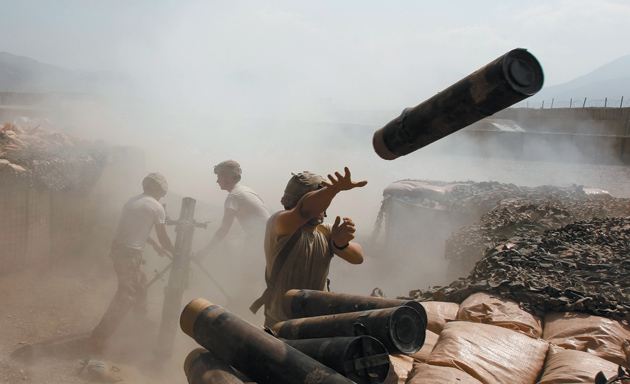
The United States and its allies today find themselves in a position in Afghanistan similar to that of the Soviet Union in the late 1980s, after Mikhail Gorbachev decided on military withdrawal by a fixed deadline. They are in a race against the clock to build up a regime and army that will survive their withdrawal, while either seeking a peace agreement with the leaders of the insurgent forces or splitting off their more moderate, pragmatic, and mercenary elements and making an agreement with them. The Soviets succeeded at least partially in some of these objectives, while failing utterly to achieve a peace settlement.
To date, that is just about true of the West as well; and while international support for the US position is much stronger than it was for the Soviets, our Afghan allies are much weaker and more fissiparous than theirs. Our Taliban enemies have been much more worn down militarily than the Afghan Mujahideen were by the Soviets during the late 1980s. But the Taliban and their allies draw on the same deep traditions of Islamist resistance to foreign “occupation” among the Pashtuns of Afghanistan and Pakistan as did some of the Mujahideen groups that fought against the Soviet occupation. (While Pashtuns are the largest ethnic group in Afghanistan, making up perhaps 40 percent of the population, they also make up about 15 percent of the Pakistani population and are concentrated along the Afghan border.) The Taliban have, moreover, comparatively safe bases in Pakistan to which they can withdraw. They will remain a very serious force.
Several recent studies and memoirs deal wholly or in part with the Soviet period in Afghanistan and draw lessons for our own campaign. Afgantsy, by the former British ambassador to Moscow Sir Rodric Braithwaite, is by far the best account in English of the Soviet experience there, and brings out very well how, in their fight against the Afghan Mujahideen, the Soviets wrestled with many of the same intractable Afghan realities that have bedeviled our efforts. A Long Goodbye, by Russian historian Artemy Kalinovsky, is an excellent account of the Gorbachev administration’s handling of the actual withdrawal process and the futile Soviet search for a peace settlement.
Two fine books by veteran journalists describe the period from the 1980s to the present. Edward Girardet, a reporter and television producer who has covered Afghanistan since the 1979 Soviet invasion, has written Killing the Cranes, an account that contains some of the best descriptions of Afghan people and events that I have read, and as a Western memoir of Afghanistan can stand comparison with David Chaffetz’s classic Journey Through Afghanistan from the pre-Communist era.1 Ghosts of Afghanistan, by the British Guardian journalist Jonathan Steele, is a more analytical account that explicitly links the Soviet and Western experiences and ends with a powerful and eloquent argument for peace with the Taliban.
Much bigger, and much more open to question, is The Wars of Afghanistan by Ambassador Peter Tomsen, President George H.W. Bush’s special envoy to the Afghan resistance from 1989 to 1992, and participant in various official and semiofficial missions thereafter. Tomsen’s work contains many fascinating anecdotes, and is indispensable reading for all students of Afghani-stan and the US achievement there over the past generation. However, its underlying message is all too typical of official Washington: despite some criticism of US errors, Tomsen attributes all the real guilt for what has happened in Afghanistan over the past twenty years to Pakistan and its “proxies.” This argument contains a measure of truth, but ignores the frequently horrible nature of the West’s own Afghan allies, the awful dilemmas faced by Pakistani policymakers, and the extent to which radical forces have attracted mass support.
Readers should balance Tomsen with an extremely important memoir-analysis by Riaz Mohammad Khan, a Pakistani diplomat who served as foreign secretary of Pakistan from 2005 to 2008. While sharply criticizing some aspects of the Pakistani military’s strategies regarding Afghanistan, he also brings out well the sheer intractability of the Afghan situation, and the degree to which Pakistan too has been trapped by forces and developments beyond its control.
It is exceptionally important that US policymakers read the book by Mohammad Khan, because there is a strong tendency in US official circles and in the US media to treat the Pakistani state as the enemy in Afghanistan, and to assume that Taliban resistance in Afghanistan would largely disappear if Pakistan could somehow be bullied or bribed into submission. This misunderstands the deep popular sympathy on the part of the Pashtuns on both sides of the border for the Taliban, who are seen among many Pakistani Pashtuns as a legitimate resistance force. A perspective such as Tomsen’s risks embroiling the US in a conflict with Pakistan that would greatly increase the terrorist threat to the West.
Advertisement
In one important respect, we can only hope that we do as well as the Soviets in Afghanistan. After the Soviet military completed its withdrawal at the start of 1989, the Afghan state that it had fostered fought on with surprising resilience. Indeed, remarkably enough, the Soviet-backed administration of Mohammad Najibullah Ahmadzai in Kabul outlasted the Soviet Union itself. Its collapse in April 1992 occurred when it did because the end of the Soviet Union also brought an end to Soviet supplies of fuel, guns, and money.
The record between 1989 and 1992 brings out the fact that it is highly unlikely that the Taliban will be able to storm Afghan cities after the US withdrawal. The respective logics, on the one hand, of guerrilla warfare, as successfully practiced by the Mujahideen and Taliban, and, on the other hand, of siege warfare are diametrically opposed. The first requires hit-and-run attacks followed by the rapid dispersal of forces. The second requires the concentration of enemy forces for a prolonged period—at which point they can be successfully blasted by the superior firepower of the other side.
This is what happened to the Mujahi- deen when, with Pakistani encourage- ment, they tried to capture the city of Jalalabad in March 1989. I witnessed that battle as a journalist for the London Times. The contrast between that terrifying battle and previous experiences with the Mujahideen, when I had felt in no serious danger except from mines, has remained with me ever since.
Instead, Pashtun cities like Kandahar may fall to defecting forces from within, just as the final blow was dealt to the Najibullah administration by splits in its own ranks, and above all by ethnic tensions between Pashtuns and Tajiks, who are Afghanistan’s second-largest ethnic group. From this point of view, we are if anything in an even worse position than the Soviets—a weakness that stems from the fact that the Soviets in 1979 inherited a battered but still functioning Afghan state and army that embodied the fragile and limited but real advances in modernization that had been made in Afghanistan during the previous century. By 2001, almost nothing of that was left. Moreover, long-suppressed ethnic tensions—for example between Pashtuns and Tajiks—burst out after the Soviet collapse in 1991, and have grown since the US invasion in 2001, leaving the West and the Hamid Karzai administration to deal with a dreadful legacy of ethnic atrocities and hatred.
The Afghan National Army put together by the US after 2001 was at first overwhelmingly dominated by non-Pashtuns, with its high command drawn almost exclusively from the ranks of Tajiks from the Panjshir Valley in north-central Afghanistan, previously commanded by the great Mujahideen leader Ahmed Shah Masoud, who was assassinated by al-Qaeda. During the years since, great efforts have been made to increase Pashtun recruitment—in part, by bringing back ex-Communist Pashtun officers who were trained in the Soviet Union and served alongside the Soviet army. (Najibullah was an ethnic Pashtun, as is President Karzai.)
However, the proportion of soldiers from Greater Kandahar and Greater Paktika—the largely Pashtun heartlands of the Taliban and Haqqani insurgencies—remains small. Two recent memoirs of the war in Afghanistan, by the US former soldier and official Bing West and the British former intelligence officer Frank Ledwidge, include accounts of occasions when they saw Tajik officers treating local Pashtuns with ferocious arrogance and intimidation. If this kind of thing takes place with US and British soldiers present, it is not hard to imagine what will happen after they leave.2
Moreover, the Afghan Communist state and army were quite well integrated. As is apparent even from the Department of Defense’s report on Afghanistan of October 2011, what America has done is to create a huge Afghan army—but one that is overwhelmingly dependent on US help to pay and arm its troops—alongside a weak and shamefully inept civilian state.
Finally, the Soviets were not burdened by even the appearance of democracy. Najibullah could remain president for life with full Soviet backing. We by contrast have in Hamid Karzai a leader who is far weaker than Najibullah; whose prestige has been disastrously undermined by corruption, incompetence, and the rigging of the 2009 presidential elections; and who according to the Afghan constitution has to step down when his second term expires in 2014. As US officials candidly admit, there is no plausible US plan for how to manage the succession to Karzai. When a list of possible candidates is assembled, each one looks disastrous, especially from the point of view of ethnic relations. Karzai himself may be thinking about how to remain in power, or about how to pick a trusted associate to succeed him. Couple this with the planned withdrawal of US ground troops in the same year, and a truly catastrophic prospect begins to emerge.
Advertisement
In these circumstances, it is highly probable that government-equipped military forces of one group or another will sooner or later stage a takeover of much of the country. The willingness of the US Congress and public to go on subsidizing Afghanistan would then be gravely undermined. If the coup were seen to be led by Tajik officers, there would be a counter-coup by Pashtun officers, and so on. If the Pashtun parts of the army lost in Kabul, many would defect to the Taliban—replicating in many ways the pattern of the civil wars that followed the Najibullah regime’s fall in 1992.
The Afghan civil war would then intensify drastically and continue indefinitely. The Taliban could not capture even Kabul, let alone the non-Pashtun areas to the west and north, in the face of the opposition from Tajiks and other ethnic groups backed by the US, India, and Russia; but the dividing lines between the different territories would be drawn in battle, and amid horrendous bloodshed.
To avoid such a ghastly outcome, I am convinced with Jonathan Steele that we would do well to prepare ourselves to seek a peace settlement with the Taliban leadership. Once an eccentric and even despised view, this argument has in recent years been made by an increasing range of leading figures involved in Afghanistan, including the commission led by former Undersecretary of State Tom Pickering and former UN Special Adviser Lakhdar Brahimi; the Afghanistan Study Group, uniting many US experts; Michael Semple, another former UN official; and the former British ambassador to Kabul, Sherard Cowper-Coles.
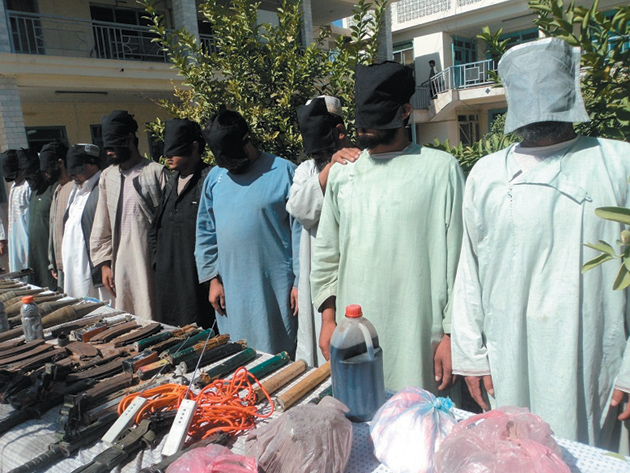
In recent months, there have been encouraging signs from both the Taliban and the US administration that they may be ready for serious peace talks. The Taliban have agreed in principle to set up an office in Qatar to conduct negotiations, an important step. On the US side, Vice President Joe Biden has declared that “the Taliban per se is not an enemy” of America, and there is talk of cease-fire zones and other confidence-building measures of a kind that have been proposed in private by Pakistan’s army chief, General Ashfaq Kayani. However, if peace is to be achieved, the administration, and the US public, will need to start focusing on what kind of settlement is realistically possible.
The various attempts at “reconciliation” undertaken so far have not really amounted to a genuine effort to reach a settlement but only to a strategy for splitting the Taliban by winning over some lower-level commanders—something that is indeed very clear from the WikiLeaks cables on the subject cited by Steele. The lack of sincerity of Karzai’s overture to the Taliban was demonstrated clearly by his choice of Burhanuddin Rabbani (assassinated in September 2011, allegedly by the Taliban) to lead the reconciliation effort. As president of the Tajik-dominated Mujahideen government in Kabul after the fall of the Communists, Rabbani stood high on the list of figures personally detested by the Taliban and their followers.
Above all, if the goal is a political settlement, then a proposal must be made that the Taliban leadership can accept as an initial basis for negotiations; and so far no such proposal has been drawn up by Washington or Kabul. A further complication is that such a proposal must also be minimally acceptable to the Pakistani security establishment. Despite the shelter given to the Taliban by the Pakistanis, deep distrust and even personal loathing exists between the Taliban leaders and Pakistani generals. However, the Pakistani high command is certainly in a position to wreck any settlement that it sees as contrary to Pakistan’s vital interests. Equally, the Pakistani generals will not press onto the Taliban any proposals that the Taliban are bound to reject, since such a rejection would only further discredit the Pakistani establishment among its own people and soldiers.
On the basis of my conversations in recent years with former leading figures in the Taliban and Pakistanis close to Mullah Omar and his colleagues, my own judgment is that a peace settlement between the US, the administration in Kabul, and the Afghan Taliban would probably have to be based on some variant of the following elements:
(1) complete withdrawal of all US troops according to a fixed timetable;
(2) exclusion of al-Qaeda and other international terrorist groups from areas controlled by the Taliban;
(3) a government in Kabul headed—at least nominally—by men the Taliban would see as good Muslims and Afghan patriots;
(4) negotiations on a new Afghan constitution involving the Taliban and leading to the transfer of most powers from the center to the regions;
(5) de facto—though not formal—Taliban control of the region of Greater Kandahar, and by the Haqqanis of Greater Paktika;
(6) a return to the Taliban offer of 1999–2001 of a complete ban on opium poppy cultivation and heroin production in the areas under their control, in return for international aid.
On the last point, it should be remembered that the Taliban are the only force to have achieved such a degree of control of the drug trade during the past thirty years. Certainly, based on their record to date, the idea that our own Afghan allies will do so after the US withdraws is pure fantasy.
The reason why the Taliban might accept such a settlement is that if they have any capacity for military analysis, they must know that even if they win in many more years of bloody battles, they would still not get much more than what I have outlined. In the face of US, Russian, and Indian backing for the non-Pashtun forces, they would still not be able to storm Kabul or the cities of the north. Among many others, I have heard anecdotal evidence that the Taliban leadership is becoming tired, and that morale is suffering from the number of commanders who have been killed. As a result, there are growing fears on the part of the leadership that they are losing control of the younger local fighters who are succeeding those who have been killed. That does not mean, however, that Mullah Omar and his comrades will ever accept an agreement that their followers would see as betrayal and surrender.
As to links between the Taliban and al-Qaeda, these will continue as long as the Taliban are at war with the US; nor will the Taliban ever hand over al-Qaeda members to America; but there is good reason to think that after the experience of 2001, the Taliban leadership will not allow al-Qaeda to wreck an agreement that the Taliban see as acceptable. The underlying tensions between the two groups before September 11 have been extensively explored in An Enemy We Created, a new book by Alex Strick van Linschoten and Felix Kuehn, who previously edited and published in English the most important document yet to emerge from the Taliban’s ranks, the memoirs of Mullah Zaeef, former Taliban ambassador to Pakistan.3 That the Taliban are overwhelmingly focused on Afghanistan also emerges strongly from the works of Antonio Giustozzi, probably the world’s greatest expert on the Afghan Taliban.
The Pakistani military analysts and Riaz Mohammad Khan share the belief that a Taliban capture of Kabul and the north is impossible. Moreover, sensible Pakistani officers do not want the Taliban to conquer the whole of Afghanistan, because they would then be free to turn on Pakistan by giving their support to their Pashtun brothers who are in revolt against Pakistan as part of the Pakistani Taliban (Tehreek-e- Taliban Pakistan, or TTP).
Just what the Pakistani security elite is really aiming at is extremely difficult to work out. Quite apart from the levels of opacity and deceit in which Pakistani policy is wrapped, the Pakistani state is weak and soft. Even in the military, lines of command have become blurred. The ultimate power of decision on Pakistan’s Afghan strategy lies with the chief of army staff (currently General Ashfaq Kayani) and the high command; but Inter-Services Intelligence (ISI), and even cells within the ISI, appear to have considerable autonomy. Since the ISI has been working with militant groups for more than four decades, some of its cadres have developed strong personal and ideological affinities with them. They may still dream of a victorious jihad in Afghanistan sweeping the Taliban to rule over the whole country. Indeed, so close is the identification of some ISI officers with the Taliban that there is some doubt whether the Taliban is acting as Pakistan’s proxy or the ISI is acting as the Taliban’s proxy.
For the Pakistani military as a whole, however, a peace settlement along the lines I have sketched above would fulfill its essential needs. It would keep the influence of India in Afghanistan at a distance from Pakistan’s borders. It would ensure adequate Pashtun representation in Afghan government, limiting the power of forces linked to India. It would remove the catastrophic threat of Indian-backed Tajik forces fighting an ethnic civil war in Afghanistan’s Pashtun territories, sending fresh millions of refugees fleeing into Pakistan. And it would end the US drone strikes and raids that are infuriating the lower ranks of the Pakistani military and leading to catastrophic clashes between Pakistani and US forces along the Afghan border.
Such an outcome would serve a vital interest of the United States. For it is no exaggeration to say that the tension between the Pakistani military and the United States now poses a threat to US security that dwarfs either the Taliban or the battered remnants of the old al-Qaeda. As I have found from speaking with Pakistani soldiers, and from visiting military families in the chief areas of recruitment in northern Punjab and Khyber-Pakhtunkhwa, the fury of the junior ranks against the US is reaching a dangerous pitch. These soldiers share both the sympathy for the Afghan Taliban of the population at large and that population’s deep distrust of US intentions. They are increasingly angry with their own commanders, whom they view as cowardly and corrupt; and they are profoundly humiliated when they return to their towns and villages and are asked by neighbors—and even their own women—why as slaves of the US they are killing fellow Muslims.
There seems, as a result, a strong likelihood that if Pakistani soldiers encounter US soldiers on what is or what they believe to be Pakistani soil, they will fight. This is apparently what happened in the incident on November 26 in which twenty-four Pakistani soldiers were killed by US forces, leading to a drastic further deterioration in relations (including retaliatory closing of the border to NATO). That encounter was bad enough; but if such clashes continue then at some point things will go the other way, and Americans will be killed—possibly a lot of Americans, if for example the Pakistanis shoot down a helicopter. If on the other hand the Pakistani generals order their men not to fight, the resulting outrage could undermine discipline to the point where the unity of the army could be in question—and if the army breaks apart, not only will immense munitions and expertise flow to terrorists, but the Pakistani state will collapse. This would be a historic triumph for al-Qaeda and its allies—and like the invasion of Iraq, one made possible for them by the United States.
To my astonishment, I find that some US officials are now arguing that a principal reason why the US must retain bases in Afghanistan—even at the price of making a settlement with the Taliban impossible—is in order to continue striking at al-Qaeda and other extremist targets in Pakistan’s border areas. More than ten years after September 11, it is simply appalling that supposedly well-informed people are still treating the terrorist threat in such a crude and mechanistic fashion. Have they not realized that the membership of al-Qaeda and its allies is not fixed, but depends on al-Qaeda’s ability to recruit among Muslims infuriated by US actions? Or that a terrorist attack on the US is as likely—more likely—to be planned in Karachi, Lahore, the English town of Bradford, or New York as in Pakistan’s frontier areas? An essential US motive for a peace settlement in Afghanistan, one allowing complete withdrawal from Afghanistan, is precisely that it would allow America to pull back from the existing confrontation with Pakistan—not continue it into the indefinite future, with all the gains that this would create for resentment by extremists.
Even if the advantages of a settlement are recognized by Washington, how can the US sell it to its allies in Afghanistan, to President Karzai and his followers, and to the leaders of the non-Pashtun ethnic groups? The answer lies partly in assuring all the other parties that the US will continue to guarantee military support against any future Taliban move to attack Kabul or invade the north; and partly in the approaching train wreck that the simultaneous departure of both US troops and Karzai may cause.
The pursuit of a peace settlement should be combined with the discussion of a post-Karzai political order in Kabul, and with an Afghan national debate on reform of the constitution, which is now widely recognized to be deeply flawed and far too centralized, and which was never truly approved by the Afghan people. The first step to peace with the Taliban therefore should be to acknowledge their right to participate in a genuine national debate on a new Afghan constitution.
Finally, what of the fate of the social progress made since 2001, especially with respect to women’s rights? Jonathan Steele gives a powerful answer to the question. The melancholy truth is that the Taliban are no more reactionary in this regard than most of Afghan rural society. As the briefest glance at media coverage of Afghanistan in recent years makes clear, the limited gains for women’s rights have been made only under intense Western pressure and in the face of apparent strong resistance from our own Afghan political and military allies.
Where the Taliban were different—and attracted international opprobrium—was not in their basic culture, but in the way they codified the suppression of women in state law rather than leaving it to local and family custom. Moreover, they extended this suppression to the cities where women had made real though precarious progress over the course of the twentieth century. The task of the US and its allies therefore must be to preserve the cities at least as areas where women can continue to enjoy more rights and opportunities in the hope that a new culture will gradually spread from them to the countryside.
This is a depressing prospect when compared with the hopes that followed the overthrow of the Taliban ten years ago. But let us face facts. Our societies and official establishments have demonstrated beyond any possible doubt that they lack the stamina and capacity for sacrifice necessary to remain in Afghanistan for the decades that would be necessary to transform the position of Afghan women as a whole; and there is nothing ethical or responsible about setting goals from the safety of London or Washington that informed people know cannot in fact be reached. We do have a chance to try to do better than the Soviets and to try to save Afghanistan from an endless future of civil war, and to establish a peace in which future progress may be possible. It is our duty to take that chance.
—January 11, 2012
This Issue
February 9, 2012

The Wrong Leonardo?
Václav Havel (1936–2011)
The Republican Nightmare
This Issue
February 9, 2012
The Wrong Leonardo?
Václav Havel (1936–2011)
The Republican Nightmare
-
1
David Chaffetz, A Journey Through Afghanistan: A Memorial (1981; University of Chicago Press, 2001). ↩
-
2
Bing West, The Wrong War: Grit, Strategy, and the Way Out of Afghanistan (Random House, 2011); Frank Ledwidge, Losing Small Wars: British Military Failure in Iraq and Afghanistan (Yale University Press, 2011). ↩
-
3
Mullah Abdul Salam Zaeef, My Life With the Taliban, edited by Alex Strick van Linschoten and Felix Kuehn (Columbia University Press, 2010). Mr. Strick van Linschoten is studying for a Ph.D. at King’s College London under my supervision. ↩

