
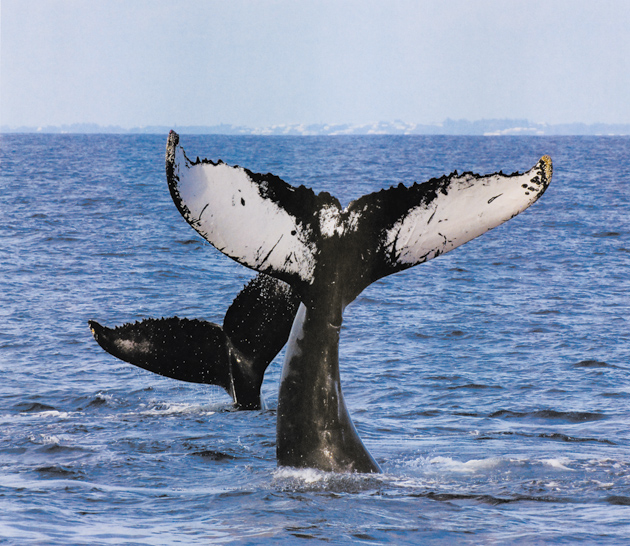
The twentieth century almost did in whales. At its opening their great feeding grounds in the southern ocean were undisturbed by the blast of the harpoon gun, yet by the 1980s it was hard to find a large whale anywhere.
I worked as a curator of mammals at the Australian Museum in Sydney at the time, and saw living whales on only a handful of occasions: most memorably when I was traveling at dawn by outrigger canoe in eastern Indonesia. The tropical sea was as smooth as oil and a pod of dolphins moved around two huge, serrated shapes lying in the water—the backs of two sperm whales. They remained motionless as we drifted to within a few meters of them. Then, almost imperceptibly, they began to shift. Their heads slipped below the water as they arched their backs until their huge flukes rose into the air above us, before they silently moved into the depths. I had not glimpsed “the awful Chaldee of the Sperm Whale’s brow,” as Melville put it, but the sight had left me by turns puzzled, awed, terrified, and profoundly touched.
D. Graham Burnett’s The Sounding of the Whale is an inquiry into the fate of the great whales of the southern Pacific. Their wholesale industrial immolation is now a fast-receding memory for most, yet the struggle to save them was an important milestone in the battle to manage our environmental commons. Played out against a background of two world wars, the halting development of international cooperation, and the rise of both deadly technology and the scientific expert, it’s a story from a very different, yet eerily familiar world.
Burnett’s primary sources are the minutes and notes of the committee meetings of the International Whaling Commission (IWC) and its predecessors. In other hands it might have yielded a story as dry as dust, but this historian has an eye for small, telling details, resulting in an intriguing book full of paradoxes and unlikely heroes. Among the latter is the American biologist John C. Lilly. He believed he could communicate with cetaceans, and he rated their powers of ratiocination far above our own. The sperm whale has the largest brain of any creature, and he reckoned that it was the greatest philosopher on Earth:
The sperm whale has gone so far into philosophical studies that he sees The Golden Rule* as only a special case of a much larger ethic…he probably has abilities here that are truly godlike.
Then again, this was the Sixties, when god-whales were as unexceptional in some quarters as female activists wishing to make love to the creatures. Despite the color provided by such characters, The Sounding of the Whale is not an easy read. Nor is it sentimental. It barely touches on the heroic era of whale hunting, when the chase involved sailing ships and hand-held harpoons, and it contains little about the lives of whales. Its great strength lies in exposing to the light of day the byzantine deliberations of the IWC—the organization charged with conserving the whales, but which instead oversaw their destruction. At almost 750 pages long it’s vast, and I regret to say that in parts its organization is as messy as a cetacean carcass bloating in the sun.
At the heart of industrial whaling lay the “floating factory,” described by one observer in 1952 as
a technical marvel. It is an oil-plant and a meat-meal factory. It is also a canning factory. It is a very well-equipped chemical works, with a most ingenious and varied routine. It is in fact a scientific institute of the first rank.
There were formerly large markets for whale meat, whale oil, and other products such as industrial wastes and fertilizers rendered from whale carcasses. (Now there is only a market for whale meat, mainly in Japan, Greenland, and Iceland.) But the idea that a whaling ship might be a scientific institute pulls one up. Burnett’s central theme is that scientists and whalers had entered a fatal compact that, from the start, doomed the whales. It was Sir Sidney Harmer, keeper of zoology of the British Museum (Natural History) from 1909 to 1921, and director from 1919 to 1927, who made that compact work. Yet his motives were pure. He had studied the tragic history of the whaling industry in the northern hemisphere and in a 1911 report concurred with Dr. Flower, his predecessor in the museum, that it was nothing but an exercise in “cupidity” and “ruthless extermination.” Now the whalers had turned their attention southward and a “gold rush” in whale products was underway. How long would it be before the great antipodean whale stocks followed those of the north into oblivion?
Advertisement
Nobody could answer that question with any certainty because virtually nothing was then known about whales. Indeed, such was the state of ignorance that the world’s leading scientific journal, Nature, could publish a grossly misidentified photograph of a whale and go uncorrected. Harmer was one of the very few professionals in a position to become an authoritative advocate on behalf of whales, but even he had no idea how long they lived, how often they reproduced, or how many there were. And without such knowledge, there was no hope of managing whale stocks.
In 1904 whalers established a beachhead on the British subantarctic island of South Georgia and were soon busy killing whales faster than they could strip them of blubber. Despite the lack of data, Harmer felt that these “noble beasts…among the most marvelous productions of nature,” were in peril. So when the opportunity arose to fund whale science using some of the royalty payments made by the whalers to the British government, Harmer saw his chance. Whale scientists would work alongside whalers to collect the required data: and so, according to Burnett, a generation of hip-booted cetologists was born.
Theirs was the first methodical attempt to study whales. As the enormous bodies were drawn to the factory in South Georgia, scientists measured and identified the whales, and dug out their gonads and fetuses to assess reproduction. Thus, paradoxically, whales were being killed in order to conduct science aimed at conserving whales. Even at this early stage some could see that the independent spirit of science might be captured by industry. Indeed it could hardly have been otherwise.
The first hip-booted cetologist was Major G.E.H. Barrett-Hamilton. An amateur field naturalist attached to the British Museum, he traveled to South Georgia in 1913 to labor in the Augean stable that was then the whaling station there. With up to forty whale carcasses amassed in the bay awaiting dismemberment and boiling down, the place was, according to one observer, “a charnel house boiling wholesale in vaseline.” The miasma that hung over the bay transformed the bright white paint of the ships to a boggish parchment, its putrid vapors resembling the pong of bad fish, manure, and a tanning works mixed together. And it was dangerous work. A rotting whale could fill with gas to bursting, ejecting a fetus the size of a motor vehicle with sufficient force to kill a man; or a chain might break, allowing a massive jaw bone to crush a worker.
In this hellhole, Barrett-Hamilton spent up to twelve hours a day measuring and burrowing into the rotting bodies of the leviathans. By January 16, 1914, he had sampled 294 individuals. But the personal cost was great. Exhausted, he died of a heart attack that night in his sleep. When the notes and specimens he had given his life for were shipped to Britain the major accompanied them, packed in a barrel of formaldehyde.
When Harmer analyzed the data collected by Barrett-Hamilton and others, he became even more alarmed about the fate of the whales. By 1914—just a decade after whaling on South Georgia had commenced—the number of humpbacks caught had declined by over 90 percent, from 5,300 per year to just 450. How long, Harmer fretted, before the fin whales, which counted among their number the blue whale—the largest creature that ever lived—followed? He asserted that the danger was imminent. The whalers, in contrast, claimed that there were fin whales aplenty. The argument that ensued bore more than a little resemblance to the 1980 wager between Paul Ehrlich and Julian Simon over whether resource scarcity would lead to an increase in their price. Like Simon, the whalers won: prices did not increase, and there were more fin whales than Harmer had thought—yet the resource would not prove inexhaustable.
By the 1920s land-based whaling stations were giving way to factory ships, and in Burnett’s book the cetologist F.D. Ommanney gives us the flavor of life aboard such vessels. He told of spending his days on the rolling and pitching cutting deck,
mountaineering…over mounds of red flesh and piles of bones [while] skillfully dodging over taut and criss-crossing steel hausers to the accompaniment of the usual warning shouts.
With trapdoors opening directly to the boilers waiting below, these were death-defying circumstances, and Ommanney was grateful when the foreman delayed proceedings for a minute or two so that a fetus could be extracted from a whale to be studied by students. Under such circumstances, could he be expected to object when, against regulations, a lactating female came up the slipway? With every whaleman paid a “lay,” or proportion of the proceeds from the catch, to save the female would amount to picking everybody’s pocket—including the man whose hand was on the trapdoor lever. Often, when the gunner who harpooned a lactating female came aboard the factory vessel, Ommanney
Advertisement
had to listen to a long explanation…. It had been dark or foggy, he did not see the calf. I smiled and felt like an indulgent schoolmaster and reached for the Red Label Johnnie Walker.
Whisky was then the coin of the whaling realm—useful for toasting mistakes, purchasing biological samples, and washing down the whale sausages that were a staple on the ships. It was understood to be so important to survival that the first whale scientists were supplied with three cases of Johnny Walker Black Label per trip as part of their kit.
If life aboard a whaler inevitably brought scientist and harpooner together, things were no different in politics. By 1946 the IWC had been established, and leadership had passed from British to American hands. In this new environment it was another museum man, Arthur Remington Kellogg, who played the leading part. He’d been a US delegate to the 1937 International Conference on Whaling, which resulted in the first global protection for whales, and he chaired the 1946 meeting that gave rise to the IWC as well as serving as its chairman twice. The pinnacle of his scientific career was doubtless the directorship of the Smithsonian Museum of Natural History, a capacity in which he served from 1948 to 1962.
Kellogg’s scientific reputation rests on his research into the bones of whales’ ears. By identifying slight changes in fossilized examples, he traced whale evolution through the eons. Like Harmer, his firsthand experience of living cetaceans was meager: indeed there is evidence of just a single interaction between Kellogg and a living cetacean, and that a horrifying one. By 1928 there was just one whaling company operating off America’s east coast. Based in New Bedford, William F. Nye Inc. captured dolphins (which are small, toothed whales) off Cape Hatteras and sold their oil for specialized lubricating requirements. Under instruction from Kellogg, workers for Nye had netted ten dolphins, looped ropes around their tails and dragged them to the high-tide mark, where Kellogg and some scientific colleagues could examine them. Kellogg knew that “a live porpoise can be handled about as readily as a satchel of dynamite,” so he had brought along a bottle of ether. This was poured into balls of cotton wool and forced into the blowholes of the dolphins, an operation that killed the first animal it was tried on. As the creatures weakened, however, they became more manageable.
One of the objectives of the scientists was to do “gross cortical mapping” of the dolphin brain. So they cut away the flesh of the head of one of the weakened animals, then chipped open its braincase. With the living brain exposed, they delivered an electric current to various parts of its surface and watched how the creature, which had not been properly anesthetized, responded. Such barbarity is today unthinkable, but we must remember that at the time whales were described as “the most splendid game in existence.” “Dude cruises” took wealthy American sportsmen out to hunt them, and even the likes of Kaiser Wilhelm II had gloried in the sport.
Like Harmer before him, Kellogg had a genuine concern for cetacean conservation. He wrote many articles on the subject, and urged others to inculcate the public with a sympathetic view of the animals. He was central to the formation of the Council for the Conservation of Whales in 1929, and turned out to be a brilliant statesman who dominated whale science and conservation from the 1940s to the 1960s.
Why then were Harmer, Kellogg, and the other whale scientists so ineffective in preventing the slaughter? Despite Burnett’s whine that “it is very hard to say anything that is actually right about anything at all,” he gets close to the truth when he points to the reluctance of the IWC’s scientific committee to take a strong stance on the increasing evidence of a decline in whale numbers. In part, he argues, they were hampered by Sidney Harmer’s assertion that the fin whales had been endangered in the early years of the twentieth century. There were far more fin whales than the scientists accounted for, and the whalers never let them forget it.
By the 1950s, however, there could be no doubt that the whales were declining. Yet whale scientists like Everhard Johannes Slijper, who had been captured by the industry, continued to deny that there was a decline in the stocks. But as Burnett reminds us, their efforts “could not have had any leverage at all—indeed, might have been laughed out of the committee room—were it not for the broader culture of research and decision making” that tied the scientists to the whaling industry. By the 1960s the scientists had become so used to thinking like whalers that Neil Alison Mackintosh, the chair of the IWC’s scientific committee, was, Burnett avers,
very interested in the idea of actually chartering a whole factory vessel for…a whaling voyage that would permit the whale scientists to hunt and collect whales all over the world without regard to regulation or commercial necessity.
The concept of “scientific whaling” that Mackintosh’s idea drew on is based on the principle that scientists should be allowed to take an unlimited number of whales above and beyond the quota set for the industry. It arose at a meeting of experts in Berlin in 1930, and the memorandum outlining it bears the signature of Remington Kellogg. The scientists, of course, had almost no capacity to catch whales by themselves. But industry did, and by the early 1950s the Soviets were invoking scientific whaling to take half a dozen large baleen whales before the opening of the whaling season and after its close. These were used as “fender whales,” whose bodies were fastened to factory vessels as buffers against the ship that chased and caught whales and delivered them to the factory ships.
Soon, other irregularities, including the taking of undersized whales, were being justified on the same false grounds of scientific knowledge. The IWC’s scientific committee noted that no science was being published as a result of these activities, and they tried to tighten up the provisions around scientific whaling. But Kellogg’s proposal proved ironclad, and soon entire schools of whales were being killed using scientific whaling as a justification. Burnett writes:
The issue remained a lingering and prominent reminder that conservation-oriented scientists had proved totally incapable of controlling the boundary of whale science…one that made a continuous mockery of the very idea that IWC science could provide a privileged or disinterested arena beyond the ongoing contest for more whales.
And the problem is still with us, for the Japanese continue commercial whaling under the guise of science.
By the 1950s it was patently obvious that the IWC was incapable of fulfilling its mandate. One of Remington Kellogg’s final acts as director of the Smithsonian Museum of Natural History was the unveiling of a ninety-seven-foot-long fiberglass model of a blue whale. It still graces the Oceans Hall, and arguably remains the grandest exhibit of a whale anywhere; but the creature it symbolized was in trouble. By 1962, according to Kellogg’s own count, 329,946 of them had vanished into the maw of the factory ships, while only a few hundred still swam the seas.
At this critical juncture a newly powerful United States came to the rescue. Between 1959 and 1963 the Americans undertook a major diplomatic and scientific initiative to improve the credibility of the IWC. Their motive, it seems, was not entirely philanthropic, but rather to head off the nationalization of oceanic resources. Latin American countries were claiming “ownership” of resources far off their coasts, and if such claims were recognized it could have a major impact on American tuna fishermen, and perhaps even more widely. Better, the US thought, to demonstrate that oceanic resources could be regulated effectively through bodies like the IWC.
The American initiative involved the creation of a new group. Known as the Committee of Three, it was headed by Canadian-born mathematician Douglas G. Chapman, and it worked with the IWC’s scientific committee in order to bring new rigor to the analysis of whale stocks. The proposal to use an IBM 1401 seemed to stun the old-timers, who offered little initial resistance. After the 100,000 computer cards were fed into the machine the result was unequivocal: the whales were headed toward extinction. But now the working cetologists began a dogged resistance. “The continuation of catching will be of considerable value to the improvement of knowledge of the stocks,” said their leader Mackintosh. But the Committee of Three had been so careful in laying its groundwork and anticipating objections that there was no gainsaying it.
The industry itself believed it had firmer grounds for rejection of the work of the committee. “We have to compare scientific evidence and economic necessity,” proclaimed the Dutch. Like most whaling nations, they possessed vastly overcapitalized whaling fleets, and any reduction in whaling would impose unacceptable costs. Burnett sees this moment as decisive: at last the public could see plainly that whales were being endangered by man’s greed.
American domestic policy was also changing. In 1970 Alaskan Republican Walter J. Hickel, Nixon’s secretary of the interior, placed all large whales on the endangered species list, making it a criminal offense to import whale products. Soon thereafter Congress adopted a resolution calling on the secretary of state to negotiate a ten-year moratorium on commercial whaling.
It was John Lilly, who in 1961 had published Man and Dolphin, who laid the groundwork for these changes. Packed with extraordinary claims about dolphin intelligence, his book held out the possibility of talking to the animals. Although roundly condemned by scientists, the book got enormous media attention, and within a few years Flipper, a TV program for which Lilly was a consultant and was given a generous credit, was being broadcast. Suddenly, whales were not just a resource. They were aquatic versions of ourselves. Thomas Sebeok, a professor of linguistics, perhaps best captured Lilly’s influence when he wrote of Man and Dolphin:
Like Blake’s Tiger, Lilly’s Dolphin is at once something less and something more than man, a visionary creature, symbol as well as thing. With this figure in a double narrative, on the level of science and on the level of myth, he has written a strange, irritating, anecdotal, and provoking book.
Before his meteoric rise Lilly had, like Kellogg and his colleagues at Cape Hatteras, devoted himself to cortical mapping. To do so he had opened the heads of hundreds of still-conscious, though anesthetized, great apes, dolphins, and other mammals, and used electrodes to stimulate the brain surface. Following the success of his book, however, he established a dolphin research station on the island of Saint Thomas in the Caribbean, whose primary objective was to communicate with dolphins. There he lived a seemingly idyllic life with his fashion-model wife and young family, but something sinister lurked beneath the surface. US Navy funding had helped build the facility, and the military hoped to train dolphins to carry bombs and perform other useful wartime functions. Lilly also had links with the FBI, whose interest in him was outlined in a memo:
By the use of electrodes placed in the brains of animals and humans the will could be controlled by an outside force…. [He] could make the subject experience great extremes of joy or depression, for example. Dr Lilly stated that the potential of this technique in “brain washing” or interrogation or in the field of controlling the actions of humans and animals is almost limitless…. Our officials are aware that the Soviets are intensely interested in this field….
Bored by the isolation, Lilly’s wife and children left for Miami in 1963, and thereafter life on Saint Thomas became increasingly bizarre. Lilly himself began “experimenting” with LSD while suspended in a flotation tank, on one occasion nearly killing himself in the process. He also began to inject dolphins with the hallucinogen. Increasingly the facility took on the air of a gentleman’s club, with Aldous Huxley and Carl Sagan, among others, visiting. By this time Lilly had employed a young woman named Margaret Howe to spend lengthy periods with his dolphins. Dressed in a “skin-tight leotard” and with her mouth brightly rouged to help the dolphin read her lips, her activities included masturbating a male dolphin to orgasm.
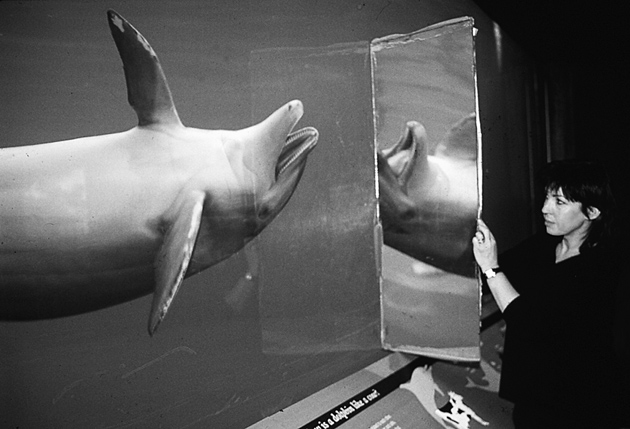
Are whales and dolphins really as intelligent as Lilly believed? The philosophizing of the sperm whale is mere fantasy, but Diana Reiss, author of The Dolphin in the Mirror, provides some significant insights into the intelligence of these smallest members of the whale tribe, which lend some credibility to Lilly’s work. Inspired by Lilly, Reiss invented a kind of aquatic keyboard that allows dolphins and humans a rudimentary form of communication. By pressing a square with a symbol on it, for example, a dolphin can request a ball rather than a hoop. Reiss’s research has gone much further than this, however, for she has used mirrors to demonstrate that dolphins are self-aware. This is regarded by behaviorists as a high state of consciousness indeed—one shared only with humans, apes, and some birds.
Demonstrating self-awareness is difficult, in part because behaviors can be interpreted in many ways. For Reiss the breakthrough came as she watched two young male dolphins, named Delphi and Pan, simulate copulation:
One of the boys would approach the other from behind and below and attempt to copulate with him. Dolphins copulate belly to belly. The boys would often switch roles…. What caused me to exclaim out loud that summer day in 1990 [seven years later] was something I had not seen before. Delphi and Pan had very deliberately positioned themselves in front of a large mirror we had recently installed in the pool. It seemed to me they were clearly and intently watching themselves in flagrante delicto.
Through the painstaking work of Reiss and others, it’s now clear that dolphins are like us in being intelligent and self-aware. They are also highly trainable, and are extraordinary mimics. Yet Reiss’s book also demonstrates that dolphins lack the individual willfulness that is such a strong part of the human character. Instead dolphins seem strikingly dog-like in their eagerness to please their human masters. Whether we will ever be able to communicate with them more effectively than we can with our dogs remains to be seen.
When Greenpeace launched its direct action campaign in 1975, even the IWC could no longer ignore the trend. By 1982 it had passed a moratorium partially suspending the hunting of whales, and in 1986 commercial whaling was finally banned. But are the whales recovering? On May 10, 2010, a solitary gray whale was sighted off the coast of Israel. The species had not been seen in the Atlantic for three hundred years, and Alisa Schulman-Janiger, who runs a gray whale census and behavior project, was so amazed that she likened the sighting to “finding a dinosaur in your backyard.” Perhaps the animal had swum a newly ice-free Northwest Passage. Or perhaps it was a last survivor of the Atlantic population. Whatever the case, it gives one a small hope that the whales might once again inherit their aquatic world.
This Issue
February 9, 2012

The Wrong Leonardo?
Václav Havel (1936–2011)
The Republican Nightmare
This Issue
February 9, 2012
The Wrong Leonardo?
Václav Havel (1936–2011)
The Republican Nightmare
-
*
Do unto others as you would be done by. ↩

