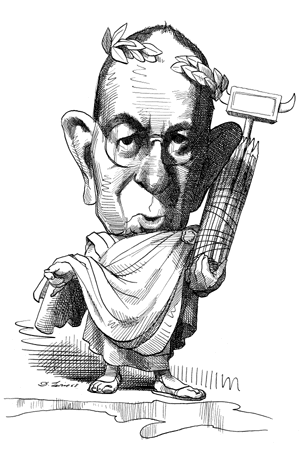
M.I. Finley

M. I. Finley (1912-1986), the son of Nathan Finkelstein and Anna Katzellenbogen, was born in New York City. He graduated from Syracuse University at the age of fifteen and received an MA in public law from Columbia, before turning to the study of ancient history. During the Thirties Finley taught at Columbia and City College and developed an interest in the sociology of the ancient world that was shaped in part by his association with members of the Frankfurt School who were working in exile in America. In 1952, when he was teaching at Rutgers, Finley was summoned before the Senate Internal Security Subcommittee and asked whether he had ever been a member of the Communist Party. He refused to answer, invoking the Fifth Amendment; by the end of the year he had been fired from the university by a unanimous vote of its trustees. Unable to find work in the US, Finley moved to England, where he taught for many years at Cambridge, helping to redirect the focus of classical education from a narrow emphasis on philology to a wider concern with culture, economics, and society. He became a British subject in 1962 and was knighted in 1979. Among Finley's best-known works are The Ancient Economy, Ancient Slavery and Modern Ideology, and The World of Odysseus.

From the Review

June 3, 1971: Ancient Technocrats*

The Muses at Work edited by Carl Roebuck

Technology in the Ancient World by Henry Hodges

Moving the Obelisks by Bern Dibner

The Ancient Engineers by L. Sprague de Camp

Agricultural Implements of the Roman World by K. D. White

Roman Farming by K. D. White

May 7, 1970: Roman Imperialism (letter)

March 12, 1970: The End of Atlantis (letter)

January 29, 1970: A Profitable Empire*

Roman Imperialism in the Late Republic by E. Badian

The Roman Empire and Its Neighbours by Fergus Millar

The Climax of Rome by Michael Grant

The Decline of Rome by Joseph Vogt, translated by Janet Sondheimer

December 4, 1969: Back to Atlantis*

Atlantis The Truth Behind the Legend by A.G. Galanopoulos, by Edward Bacon

Lost Atlantis New Light on an Old Legend by J.V. Luce

May 22, 1969: Atlantis or Bust*

Voyage to Atlantis by James W. Mavor Jr.

November 21, 1968: Et tu, Teddy White*

Caesar at the Rubicon by Theodore H. White

The Authoress of the Odyssey by Samuel Butler

June 20, 1968: Up from Democritus*

Democritus and the Sources of Greek Anthropology Association) by Thomas Cole

The Idea of Progress in Classical Antiquity by Ludwig Edelstein

December 7, 1967: Competent Authorities (letter)

November 23, 1967: Daedalus Lives!*

The Maze Maker by Michael Ayrton

September 14, 1967: Plutarch, Historical Novelist*

Plutarch and His Times by R.H. Barrow

Julius Caesar, A Political Biography by J.P.V.D. Balsdon

August 3, 1967: Digging the Trojans*

The Palace of Nestor at Pylos in Western Messenia: Vol. I, The Buildings and Their Contents by Carl W. Blegen, by Marion Rawson

Mycenae and the Mycenaean Age by George E. Mylonas

June 1, 1967: Trivia Preferred (letter)

May 18, 1967: UnRoman Activities*

The Mask of Jove by Stringfellow Barr

Enemies of the Roman Order by Ramsay MacMullen

March 23, 1967: The Classical Cold War*

Thucydides and the Politics of Bipolarity by Peter J. Fliess

The Reluctant Warriors by Donald Armstrong

The Political Background of Aeschylean Tragedy by Anthony J. Podlecki

January 26, 1967: The Idea of Slavery*

The Problem of Slavery in Western Culture by David Brion Davis

September 22, 1966: Name Calling (letter)

August 18, 1966: Greek to Him*

Enter Plato by Alvin W. Gouldner

Plato's Thought in the Making by J.E. Raven

February 17, 1966: Must We Dig?*

Introduction to Archaeology by Shirley Gorenstein

They Found the Buried Cities by Robert Wauchope

Testaments of Time by Leo Deuel

New Roads to Yesterday edited by Joseph R. Caldwell

Marine Archaeology edited by Joan du Plat Taylor

Most Ancient Egypt by William C. Hayes, edited by Keith C. Seele

October 14, 1965: Good and Bad History*

Ancient Mesopotamia by A. Leo Oppenheim

Daily Life in Greece at the Time of Pericles by Robert Flacelière, translated by Peter Green

March 11, 1965: Jesus and the Jews (letter)

March 11, 1965: The Anonymity of Antiquity*

Greece in the Bronze Age by Emily Vermeule

The Mycenaeans by Lord William Taylour

January 28, 1965: The Jews and the Death of Jesus*

December 17, 1964: Letters (letter)

November 5, 1964: Etruscan Things*

Etruscan Culture, Land and People by Axel Boethius. and others. with the collaboration of King Gustav Adolf of Sweden, translated by N.G. Sahlin

Those Mysterious Etruscans by Agnes Carr Vaughan

The Etruscans by Zacharie Mayani, translated by Patrick Evans

The Etruscans by Emeline Richardson

August 20, 1964: The Origins of Christianity*

The Primitive Church by Maurice Goguel, translated by H.C. Snape

May 28, 1964: Alsop's Archeology (letter)

April 16, 1964: Alsop's Archaeology*

From the Silent Earth by Joseph Alsop

March 5, 1964: Christian Beginnings*

Greek Myths and Christian Mystery by Hugo Rahner, by S.J., translated by Brian Batteshaw

December 12, 1963: Bogus Togas*

The Civilization of Rome by Pierre Grimal, translated by W.S. Maguiness

The Revolutions of Ancient Rome by F.R. Cowell

October 17, 1963: In a Nutshell*

The Rise Of The West by William H. McNeill

From New York Review Books

The World of Odysseus
The World of Odysseus provides a vivid picture of the Greek Dark Ages, its men and women, works and days, morals and values.