Table of Contents

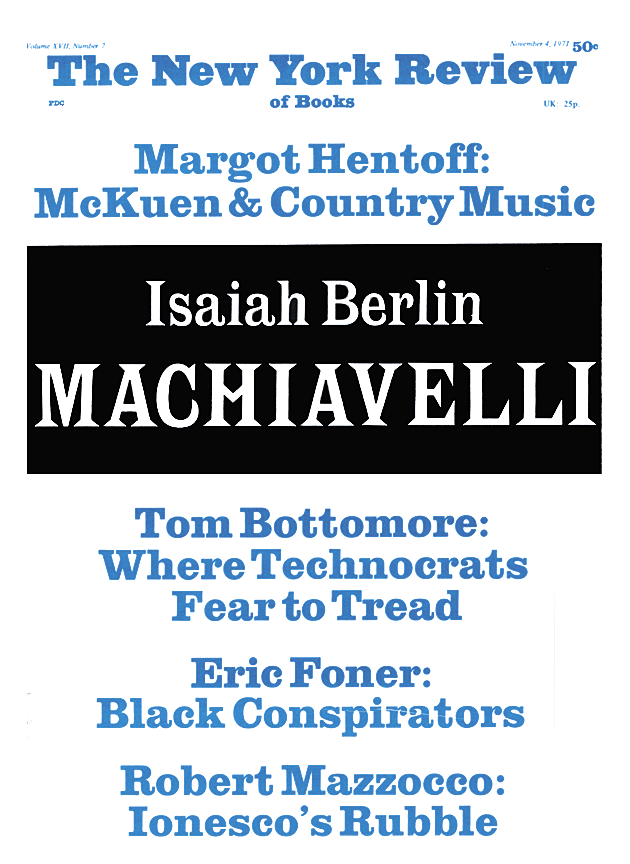
Volume 17, Number 7 · November 4, 1971

Neal Ascherson, A Modern Instance

The Affair of Gabrielle Russier with a Preface by Raymond Jean, an Introduction by Mavis Gallant

Robert Mazzocco, The Family Man

Present Past Past Present: A Personal Memoir by Eugène Ionesco, translated by Helen R. Lane

V.S. Naipaul, The Circus at Luxor Epilogue to a Novel

Tom Bottomore, Machines Without a Cause

Technological Change: Its Impact on Man and Society by Emmanuel G. Mesthene

La Civilisation au carrefour by Radovan Richta

Innovations: Scientific, Technological and Social by Dennis Gabor

Overskill: The Decline of Technology in Modern Civilization by Eugene S. Schwartz

Run, Computer, Run: The Mythology of Educational Innovation by Anthony G. Oettinger, by Sema Marks

W.H. Auden, Too Much Mustard

The Complete Immortalia edited by Harold H. Hart

The Gambit Book of Popular Verse edited by Geoffrey Grigson

Isaiah Berlin, A Special Supplement: The Question of Machiavelli

Edgar Z. Friedenberg, The Love that Dare Now Speak Its Name—in The New York Times

On Being Different by Merle Miller

Margot Hentoff, The You and Me that Used to Be

Caught in the Quiet by Rod McKuen

Listen to the Warm by Rod McKuen

The Nashville Sound by Paul Hemphill

Freakshow by Albert Goldman

A.J.P. Taylor, Rational Wars?

Clausewitz by Roger Parkinson

Studies in War and Peace by Michael Howard

Eric Foner, Black Conspiracies

Denmark Vesey: The Slave Conspiracy of 1822 edited by Robert S. Starobin

The Southampton Slave Revolt of 1831: A Compilation of Source Materials by Henry Irving Tragle
Merrill Leffler, Stephen Spender, In Defense of James Wright

Richard B. Du Boff, Peter Passell, Leonard Ross, Nixon Imperator?


Letters

John Holt, Paul Goodman, Good Music
Erazim V. Kohak, Neal Ascherson, Idealism & Power
Richard Arens, Attica
Ralph Shapiro, Attica
Patrice Higonnet, C.B.A. Behrens, Defending Tocqueville
Albert H. Silverman, Elizabeth Hardwick, What Happens in Hedda
Ron Wolin, Peace Action


Contributors

Neal Ascherson is the author of The Struggles for Poland, The Black Sea, and Stone Voices: The Search for Scotland. He is the editor of the journal Public Archaeology at University College London. (November 2007)

W. H. Auden (1907–1973) was born in North Yorkshire, England, the son of a doctor. He studied at Oxford and published his first book, Poems, in 1930, immediately establishing himself as one of the outstanding voices of his generation. Auden emigrated to New York in 1939, where he became a US citizen and converted to Anglicanism. He wrote essays, critical studies, plays, and opera librettos for such composers as Benjamin Britten, Igor Stravinsky, and Hans Werner Henze, as well as the poems for which he is most famous.

Isaiah Berlin was born in Riga in 1909. In 1916 his family moved to Petrograd, where he witnessed the Russian Revolution, and in 1921 he emigrated to England. He was educated at Corpus Christi College, Oxford, and became a Fellow of All Souls College, Oxford, where he was later appointed Professor of Social and Political Theory. He served as the first president of Wolfson College, Oxford, and as president of the British Academy. He died in 1997. For more information, see the Isaiah Berlin Virtual Library.

V. S. Naipaul was born in Trinidad in 1932 and emigrated to England in 1950, when he won a scholarship to University College, Oxford. He is the author of many novels, including A House for Mr. Biswas, A Bend in the River, and In a Free State, which won the Booker Prize. He has also written several nonfiction works based on his travels, including India: A Million Mutinies Now and Beyond Belief: Islamic Excursions Among the Converted Peoples. He was knighted in 1990 and in 1993 was the first recipient of the David Cohen British Literature Prize.


Search the Review
Advanced search