Table of Contents

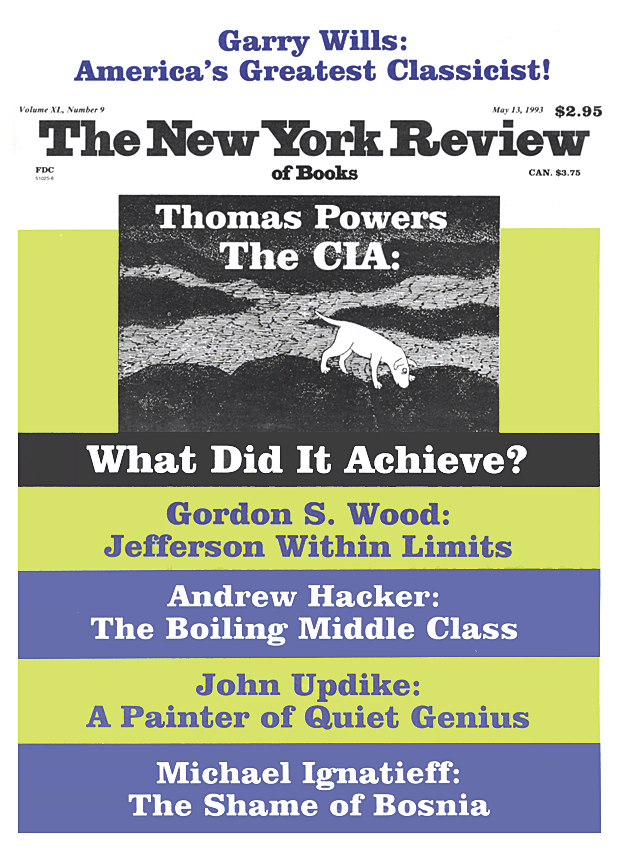
Volume 40, Number 9 · May 13, 1993

Michael Ignatieff, The Balkan Tragedy

The Fall of Yugoslavia: The Third Balkan War by Misha Glenny

The Destruction of Yugoslavia: Tracking the Break-up, 1980–92 by Branka Magaš

The Balkan Express: Fragments from the Other Side of War by Slavenka Drakulić

Gordon S. Wood, Jefferson at Home

Jeffersonian Legacies edited by Peter S. Onuf

Gordon A. Craig, Letters On Dark Times

Hannah Arendt Karl Jaspers: Correspondence, 1926–1969 edited by Lotte Kohler, by Hans Saner, translated by Robert Kimber, by Rita Kimber

John Updike, The Lean and Optical Dane

Christen Koobke by Sanford Schwartz

Timothy Ferris, The Case Against Science

Understanding the Present: Science and the Soul of Modern Man by Brian Appleyard

Alan Ryan, Twenty-first Century Blues

Preparing for the Twenty-first Century by Paul Kennedy

Leo Steinberg, This Is a Test

John Bayley, 'Anna of All the Russias'

The Complete Poems of Anna Akhmatova, Updated and Expanded Edition translated by Judith Hemschemeyer, edited by Roberta Reeder

Remembering Anna Akhmatova by Anatoly Nayman, translated by Wendy Rosslyn

In a Shattered Mirror: The Later Poetry of Anna Akhmatova by Susan Amert

Amos Elon, The Nowhere City

Andrew Hacker, Paradise Lost

Boiling Point: Democrats, Republicans, and the Decline of Middle-Class Prosperity by Kevin Phillips

Garry Wills, Hanging Out with Greeks

The Oldest Dead White European Males and Other Reflections on the Classics by Bernard Knox

New Perspectives in Early Greek Art England edited by Diana Buittron-Oliver

The Norton Book of Classical Literature edited by Bernard Knox

Joseph McBride, The Lost Kingdom of Orson Welles

This Is Orson Welles by Orson Welles, by Peter Bogdanovich, edited by Jonathan Rosenbaum

The Cradle Will Rock a screenplay by Orson Welles, edited by James Pepper

The Magnificent Ambersons: A Reconstruction by Robert L. Carringer

This Is Orson Welles (audio tapes) conversations between Welles and Bogdanovich, edited by Jonathan Rosenbaum

Ann Hulbert, Grim Fairy Tale

The Furies by Janet Hobhouse

Thomas Powers, The Truth About the CIA

Eclipse: The Last Days of the CIA by Mark Perry

Casey: From the OSS to the CIA by Joseph Persico

The Bear Trap: Afghanistan's Untold Story by Gen. Mohammad Yousaf, by Mark Adkin

The Red Web: MI6 and the KGB Master Coup by Tom Bower

The FBI–KGB War: A Special Agent's Story by Robert J. Lamphere, by Tom Schactman

Cold Warrior: James Jesus Angleton: The CIA's Master Spy Hunter by Tom Mangold

Molehunt: The Secret Search for Traitors that Shattered the CIA by David Wise

No Other Choice: The Cold War Memoirs of the Ultimate Spy by George Blake

The Cambridge Spies: The Untold Story of Maclean, Philby, and Burgess in America by Verne W. Newton

The Spy Who Saved the World: How a Soviet Colonel Changed the Course of the Cold War by Jerrold L. Schechter, by Peter S. Deriabin

The Central Intelligence Agency: An Instrument of Government, to 1950 by Arthur B. Darling

General Walter Bedell Smith as Director of Central Intelligence, October 1950–February 1953 by Ludwell Lee Montague

Moscow Station: How the KGB Penetrated the American Embassy by Ronald Kessler

The Old Boys: The American Elite and the Origins of the CIA by Burton Hersh

America's Secret Eyes in Space: The U.S. Spy Satellite Program by Jeffrey T. Richelson

American Espionage and the Soviet Target by Jeffrey T. Richelson

Letters

Peter Linebaugh, Keith Thomas, 'The London Hanged'
Janet Coleman, Yael Danieli, et al. Safe Havens in Bosnia
Edward Albee, Margaret Atwood, et al. Murder in Turkey


Contributors

John Bayley has written two books about his wife, the novelist Iris Murdoch, Elegy for Iris and Iris and Her Friends. (July 2004)

Gordon A. Craig is J.E. Wallace Sterling Professor Emeritus of Humanities at Stanford. His latest book is Politics and Culture in Modern Germany. (December 2003)

Amos Elon's most recent book is The Pity of It All: German Jews Before Hitler. He is a Fellow at the Center for Law and Security at NYU. (February 2008)

Timothy Ferris, Emeritus Professor of Journalism at the University of California, Berkeley, is the author, most recently, of Seeing in the Dark. (March 2003)

Andrew Hacker teaches political science at Queens College. He is currently writing a book on higher education in collaboration with Claudia Dreifus. (September 2008)

Ann Hulbert is a Fellow at the Woodrow Wilson International Center for Scholars and the author of The Interior Castle: The Art and Life of Jean Stafford. She is currently at work on a book about twentieth-century American child-rearing experts. (June 1998)

Michael Ignatieff is the Carr Professor and Director of the Carr Center for Human Rights Policy at the Kennedy School of Government at Harvard. His latest book is Human Rights as Politics and Idolatry. (April 2003)

Joseph McBride's books include Steven Spielberg: A Biography, Frank Capra: The Catastrophe of Success, Orson Welles, and Hawks on Hawks. His biography Searching for John Ford will be published in December. He writes a regular column on film for Irish America magazine. (July 1999)

Thomas Powers is the author of The Man Who Kept the Secrets: Richard Helms and the CIA (1979), Heisenberg's War: The Secret History of the German Bomb (1993), Intelligence Wars: American Secret History from Hitler to al-Qaeda (2002; revised and expanded edition, 2004), and The Confirmation (2000), a novel. He won a Pulitzer Prize for National Reporting in 1971 and has contributed to The New York Review of Books, The New York Times Book Review, Harper's, The Nation, The Atlantic, and Rolling Stone.

Alan Ryan is Warden of New College, Oxford, and the author of intellectual biographies of John Stuart Mill, Bertrand Russell, and John Dewey. (November 2007)

John Updike was born in 1932 in Shillington, Pennsylvania. In 1954 he began to publish in The New Yorker, where he continues to contribute short stories, poems, and criticism. His novels have won the Pulitzer Prize, among other awards. His most recent books are the novel Terrorist and Due Considerations, a collection of his essays and criticism.

Garry Wills was born in Atlanta, Georgia. One of our most distinguished historians and critics, he is the author of numerous books, including Saint Augustine, Papal Sin, and the Pulitzer Prize–winning Lincoln at Gettysburg. He has won many other awards, among them two National Book Critics Circle Awards and the 1998 National Medal for the Humanities. He is currently Professor of History Emeritus at Northwestern University. A regular contributor to the New York Review of Books, he lives in Evanston, Illinois.

Gordon Wood is the Alva O. Way University Professor and Professor of History at Brown. A collection of his essays, The Purpose of the Past: Reflections on the Uses of History, was published in March. (May 2008)


Search the Review
Advanced search