Table of Contents

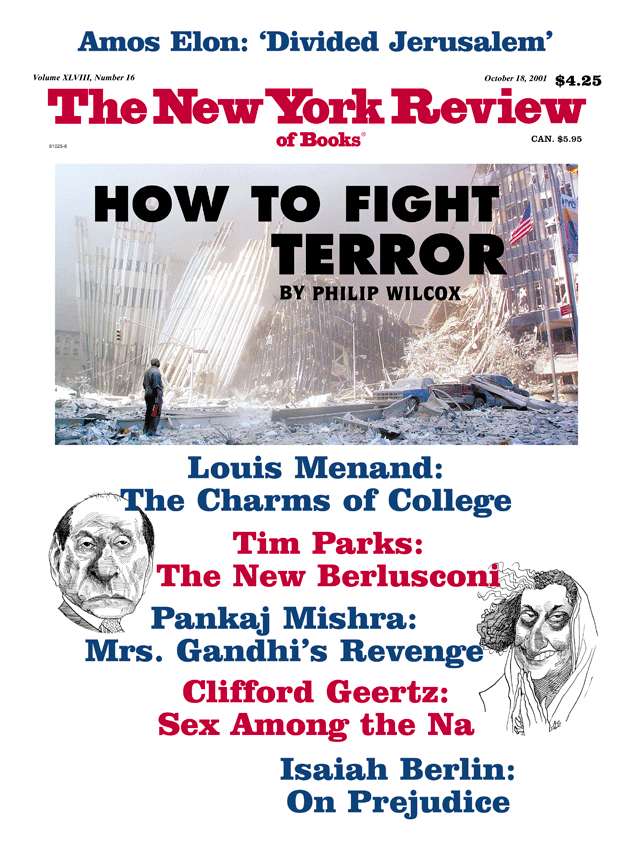
Volume 48, Number 16 · October 18, 2001

Philip C. Wilcox Jr., The Terror

Amos Elon, The Deadlocked City

Divided Jerusalem: The Struggle for the Holy City by Bernard Wasserstein

Isaiah Berlin, Notes on Prejudice

Paul Berman, Landscape Architect

Looking for History: Dispatches from Latin America by Alma Guillermoprieto

Andrew O'Hagan, Unlikely Hero

Romancing: The Life and Work of Henry Green by Jeremy Treglown

Pack My Bag: A Self-Portrait by Henry Green

Blindness by Henry Green

Caught by Henry Green

Nothing by Henry Green

Doting by Henry Green

Concluding by Henry Green

Pankaj Mishra, Mrs. India

Indira: The Life of Indira Nehru Gandhi by Katherine Frank

Clifford Geertz, The Visit

A Society Without Fathers or Husbands: The Na of China by Cai Hua, translated from the French by Asti Hustvedt

Ronald Steel, Big Daddy

Hostage to Fortune: The Letters of Joseph P. Kennedy edited by Amanda Smith

Anne Applebaum, A History of Horror

Le Siècle des camps by Joël Kotek and Pierre Rigoulot

Louis Menand, College: The End of the Golden Age

Jonathan Mirsky, China's Assault on the Environment

Mao's War Against Nature: Politics and the Environment in Revolutionary China by Judith Shapiro

Feeding the World: A Challenge for the Twenty-First Century by Vaclav Smil

Frederick C. Crews, Saving Us from Darwin, Part II

The Faith of Biology and the Biology of Faith: Order, Meaning, and Free Will in Modern Medical Science by Robert Pollack

God After Darwin: A Theology of Evolution by John F. Haught

Can a Darwinian Be a Christian? The Relationship Between Science and Religion by Michael Ruse

Finding Darwin's God: A Scientist's Search for Common Ground Between God and Evolution by Kenneth R. Miller

Rocks of Ages: Science and Religion in the Fullness of Life by Stephen Jay Gould

Oliver Sacks, First Love

Anthony Hecht, Treasure Box

Night Picnic by Charles Simic

A Fly in the Soup by Charles Simic

Tim Parks, Berlusconi's Way

L'odore dei soldi (The Smell of Money) by Marco Travaglio

Social Identities and Political Cultures in Italy: Catholic, Communist and Leghist Communities Between Civicness and Localism by Anna Cento Bull

L'Italia che ho in mente (The Italy I Have in Mind) by Silvio Berlusconi

Italian Politics 1998: The Return of Politics edited by David Hine and Salvatore Vassallo

Italian Politics 1999: The Faltering Transition edited by Mark Gilbert and Gianfranco Pasquino

Alfred R. Barr, Shep Lowman, Theodore S. Wilkinson, et al. An Exchange on John Negroponte


Letters

Frederick C. Crews, Alan Sokal, An Urgent Matter
Daniel P. Jones, Robert Darnton, 'Scare Tactics'
Andrew Butterfield, Correction


Contributors

Anne Applebaum is a columnist for The Washington Post. Her book Gulag: A History won the 2004 Pulitzer Prize for nonfiction. She lives in Poland. (October 2008)

Isaiah Berlin was born in Riga in 1909. In 1916 his family moved to Petrograd, where he witnessed the Russian Revolution, and in 1921 he emigrated to England. He was educated at Corpus Christi College, Oxford, and became a Fellow of All Souls College, Oxford, where he was later appointed Professor of Social and Political Theory. He served as the first president of Wolfson College, Oxford, and as president of the British Academy. He died in 1997. For more information, see the Isaiah Berlin Virtual Library.

Paul Berman is the author of A Tale of Two Utopias: The Political Journey of the Generation of 1968. (October 2001)

Frederick Crews's most recent book is Follies of the Wise: Dissenting Essays. (December 2007)

Amos Elon's most recent book is The Pity of It All: German Jews Before Hitler. He is a Fellow at the Center for Law and Security at NYU. (February 2008)

Clifford Geertz is Professor Emeritus at the Institute for Advanced Study in Princeton. He is the author of, among other works, The Social History of an Indonesian Town and Negara: The Balinese State in the Nineteenth Century. (March 2006)

Anthony Hecht'sCollected Later Poems and Melodies Unheard: Essays on the Mysteries of Poetry were published in 2003. He died on October 20. (December 2004)

Louis Menand is the Robert M. and Anne T. Bass Professor of English and American Literature and Language at Harvard University, and a staff writer at The New Yorker. He is the author of The Metaphysical Club—which won the Pulitzer Prize for History and the Francis Parkman Prize in 2002—and of American Studies, a collection of essays.

Jonathan Mirsky is a journalist and historian specializing in Chinese affairs. He reported from Vietnam in 1965 and 1967. (November 2008)

Pankaj Mishra was born in North India in 1969 and now lives in London and India. He is the author of The Romantics, winner of the Los Angeles Times's Art Seidenbaum Award for First Fiction, and An End to Suffering: The Buddha in the World. He is a frequent contributor to The New York Review of Books and The Guardian. His most recent book is Temptations of the West: How to Be Modern in India, Pakistan, Tibet, and Beyond.

Andrew O'Hagan is a recipient of the E.M. Forster Prize from the American Academy of Arts and Letters. A book of his essays, The Atlantic Ocean, was published in June. (November 2008)

Tim Parks, a novelist, essayist, and translator, is Associate Professor of English Literature at IULM University in Milan. His most recent novel is Cleaver. (September 2008)

Oliver Sacks is a physician and the author of ten books, including The Man Who Mistook His Wife for a Hat, Awakenings, An Anthropologist on Mars, and, most recently, Musicophilia. He lives in New York City, where he is University Artist and Professor of Neurology and Psychiatry at Columbia University.

Ronald Steel is Professor of International Relations at the University of Southern California, a recent fellow at the American Academy in Berlin, and the author of biographies of Walter Lippmann and Robert Kennedy. (June 2006)

Philip C. Wilcox Jr. is a retired US Foreign Service Officer who served from 1994 to 1997 as Ambassador at Large and Coordinator for Counter-Terrorism in the Department of State.


Search the Review
Advanced search