Table of Contents

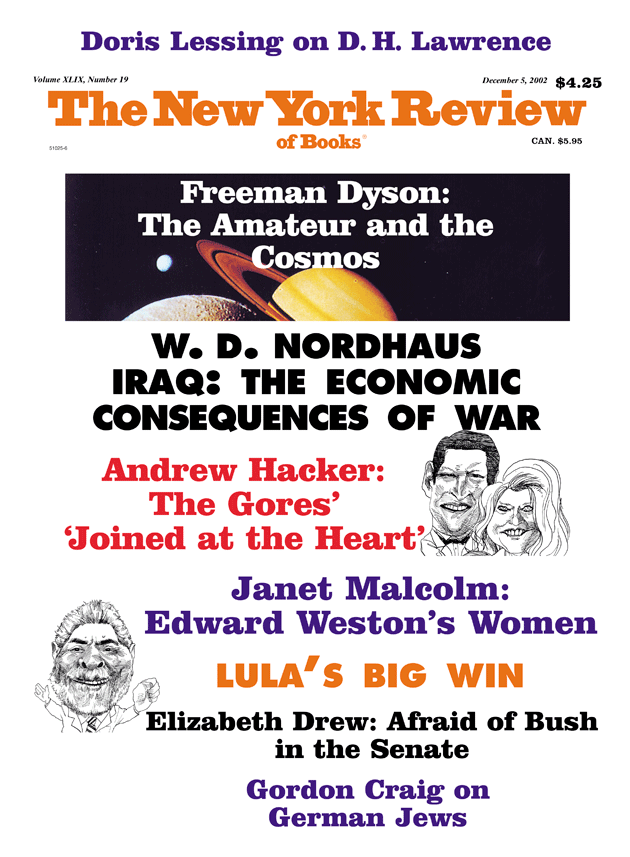
Volume 49, Number 19 · December 5, 2002

Freeman Dyson, In Praise of Amateurs

Seeing in the Dark: How Backyard Stargazers Are Probing Deep Space and Guarding Earth from Interplanetary Peril by Timothy Ferris

Robin Robertson, Waves (poem)

William D. Nordhaus, Iraq: The Economic Consequences of War

Janet Malcolm, Edward Weston's Women

Margrethe Mather and Edward Weston: A Passionate Collaboration by Beth Gates Warren

Through Another Lens: My Years with Edward Weston by Charis Wilson and Wendy Madar

Doris Lessing, 'The Fox' of D.H. Lawrence

Andrew Hacker, Gore Family Values

Joined at the Heart: The Transformation of the American Family by Al and Tipper Gore

Gordon A. Craig, The Magic Circle

The Pity of It All: A History of Jews in Germany, 1743–1933 by Amos Elon

Kenneth Maxwell, Brazil: Lula's Prospects

Elizabeth Marshall Thomas, Nature & the Art of Running

Why We Run: A Natural History by Bernd Heinrich

Charles Hope, Mind Your Maniera

Painting in Renaissance Florence, 1500–1550 by David Franklin

Pontormo, Bronzino, Allori: A Genealogy of Florentine Art by Elizabeth Pilliod

Objects of Virtue: Art in Renaissance Italy by Luke Syson and Dora Thornton

Joseph Roth, Passengers with Heavy Loads

Garry Wills, High Fidelity

The Courage to Be Catholic: Crisis, Reform, and the Future of the Church by George Weigel

Gabriele Annan, Brief Encounter

Ignorance by Milan Kundera, translated from the French by Linda Asher

Larry McMurtry, On the Road

Geoffrey O'Brien, Unlocking the Cupboard

The Human Country: New and Collected Stories by Harry Mathews

Ian Buruma, Portrait of the Artist

Youth: Scenes from Provincial Life II by J.M. Coetzee

Anthony Hecht, Knowing the Score

Finders Keepers: Selected Prose, 1971–2001 by Seamus Heaney

Jill Nelson, Good Hair Day

On Her Own Ground: The Life and Times of Madam C.J. Walker by A'Lelia Bundles

Mark Lilla, A Battle for Religion

The Star of Redemption by Franz Rosenzweig, translated from the German by William W. Hallo

Philosophical and Theological Writings by Franz Rosenzweig, translated from the German and edited by Paul W. Franks and Michael L. Morgan

Cultural Writings of Franz Rosenzweig edited and translated from the German by Barbara E. Galli, with a foreword by Leora Batnitzky

God, Man, and the World: Lectures and Essays by Franz Rosenzweig, edited and translated from the German by Barbara E. Galli, with a foreword by Michael Oppenheim

Franz Rosenzweig's "The New Thinking" edited and translated from the German by Alan Udoff and Barbara E. Galli

On Jewish Learning by Franz Rosenzweig, edited by N.N. Glatzer

Rosenzweig and Heidegger: Between Judaism and German Philosophy by Peter Eli Gordon

Understanding the Sick and the Healthy: A View of World, Man, and God by Franz Rosenzweig, translated from the German and with an introduction by Nahum Glatzer, and an introduction by Hilary Putnam

Idolatry and Representation: The Philosophy of Franz Rosenzweig Reconsidered by Leora Batnitzky

On the Psychotheology of Everyday Life: Reflections on Freud and Rosenzweig by Eric L. Santner

Franz Rosenzweig: His Life and Thought by Nahum N. Glatzer, with a foreword by Paul-Mendes Flohr
Elizabeth Drew, War Games in the Senate

Ian Buruma, On the West Bank


Letters

David E. Narrett, Russell Jack Smith, et al. 'Secrets of September 11'
Robert Hollander, What Did the Decameron Do?
Anthony Lewis, A Phantom Triumph?
Mark Huessy, Query


Contributors

Gabriele Annan is a book and film critic living in London. (March 2006)

Ian Buruma is the Henry R. Luce Professor at Bard. He received this year’s Shorenstein Award for writing about Asia. His novel The China Lover will be published this fall. (June 2008)

Gordon A. Craig is J.E. Wallace Sterling Professor Emeritus of Humanities at Stanford. His latest book is Politics and Culture in Modern Germany. (December 2003)

Elizabeth Drew, who lives in Washington, is a regular contributor to The New York Review of Books. She is the author of twelve books.

Freeman Dyson has spent most of his life as a professor of physics at the Institute for Advanced Study in Princeton, taking time off to advise the US government and write books for the general public. He was born in England and worked as a civilian scientist for the Royal Air Force during World War II. He came to Cornell University as a graduate student in 1947 and worked with Hans Bethe and Richard Feynman, producing a user-friendly way to calculate the behavior of atoms and radiation. He also worked on nuclear reactors, solid-state physics, ferromagnetism, astrophysics, and biology, looking for problems where elegant mathematics could be usefully applied.

Dyson's books include Disturbing the Universe (1979), Weapons and Hope (1984), Infinite in All Directions (1988), Origins of Life (1986, second edition 1999), and The Sun, the Genome and the Internet (1999). He is a fellow of the American Physical Society, a member of the National Academy of Sciences, and a fellow of the Royal Society of London. In 2000 he was awarded the Templeton Prize for Progress in Religion.

Andrew Hacker teaches political science at Queens College. He is currently writing a book on higher education in collaboration with Claudia Dreifus. (October 2007)

Anthony Hecht'sCollected Later Poems and Melodies Unheard: Essays on the Mysteries of Poetry were published in 2003. He died on October 20. (December 2004)

Charles Hope is Director of the Warburg Institute, London, and the author of Titian. (December 2002)

Doris Lessing's books include the novels The Sweetest Dream, Mara and Dann, and Ben, in the World, as well as two volumes of her autobiography, Under My Skin and Walking in the Shade. (April 2003)

Mark Lilla is Professor at the Committee on Social Thought at the University of Chicago. He is the author of G.B. Vico: The Making of an Anti-Modern (1993) and the editor of New French Thought: Political Philosophy (1991). His latest book is The Stillborn God: Religion, Politics, and the Modern West.

Janet Malcolm was born in Prague. She was educated at the High School of Music and Art, in New York, and at the University of Michigan. Along with In the Freud Archives, her books include Diana and Nikon: Essays on Photography, Psychoanalysis: The Impossible Profession, The Journalist and the Murderer, The Purloined Clinic: Selected Writings, The Silent Woman: Sylvia Plath and Ted Hughes, The Crime of Sheila McGough, and Reading Chekhov: A Critical Journey. She lives in New York with her husband, Gardner Botsford.

Elizabeth Marshall Thomas's most recent books are The Hidden Life of Dogs, Certain Poor Shepherds, and The Tribe of Tiger: Cats and Their Culture. (May 1997)

Kenneth Maxwell is Director of Latin American Studies at the Council on Foreign Relations. His new book, Naked Tropics: Essays on Empire and Other Rogues, will be published this month. (July 2003)

Larry McMurtry is the author of twenty-four novels, including The Last Picture Show, Terms of Endearment, Lonesome Dove, winner of the 1986 Pulitzer Prize for Fiction, and, most recently, Folly and Glory. His nonfiction works include a biography of Crazy Horse, Walter Benjamin at the Dairy Queen, Paradise, and Sacagawea’s Nickname: Essays on the American West (published by New York Review Books). He lives in Archer City, Texas.

Jill Nelson is the author of Volunteer Slavery. Her first novel, Sexual Healing , will be published in June 2003. (December 2002)

William D. Nordhaus is Sterling Professor of Economics at Yale and was a member of the President's Council of Economic Advisers between 1977 and 1979. He has been writing recently on productivity growth, the new economy, and the business cycle. See his site at www.econ.yale.edu. (January 2004)

Geoffrey O'Brien is Editor in Chief of the Library of America. He is the author, most recently, of Sonata for Jukebox: An Autobiography of My Ears and Red Sky Café. (April 2008)

Robin Robertson's Swithering won the 2006 Forward Prize. His translation of Medea will be published in September. (May 2008)

Joseph Roth died at age forty-five in Paris in 1939. He is the author of The Radetzky March, among many other novels. The article in this issue will appear in What I Saw: Reports from Berlin, 1920– 1933, to be published this month by W.W. Norton. (December 2002)

Garry Wills was born in Atlanta, Georgia. One of our most distinguished historians and critics, he is the author of numerous books, including Saint Augustine, Papal Sin, and the Pulitzer Prize–winning Lincoln at Gettysburg. He has won many other awards, among them two National Book Critics Circle Awards and the 1998 National Medal for the Humanities. He is currently Professor of History Emeritus at Northwestern University. A regular contributor to the New York Review of Books, he lives in Evanston, Illinois.


Search the Review
Advanced search