Table of Contents

Volume 50, Number 10 · June 12, 2003

Margaret Atwood, Arguing Against Ice Cream

Enough: Staying Human in an Engineered Age by Bill McKibben

C.K. Williams, Leaves (poem)

Russell Baker, An American Family

Memoirs by David Rockefeller

John Updike, Logic Is Beautiful

Elie Nadelman: Sculptor of Modern Life Catalog of the exhibitionby Barbara Haskell

Elizabeth Drew, The Neocons in Power

J.M. Coetzee, Victims

Crabwalk by Günter Grass, translated from the German by Krishna Winston

Clifford Geertz, Which Way to Mecca?

What Went Wrong? The Clash Between Islam and Modernity in the Middle East by Bernard Lewis

The Crisis of Islam: Holy War and Unholy Terror by Bernard Lewis

Islam in a Globalizing World by Thomas W. Simons Jr.

The Shade of Swords: Jihad and the Conflict Between Islam and Christianity by M.J. Akbar

Islam: A Short History by Karen Armstrong

Michael Kimmelman, Piano Portraits

Me of All People: Alfred Brendel in Conversation with Martin Meyer translated by Richard Stokes

Mozart Piano Sonatas, K. 310, K. 311, and K. 533/494; Fantasy in D Minor, K. 397 Alfred Brendel, pianist

Alfred Brendel Live in Salzburg Alfred Brendel, pianist

Dreizehn Engel/Thirteen Angels: Poems by Alfred Brendel; Etchings, Drawings, and Sculptures by George Nama Catalog of the exhibition edited by Elisabeth Kashey

Vladimir de Pachmann: A Piano Virtuoso's Life and Art by Mark Mitchell

Pachmann, the Mythic Pianist: 1907–1927 Recordings

Pankaj Mishra, The Way to the Middle Way

The Search for the Buddha: The Men Who Discovered India's Lost Religion by Charles Allen

Anita Desai, Revenge Tragedy

The Light of Day by Graham Swift

Colm Tóibín, New Ways to Kill Your Father

Rory & Ita by Roddy Doyle

The Speckled People by Hugo Hamilton

Mark Lilla, The Big E

Evil in Modern Thought: An Alternative History of Philosophy by Susan Neiman

Orlando Figes, Reconstructing Hell

Gulag: A History by Anne Applebaum

Tim Flannery, Who Came First?

The First Americans: In Pursuit of Archaeology's Greatest Mystery by J.M. Adovasio with Jake Page

America Before the European Invasions by Alice Beck Kehoe

Ian Buruma, AsiaWorld

Gordon S. Wood, Debt and Democracy

Republic of Debtors: Bankruptcy in the Age of American Independence by Bruce H. Mann

A Free Nation Deep in Debt: The Financial Roots of Democracy by James Macdonald

Jean Strouse, Triumph at Heart's Content

A Thread Across the Ocean: The Heroic Story of the Transatlantic Cable by John Steele Gordon

Joseph Frank, The Tragedy of Prince Mirsky

D.S. Mirsky:A Russian-English Life, 1890–1939 by G.S. Smith

P.N. Furbank, 'Their Noon, Their Midnight...'

The Great Nation: France from Louis XV to Napoleon, 1715–99 by Colin Jones

Michael Wood, Experience's Ghosts

The Story of Our Lives, with The Monument and The Late Hour by Mark Strand

Looking for Poetry: Poems by Carlos Drummond de Andrade and Rafael Alberti, and Songs from the Quechua translated by Mark Strand
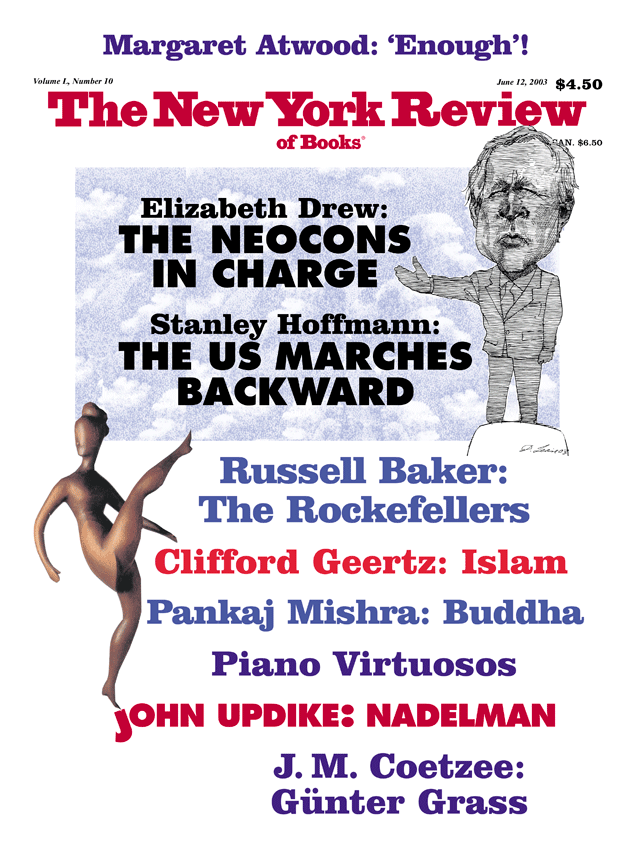
Stanley Hoffmann, America Goes Backward


Letters

Evelyn Fox Keller, Richard C. Lewontin, Is Biology Messy?
Joseph Lelyveld, 'The Clinton Wars': A Correction
Robert P. Pula, John Bayley, Flying for Poland


Contributors

Margaret Atwood is the author of eleven novels, among them The Handmaid’s Tale, Cat’s Eye, Alias Grace, and The Blind Assassin. Her most recent works of fiction are Oryx and Crake, The Tent, and Moral Disorder. (December 2006)

Russell Baker is a former columnist and correspondent for The New York Times and The Baltimore Sun. His books include The Good Times, Growing Up, and Looking Back. (July 2008)

Ian Buruma is the Henry R. Luce Professor at Bard. He received this year’s Shorenstein Award for writing about Asia. His novel The China Lover will be published this fall. (June 2008)

J. M. Coetzee, who was awarded the Nobel Prize for literature in 2003, is currently Visiting Professor of Humanities at the University of Adelaide. His latest novel, Diary of a Bad Year, was published in December. (March 2008)

Anita Desai's most recent novel is The Zigzag Way. (July 2007)

Elizabeth Drew, who lives in Washington, is a regular contributor to The New York Review of Books. She is the author of twelve books.

Orlando Figes is Professor of History at Birkbeck College, London University. His new book, The Whisperers: Private Life in Stalin’s Russia, will be published this month. (November 2007)

Tim Flannery is a professor at Macquarie University in Sydney and chair of the Copenhagen Climate Council. His latest book is The Weather Makers: How Man Is Changing the Climate and What It Means for Life on Earth. (May 2008)

Joseph Frank is Professor Emeritus of Slavic and Comparative Literature at Stanford. He is the author of Dostoyevsky: The Mantle of the Prophet, 1871–1881. (June 2008)

P. N. Furbank is the author of Diderot and, with W.R. Owens, A Political Biography of Daniel Defoe. (December 2007)

Clifford Geertz is Professor Emeritus at the Institute for Advanced Study in Princeton. He is the author of, among other works, The Social History of an Indonesian Town and Negara: The Balinese State in the Nineteenth Century. (March 2006)

Stanley Hoffmann is Paul and Catherine Buttenwieser University Professor at Harvard. His forthcoming book is Chaos and Violence. (August 2006)

Michael Kimmelman is chief art critic of The New York Times. Starting this fall he is based in Berlin writing the Abroad column for the Times on culture and society across Europe. He is the author, most recently, of The Accidental Masterpiece: On the Art of Life and Vice Versa. (October 2007)

Mark Lilla is Professor at the Committee on Social Thought at the University of Chicago. He is the author of G.B. Vico: The Making of an Anti-Modern (1993) and the editor of New French Thought: Political Philosophy (1991). His latest book is The Stillborn God: Religion, Politics, and the Modern West.

Pankaj Mishra was born in North India in 1969 and now lives in London and India. He is the author of The Romantics, winner of the Los Angeles Times's Art Seidenbaum Award for First Fiction, and An End to Suffering: The Buddha in the World. He is a frequent contributor to The New York Review of Books and The Guardian. His most recent book is Temptations of the West: How to Be Modern in India, Pakistan, Tibet, and Beyond.

Jean Strouse is the author of Alice James, A Biography and Morgan, American Financier. A Fellow of the MacArthur Foundation, she lives in New York City.

Colm Tóibín is the author of five novels, including The Story of the Night, The Blackwater Lightship, and The Heather Blazing. The Master, a novel based on the life of Henry James, was published in 2004 and shortlisted for the Man Booker Prize. Among his nonfiction works are Bad Blood: A Walk Along the Irish Border, Homage to Barcelona, The Sign of the Cross: Travels in Catholic Europe, and, most recently, Love in a Dark Time. In 2004, his first play, Beauty in a Broken Place, was produced in Dublin. His most recent novel, The Master, which is based on the life of Henry James, won the Los Angeles Times Novel of the Year Award in 2005 and the Prix du Meilleur Livre Étranger in France. He lives in Dublin.

John Updike was born in 1932 in Shillington, Pennsylvania. In 1954 he began to publish in The New Yorker, where he continues to contribute short stories, poems, and criticism. His novels have won the Pulitzer Prize, among other awards. His most recent books are the novel Terrorist and Due Considerations, a collection of his essays and criticism.

C.K. Williams's new book of poetry, The Singing, will be published this winter. His last, Repair, won the Pulitzer Prize. He teaches at Princeton. (June 2003)

Gordon Wood is the Alva O. Way University Professor and Professor of History at Brown. A collection of his essays, The Purpose of the Past: Reflections on the Uses of History, was published in March. (May 2008)

Michael Wood is Professor of English and Comparative Literature at Princeton. His most recent book is Literature and the Taste of Knowledge. (April 2008)


Search the Review
Advanced search