Table of Contents
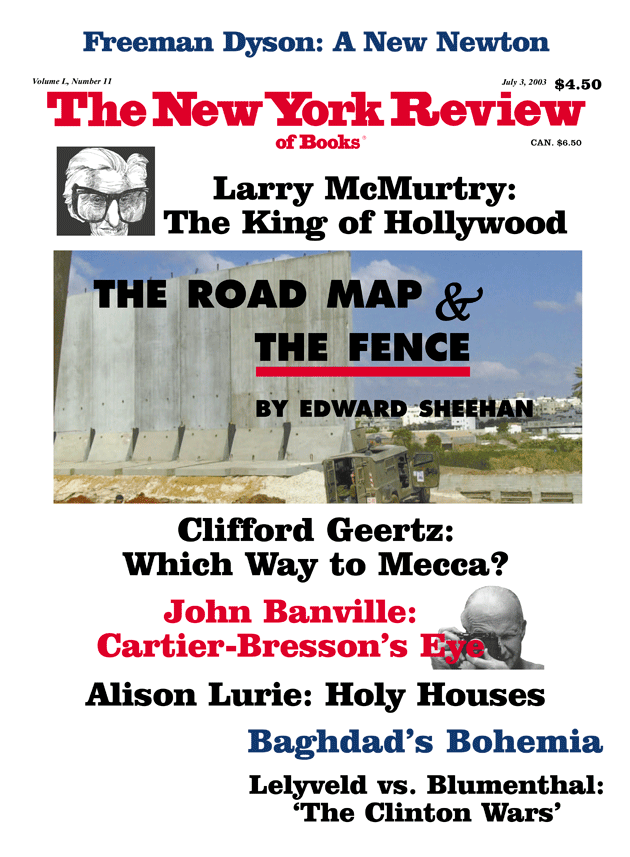
Volume 50, Number 11 · July 3, 2003
Freeman Dyson, A New Newton
Isaac Newton by James Gleick
Edward R.F. Sheehan, The Map and the Fence
Larry McMurtry, The Don of Dons
When Hollywood Had a King: The Reign of Lew Wasserman, Who Leveraged Talent into Power and Influence Connie Bruck
John Banville, Secret Geometry
Henri Cartier-Bresson: The Man, the Image and the World with essays by Philippe Arbaïzar, Jean Clair, Claude Cookman, Robert Delpire, Peter Galassi, Jean-Noël Jeanneney, Jean Leymarie, and Serge Toubiana, and with translations from the French by Jane Brenton
Max Rodenbeck, Bohemia in Baghdad
Geoffrey O'Brien, You Can't Go Home Again?
Kenneth Maxwell, Lula's Surprise
Alison Lurie, God's Houses
Building from Belief: Advance, Retreat, and Compromise in the Remaking of Catholic Church Architecture by Michael E. DeSanctis
Houses of God: Region, Religion, and Architecture in the United States by Peter W. Williams
Wooden Churches: A Celebration with an introduction by Rick Bragg
When Church Became Theatre: The Transformation of Evangelical Architecture and Worship in Nineteenth-Century America by Jeanne Halgren Kilde
Sacred Architecture by Caroline Humphrey and Piers Vitebsky
Charles Simic, Where the Fun Starts
The Paris Review Book of Heartbreak, Madness, Sex, Love, Betrayal, Outsiders, Intoxication, War, Whimsy, Horrors, God, Death, Dinner, Baseball, Travels, The Art of Writing, and Everything Else in the World Since 1953 by the editors of The Paris Review, with an introduction by George Plimpton
Clifford Geertz, Which Way to Mecca? Part II
Jihad: The Trail of Political Islam by Gilles Kepel
Militant Islam Reaches America by Daniel Pipes
The Two Faces of Islam: The House of Sa'ud from Tradition to Terror by Stephen Schwartz
Terror and Liberalism by Paul Berman
The Future of Political Islam by Graham E. Fuller
After Jihad: America and the Struggle for Islamic Democracy by Noah Feldman
Faithlines: Muslim Conceptions of Islam and Society by Riaz Hassan
The Ulama in Contemporary Islam: Custodians of Change by Muhammad Qasim Zaman
James Fenton, The Cambodia Obsession
The Gate by François Bizot, translated from the French by Euan Cameron, with a foreword by John le Carré
Daniel Mendelsohn, After the Fall
Oryx and Crake by Margaret Atwood
Darryl Pinckney, A Lost World
Forgotten Readers: Recovering the Lost History of African American Literary Societies by Elizabeth McHenry
Robert M. Solow, Mysteries of Growth
Why Economies Grow: The Forces That Shape Prosperity and How We Can Get Them Working Again by Jeff Madrick
Adam Shatz, Algeria's Failed Revolution
La Sale Guerre by Habib Souaïdia
The Battlefield: Algeria, 1988–2002, Studies in a Broken Polity by Hugh Roberts
Double Blanc by Yasmina Khadra
Time for Reckoning: Enforced Disappearances in Algeria by The Human Rights Watch
Sidney Blumenthal, Joseph Lelyveld, 'The Clinton Wars': An Exchange
Contributors
John Banville was born in Wexford, Ireland, in 1945. He is the author of many novels, including The Book of Evidence, The Untouchable, and Eclipse. Banville's novel The Sea was awarded the 2005 Man Booker Prize. On occasion he writes under the pen name Benjamin Black.
Freeman Dyson has spent most of his life as a professor of physics at the Institute for Advanced Study in Princeton, taking time off to advise the US government and write books for the general public. He was born in England and worked as a civilian scientist for the Royal Air Force during World War II. He came to Cornell University as a graduate student in 1947 and worked with Hans Bethe and Richard Feynman, producing a user-friendly way to calculate the behavior of atoms and radiation. He also worked on nuclear reactors, solid-state physics, ferromagnetism, astrophysics, and biology, looking for problems where elegant mathematics could be usefully applied.
Dyson's books include Disturbing the Universe (1979), Weapons and Hope (1984), Infinite in All Directions (1988), Origins of Life (1986, second edition 1999), and The Sun, the Genome and the Internet (1999). He is a fellow of the American Physical Society, a member of the National Academy of Sciences, and a fellow of the Royal Society of London. In 2000 he was awarded the Templeton Prize for Progress in Religion.
James Fenton's new book, School of Genius, a history of the Royal Academy in London, will be published in the US in May. (May 2006)
Clifford Geertz is Professor Emeritus at the Institute for Advanced Study in Princeton. He is the author of, among other works, The Social History of an Indonesian Town and Negara: The Balinese State in the Nineteenth Century. (March 2006)
Alison Lurie is the author of two collections of essays on children’s literature, Don’t Tell the Grownups and Boys and Girls Forever. She is a former professor of English at Cornell and has published nine novels, of which the most recent is Truth and Consequences. (May 2008)
Kenneth Maxwell is Director of Latin American Studies at the Council on Foreign Relations. His new book, Naked Tropics: Essays on Empire and Other Rogues, will be published this month. (July 2003)
Larry McMurtry is the author of twenty-four novels, including The Last Picture Show, Terms of Endearment, Lonesome Dove, winner of the 1986 Pulitzer Prize for Fiction, and, most recently, Folly and Glory. His nonfiction works include a biography of Crazy Horse, Walter Benjamin at the Dairy Queen, Paradise, and Sacagawea’s Nickname: Essays on the American West (published by New York Review Books). He lives in Archer City, Texas.
Daniel Mendelsohn, is the author of The Lost: A Search for Six of Six Million, which won the National Book Critics
Circle Award and the Prix Médicis Étranger in France. A collection of his essays, How Beautiful It Is and How Easily It Can Be Broken, mostly from these pages, will be published in August. He teaches at Bard. (June 2008)
Geoffrey O'Brien is Editor in Chief of the Library of America. He is the author, most recently, of Sonata for Jukebox: An Autobiography of My Ears and Red Sky Café. (April 2008)
Darryl Pinckney is the author of a novel, High Cotton, and Out There: Mavericks of Black Literature.
Max Rodenbeck is The Economist’s Mideast Correspondent. He is based in Cairo. (May 2008)
Adam Shatz is the literary editor of The Nation. (September 2005)
Edward R. F. Sheehan is a former US diplomat in the Middle East, a novelist (Cardinal Galsworthy), and the author of The Arabs, the Israelis, and Kissinger. He is a former Fellow of Harvard's Weatherhead Center for International Affairs. (April 2004)
Charles Simic is a poet, essayist and translator. He has published twenty collections of his own poetry, five books of essays, a memoir, and numerous of books of translations. He has received many literary awards for his poems and his translations, including the Pulitzer Prize, the Griffin Prize and the MacArthur Fellowship. Voice at 3 A.M., his selected later and new poems, was published in 2003 and a new book of poems My Noiseless Entourage came out in the spring of 2005.
Robert M. Solow, Institute Professor Emeritus of Economics at MIT, won the 1987 Nobel Prize in Economics. His most recent book is Work and Welfare. (November 2007)