Table of Contents

Volume 51, Number 12 · July 15, 2004

Anthony Lewis, Making Torture Legal

John Updike, Street Arab

Childe Hassam, American Impressionist Catalog of the exhibition edited by H. Barbara Weinberg

Simon Sebag Montefiore, A Great Betrayal

Rising '44: The Battle for Warsaw by Norman Davies

John Bayley, What Henry Knew

The Master by Colm Tóibín

Frederick C. Crews, Out, Damned Blot!

What's Wrong with the Rorschach?: Science Confronts the Controversial Inkblot Test by James M. Wood, M. Teresa Nezworski, Scott O. Lilienfeld, and Howard N. Garb

Constantine Cavafy, One of Their Gods (poem)

Amos Elon, War Without End

How Israel Lost: The Four Questions by Richard Ben Cramer

Waging Peace: Israel and the Arabs, 1948–2003 by Itamar Rabinovich

Ingrid D. Rowland, The Lost Art of Eating

Feast: A History of Grand Eating by Roy Strong

Pankaj Mishra, The Empire Under Siege

John Brewer, Big Ben

The Americanization of Benjamin Franklin by Gordon S. Wood

Stephen Kinzer, Will Turkey Make It?

Daniel Mendelsohn, Nailed!

Hatchet Jobs: Writings on Contemporary Fiction by Dale Peck

Larry McMurtry, The Unknown West

One Vast Winter Count: The Native American West Before Lewis and Clark by Colin G. Calloway

Before Lewis and Clark: The Story of the Chouteaus, the French Dynasty That Ruled America's Frontier by Shirley Christian

Caleb Crain, The Murder of Lucy Pollard

A Murder in Virginia: Southern Justice on Trial by Suzanne Lebsock

Race Man: The Rise and Fall of the 'Fighting Editor' John Mitchell Jr. by Ann Field Alexander
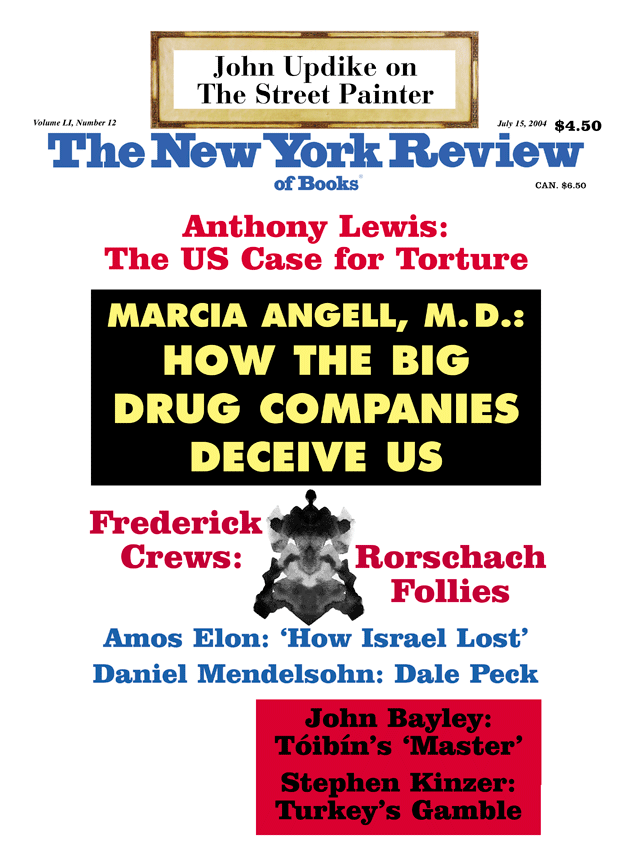
Marcia Angell, The Truth About the Drug Companies

Robert Moats Miller, Russell Baker, John D. Rockefeller Jr.: An Exchange


Letters

Solomon Volkov, Orlando Figes, The Shostakovich Case
McAllister Hull, Brian Urquhart, A Major Attack
Solomon Feferman, Brian Greene, et al. 'The Fabric of the Cosmos'
The Editors, Corrections


Contributors

Marcia Angell is a Senior Lecturer in Social Medicine at Harvard Medical School. A physician, she is a former Editor in Chief of The New England Journal of Medicine. Her latest book is The Truth About the Drug Companies: How They Deceive Us and What to Do About It. (January 2009)

John Bayley has written two books about his wife, the novelist Iris Murdoch, Elegy for Iris and Iris and Her Friends. (July 2004)

John Brewerteaches in the Humanities and Social Sciences Division at the California Institute of Technology. His most recent book is A Sentimental Murder: Love and Madness in the Eighteenth Century. (June 2008)

Constantine Cavafy was born in Alexandria in 1863 and died there in 1933. He wrote most of his poems while employed in the Third Circle of Irrigation of the Ministry of Public Works. (June 2005)

Caleb Crain is the author of Sweet Grafton, a novella published in the winter 2008 issue of the journal n+1. (May 2008)

Frederick Crews's most recent book is Follies of the Wise: Dissenting Essays. (December 2007)

Amos Elon's most recent book is The Pity of It All: German Jews Before Hitler. He is a Fellow at the Center for Law and Security at NYU. (February 2008)

Stephen Kinzer, a former New York Times bureau chief in Managua, Berlin, and Istanbul, is the author of Overthrow: America’s Century of Regime Change from Hawaii to Iraq. He is writing a book about Rwanda. (June 2008)

Anthony Lewis, a former columnist for The New York Times, has twice won the Pulitzer Prize. His book Freedom for the Thought That We Hate: A Biography of the First Amendment was published last year.

Larry McMurtry is the author of twenty-four novels, including The Last Picture Show, Terms of Endearment, Lonesome Dove, winner of the 1986 Pulitzer Prize for Fiction, and, most recently, Folly and Glory. His nonfiction works include a biography of Crazy Horse, Walter Benjamin at the Dairy Queen, Paradise, and Sacagawea’s Nickname: Essays on the American West (published by New York Review Books). He lives in Archer City, Texas.

Daniel Mendelsohn, a frequent contributor to The New York Review, is the Charles Ranlett Flint Professor of Humanities at Bard College. His translations, with commentary, of the Collected Poems and Unfinished Poems of Constantine Cavafy will be published this month. His other books include The Elusive Embrace: Desire and the Riddle of Identity (1999), Gender and the City in Euripides' Political Plays (2002), The Lost: A Search for Six of Six Million (2006), and How Beautiful It Is And How Easily It Can Be Broken: Essays (2008). (March 2009)

Pankaj Mishra was born in North India in 1969 and now lives in London and India. He is the author of The Romantics, winner of the Los Angeles Times's Art Seidenbaum Award for First Fiction, and An End to Suffering: The Buddha in the World. He is a frequent contributor to The New York Review of Books and The Guardian. His most recent book is Temptations of the West: How to Be Modern in India, Pakistan, Tibet, and Beyond.

Simon Sebag Montefiore is a historian specializing in Russia. His book Stalin: The Court of the Red Tsar won the History Book of the Year Prize in the British Book Awards. His Potemkin: Catherine the Great's Imperial Partner, which was shortlisted for the British Samuel Johnson Prize, has just been published in paperback. (February 2005)

Ingrid D. Rowland is a professor, based in Rome, at the University of Notre Dame School of Architecture. A frequent contributor to The New York Review of Books, she is the author of The Culture of the High Renaissance: Ancients and Moderns in Sixteenth-Century Rome and The Scarith of Scornello: A Tale of Renaissance Forgery. She has published a translation of Vitruvius' Ten Books of Architecture. Her latest books are a biography of Giordano Bruno and a translation of Bruno's dialogue On the Heroic Frenzies.

John Updike was born in 1932 in Shillington, Pennsylvania. In 1954 he began to publish in The New Yorker, where he continued to contribute short stories, poems, and criticism until his death in 2009. His novels have won the Pulitzer Prize, among other awards. His last books were the novel The Widows of Eastwick and Due Considerations, a collection of his essays and criticism.


Search the Review
Advanced search